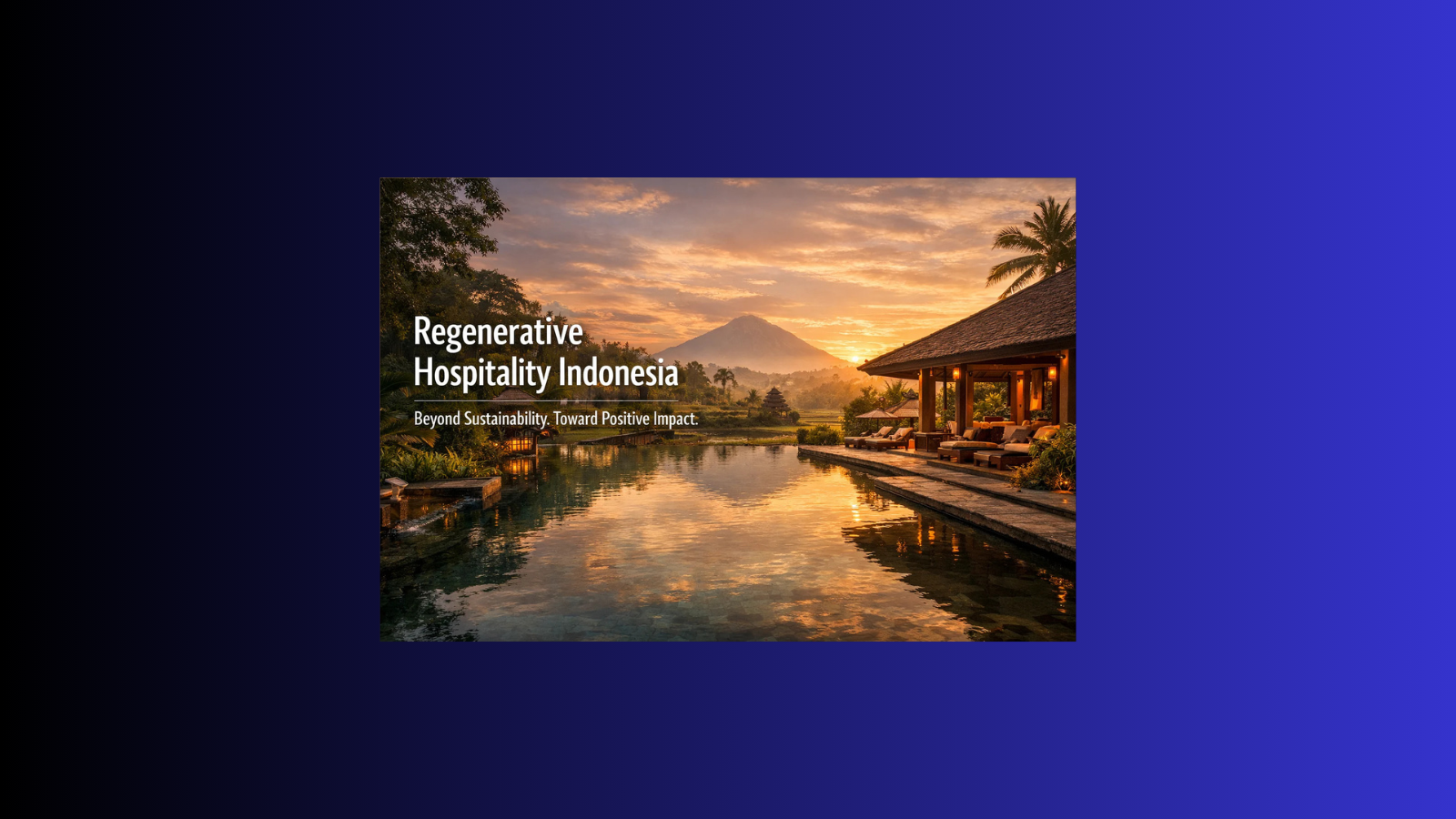
Sustainability is no longer a differentiator. It is baseline credibility. For developers, foreign investors, asset managers, and hotel owners, the more important question now is whether a project simply reduces harm or actually improves the destination around it. That is the real meaning of regenerative hospitality Indonesia.
In practical terms, regenerative hospitality goes beyond lower energy use, less plastic, or better wastewater treatment. It asks whether a hotel or resort leaves ecosystems healthier, community economies stronger, and local culture more visible and respected than before. That is a much higher bar. It is also where the market is heading.
For Indonesia, and especially Bali, this shift matters because tourism growth is already colliding with land pressure, water stress, waste challenges, and cultural dilution. The old “eco” language is no longer enough. Investors need operating models that create measurable positive impact and a stronger long-term business case.
At Zenith Hospitality Global, we see regenerative hospitality as a design and operating discipline, not a marketing layer. It starts in concept strategy, continues through master planning and pre-opening systems, and shows up in how the asset sources, hires, trains, measures, and tells its story. This is the same operator-first logic behind our work on hospitality strategy and concept development, our perspective on integrated hospitality in Bali, and our analysis of Bali yield strategy.
What is regenerative hospitality?
Regenerative hospitality is an approach in which a hospitality asset is designed and operated to create net-positive outcomes for the place it occupies. That includes ecology, local livelihoods, cultural continuity, and destination resilience.
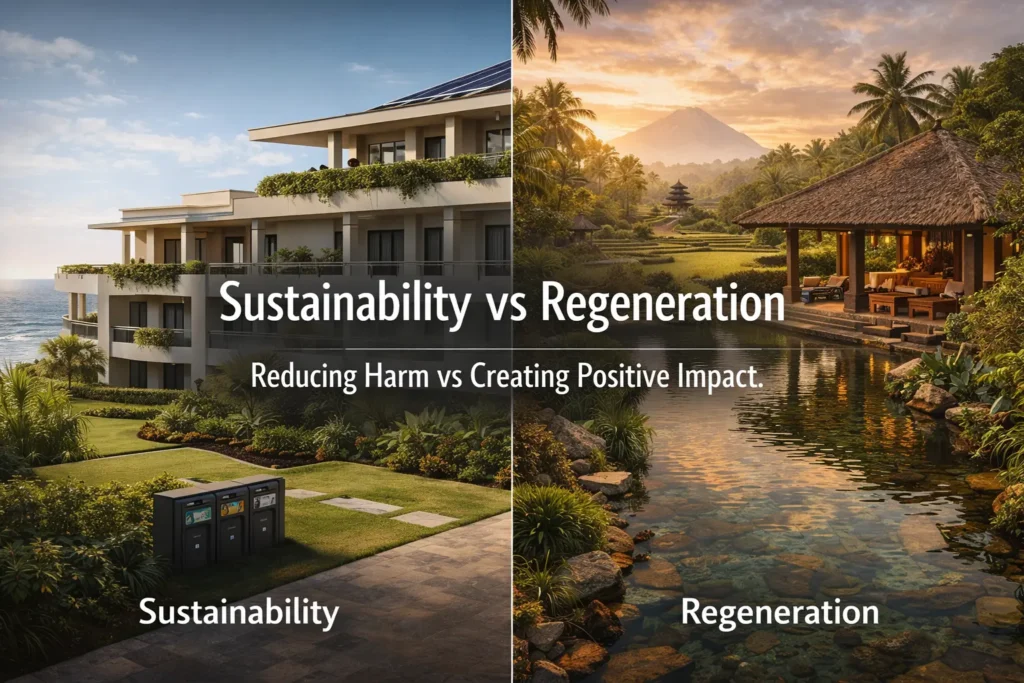
Traditional sustainability asks, “How do we reduce damage?” Regeneration asks, “How do we leave this place stronger because this project exists?” That distinction matters. A property can reduce plastic and install solar panels while still overextracting water, importing too much value from outside, and flattening local identity.
This is why so much “sustainable hospitality” now feels thin. In too many cases, it is still a brand narrative rather than a business model. The direction of travel in tourism measurement is moving toward integrated economic, environmental, and social outcomes, not isolated green gestures. UN Tourism’s statistical framework for measuring the sustainability of tourism is part of that shift.
Why does regenerative hospitality Indonesia matter now?
Because Indonesia’s tourism markets are no longer operating in a low-pressure environment. Bali is the clearest example. Water availability, land conversion, waste systems, and cultural pressure are already operational issues, not future theory.
At the same time, policy and investor expectations are moving. More serious tourism frameworks increasingly emphasize inclusive development, environmental stewardship, and local benefit, not just arrival growth. That creates a strategic opening for projects that can prove they are adding value to place rather than extracting from it.
For owners and investors, this means regenerative hospitality Indonesia is not a niche ideology. It is a commercial response to a more demanding market. The assets most likely to hold pricing power, reputational strength, and long-term defensibility will be the ones with a credible relationship to destination health.
This also aligns with a broader shift in how luxury is being redefined. Guests paying premium rates increasingly want authenticity, meaning, and visible integrity, not generic eco-language. That same pattern is already shaping adjacent themes such as digital nomad and bleisure-driven hospitality models and frontier destination positioning such as Sumba hospitality investment.
Why is sustainability alone no longer enough?
Because the term has been stretched too far and applied too loosely.
A project is not regenerative because it uses natural materials, mentions local inspiration, or places a few environmental claims on its website. It only becomes regenerative when it changes the economics and health of the surrounding system. That means stronger local procurement, better skills transfer, clearer cultural integration, stronger biodiversity outcomes, and transparent impact measurement.
This is where many hospitality projects fail. They copy the look of eco-luxury while keeping the logic of extractive tourism. They import too much, retain too little value locally, and use community language without community economics.
That is the real truth bomb: most “sustainable” hospitality is still designed to be less bad, not structurally beneficial. Regenerative hospitality is harder because it requires governance, metrics, and operating discipline. But it is also far more defensible because it creates real differentiation and stronger destination value.
What does regenerative hospitality look like in practice?
The strongest examples do not all look the same, but they tend to share a clear pattern: deep place response, visible local integration, and an operating model that supports the narrative.
Buahan: immersion, locality, and operating coherence
Buahan, a Banyan Tree Escape in Bali, is one of the clearest illustrations of a premium asset built around place rather than separation from place. Its concept is intentionally immersive, and its dining, guest experiences, and wellness logic are closely tied to local sourcing, local ingredients, and the surrounding environment. Buahan’s own sustainability positioning and broader coverage in serious hospitality media have made it a visible benchmark for values-led luxury.
The lesson is not that every project should copy Buahan’s form. The lesson is that concept clarity matters. Guests respond when the property feels inseparable from its setting.
Intaaya: regenerative design begins at the build stage
Another relevant example is Intaaya in Nusa Penida, which has been recognized in the regenerative travel space for combining local materials, passive design, water logic, and community integration. This matters because it shows that regeneration should begin in planning and construction, not only in post-opening CSR language.
Bambu Indah: culture and landscape as core product DNA
Bambu Indah is useful for a different reason. It demonstrates how architecture, landscape, food systems, and cultural continuity can form part of the guest value proposition itself. The property does not treat local identity as decoration. It treats it as operating substance.
For developers, that is the larger point. Regenerative hospitality works when environmental logic, local economy, and cultural narrative are part of the asset’s product DNA from the start.
What are the core pillars of regenerative hospitality Indonesia?
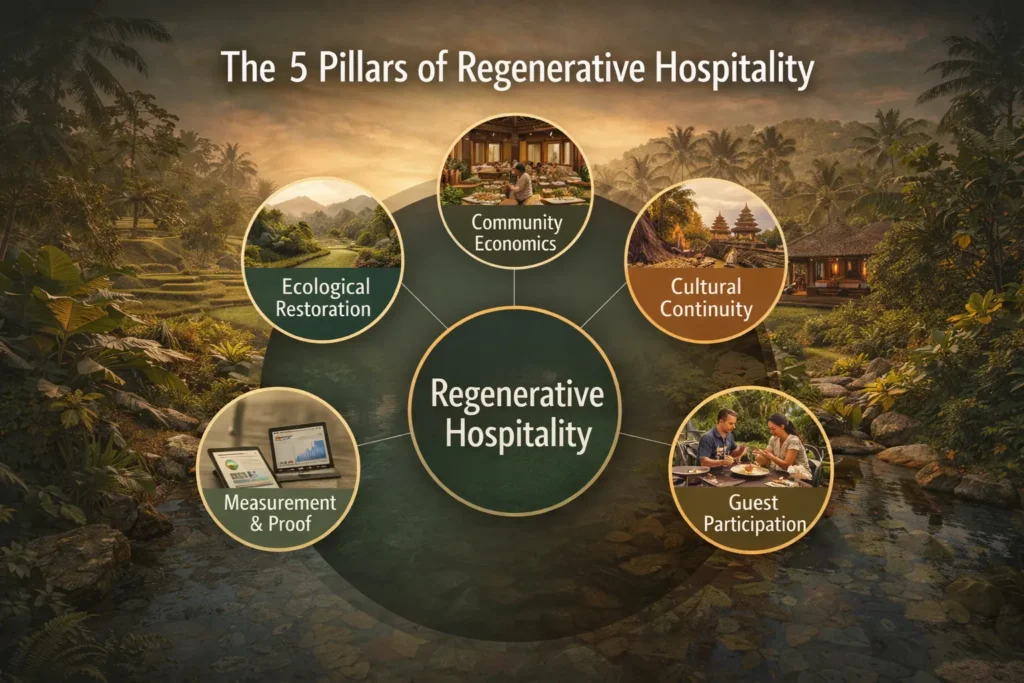
A practical regenerative model usually rests on five pillars.
1. Ecological restoration
This is not just resource efficiency. It is about improving ecological health. That can include native planting, soil restoration, watershed protection, mangrove or reef partnerships, habitat protection, and low-impact infrastructure.
2. Community economics
A regenerative project should keep more value within the local economy than a conventional one. That means local hiring, supplier development, skills transfer, and fairer procurement systems. If the surrounding economy is not stronger, the project is not truly regenerative.
3. Cultural continuity
Culture should not sit only in styling and storytelling. It should appear in rituals, design language, crafts, foodways, local partnerships, and guest programming. A project that erodes local identity while selling “authenticity” is not regenerative.
4. Guest participation and education
Guests should be able to understand the property’s relationship to place. Farm experiences, landscape walks, local workshops, and transparent operating systems help turn stewardship into part of the stay experience.
5. Measurement and proof
Without KPIs, regeneration remains a narrative. The Global Sustainable Tourism Council criteria and recognized standards are useful reference points for system discipline, while broader tourism measurement frameworks are pushing the sector toward more integrated reporting.
How do you measure regenerative hospitality?
You measure it by tracking whether the project is improving real conditions, not just reducing operational inputs.
At minimum, a serious framework should include environmental, community, cultural, and commercial indicators. The exact mix depends on site and asset type, but the discipline should be clear from the beginning.
Typical KPI groups include:
- Environmental KPIs: water use per occupied room, percentage of water reused, waste diversion rate, renewable energy share, habitat area restored, native planting survival.
- Community KPIs: percentage of payroll retained locally, percentage of procurement spent within defined local radii, training hours delivered, local management promotions, supplier development outcomes.
- Cultural KPIs: local artisan revenue generated, local ingredients by value, number of recurring cultural partnerships, heritage practices embedded into programming.
- Commercial KPIs: ADR premium versus local comp set, guest satisfaction linked to authenticity and sense of place, ancillary spend from place-based experiences, staff retention, brand sentiment.
The point is not to create a giant ESG dashboard for its own sake. The point is to define what the project is promising the destination and then measure whether it is actually delivering. That is also how owners reduce greenwashing risk.
Why is regenerative hospitality commercially attractive?
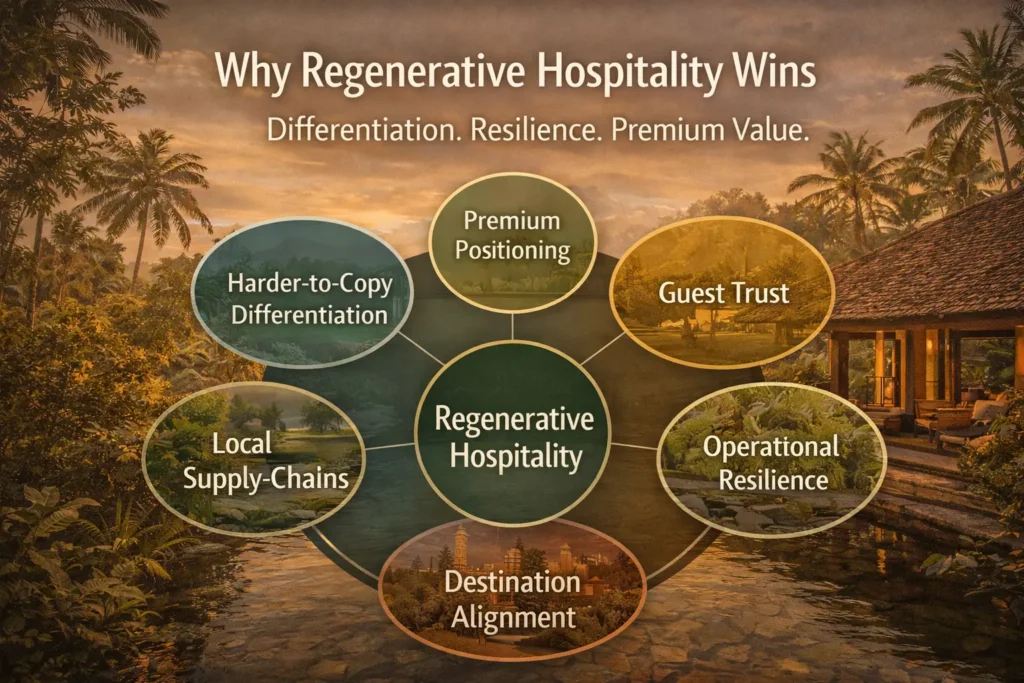
Because it creates harder-to-copy value.
First, regenerative assets are more differentiated. Many projects can imitate aesthetics. Far fewer can build a real local supply chain, deep cultural logic, and measurable positive impact.
Second, regenerative thinking can improve operating resilience. Better water strategy, stronger local sourcing, deeper community alignment, and lower waste intensity all reduce exposure to future regulatory, utility, and reputational pressure.
Third, regeneration can support stronger pricing integrity. Guests are more willing to pay premium rates when the experience feels meaningful, coherent, and rooted in place. That is particularly relevant in Bali and Indonesia, where luxury buyers increasingly compare not just room product, but purpose and authenticity.
Zenith’s view is straightforward: the next wave of high-performing assets in Indonesia will not win because they are the loudest about sustainability. They will win because they are structurally regenerative and operationally credible.
How to build regenerative hospitality Indonesia from day one
For developers and investors, the most important question is execution. The sequence matters.
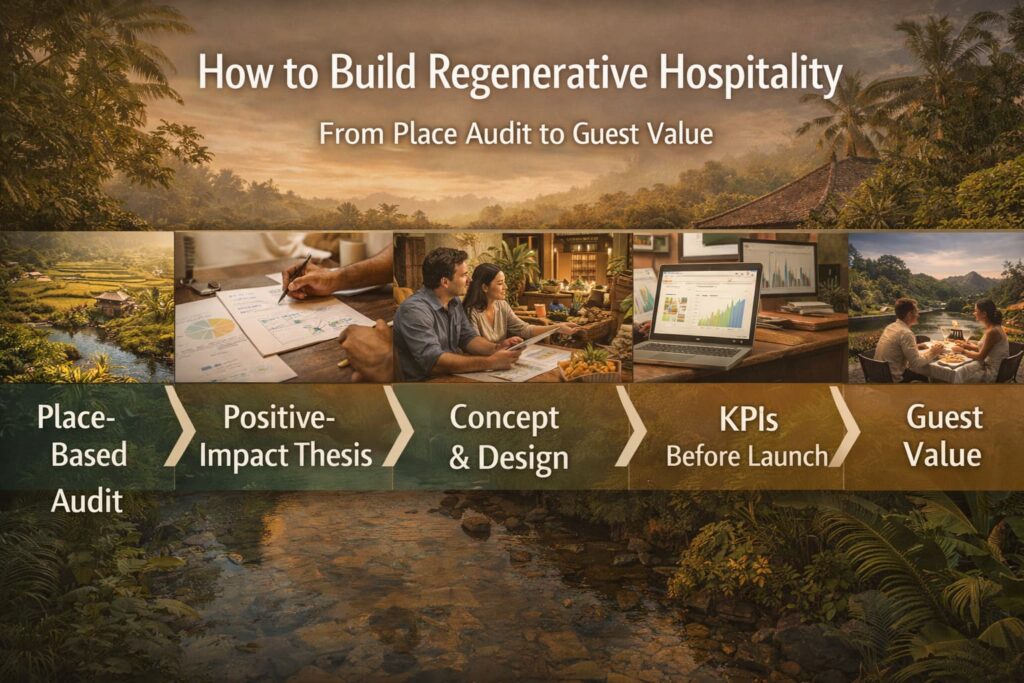
Step 1: Start with a place-based audit
Do not begin with a mood board. Begin with land, water, ecology, community, culture, and local supply mapping. Understand the site’s real constraints and strengths before locking concept and masterplan.
Step 2: Define the positive-impact thesis
State clearly what the project is supposed to improve. That might be watershed health, local livelihoods, craft preservation, food system resilience, or biodiversity restoration. If the positive-impact thesis is vague, the execution will also be vague.
Step 3: Translate the thesis into concept and design
The room count, land plan, MEP logic, circulation, F&B concept, wellness programming, and guest journey should all reinforce the same impact thesis. If concept and impact model are separate tracks, regeneration will collapse into branding language later.
Step 4: Build local supply chains early
Do not wait until pre-opening to think about local sourcing. Supplier mapping, community engagement, training pathways, and local partnership structures need to be built during development.
Step 5: Set KPIs before launch
Assign baselines, targets, ownership, and reporting cadence before the first guest arrives. This is what separates operational discipline from improvisation.
Step 6: Turn impact into guest value
Guests should feel the difference. They should taste it in the food, experience it in the programming, see it in the design language, and believe it through the confidence of the team. That is how impact becomes part of commercial performance.
What are the biggest mistakes owners make?
The most common mistakes are predictable.
- Treating regeneration as a brand story instead of an operating system.
- Starting community integration too late.
- Confusing local decoration with cultural continuity.
- Measuring inputs but not outcomes.
- Overusing imported design and imported procurement in projects that claim to be place-based.
- Assuming guests will pay more for “eco” language without visible proof.
This is why operator-first development matters. Regenerative ambition without systems usually turns into a weak guest experience and a weak investment case.
Frequently asked questions
What is the difference between sustainable hospitality and regenerative hospitality?
Sustainable hospitality focuses on reducing negative impact. Regenerative hospitality aims to create measurable positive impact. In simple terms, sustainability tries to do less damage, while regeneration tries to improve the ecosystem, economy, and cultural fabric around the asset.
Can regenerative hospitality improve investor returns?
Yes, but only when it is built into concept, operations, and measurement. The return case usually comes through stronger differentiation, more defensible pricing, better destination alignment, lower long-term risk, and stronger brand credibility. It is not a shortcut. It is a better-quality operating model.
Is regenerative hospitality only relevant for eco-resorts?
No. The logic applies to boutique hotels, wellness retreats, mixed-use hospitality, branded residences, and destination clubs. The issue is not asset class. The issue is whether the project strengthens local systems or simply extracts value from them.
What should operators measure first?
Start with a credible core set: water use, waste diversion, local payroll share, local procurement share, training hours, and at least one place-based ecological or cultural KPI tied directly to the site. Expand only after the data discipline exists.
Why is Bali such an important testing ground for regenerative hospitality?
Because Bali has both visible destination pressure and strong premium demand. That makes it one of the clearest markets where investors can see the downside of generic tourism models and the upside of more place-sensitive, higher-integrity hospitality strategies.
For owners, investors, and developers, regenerative hospitality Indonesia is becoming a stronger strategic model than generic sustainability positioning.
Summary Takeaways
- Sustainability is now baseline credibility, not a strong standalone differentiator.
- Regenerative hospitality Indonesia is about measurable positive impact, not softer negative impact.
- The strongest projects improve ecosystems, strengthen local economies, and preserve cultural identity.
- Regeneration only works when it is embedded into concept, design, sourcing, staffing, and reporting from day one.
- Owners should measure environmental, community, cultural, and commercial outcomes together.
- In Bali and Indonesia, regenerative models are not just ethical. They are increasingly strategic and investable.
Author
André Priebs
CEO & Co-Founder, Zenith Hospitality Global
André Priebs advises developers, investors, and owners on luxury boutique hotels, wellness retreats, branded residences, and next-generation hospitality assets across Bali and Indonesia. His work focuses on concept strategy, Product DNA, pre-opening governance, operational systems, and commercial performance. Through Zenith Hospitality Global, he helps structure hospitality projects that are operationally credible, commercially resilient, and aligned with long-term destination value.