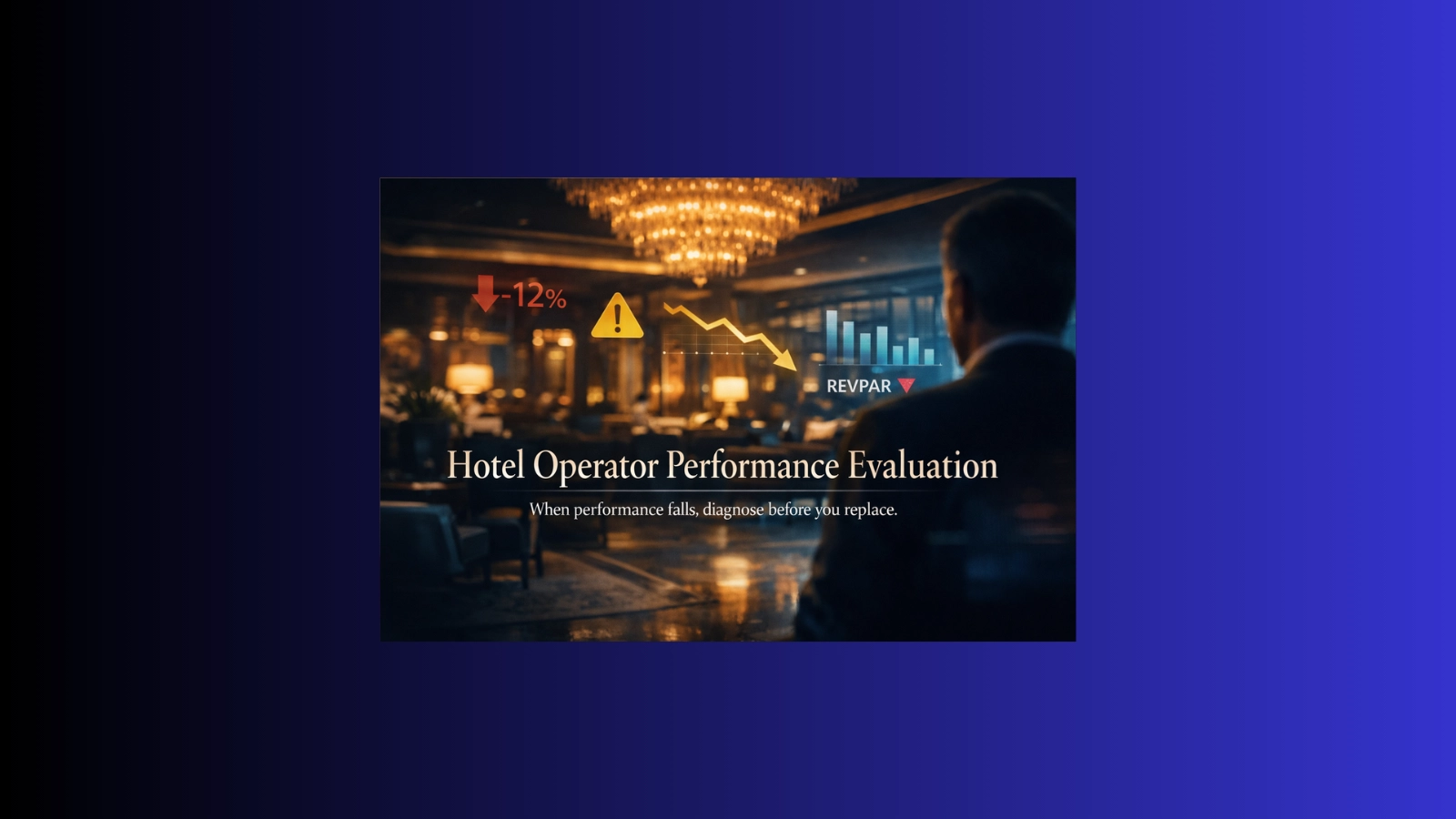
You hired a management company to protect performance, not explain away decline. But when occupancy softens, costs rise, and owner distributions disappear, many owners do not know whether the real issue is the operator, the market, or the asset itself. That is exactly why a proper hotel operator performance evaluation matters.
Too many owners react too early or too late. They terminate the operator out of frustration, or they tolerate weak performance for another year because reporting is unclear and accountability is weak. Both mistakes are expensive. The right sequence is simpler: diagnose first, then remediate, then renegotiate, and only then decide whether replacement is justified.
For owners in Bali and Indonesia, the stakes are even higher. Operator underperformance is rarely just an operations problem. It can also affect governance, owner rights, licensing pathways, reporting quality, and transition risk. Zenith’s role is to help owners separate those issues clearly and act from evidence, not emotion.
Why is hotel operator underperformance so hard to diagnose?
Because the visible symptoms are misleading.
A hotel with falling occupancy, rising labor cost, and weak owner cash flow may be suffering from any mix of three problems: operator execution failure, product-market mismatch, or genuine market pressure. On paper, all three can look similar.
That is why hotel operator performance evaluation cannot be reduced to guest complaints or one bad month. It has to test whether the operator is protecting market share, converting revenue into profit, and executing the asset’s intended market position.
There is also a structural problem inside many hotel management agreements. Operators are often paid through a base fee tied to revenue and an incentive fee tied to profit. In theory, that aligns interests. In practice, it can still leave the operator financially protected while owner returns deteriorate. Your operator may be “performing” against their fee mechanics while the owner’s investment is underperforming in reality. That distinction matters.
What does a hotel operator performance evaluation actually test?
A serious hotel operator performance evaluation should test six areas at the same time:
- Commercial performance
Is the hotel holding or losing market share? - Profit conversion
Is revenue turning into GOP at the right level? - Operator incentives
Are fees, central charges, and budget mechanics aligned with owner outcomes? - Positioning execution
Is the operator delivering the concept the asset was supposed to be? - Reporting and governance
Are owners receiving decision-grade reporting or operator-friendly summaries? - Remedy options
Is the right answer owner support, contract reset, strategic pivot, or operator replacement?
This is where many owners go wrong. They ask whether the operator is “good” or “bad.” That is the wrong question. The right question is whether the management company is preserving asset value.
What are the first warning signs your management company may be failing?
Operator failure is usually slow, not dramatic.
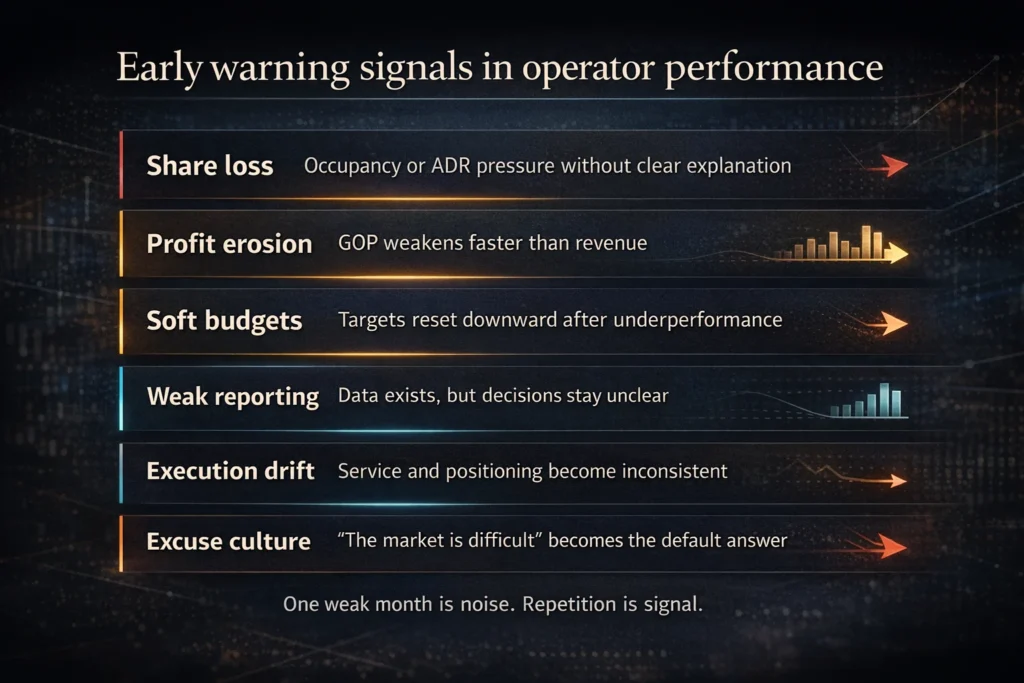
It tends to show up as repeated small weaknesses that compound over two or three budget cycles. Common signs include:
- Occupancy or ADR pressure without a clear market-share explanation
- GOP weakening faster than revenue
- Budget targets becoming easier after a weak year
- Reporting packs that are complete but not decision-useful
- Service and guest-experience inconsistency that starts to hit conversion
- Constant use of “the market is difficult” as a blanket excuse
A single weak month is not proof. A repeated pattern with weak explanation is.
How does hotel operator performance evaluation separate operator failure from market failure?
Start with two questions:
- Are you losing share?
- Are you losing margin?
If the answer is yes to both, operator underperformance becomes much more likely.
What is the fastest way to assess operator underperformance?
The fastest way to assess operator underperformance is to compare market-share trend and profit-conversion trend over the last 24 to 36 months. In practical terms, that means reviewing RevPAR Index / RGI, GOPPAR movement, labor productivity, channel mix, and budget integrity together rather than in isolation.
For benchmark definitions, the industry standard references for RevPAR and RGI terminology and GOPPAR as a profit-conversion measure are useful starting points.
When is the market the problem, not the operator?
The market is more likely the problem when the competitive set is also down in comparable ways and your asset is broadly holding share. In that case, the operator may still need to adapt strategy, but replacement is not automatically the answer.
For Bali specifically, macro tourism headlines can be misleading. Official Bali statistics showed direct foreign arrivals rising in 2025, but property-level performance still varied materially by micro-location, product strength, and execution quality. Strong arrival numbers do not excuse weak operator execution at asset level.
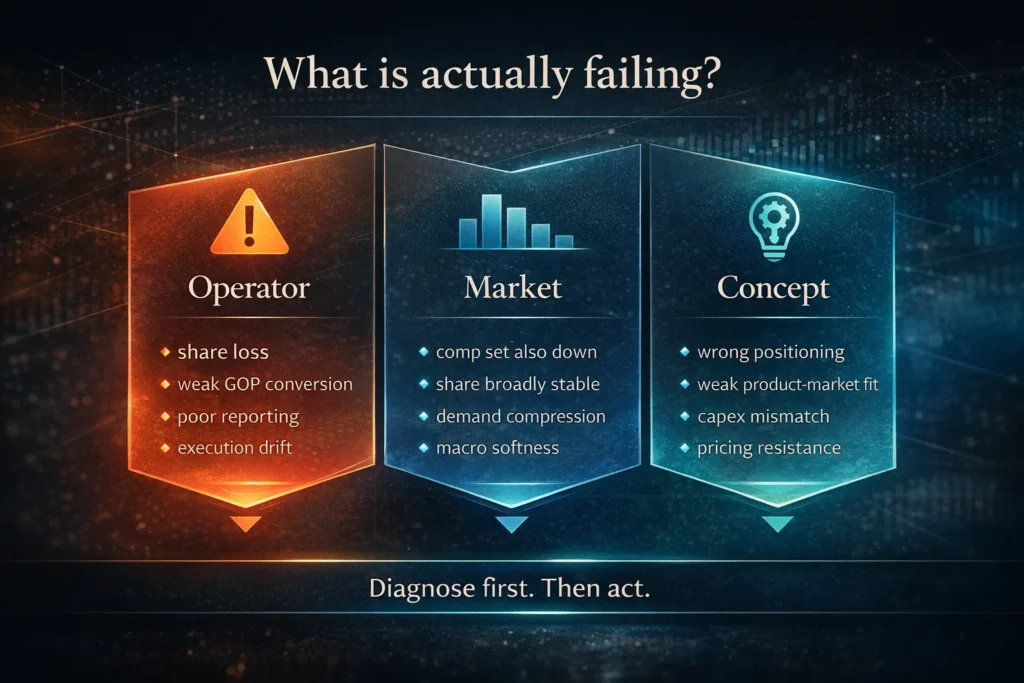
A practical diagnostic split
| What the data shows | What it usually means | Likely owner response |
|---|---|---|
| RGI broadly stable, market demand down | Market pressure | Strategy adjustment, not automatic operator change |
| RGI down vs comp set and GOPPAR also weak | Operator execution failure | Formal operator review and remediation plan |
| RGI chronically weak despite pricing effort | Product or concept issue | Repositioning, capex rethink, or concept reset |
| Revenue broadly acceptable but profit weak | Cost-control failure | Governance reset, labor and overhead review |
This is the core of owner-side triage. The aim is not to assign blame quickly. The aim is to identify what is actually operator-controlled.
Why do owners often blame the wrong problem?
Because the reporting is usually not built for owners.
Many monthly packs look polished but still fail the real governance test. They describe what happened but not why it happened, what was controllable, what was not, and what the operator is doing next.
At minimum, owners should expect:
- budget vs actual by department
- prior year comparison
- market benchmarking
- segment and channel mix
- labor productivity indicators
- distribution cost visibility
- capex or FF&E reserve tracking
- next-step action plan for the following 30 to 60 days
Without that level of transparency, an owner is not really managing the manager.
This is also why standardized financial reporting matters. The Uniform System of Accounts for the Lodging Industry (USALI) remains the core reference point for consistent hotel financial reporting and analysis.
How to run a hotel operator performance evaluation in 7 steps
This is the sequence Zenith recommends for an owner-side hotel operator performance evaluation.
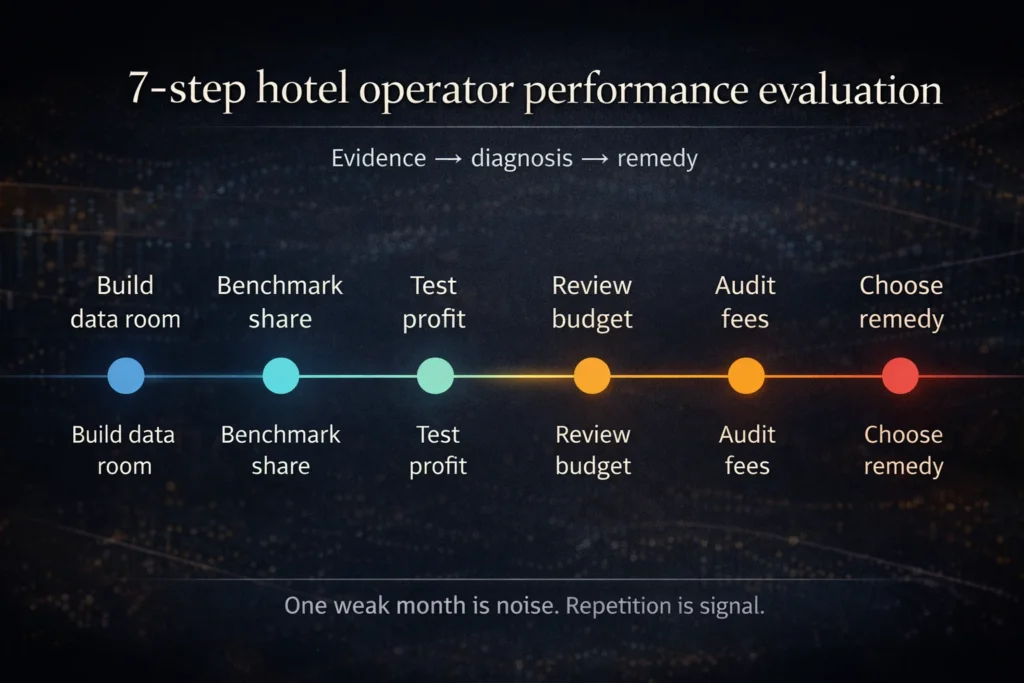
Step 1 — Build the data room
Pull 24 to 36 months of monthly P&L, benchmarking, payroll, channel mix, guest review trend, capex reserve movement, and budget/reforecast history.
Do not start with opinions. Start with evidence.
Step 2 — Benchmark share before blaming the operator
Review RGI or equivalent market-share indicators against a credible comp set.
If you are losing share, the operator has more explaining to do. If you are holding share while the market is down, the answer may be different.
Step 3 — Test profit conversion
A hotel can look commercially acceptable while still being badly managed.
If topline is stable but GOPPAR is deteriorating, you are likely looking at cost drift, labor inefficiency, weak departmental control, or overhead leakage.
Step 4 — Review budget integrity
Compare original budget, reforecast, and actual results.
One of the most common owner frustrations is discovering that weak operators preserve performance-test optics by quietly resetting targets downward after underperformance. That may protect the agreement while eroding owner value.
Step 5 — Audit fees, charges, and owner/operator alignment
Review:
- base fee
- incentive fee
- central service charges
- marketing allocations
- reservation or distribution fees
- technical service fees
- owner approval rights
- cure and termination provisions
A weak fee structure can make a mediocre operator harder to discipline than they should be.
Step 6 — Evaluate execution against Product DNA and market position
This is where operator review becomes strategic, not just financial.
A luxury boutique hotel, wellness retreat, or experience-led resort cannot be run with generic room-led logic. If the operator is not executing the property’s market position properly, even decent commercial systems will not fix the problem.
That same principle underpins Zenith’s work across hospitality ROI in Southeast Asia, where weak assumptions and weak concept execution often collapse investor returns, and in our broader thinking on co-living vs hotels and long-stay demand capture, where operating logic must match the actual guest and revenue model.
Step 7 — Choose the right remedy path
Only after diagnosis should the owner choose between:
- supporting the operator with clearer strategy or capital
- resetting governance and reporting obligations
- renegotiating fees and performance mechanics
- repositioning the concept
- replacing the operator
Replacement is a tool. It is not a strategy.
What should owners do after a hotel operator performance evaluation?
Three things.
First, quantify the underperformance on controllable metrics. Second, test whether remediation has a realistic chance of success. Third, model the transition cost properly.
Too many owners underestimate the cost of replacing a hotel operator. Transition risk can include management agreement exit mechanics, cure rights, damages exposure, team instability, brand detachment, owner-side execution burden, and local compliance work.
In Indonesia, that last part matters more than many foreign investors realize. Operator transition may interact with local structure, licensing, and enforceability realities. This is why operator change has to be treated as both a commercial and implementation exercise.
Zenith has written before about how weak structure reduces optionality, especially in Bali. That same principle appears in our Bali licensing analysis and in our work on illegal villa exposure and compliance risk. If the ownership, licensing, or operating structure is weak, the transition path becomes harder, slower, and more expensive.
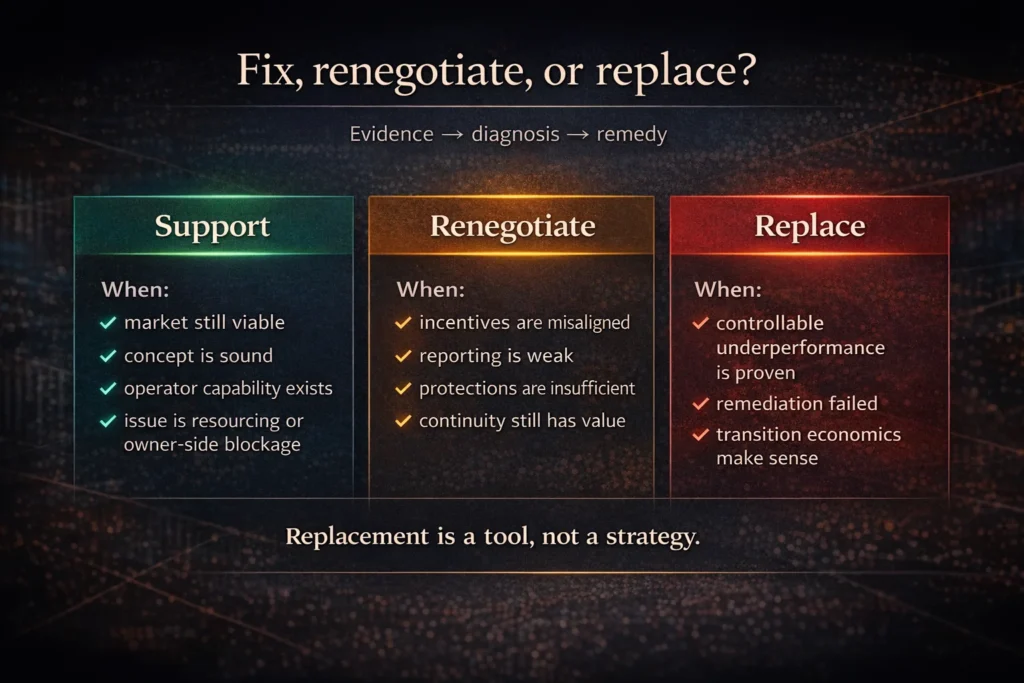
When is renegotiation better than replacement?
Quite often.
Renegotiation is usually the better move when the market remains viable, the concept still has logic, and the operator still has some strengths, but the agreement has weak owner protections or misaligned economics.
Typical renegotiation points include:
- stronger owner budget approval rights
- clearer reimbursable-charge definitions
- tighter performance-test wording
- more meaningful reporting obligations
- fee structures weighted more toward real performance
- better escalation and cure mechanics
In these cases, hotel management contract negotiation can create more value than immediate termination because it preserves continuity while correcting misalignment.
What is the Bali and Indonesia lens owners should not ignore?
Do not confuse tourism strength with operator success.
Bali can have strong demand signals at destination level while individual assets still underperform because their concept is weak, their execution is generic, or their operator is not disciplined enough. Bali’s market is not one market. It is a set of micro-markets with different pricing power, guest mix, seasonality, and competitive pressure.
That is also why owners should read performance through both asset-level data and destination-level context. Our own work on Bali yield strategy addresses this directly: headline demand is not the same as yield quality, and occupancy alone is not proof of good management.
The second Indonesia-specific issue is enforceability and transition design. Where disputes escalate, owners should evaluate dispute-resolution mechanics early, not late. Indonesia’s Law No. 30 of 1999 on Arbitration and Alternative Dispute Resolution is a relevant legal reference point for structuring cross-border dispute strategy.
Zenith’s view: what is the real truth bomb here?
Most owner-operator disputes are not caused by one catastrophic failure.
They are caused by bad structure, weak oversight, and delayed diagnosis.
By the time an owner says, “Our operator is not delivering,” the problem has often already existed for two budget cycles. The owner has usually been receiving reporting without true visibility, governance without real leverage, and explanations without measurable accountability.
That is why Zenith’s position is clear: the goal of a hotel operator performance evaluation is not to attack the operator. The goal is to establish whether the value leakage is being caused by the operator, the concept, the market, or a combination of all three. Only then can the owner choose the right action.
FAQ
What is hotel operator performance evaluation?
Hotel operator performance evaluation is an owner-side review of whether a hotel management company is preserving value through commercial execution, profit conversion, reporting quality, cost control, and contractual alignment. It is broader than a service audit and more practical than a generic consultant’s review. It should tell the owner whether the problem is operator failure, concept weakness, market pressure, or a mixed case requiring staged remediation.
When should an owner replace a hotel management company?
An owner should replace a hotel management company only when underperformance is proven on controllable metrics, remediation has either failed or lacks credibility, and the transition economics still make sense. That means testing share loss, GOP weakness, reporting failure, and contractual leverage before acting. Replacement driven by frustration rather than evidence often destroys more value than it saves.
Can a weak operator be fixed without termination?
Yes. In many cases, the better route is governance reset and renegotiation rather than immediate termination. If the market is still viable and the concept is still sound, owners can often recover value by tightening owner approval rights, improving reporting, resetting fee alignment, clarifying reimbursables, and forcing clearer commercial accountability. Termination is sometimes necessary, but it should follow diagnosis, not replace it.
Why is operator review more complex in Bali and Indonesia?
Because the issue is not only operational. In Bali and Indonesia, operator decisions may overlap with licensing, ownership structure, local business practice, dispute-resolution mechanics, and transition timing. Foreign investors often assume the answer is purely commercial, when in reality the operational remedy and the executable remedy are not always the same. That is why owner-side review has to be commercially sharp and locally informed.
How does Zenith support owners when operators are underperforming?
Zenith supports owners through independent operator review, performance diagnosis, governance redesign, incentive analysis, remediation planning, and transition strategy. We help determine whether the answer is support, renegotiation, repositioning, or operator replacement. For background on the firm and leadership, see Zenith Hospitality Global.
Summary Takeaways
- Do not assume weak hotel results automatically mean operator failure.
- Run a hotel operator performance evaluation before discussing replacement.
- Test market share and profit conversion together, not separately.
- Weak reporting is itself a governance failure.
- Renegotiation often creates more value than immediate termination.
- In Bali and Indonesia, operator transition has operational, legal, and structural implications.
- The owner’s real objective is not to win an argument with the operator. It is to restore asset value.
Call to Action
If your hotel management company is not delivering and you need a clear owner-side view of performance, governance, and remedy options, contact Zenith Hospitality Global to structure an independent hotel operator performance evaluation before you renegotiate, reposition, or replace the operator.
About the Author
André Priebs is CEO and Co-Founder of Zenith Hospitality Global, a Bali-based hospitality consultancy and management company focused on luxury boutique hotels, lifestyle retreats, and wellness-led assets across Indonesia. He specializes in Product DNA, pre-opening governance, operating systems, and commercial performance, helping owners align concept, execution, and investor outcomes into one coherent operating model.