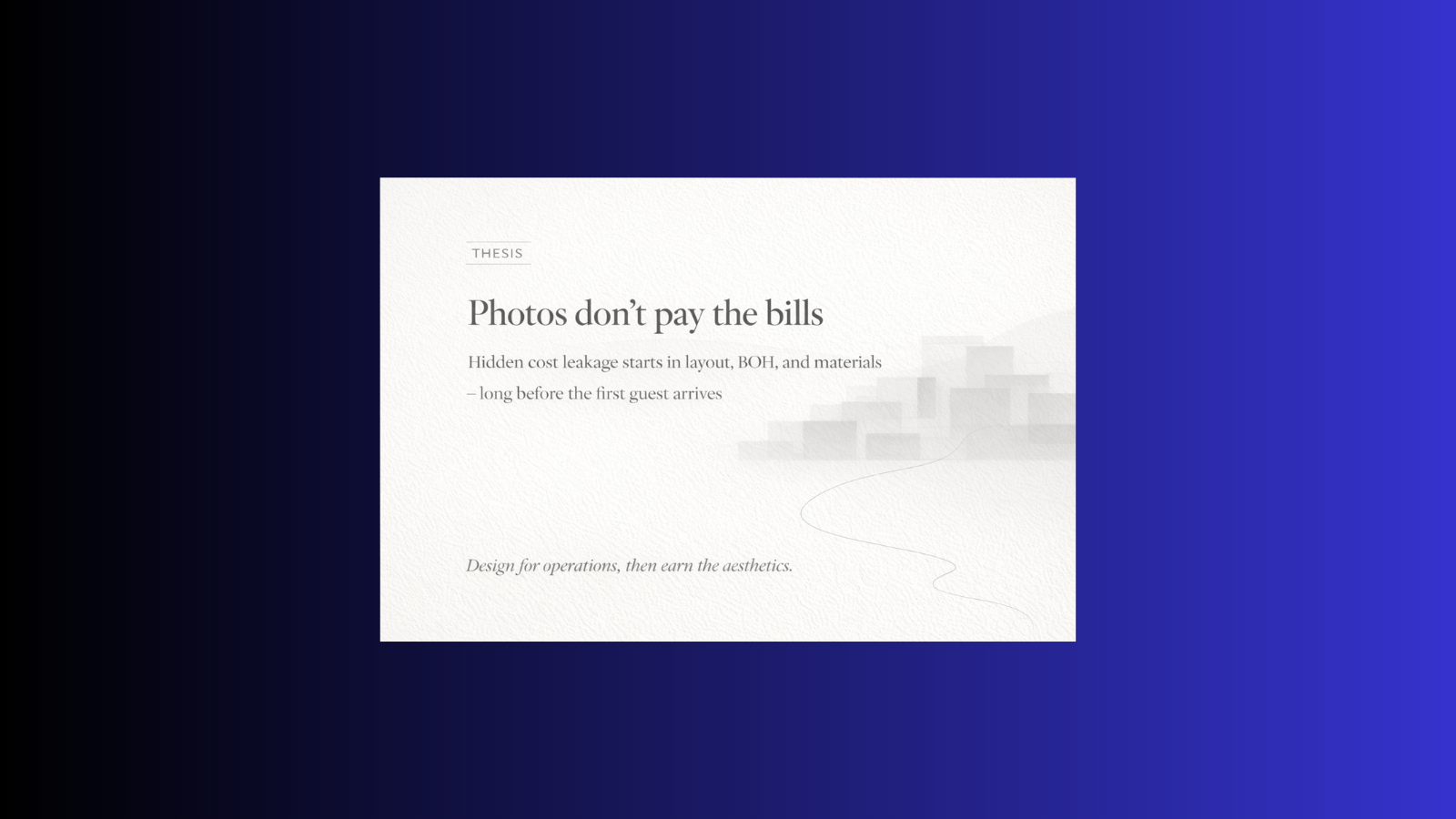
Bali doesn’t punish beautiful design. Bali punishes design that performs only in photos. Practically, the fastest way to destroy margins in a luxury resort is to build an Instagram-first hotel design that ignores staff flow, tropical materials reality, and the back-of-house engine that makes the guest experience feel effortless.
A recent luxury travel report (as covered by The Independent) found 68% of affluent travelers feel hotel design is too “Instagram-ready,” and 62% say luxury hotels are starting to look and feel the same. (independent.co.uk) Therefore, the message is uncomfortable but useful: photo-led sameness doesn’t earn pricing power—and it often creates operational fragility behind the scenes.
TL;DR / Key Takeaways (for owners & operators)
- Instagram-first hotel design increases hidden costs: labor minutes, maintenance cycles, downtime, and brand-reputation leakage.
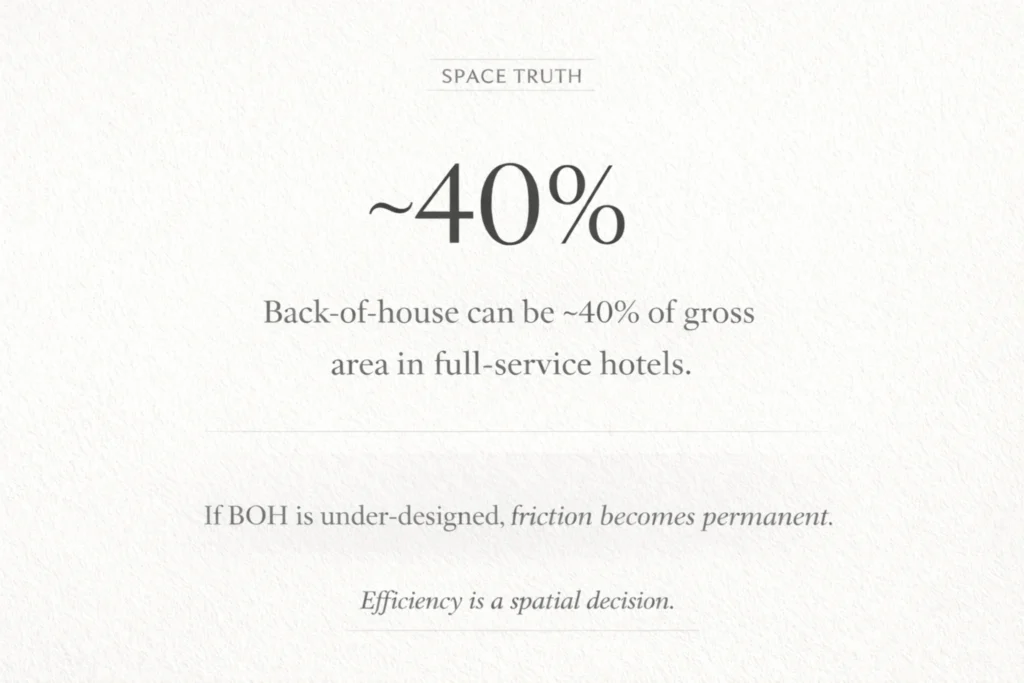
- For full-service hotels, ~40% of gross area can be back-of-house—so ignoring it creates permanent friction. (hksinc.com)
- Under coastal/tropical conditions, wrong metal/finish specs (and “equivalent substitutions”) become predictable failure modes. (nemaenclosures.com)
- The fix is not “less design.” Instead, it’s experience-first, operations-smart design: build a few hero moments on top of a flow-accurate, climate-correct base.
Why does Instagram-first hotel design create hidden costs in Bali?
The core issue is optimization for the guest camera path, not the service delivery system. As a result, costs show up when staff routes are long, storage is missing, corridors are narrow, engineering access is painful, and finishes decay faster than the maintenance model assumed.
To anchor the operational baseline for Bali, use this reference:
Operational hotel design Bali
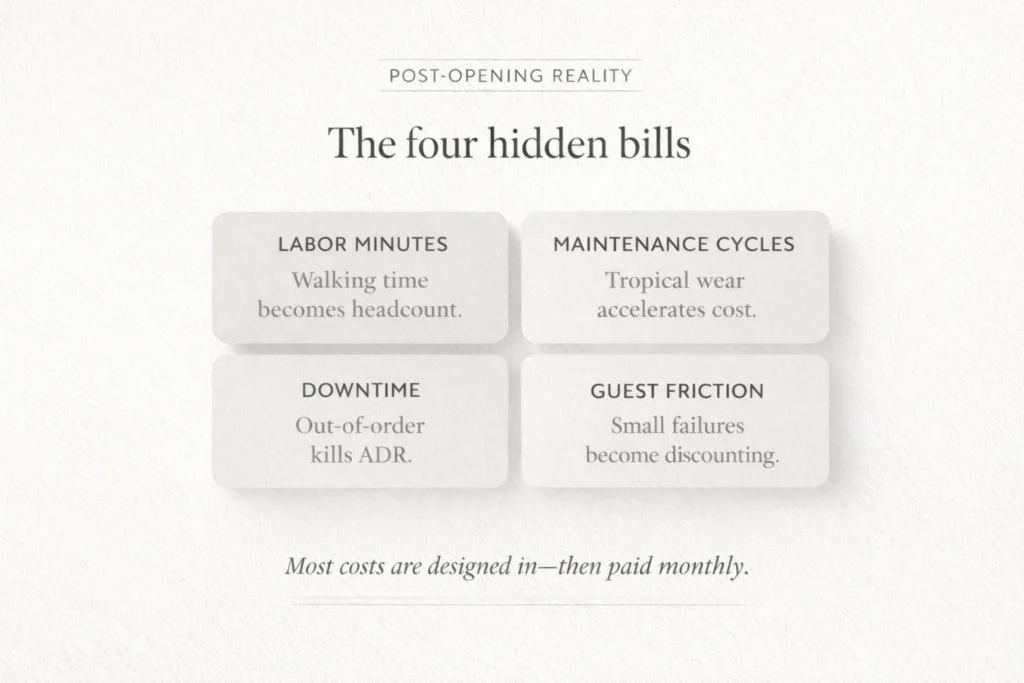
The “four hidden bills” that arrive after opening
- Labor minutes bill (invisible at design stage)
Extra steps per room clean, per cover served, per delivery received. Over time, minutes become headcount. - Maintenance cycle bill (tropical reality)
Corrosion, swelling timber, UV degradation, and mold pressure—especially near the ocean. - Downtime bill (lost ADR, not just repair cost)
Shut zones, scaffolded façades, out-of-order features, guest complaints, and review drag. - Experience friction bill (brand damage)
Noise, smells, staff-guest collisions, queues, slow service, and “luxury that feels inconvenient.”
Instagram-first resort design mistakes: the operational layout failures
Almost always, they’re flow mistakes. When staff circulation, receiving, waste, laundry, storage, and service access aren’t designed as a system, the property opens “beautiful but exhausting.” Importantly, those flaws compound under peak occupancy, so the real pain arrives when you’re busy.
1) Staff flow that is longer than the guest journey
Direct answer: Staff flow becomes expensive when the shortest route isn’t available, supply closets are too far, and service elevators are missing or poorly placed—so teams burn time walking instead of producing.
What it looks like in reality:
- Housekeeping crossing guest zones because BOH continuity breaks
- Mini “traffic jams” at pinch points: linen drops, service doors, receiving-to-kitchen routes
- Engineering access requiring guest-area disruption (noise, dust, closures)
Operator lens: every 10–20 seconds added to a repeated task compounds into headcount and fatigue. Consequently, fatigue becomes turnover; turnover becomes inconsistency; inconsistency becomes discounting.
2) Beautiful F&B spaces that cannot execute service
Direct answer: If kitchen and restaurant layouts ignore workflow, service slows, quality drops, and F&B costs rise—because labor and errors increase under pressure.
Common root causes:
- Pass not aligned to service points
- Dishwash and waste flows crossing “clean” paths
- No staging, no cold/hot holding logic
- Deliveries received far from storage and prep
If you’re in late-stage design, the fastest risk-control move is a pre-opening systems audit.
42-Point Pre-Opening Handover Audit (Bali)
3) Back-of-house sized like an afterthought
HKS highlights a common benchmark: in full-service hotels, back-of-house can represent roughly 40% of gross area—so under-designing it creates structural inefficiency. (hksinc.com)
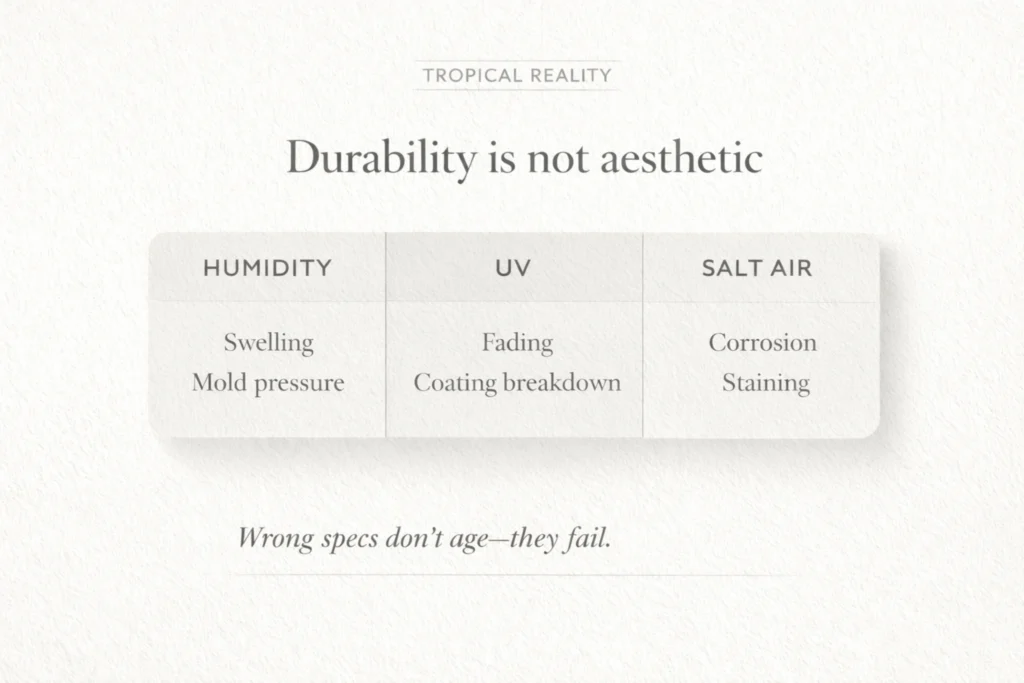
Tropical materials reality in Bali resorts: why specs fail and ROI suffers
Direct answer: Bali’s humidity, UV exposure, monsoonal patterns, and salt-laden coastal air accelerate corrosion, swelling/rot, coating failure, and mold pressure—turning “portfolio-standard” specs into an unplanned maintenance and downtime machine.
That becomes a commercial problem:
- Railings corrode → safety complaints → emergency fixes → scaffolded guest zones
- Paint blisters → brand perception drops → rate resistance increases
- Timber swells/rots → frequent patching → constant rooms/areas out of service
To ground the specifications (what holds up, what fails, and what to specify instead), start here:
Hotel Materials Tropical Climate Bali: Avoid Costly Failures
External authority anchor (coastal corrosion):
Stainless steel for coastal and salt corrosion (PDF)
Instagram-first vs operations-first: what actually changes in design decisions?
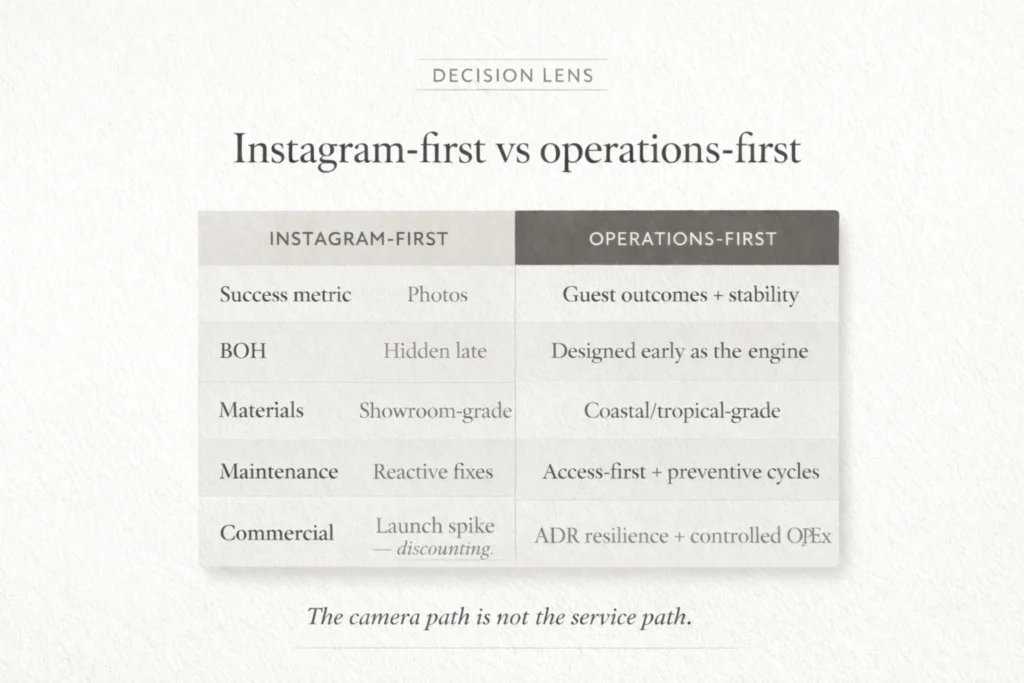
| Dimension | Instagram-first hotel design | Experience-first, operations-smart design |
|---|---|---|
| Primary success metric | Photos, renders, social shares | Guest outcomes + operational stability |
| BOH priority | Minimized / hidden late | Designed early as the engine |
| Materials | “Looks premium” in showroom | Performs in salt/UV/humidity for years |
| Staff flow | Patchwork routes | Continuous service spine |
| Maintenance strategy | Reactive fixes | Access-first + preventive cycles |
| Commercial impact | Launch spike → sameness → discounting | ADR resilience + controlled OpEx |
The Zenith framework: The 6-point “Resort Reality Check” (Bali)
- Flow spine (staff circulation continuity)
Can staff move end-to-end without guest collision? - Receiving → storage → production
Are deliveries processed fast, cleanly, and invisibly? - F&B execution geometry
Does the kitchen actually serve the restaurant you designed? - Climate-correct envelope & finishes
Are exterior metals, coatings, membranes, and timber specs coastal/tropical grade? - Maintenance access
Can engineering reach critical assets without shutting guest areas? - Downtime containment
When something fails, can you isolate impact and keep selling the rest?
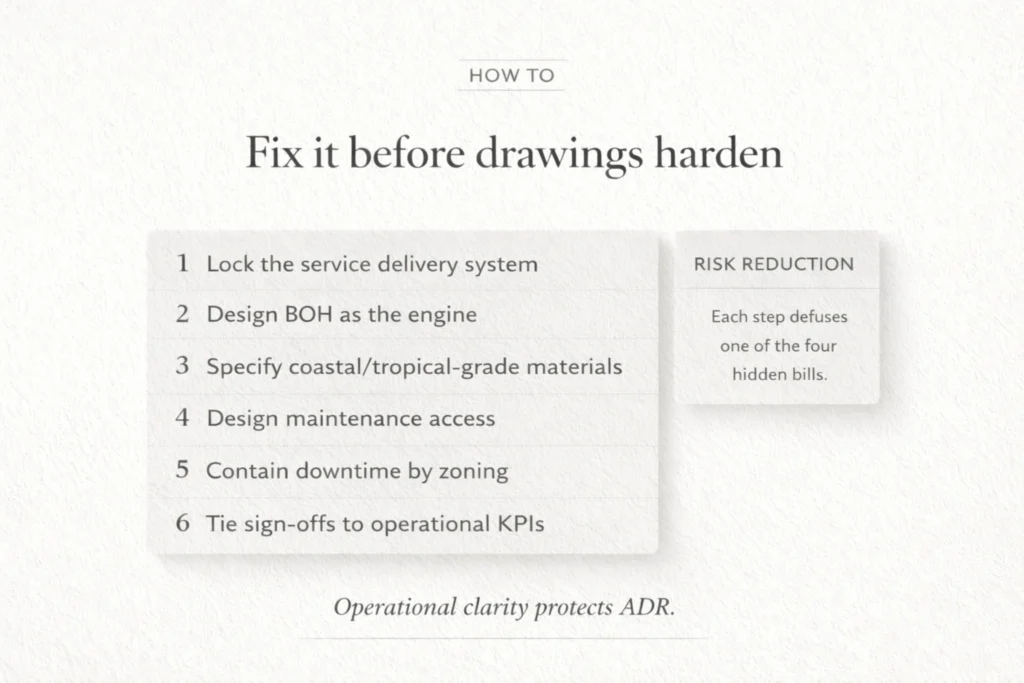
HOW TO: Design a Bali luxury resort that photographs beautifully and operates profitably
Step 1: Lock the “service delivery system” before aesthetics harden
- Map guest journey + staff journey on the same plan
- Then identify collision points and eliminate them (doors, corridors, lifts)
- Finally run a simple “service delivery simulation” to catch bottlenecks on paper
Step 2: Design BOH as a productivity machine, not leftover space
- Separate guest/staff circulation where possible
- Put housekeeping closets and linen logistics where work happens
- Also give receiving a real workflow and capacity
Hospitality Institute notes that a properly designed receiving area can reduce delivery processing time by up to ~40% in some cases.
Back of House Planning: Optimizing Staff Areas and Operational Flow
Step 3: Make tropical-grade specs the default (not an upgrade)
- Set coastal-grade baselines for exterior metalwork (and don’t accept “equivalents” lightly)
- Choose UV-rated, moisture-rated coatings/adhesives (avoid interior-only assumptions)
- Align waterproofing membranes and detailing to monsoon reality
Step 4: Design maintenance access like a first-class guest
- Provide access panels, catwalks, plant-room clearance, and service shafts sized for real replacement
- Avoid any “tear out a ceiling in a guest corridor” maintenance strategy
Step 5: Protect the brand with “failure containment”
- Use zone isolation so one feature failure doesn’t shut the entire experience
- Keep noisy/dirty maintenance routes away from peak guest paths
Step 6: Tie design sign-offs to operational KPIs
- Housekeeping minutes per room (targets by room type)
- Covers per labor hour in F&B
- Preventive maintenance hours per key
- Engineering response time without guest disruption
PAA-STYLE ANSWER BLOCKS
What does “Instagram-first hotel design” mean in practice?
It means the design process prioritizes visual moments—hero pools, staircases, atriums, minimalism—before the operational system that delivers luxury: staff circulation, storage, kitchen geometry, maintenance access, and climate-correct materials. As a result, the property may look premium at launch but becomes expensive, fragile, and easy to copy within a few seasons.
How much space should back-of-house take in a full-service hotel?
A common benchmark referenced in hotel operations design is that back-of-house can represent roughly 40% of gross area in full-service hotels. However, the point isn’t the exact number—it’s that BOH is a major portion of the building, and efficiency gains there reduce costs while improving guest experience.
HKS: Redefining Hotel Design for Maximum Efficiency
Why do “beautiful” resorts end up discounting after launch?
Because the hidden bill arrives: labor minutes, accelerated maintenance, downtime, and guest friction. Consequently, service consistency and review sentiment degrade, ADR power weakens, and discounting becomes the lever.
Call to action (consideration stage)
If you’re developing or renovating in Bali and you want the asset to keep ADR power after the launch hype, Zenith can run an Operational Design & Durability Audit: staff flow, BOH sizing, maintenance access, materials baseline, and downtime containment—before drawings lock expensive mistakes.
When underwriting returns, connect design decisions to downside risk (ADR compression, shutdown days, maintenance spikes):
Hotel feasibility study is wrong: the ADR and occupancy fantasy
For macro context, oversupply dynamics matter as well:
Bali’s real-estate bubble: oversupply threatens ROI
FAQ
Does Instagram-first hotel design always hurt profitability?
Not automatically. A few hero moments can help marketing and launch velocity. However, the problem starts when those moments drive planning logic and BOH/materials are minimized to fund them. Then, the property “pays back” the design through labor inefficiency, maintenance failures, and guest friction that forces discounting.
What’s the fastest operational win in a new resort layout?
Staff flow continuity. In most cases, fixing circulation, storage placement, and service access produces immediate gains in housekeeping productivity, service speed, and guest privacy—without changing the concept.
What’s the biggest materials mistake in Bali luxury builds?
Treating Bali like a temperate market. Coastal humidity + salt + UV accelerates corrosion and finish failure. Therefore, in exposed exterior applications, coastal-grade stainless selection and detailing reduce repeat replacements and downtime.
Stainless steel for coastal and salt corrosion (PDF)
How do I justify BOH investment to investors focused on “sellable beauty”?
Model avoided costs: labor minutes (headcount), preventive vs emergency maintenance, and—most importantly—avoided downtime and avoided discounting. In other words, BOH protects both guest experience and the P&L.
AUTHOR
André Priebs
CEO, Zenith Hospitality Global
Operator-first hospitality advisor supporting owners and developers to design and launch luxury boutique hotels, lifestyle retreats, and wellness/longevity assets—built for real-world operations, not just renders.
Summary Takeaways
- Instagram-first hotel design creates four hidden bills: labor minutes, maintenance cycles, downtime, and friction.
- BOH is not leftover space—it’s the operational engine, often a large share of total area in full-service hotels.
- Coastal/tropical durability is a spec discipline, not a style preference.
- Flow continuity and maintenance access are cheapest to fix before drawings harden.
- The goal is not less beauty—it’s beauty built on an operations-smart base.