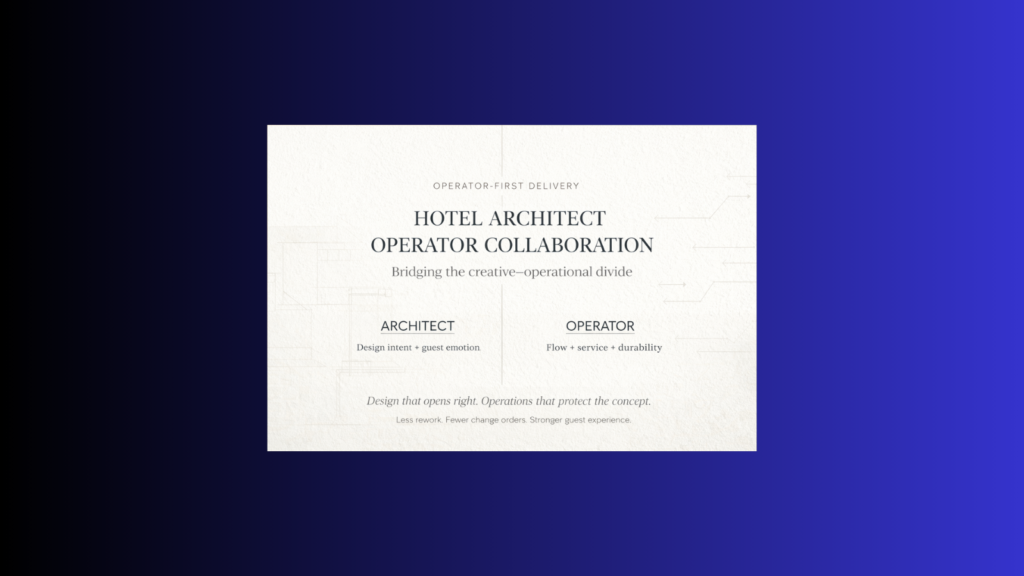

Hotel operator early involvement is the difference between an asset that is elegant on paper and one that is profitable in reality. Most hotel projects still follow the wrong sequence: design → build → then find the operator. By the time the operator walks the site, critical mistakes are already embedded in concrete—flow, back-of-house (BOH) sizing, MEP allowances, IT rooms, storage, laundry, service access, and sometimes even compliance constraints.
Best practice is hotel operator early involvement at schematic design—or, if no operator is signed yet, an interim operator advisor who brings the same design-phase rigor a branded operator would.
If you want the “why” behind this (and the operator mechanics that actually prevent rework), start with Hotel Product DNA: The Code That Decides Whether Your Hotel Survives.
In 60 seconds (executive summary)
- Design decisions are cheap; construction changes are expensive. If you wait until handover, you’re buying fixes at the worst point of the cost curve.
- Operators don’t “just run the building.” They define service logic, staffing efficiency, guest journey, systems needs, and realistic FF&E—which must be baked into design.
- Early operator involvement typically prevents: undersized BOH, broken service routes, wrong adjacencies, missing plant allowances, weak IT/security architecture, and mis-priced FF&E.
- In Indonesia/Bali, early operator input also functions as a compliance and operational-readiness layer because permits and occupancy readiness are tightly coupled to what is actually built.
- If you don’t have an operator signed, you still need operator-grade input. That is exactly the gap Zenith fills.
Quick Answer blocks for hotel operator early involvement (People Also Ask)
You may see these as “PAA blocks” elsewhere. PAA = “People Also Ask.” These blocks are written as complete, standalone answers so they can be understood even if read out of context.
When should a hotel operator be involved in a hotel project?
A hotel operator should be involved during schematic design, not after construction. That is when layout, adjacencies, BOH sizing, MEP allowances, and systems can still be shaped without expensive rework. If you wait until the building is finished, operational constraints are locked in and fixes become costlier, slower, and often compromised.
What’s the real risk of bringing an operator in after construction?
The risk is not “a few tweaks.” It is structural inefficiency: longer staff travel paths, missing storage, undersized kitchens/laundry, service conflicts with guest flow, wrong technical rooms, and under-scoped systems. These issues typically show up as higher payroll %, weak guest experience, delayed opening, and capex overruns—all tied directly to decisions made early.
Can an independent hotel do this without a brand operator?
Yes—but only if the project appoints operator-grade advisory during design. Branded hotels receive design-phase operator review as standard; independent projects often skip it and pay later. An interim operator advisor can provide the same core inputs: operational flow, standards/specs, systems planning, FF&E realism, and a pre-opening roadmap.
Why is hotel operator early involvement a design-stage decision?
Because hotel performance is not created at opening—it is pre-engineered in drawings.
Architects can design beautiful spaces. Investors can fund them. Developers can build them. But only an operator can pressure-test how the building behaves at 100% reality:
- How staff move (minutes per room matter)
- Where linen, waste, amenities, and equipment actually live
- Whether kitchen/service logistics scale on peak days
- Whether guest flow supports upsell, privacy, and quiet
- Whether systems and technical rooms are sized for the real tech stack
- Whether FF&E is aligned to positioning—not just aesthetics
When operator logic is missing, the project usually becomes a retrofit exercise.
What goes wrong in the typical “design → build → operator” sequence?
The common chain of events looks like this:
- Land secured
- Architect designs around massing + aesthetics
- Design is value-engineered by QS/contractor
- Construction starts
- Operator is introduced late
- Operator flags fundamental issues
- Project faces rework, compromises, delays, and budget creep
- Opening happens underprepared, with operational friction “baked in”

This is exactly why design-phase rigor exists in branded developments—and why independent developments need an equivalent discipline.
How hotel operator early involvement reduces cost and schedule risk?
Two widely-used construction principles explain the economics:
- Early decisions have the highest leverage. As project phases advance, the ability to influence cost and performance drops while the cost of change rises (see AIA’s Integrated Project Delivery guidance).
- Rework is not a rounding error. Construction rework materially impacts cost and schedule (see CMAA’s “Impact of Rework on Construction”).

Operators reduce rework by making the project “constructible for operations,” not only “buildable for design.”
What hotel operator early involvement delivers during schematic design and design development?
Below is a practical framework you can use with your project team.
The 6 operator inputs that must happen before construction
| Operator input | What it protects | Typical “late discovery” symptom |
|---|---|---|
| Brand/standards logic (or Product DNA) | Positioning integrity + consistency | Great design, unclear product; weak pricing power |
| Guest journey + revenue logic | Conversion + upsell + repeat behavior | Public spaces don’t monetize; wrong adjacencies |
| BOH flow + staffing efficiency | Payroll %, service speed, quality | Long routes, bottlenecks, missing support areas |
| Systems + technical integration | Reliability, security, future-proofing | No space for IT, low-voltage, access control, storage |
| FF&E realism (scope + budget) | Capex control + operational durability | Underbudgeted, then downgraded finishes and equipment |
| Pre-opening readiness plan | On-time opening + reputation protection | “Soft opening chaos,” undertrained teams, delayed ramp |

If you want the strategic layer behind standards and positioning, refer to Zenith’s Product DNA article.
Which “cast-in-concrete” mistakes show up most often?
These are recurring failures when operator review is late:
- Undersized BOH (storage, linen, staff facilities, waste, engineering)
- Broken service routes (service and guest traffic colliding)
- Kitchen plan mismatch (menu ambition doesn’t fit production reality)
- Laundry strategy not designed (in-house vs outsourced not resolved early)
- Insufficient technical rooms (IT, CCTV, server, BMS, UPS, ELV pathways)
- Wrong adjacencies (receiving too far from stores; stores too far from points of use)
- Housekeeping unworkable (pantries, elevators, back corridors not optimized)
- Noise and privacy failures (acoustics and buffers ignored)
- MEP allowances too tight (retrofits become expensive and messy)
- FF&E scope drift (design wants one thing; budget delivers another)

These are not “operator preferences.” They are predictable constraints that determine payroll, guest satisfaction, and uptime.
How branded operators manage hotel operator early involvement—and what independents should do?
Branded projects typically formalize design-phase involvement through technical services and pre-opening services. The legal/industry model is well-established: see Holland & Knight’s overview of Hotel Technical Services Agreements.
Independent projects often skip this structure, which creates a blind spot:
- No one “owns” operational performance during design
- Design and procurement drift away from what operations can actually run
- Pre-opening becomes reactive instead of engineered
Solution: appoint an interim operator advisory function during schematic design—so your project receives operator-grade discipline even before an operator is signed.
Why is this even more critical in Indonesia and Bali?
In Indonesia, the operator’s early input often doubles as a practical compliance and readiness filter because approvals and operational readiness are tightly connected to what is built.
Two terms worth clarifying:
- PBG (Persetujuan Bangunan Gedung): building approval/permit process that governs what you are allowed to build.
- SLF (Sertifikat Laik Fungsi): certificate confirming the building is functionally fit for use (an occupancy-readiness milestone).

For official references, see SIMBG (Indonesia’s PBG/SLF platform) and Bali Province PUPRKIM overview of PBG & SLF.
Where this becomes operationally relevant:
- Late layout changes can cascade into permit amendments, documentation rework, and schedule risk.
- Misalignment between design intent and real operations can create compliance friction at the worst possible time—when you want smooth commissioning and opening.
If you operate in Bali and want a direct, investor-oriented view of regulatory and process traps, read Navigating Bali’s licensing maze.
Zenith’s interim-operator method
Zenith provides pre-development operator advisory—acting as an interim operator during design for projects without a signed operator. The goal is simple: make the building operationally correct before it is built.
The “Design-to-Operate Gate Review” (practical sequence)
- Schematic design review (layout + adjacencies + flows)
- BOH sizing + logistics validation (housekeeping, laundry, stores, waste, receiving)
- F&B and spa/service logic alignment (production reality vs concept)
- MEP/ELV systems allowances (tech rooms, routes, access control, security)
- FF&E scope + budget sanity check (durability, replaceability, ROI alignment)
- Pre-opening critical path (staffing plan, training plan, procurement sequencing)
- Operational readiness checks (commissioning inputs, opening ramp protection)
For broader context on budgeting discipline (often where projects quietly break), see 2026 Hotel Budget Indonesia.
To understand Zenith’s positioning and capabilities, see About Zenith Hospitality Global and browse the Zenith blog hub for related operator-grade frameworks.
FAQ
Is early operator involvement only necessary for branded hotels?
No. Branded hotels get this discipline by default. Independent hotels often need it more because they lack brand technical services and standardized pre-opening systems. Early operator involvement ensures operational logic, systems needs, and FF&E realism are designed into the asset, protecting both guest experience and long-term profitability.
What’s the minimum scope of operator input that actually moves the needle?
At minimum: (1) schematic layout and adjacency review, (2) BOH logistics and staffing efficiency validation, (3) core systems and technical room allowances, (4) FF&E scope/budget alignment to positioning, and (5) a pre-opening critical path that runs in parallel with design. Anything less is usually “opinions,” not operational engineering.
How does this impact returns and investor risk?
Early operator involvement reduces downside risk by preventing capex blowouts, schedule delays, and operational inefficiencies that raise payroll and depress guest satisfaction. Investors should treat design-phase operator input as a risk-control instrument—similar to a lender’s technical advisor—because it protects the asset’s ability to operate to its intended revenue model.
If an operator will be signed later, why not wait?
Because the operator’s requirements will still arrive—just later, when changes are expensive and politically difficult. Signing an operator later does not remove design-phase requirements; it merely turns them into rework, compromises, and delays. Early operator-grade input keeps the project “operator-ready” regardless of who is eventually signed.
What should architects expect from an operator advisor during design?
Clear, decision-grade inputs: flow diagrams, adjacency corrections, BOH sizing guidance, service route logic, systems allowances, and FF&E implications. The aim is not to “override design,” but to ensure the design is operationally executable and commercially aligned with the hotel’s intended product and guest journey.
Summary Takeaways
- Operator involvement is not a post-construction step. It is a design-phase control system.
- If you wait, you will pay for fixes when they are most expensive—often as rework or compromised operations.
- Operators protect flow, BOH sizing, systems allowances, FF&E realism, and pre-opening readiness—all before concrete is poured.
- In Indonesia/Bali, early operator logic also supports smoother approvals and operational readiness (PBG/SLF reality).
- Independent projects need an interim operator advisory layer to match branded design-phase rigor.
Call-to-Action
If your project is in pre-development, schematic design, or early design development, this is the window where operator input has maximum leverage. If you do not yet have an operator signed, Zenith can step in as interim operator advisor to prevent “cast-in-concrete” errors and build a clean runway to opening.
Learn more about Zenith on our About page, or explore related frameworks on the Zenith blog hub.
Next actions
- Confirm your project phase (concept / schematic / DD / construction) and freeze date targets.
- Run a schematic Design-to-Operate Gate Review focused on BOH, flows, and systems allowances.
- Lock the operating model assumptions early (service levels, staffing, F&B complexity, laundry strategy).
- Align FF&E scope and budget to positioning before tendering.
- Map PBG/SLF pathway and documentation dependencies into the design schedule (Indonesia/Bali).
- Build the pre-opening critical path now (procurement sequencing, staffing, training, ramp plan).
About the author
André Priebs is the CEO of Zenith Hospitality Global, an operator-first hospitality advisory and operations partner focused on luxury boutique hotels, lifestyle retreats, and wellness/longevity assets across Indonesia and Southeast Asia. He supports owners, developers, and architects at the earliest project stages—translating commercial intent into buildable operating systems through Product DNA, schematic design operator reviews, pre-opening governance, and performance-led operating models.
Explore more at Zenith Hospitality Global and the Zenith Blog.