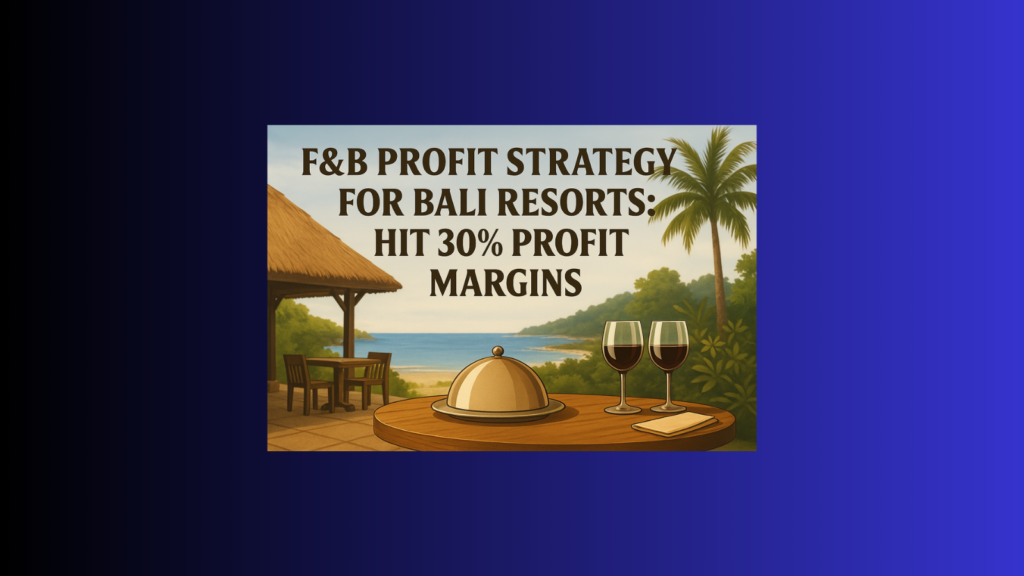

Hotel F&B Concept Development Bali is the discipline of building outlets that win locals, protect margin, and lift total hotel performance—not just serve in-house guests.
Most hotel restaurants lose money or barely break even—and owners quietly accept it as “the cost of having F&B.” In Bali and Indonesia, that mindset is especially expensive: guests are surrounded by world-class independent cafés in Canggu, chef-driven dining in Ubud, and nightlife-led venues that don’t carry hotel overhead. If your outlets cannot compete in the open market, they will not carry their own P&L—and they will continue to drag your asset returns.
This guide explains what it actually takes to build a hotel F&B profit center: not “better food,” but a commercial concept engineered to win locals, protect margins, and lift total hotel performance through brand heat, footfall, and TRevPAR.
Key Takeaways (TL;DR)
- Amenity F&B feeds in-house guests; profit-center F&B competes like an independent restaurant—with clear positioning, targets, and accountability.
- In competitive markets like Bali, “hotel-good” is invisible. You must be city-good (or deliberately niche).
- Profit is unlocked by concept + menu engineering + design access + operating discipline + marketing/community, not by a chef name alone.
- The strategic win is bigger than the outlet: a strong venue becomes a demand engine for the whole property.
Hotel F&B Concept Development Bali: what a profit-center outlet actually is (and why it matters)
A hotel F&B profit center is an outlet designed and operated as a standalone business unit with its own customer base, brand identity, commercial targets, and measured contribution—rather than a service cost justified by rooms.
In Bali, the “profit center vs amenity” distinction is not theoretical. The island’s dining ecosystem is a daily comp set: guests can leave your property in five minutes and choose from dozens of highly differentiated experiences. Meanwhile, macro tourism demand still fluctuates by season and market mix—owners ignore this at their peril. For context on recent inbound volumes and seasonality, reference official monthly statistics via BPS Bali’s tourism press release (Oct 2025).
Truth bomb: If your outlet cannot win locals, it will never win your hotel P&L. Locals are your frequency customers; tourists are your spikes.
Amenity F&B vs profit-center F&B: what changes in decisions, not just language?
Direct answer: Amenity-driven F&B is built to “cover guest needs” and is tolerated at break-even; profit-center F&B is built to attract demand, protect margin, and create brand heat with clear P&L targets and market positioning.
| Dimension | Amenity-Driven F&B | Profit-Center F&B |
|---|---|---|
| Core role | Support rooms; “necessary service” | Strategic business unit; competitive advantage |
| Target market | In-house guests | Locals + non-guests + guests (expanded capture) |
| Concept | Broad, safe, generic | Sharp point of view; “standalone brand” |
| Investment | Minimal beyond basics | Design, talent, branding treated as ROI levers |
| Marketing | Hotel-led, limited outlet identity | Dedicated social, PR, events, community building |
| Financial discipline | Break-even is “fine” | Targets, menu engineering, cost controls, KPI cadence |
Why this matters operationally: Profit-center thinking forces earlier, harder decisions—positioning, access, staffing model, menu architecture, and capex allocations—before bad habits calcify.
Why do generic hotel restaurants struggle (especially in Indonesia)?
Direct answer: Generic hotel restaurants fail because they lack identity, compete poorly against local independents, carry bloated cost structures, and are often designed as hotel facilities (buffet logistics first) rather than as destinations.
The most common failure modes:
- Lack of identity: If your concept could exist in any hotel, it will not win mindshare—or Instagram—against Bali’s best independent operators.
- Rooms-first mentality: RevPAR obsession sidelines outlet innovation, leaving F&B under-invested and under-managed.
- Operational inefficiencies: Over-staffing, wastage, poor menu engineering, weak cost controls—margin dies quietly.
- Design that signals “hotel restaurant”: Hidden locations, poor street presence, layouts optimized for breakfast buffet flow instead of night-time energy.
What does a profit-centered culinary concept actually require?
Your concept must be commercially complete—meaning every component supports both desirability and margin. The success pattern is consistent: concept positioning, market targeting, talent leadership, engineered menus, immersive design, operational discipline, and marketing/community activation.
If you want a parallel reference on “defensible positioning” (Bali comp-set reality, ADR protection, and concept discipline), see Bali boutique hotel brand strategy (Amandari & Six Senses lens).
1) Concept & positioning: one clear reason to exist
A profit-center outlet starts with a strong point of view—local terroir, a regional narrative, a chef-led method, a disciplined wellness lens, or a nightlife-first bar identity—executed consistently across menu, design, and service.
If you want a broader concept longevity frame (useful for owners building outlets meant to last 10–20 years), link to Timeless hotel concept: build for 20-year relevance.
2) Market definition: “city-good,” not “hotel-good”
A profit-center outlet actively designs for locals and non-guests (frequency and community), which stabilizes cash flow during soft occupancy.
3) Talent and leadership: execution is the brand
Chef and F&B leadership must embody the concept and deliver repeatable excellence. In Bali, credibility matters; the market is opinionated, fast-moving, and transparent online.
4) Menu engineering + pricing: your P&L is printed on the menu
Profitability is engineered through portion logic, mix strategy, prep discipline, waste control, and pricing aligned to the true comp set (not only hotels).
5) Design & access: remove friction for outsiders
If locals feel like they’re entering a “hotel facility,” you lose before the first bite. Separate access, visible frontage, and an atmosphere designed for the right dayparts are commercial—not aesthetic—decisions.
6) Marketing + community: demand is built, not hoped for
Profit-center F&B is marketed like a standalone brand (content cadence, PR, events, collaborations).
Hotel F&B Concept Development Bali: how to make a hotel restaurant profitable (operator-grade steps)
Direct answer: To make a hotel restaurant profitable, treat it as a standalone venture: define a concept that wins locally, engineer the menu for margin, design access that invites non-guests, run tight cost controls, and build repeat demand through marketing and programming.
How-To: Build a Hotel F&B Profit Center in 10 Steps

- Set the mandate: Decide if the outlet is an amenity or a profit center—then assign targets (covers, APC, labour %, food cost %, contribution).
- Define the comp set correctly: Compare against Bali’s independent leaders (not only other hotel outlets).
- Write a concept brief: Positioning, story, signature items, daypart strategy, target guest segments, price band, vibe.
- Engineer the guest journey: Arrival, seating mix, service choreography, music/lighting shifts by daypart, payment flow.
- Design for access: Separate entrance or obvious frontage, signage, parking/arrival logic, visibility from public areas.
- Build the menu architecture: Stars/plowhorses/puzzles/dogs; attach beverages; reduce SKU creep; protect prep efficiency.
- Model throughput + staffing: Seat utilization, table turn assumptions, peak compression plan; align roster to demand curves.
- Install cost controls: Recipe cards, purchasing specs, inventory cadence, waste tracking, portion discipline.
- Launch like an independent: Soft-open with locals, influencers, PR tastings, and weekly programming—then iterate.
- Run a KPI cadence: Weekly P&L review, menu mix review, labour productivity, guest sentiment, retention metrics.
Owner warning: Without step 1 (mandate + targets), every other step degrades into “nice ideas” with no accountability.
If you want a complementary pre-opening discipline reference (systems, SOP sequencing, and ramp logic), link this to Pre-Opening SOP Checklist: the blueprint of hotel success.
What KPIs prove your hotel F&B profit center is real?
In Hotel F&B Concept Development Bali, KPI cadence is non-negotiable because margin drift is silent.

Owners and investors should demand a compact dashboard. At minimum:
- Cover counts by daypart + peak compression
- Average spend per cover (APC) + beverage attach rate
- Seat utilization % and revenue per available seat hour (RevPASH logic)
- Food cost % / beverage cost % / labour %
- Contribution margin by outlet and daypart
- Non-guest share of covers (locals + external traffic)
- TRevPAR thinking: outlet contribution should show up in total revenue logic, not just “restaurant revenue”
Bali case lessons: what “destination F&B” looks like in practice
You do not need to copy cases—you need to understand the mechanics behind why they work:
- A place-based narrative that is bigger than the menu
- A venue identity that feels independent, not “hotel facility”
- A demand engine: PR, community, collaborations, and repeatable programming
At the destination level, gastronomy is increasingly recognized as a serious tourism value chain, not a side activity—see UN Tourism’s overview on gastronomy and wine tourism and UN Tourism’s Indonesia-relevant work on the Ubud gastronomy tourism project.
Where owners lose money: the 7 “silent killers” of hotel F&B profitability
Most failures in Hotel F&B Concept Development Bali come from design friction, menu sprawl, and weak operating discipline.

- Menu sprawl: Too many SKUs, too many prep paths, too much waste.
- Design that blocks demand: A great kitchen inside a hidden venue is still a hidden venue.
- Wrong target guest: Building for in-house guests only (low frequency) instead of locals (high frequency).
- No price authority: Fear-based pricing that under-recovers costs—or overpricing that scares locals.
- Labour drift: Staffing patterns not aligned to real demand curves.
- Weak procurement specs: Inconsistent yields, quality variance, no portion control discipline.
- No brand engine: If marketing is “post sometimes,” your competitors will take your share every week.
FAQ (PAA-style; investor + operator coverage)
Is F&B supposed to be a loss leader in a hotel?
No. Some hotels tolerate F&B as a loss leader under an amenity mindset, but that is a choice—not a law. A profit-center model sets clear targets and builds a concept that can attract non-guests, improving resilience and total asset performance.
How do you attract locals to a hotel restaurant in Bali?
You attract locals by removing friction (access, visibility), offering a differentiated concept with a clear point of view, pricing to the real local comp set, and running consistent programming and marketing like an independent venue. Locals are high-frequency customers and stabilize demand beyond occupancy cycles.
What’s the first operational lever to improve F&B profitability fast?
Menu engineering and cost controls. Most losses come from waste, overproduction, and poor product mix. Tight recipe specs, portion discipline, and a simplified menu architecture often produce the fastest margin recovery—before you even touch branding or capex.
How should owners evaluate a proposed F&B concept financially?
Owners should require a feasibility model based on seats, turns, APC, daypart demand, and a realistic cost stack (food, beverage, labour, fixed overhead, marketing). Then set KPI cadence and governance so the outlet is managed like a business, not a facility.
Can strong F&B lift hotel performance beyond restaurant revenue?
Yes. Strong F&B drives incremental profit and can lift the hotel’s market positioning and guest decision-making, becoming a marketing engine that supports total revenue and resilience—especially in competitive destinations like Bali. If you want a macro reference point on travel recovery economics, WTTC’s outlook on Indonesia’s international visitor spend is a useful anchor.
Summary Takeaways
- Decide: amenity or profit center—and govern accordingly.
- In Bali, your real comp set is independents, not hotel outlets.
- Profit comes from engineering (menu, costs, labour, throughput), not hope.
- Design is commercial: access + vibe + daypart logic decides whether locals convert.
- The best outlets become a brand and demand engine for the entire asset.
Call to Action (Zenith Hospitality Global)
If you are planning a new hotel, repositioning an existing asset, or trying to stop F&B losses, treat the outlet as a commercial concept—then engineer it end-to-end: positioning, menu architecture, kitchen and service logic, cost controls, and demand generation. This is where Zenith Hospitality Global typically helps owners and operators move from “amenity dining” to a defensible hotel F&B profit center—aligned with the asset’s Product DNA and ROI realities.
To align strategy with on-the-ground Bali execution and governance, start with Business Consultant in Bali: compliance and strategy for success, then explore related frameworks on the Zenith Blog.
For owners who want budgeting discipline to protect margins (utilities, labour, cost escalation), this pairs well with 2026 Hotel Budget Indonesia: OPEX, CAPEX & Wellness.
Author
André Priebs is the CEO of Zenith Hospitality Global, an operator-first hospitality consultancy focused on luxury boutique hotels, lifestyle retreats, and wellness/longevity assets across Indonesia and Southeast Asia. He supports owners, developers, and family offices with Product DNA, concept governance, pre-opening operating systems, and commercial performance strategy—aligning brand, design, and operations into investment-grade hotel businesses.