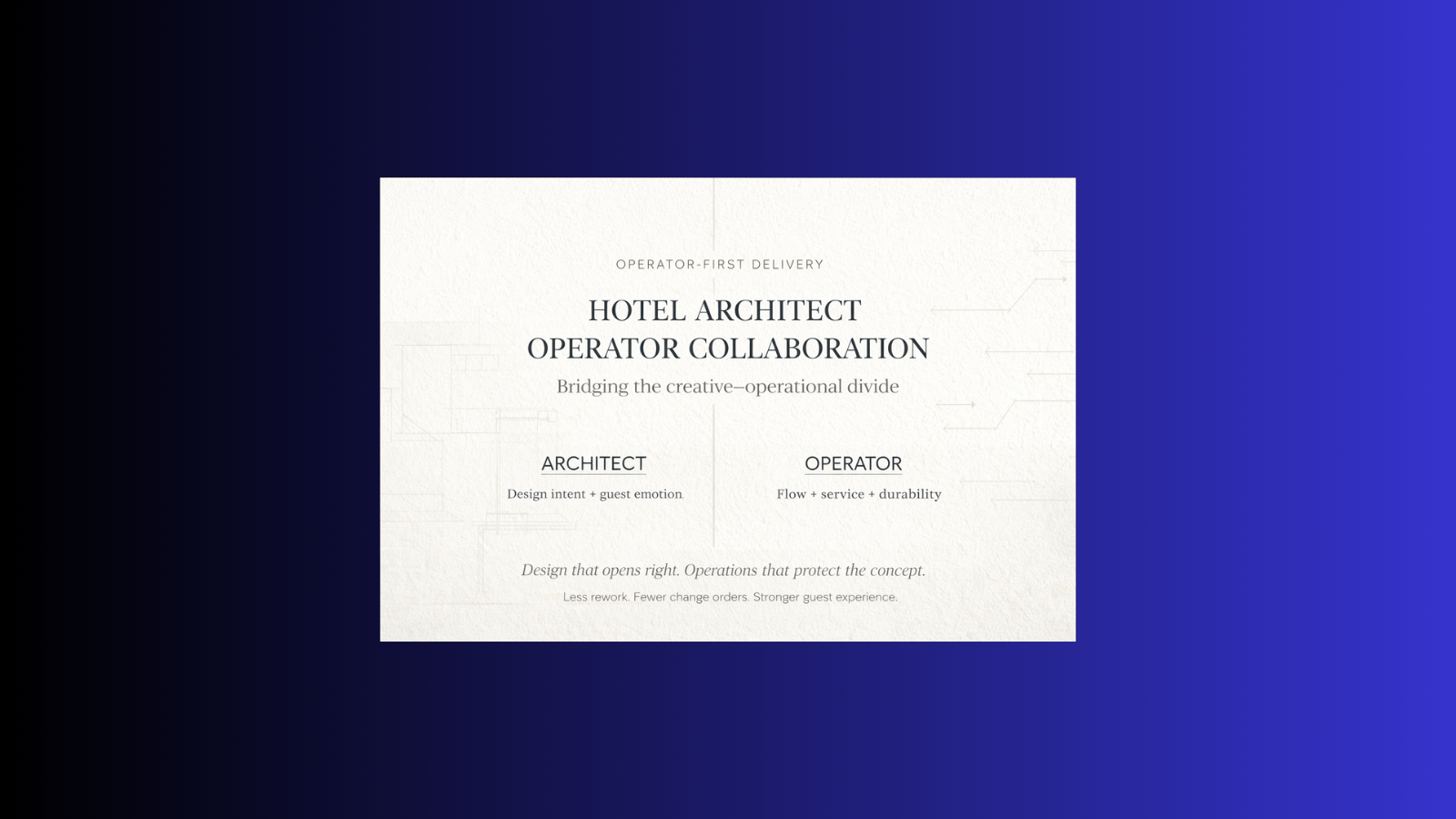
Great hotels are born when architects and operators collaborate as partners—yet in most projects, hotel architect operator collaboration is treated like an afterthought. The result is painfully predictable: either a beautiful property that is operationally dysfunctional, or an efficient property that feels soulless.
This article explains why the divide happens, what it costs (financially and reputationally), and how to run a collaboration process that protects design integrity and operational performance—especially for luxury, lifestyle, and wellness hotels in Bali and wider Indonesia, where fragmented project delivery is still the default. A useful local context reference is the Indonesian IPD awareness discussion in Buildings (MDPI): IPD adoption challenges in Indonesian projects.
TL;DR (Key Takeaways)
- Most “design vs ops” conflict is a timing and incentives problem, not a personality problem.
- The fix is not more meetings. The fix is a shared operating system: gates, artifacts, decision rights, and measurable trade-offs.
- Collaboration pays off when it reduces rework, change orders, and “silent OPEX bombs” (maintenance, staffing friction, guest complaints).
- In Bali/Indonesia, structured collaboration is a risk control mechanism, not a “nice-to-have.”
Why does hotel architect operator collaboration fail in most projects?
Direct answer (40–60 words):
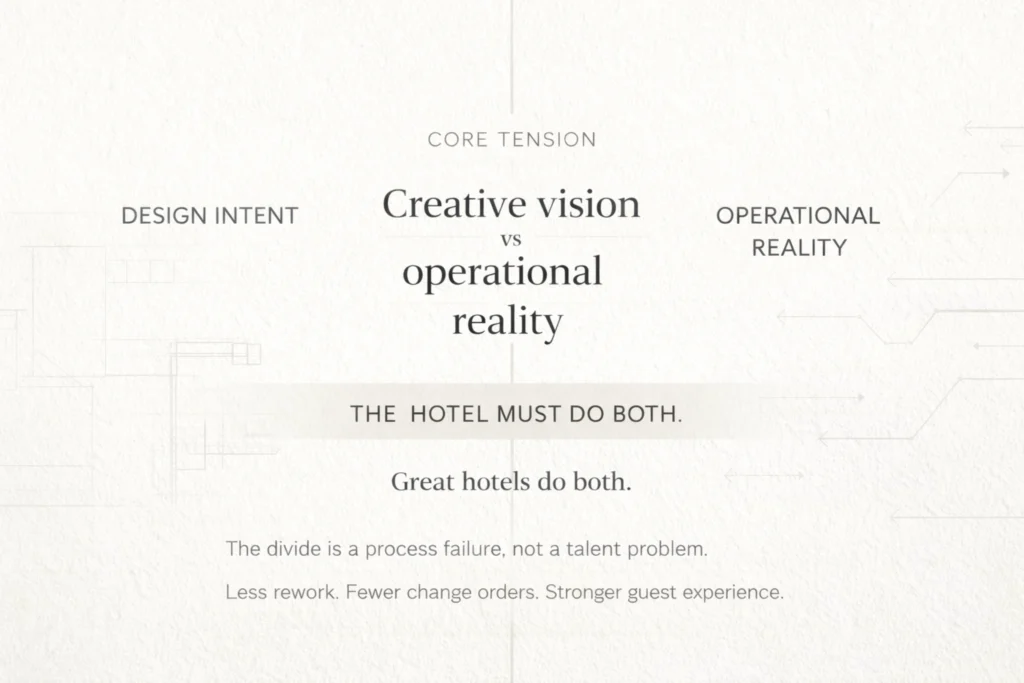
It fails because architects and operators optimize different outcomes under different constraints, and operators typically enter late—when decisions are expensive to change. Operational truth arrives as “restrictions” or value engineering, creating mistrust. Without a clear framework and decision gates, feedback becomes subjective and adversarial.
The two cultures (and why both are right)
- Architecture culture: narrative, proportion, materiality, brand feeling, guest psychology.
- Operations culture: throughput, staffing hours, SOPs, maintenance cycles, safety, hygiene, cost control.
Neither is “right.” The failure is structural: if your workflow is sequential (concept → design → build → operate), the two cultures collide under budget and schedule pressure.
The hidden culprit: fragmented delivery and misaligned incentives
Traditional project delivery rewards lane-keeping and finger-pointing. Integrated models exist specifically to reduce late change by aligning stakeholders earlier. A clean overview of that logic is Procore’s framework: Integrated Project Delivery (IPD) as a collaboration model.
What does poor collaboration actually cost?
Direct answer:
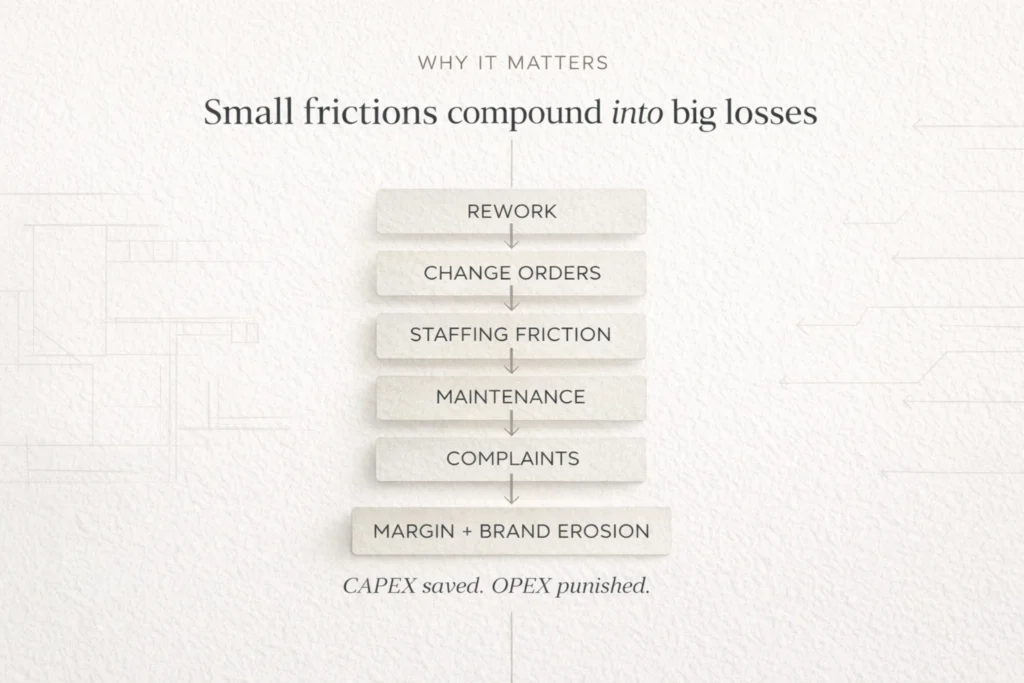
It creates permanent micro-frictions that compound into slower service, higher staffing demand, higher maintenance, delayed stabilization, weaker reviews, and brand erosion. Small “savings” during design or construction often become long-term operational losses.
A simple illustration: a minor restroom fixture change to save cost can trigger daily complaints and extra cleaning—CAPEX saved, OPEX punished.
The three most common failure modes
1) Beautiful-but-unworkable
- Circulation bottlenecks, service access conflicts, noise/privacy failures
- Hard-to-clean details and materials that degrade quickly (especially in tropical climates)
2) Efficient-but-soulless
- Over-standardized layouts that kill identity and pricing power
3) Late-stage compromise spiral
- Ops enters late → rework → change orders → blame game → diluted product
If your team wants a Bali-specific reality check on lifecycle durability (where “materials” become operating disruption), read: Hotel materials for tropical climates in Bali (what survives real operations).
Hotel architect operator collaboration is not “more input”—it’s a better system
Collaboration works when it is structured around:
- Timing (operators influence early, not late)
- Artifacts (briefs, models, matrices)
- Decision rights (who decides what, and when)
- Trade-off logic (design intent and operational performance are explicit)
Framework: The 6-Layer Collaboration Stack
Use this stack to make collaboration tangible and auditable (instead of subjective).
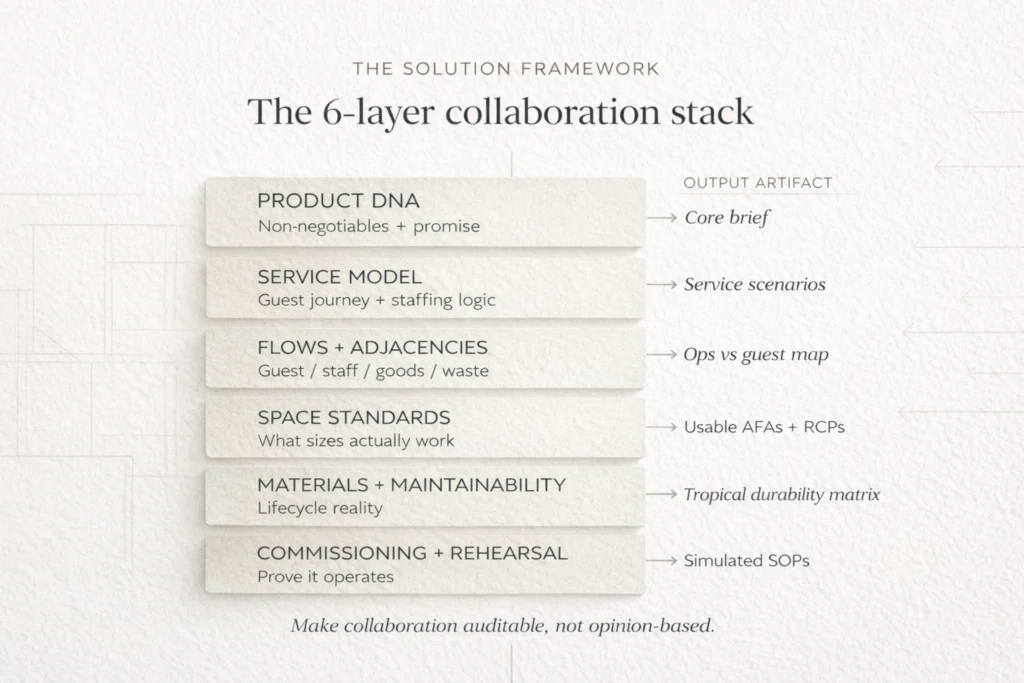
| Layer | What it answers | Output artifact | What goes wrong without it |
|---|---|---|---|
| 1) Product DNA | “What are we building, for whom, and why?” | Experience pillars + non-negotiables | Design drifts; ops assumes wrong service level |
| 2) Service Model | “What is the service promise, staffing logic, and guest journey?” | Guest journey + staffing assumptions | Under/over-staffing baked into design |
| 3) Flow & Adjacencies | “How do guests, staff, goods, linen, waste move?” | Flow maps + adjacencies | BOH friction, safety issues, long task times |
| 4) Space Standards | “What sizes actually work for operations?” | Area schedule + room templates | Rooms that look fine but don’t function |
| 5) Materials & Maintainability | “Will it survive real use?” | Materials matrix + durability spec | Early wear, mold/corrosion, replacement CAPEX |
| 6) Commissioning & Rehearsal | “Does it operate as designed?” | Mock service + snagging + SOP alignment | Soft opening becomes live debugging |
How does hotel design operational integration reduce rework and change orders?
Direct answer (40–60 words):
When design and operations are integrated early, constraints are designed-in instead of patched later. That reduces late revisions, RFIs, and change orders because flows, service adjacencies, and maintainability are validated before drawings are “locked.” It also protects the concept, because operational realities stop arriving as last-minute compromises.
For a strong operations-through-design perspective, HKS has a useful overview: Redefining hotel design for maximum operational efficiency.
Comparative insight: Traditional handoff vs integrated collaboration
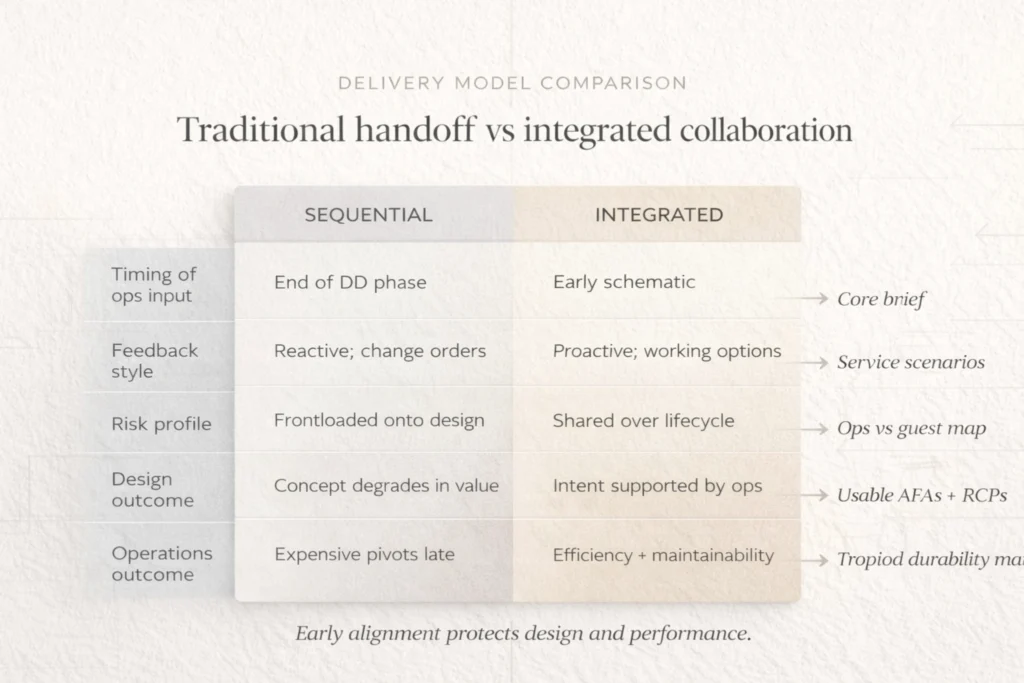
| Topic | Traditional (sequential) | Integrated (collaborative) |
|---|---|---|
| When ops input happens | Late (DD/CD or pre-opening) | Early (concept + schematic) |
| Nature of feedback | “Restrictions” and cost cutting | Co-authored solutions and trade-offs |
| Risk profile | Rework + change orders | Fewer change orders, earlier alignment |
| Design outcome | Diluted under pressure | Stronger, because constraints are designed-in |
| Operations outcome | Friction baked in | Flow, maintainability, and staffing engineered-in |
Segment-by-segment: how collaboration changes across hospitality types
Luxury / lifestyle hotels
- Brand “feel” is monetized—operators must protect sensory consistency, not just efficiency.
- Risk: ops feedback becomes “make it standard,” killing uniqueness.
Wellness & longevity resorts
- Clinical-adjacent operations: hygiene, protocols, privacy, storage, waste flow, time-window throughput.
- Risk: calm aesthetics without backstage logic creates invisible operational failure.
Resorts (tropical / remote)
- Supply chain, maintenance access, staff logistics, weather resilience become major design drivers.
- Risk: “perfect renders” fail under humidity, salt air, and heavy use.
Select service / limited service
- Thin economics: efficiency is survival.
- Risk: over-customization makes operations too expensive for ADR.
Why is this harder in Bali and Indonesia?
Direct answer (40–60 words):
Because most projects still use fragmented, sequential handoffs and the market has limited history with integrated delivery models. That increases late operator onboarding, contractor substitutions without lifecycle governance, and budget-driven edits that create long-term operational pain. The fix requires a collaboration system plus cultural change management.
How to make hotel architect operator collaboration work (a practical operating model)
Below is a sequence that works across luxury, lifestyle, wellness, and broader hospitality segments—adapted to Bali/Indonesia realities (fragmentation, late operator input, contractor substitutions).
How To: Run Architect–Operator Collaboration as a Structured Process
Step 1 — Lock the collaboration charter (Week 0)
- Confirm shared goals (guest promise + performance targets)
- Define decision rights (who approves what)
- Set cadence and required attendees
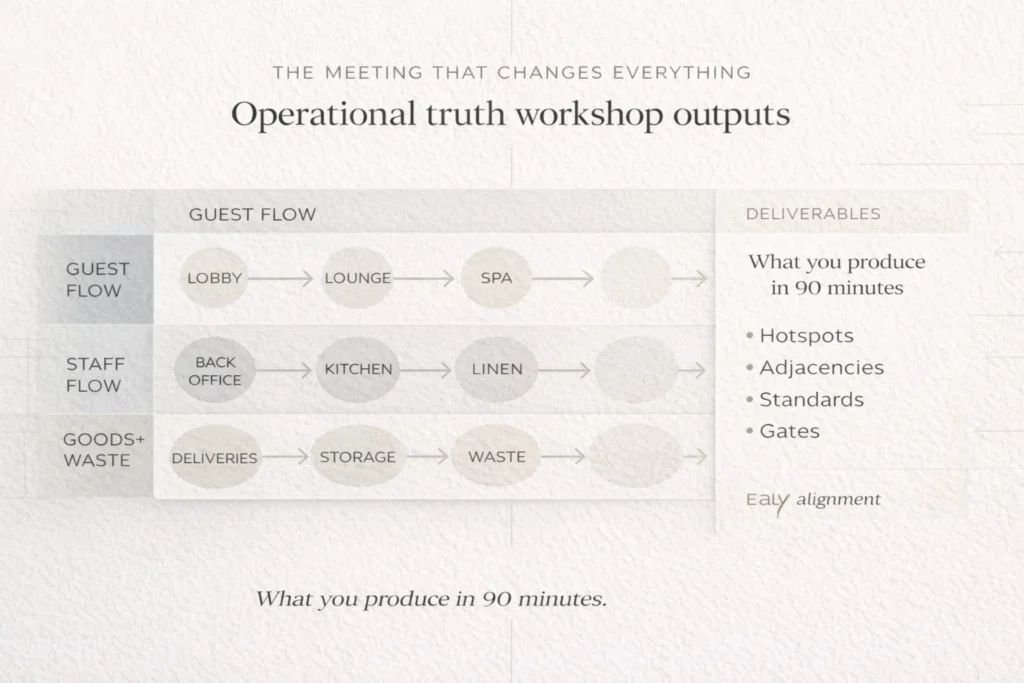
Step 2 — Run a joint “Operational Truth” workshop (Week 1)
- Guest journey mapping (arrive → check-in → room → wellness → F&B → depart)
- Staff journey mapping (arrival, BOH access, linen, waste, maintenance)
- Identify “friction hotspots” and translate them into design requirements
A good reference for why a co-constructed framework matters is Delporte’s “triangle” perspective: co-constructing specifications between architect, operator, and owner.
Step 3 — Build the Operational Design Brief (Week 1–2)
Outputs include:
- adjacency rules
- space standards
- storage logic
- BOH ratios and vertical circulation principles
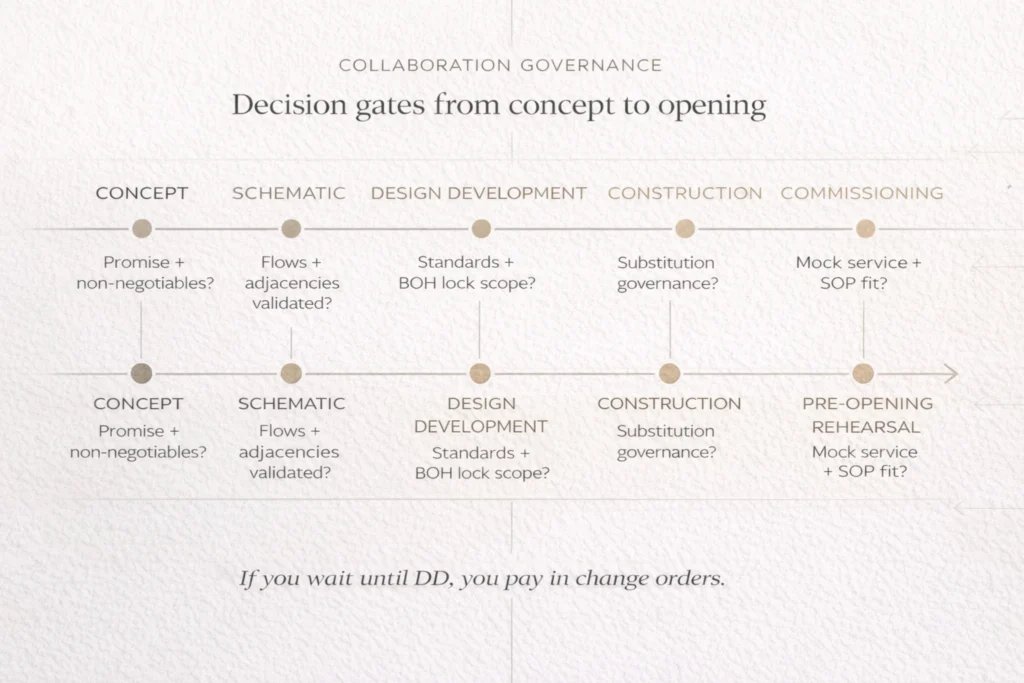
Step 4 — Gate reviews at schematic + DD + pre-opening
At each gate, assess:
- flows (guest/staff/goods/waste)
- maintainability and materials (tropical reality)
- safety, privacy, acoustics
- service speed and staffing logic
Step 5 — Material selection as a tri-party decision
Architect + operator + owner evaluate:
- durability and cleaning
- replacement availability in Indonesia
- slip resistance, corrosion resistance, mold risk
Step 6 — Commissioning + mock service rehearsal (pre-opening)
Treat opening as a performance:
- test flows with real teams
- snag list prioritized by operational risk
- SOPs aligned to the built environment
If you want the operations “rehearsal mindset” applied to openings, this pairs directly with the method above: Pre-opening SOP checklist (performance launch vs reactive soft opening).
What Zenith does differently (and why it prevents “creative vs operational” stalemates)
Zenith’s role is not to police design or defend ops. It is to run the collaboration system:
- translate ops reality into design language
- quantify lifecycle trade-offs (not preferences)
- protect design intent through explicit non-negotiables
- prevent late-stage value engineering from deleting the product promise
If you want the collaboration model framed specifically for architects and developers, start here: Architect hospitality consultant in Bali (how to design that opens right).
FAQ (Hotel Architect Operator Collaboration)
1) What is hotel architect operator collaboration, in plain terms?
Hotel architect operator collaboration is a structured way of designing hotels where operators participate early enough to shape layouts, flows, materials, and service logic—before design decisions become expensive to change. Instead of “operators controlling design,” the goal is to bring operational truth into the process early, so the finished product is both beautiful and easy to run. In practice, this prevents late rework and protects the original design intent.
2) How early should an operator be involved?
Bring the operator in at concept and schematic design—before space planning is locked. When the operator joins at DD or later, feedback tends to become late-stage rework under budget pressure. As a result, the project either compromises the concept or absorbs avoidable change orders. For context, see Procore’s overview of IPD and early alignment: how IPD aligns stakeholders early.
3) How do we prevent operators from killing creativity?
Codify design intent as non-negotiables and translate operational needs into measurable outcomes (task time, maintainability, safety, guest experience). When design intent is explicit, the team solves constraints creatively instead of debating taste.
4) What’s different for wellness and longevity properties?
Wellness operations behave like hospitality plus protocols: hygiene, privacy, storage, waste flow, and time-window throughput. Collaboration must include protocol owners so treatment room standards, cleaning cycles, and guest circulation are designed-in—not patched later.
5) Why is this especially important in Bali/Indonesia?
Because fragmented delivery increases late operator input, substitutions, and budget-driven edits that create long-term operational pain. Structured collaboration is a competitive advantage because it reduces rework and protects both product quality and margin.
Summary Takeaways
- The creative vs operational divide is primarily a process and incentives problem.
- Start collaboration early, or operational truth will arrive late as conflict.
- Use a collaboration stack (DNA → service model → flows → standards → materials → rehearsal) to make decisions auditable.
- Treat value engineering as a lifecycle decision, not a cost-cutting reflex.
- In Bali/Indonesia, collaboration is risk control—because fragmentation is still common.
CTA — Want Zenith to facilitate architect–operator collaboration?
If you’re developing a luxury, lifestyle, or wellness hotel (or any hospitality asset where design intent and operations must align), Zenith can run the collaboration system: charrettes, operational flow workshops, materials governance, and pre-opening operationalization.
If your investment story depends on clean stabilization (ADR/occupancy) but your delivery model creates operational friction, you’ll also want to read: Why a hotel feasibility study is wrong when it ignores operational risk.
You can also explore more playbooks in the Zenith blog hub.
Author
André Priebs — CEO, Zenith Hospitality Global
Operator-first hospitality advisory supporting owners, developers, and operators to design and launch luxury boutique hotels, lifestyle retreats, and wellness/longevity assets—built for real-world operations, not just renders. Learn more about Zenith on the Zenith homepage.