Sustainability is now table stakes. For developers and owners, regenerative hospitality Indonesia is the next investable frontier: hospitality models that restore ecosystems, strengthen community economies, and protect cultural continuity—while delivering premium ADR, stronger direct demand, and lower long-term risk.
This guide explains what regenerative hospitality is (and what it is not), why it matters specifically in Indonesia and Bali, and how to design a measurable, investor-grade impact framework that avoids greenwashing.
Key takeaways
- “Sustainable” often means less harm; regenerative hospitality Indonesia means net positive outcomes for nature, people, and place.
- Regeneration is a commercial strategy: it protects water security, waste capacity, community license-to-operate, and destination appeal.
- Winning projects operationalize regeneration through procurement, HR, utilities, guest programming, and measurement—not marketing.
- Investors should demand baselines, KPIs, and reporting cadence—not slogans.
Why is “sustainable hospitality” now a credibility problem?
“Sustainable” has been diluted by vague claims and checklist certifications that do not prove real-world outcomes. The result is a credibility gap: what gets marketed as sustainability often behaves like risk management without proof—the polite industry term is “greenwashing.”
Regenerative hospitality is the response: a model designed to leave a destination measurably better than before the project arrived. In practice, regenerative hospitality Indonesia is not a single “eco feature.” It is an operating model that ties place-based regeneration to commercial resilience.
Example (Bali lens): A regenerative positioning is strongest when the product is inseparable from place—architecture, food systems, cultural integration, and verifiable impact. Properties like Buahan, a Banyan Tree Escape show how “open living + hyper-local sourcing + community connection” becomes the luxury proposition—not a footnote.
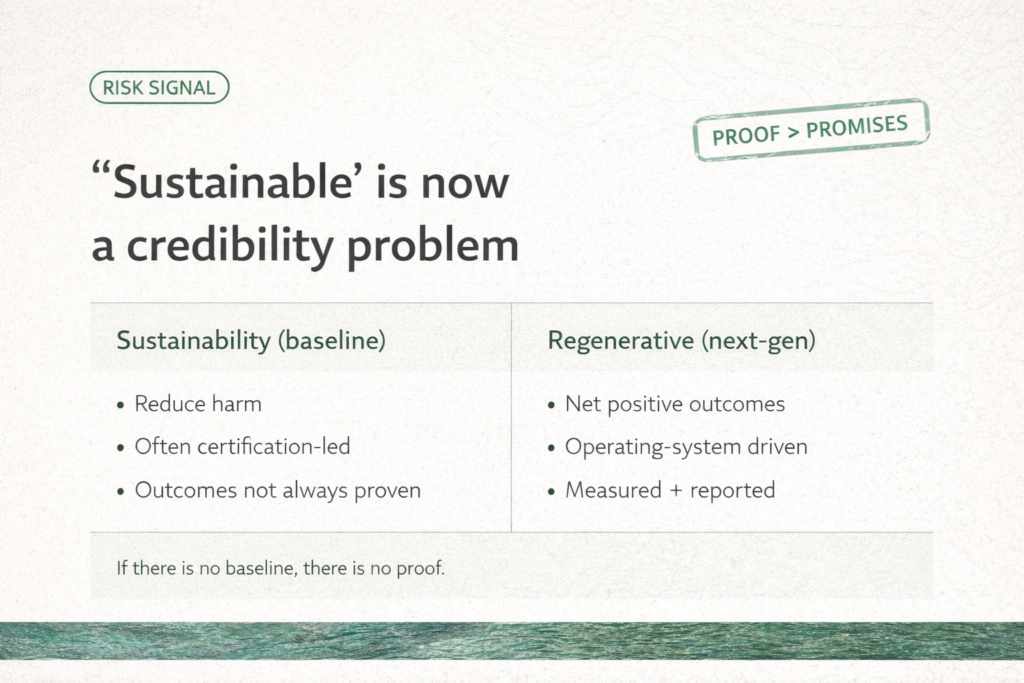
Sustainability vs. regenerative: what is the operational difference?
| Dimension | “Sustainable” (baseline) | Regenerative hospitality Indonesia (next-gen) |
|---|---|---|
| Core intent | Reduce negative impact | Create positive impact (net positive) |
| Water | Reduce usage | Reduce + recharge / restore watersheds |
| Waste | Recycle + reduce | Design-out waste + circular local systems |
| Nature | Avoid damage | Restore habitat, biodiversity, reef/forest health |
| Community | Hire locally | Build local capability + local enterprises |
| Culture | Decor / performances | Co-created, protected, fairly compensated |
Minimum baselines can be mapped to the GSTC Industry Standard for Hotels.
Net-positive ambition can be structured against the Sustainable Hospitality Alliance Pathway to Net Positive Hospitality.
Why regenerative hospitality Indonesia matters for developers and owners
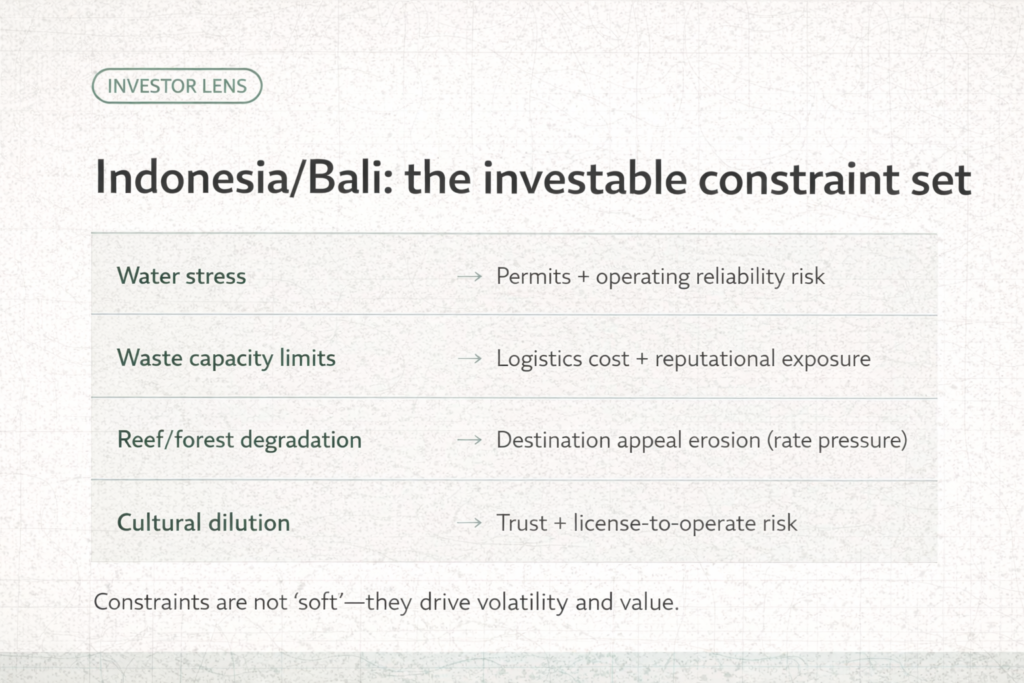
Indonesia’s tourism economy is powerful. However, its destination constraints are just as real. In practice, these are no longer “soft” issues: they directly drive permitting friction, community resistance, and operating volatility—especially in fast-growing corridors such as Bali.
Indonesia/Bali: the investable constraint set
- Water stress and aquifer pressure, particularly where tourism growth outpaces infrastructure capacity
- Waste management limits, because landfills and logistics quickly become bottlenecks
- Coastal and reef degradation, often compounded by upstream deforestation, erosion, and run-off
- Cultural dilution risk, as hyper-tourism can weaken living traditions and local trust
Consequently, Bali’s policy direction is shifting toward “quality and sustainability,” not just volume. For example, the foreign tourist levy and stricter environmental controls signal a higher expectation for compliance and destination stewardship. The levy is formalized in Bali Governor Regulation No. 36/2023.
Meanwhile, demand remains strong: BPS Bali reported 697.11k international arrivals in July 2025 and 3.98m arrivals Jan–Jul 2025 (direct to Bali), up year-on-year.
Investor implication: the opportunity is not “less tourism.” Instead, it is better tourism: higher yield, higher quality, and a regenerative model that protects—rather than degrades—the destination that powers the revenue engine.
Regenerative hospitality Indonesia: the commercial case (ADR, NOI, risk)
Developers often treat sustainability as a cost line. In reality, regenerative hospitality Indonesia can function as an NOI protection strategy—especially for long-hold owners and institutional capital—because it reduces operational volatility, strengthens pricing power, and protects license-to-operate.
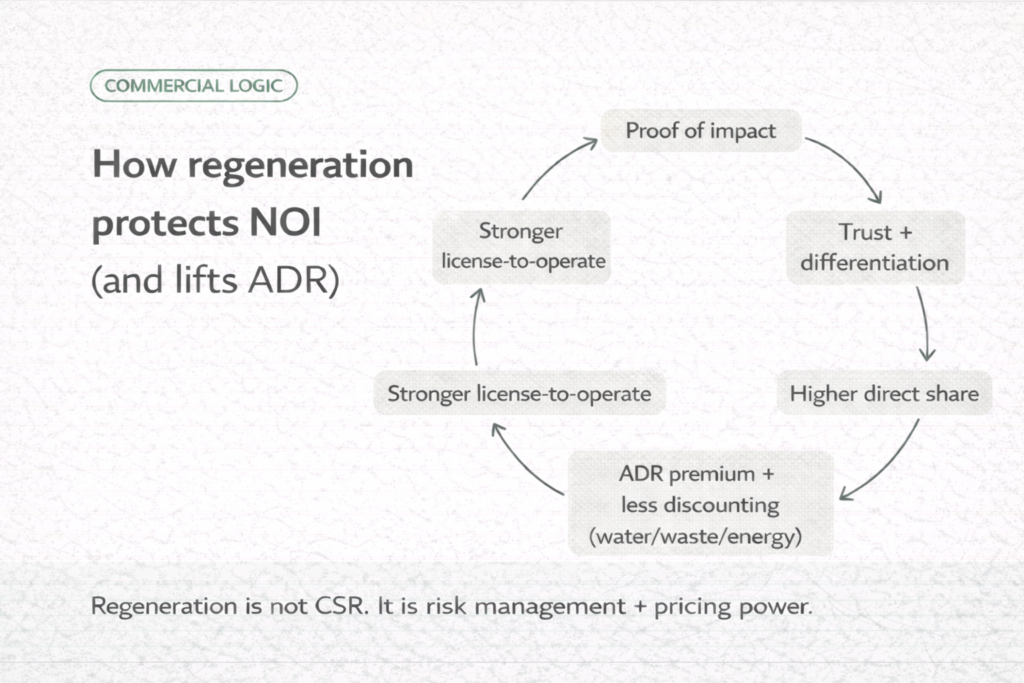
1) Rate premium and demand resilience
High-intent travelers increasingly pay for authenticity, transparency, and credible impact. As a result, projects that prove positive outcomes typically reduce discount dependency and improve direct share—because the story is tangible, not abstract.
Booking.com research in 2025 makes this shift explicit: 73% of travelers want their spending to go back to the local community, and 69% want to leave places better than when they arrived (Booking.com 2025 research).
2) Lower operating volatility (utilities are constraints)
In Indonesia, water, energy, and waste are not just utilities—they are constraints. Therefore, systems designed for efficiency plus circularity reduce exposure to future tariffs, scarcity, and disruption. For the broader green-building business case, see IFC: Building Green.
3) De-risking permitting and community license-to-operate
Projects that deliver local jobs, supplier development, and shared value face fewer conflicts and fewer delays. In addition, they tend to earn stronger stakeholder alignment over time—which becomes a material advantage at scale and during expansion phases.
4) Institutional capital alignment (nature + impact reporting)
Asset managers are increasingly aligning with frameworks that translate “impact” into investable risk management, particularly nature exposure. Meanwhile, TNFD momentum is accelerating nature-related disclosure expectations; see the context covered by Reuters: Nature-related financial disclosures explainer.
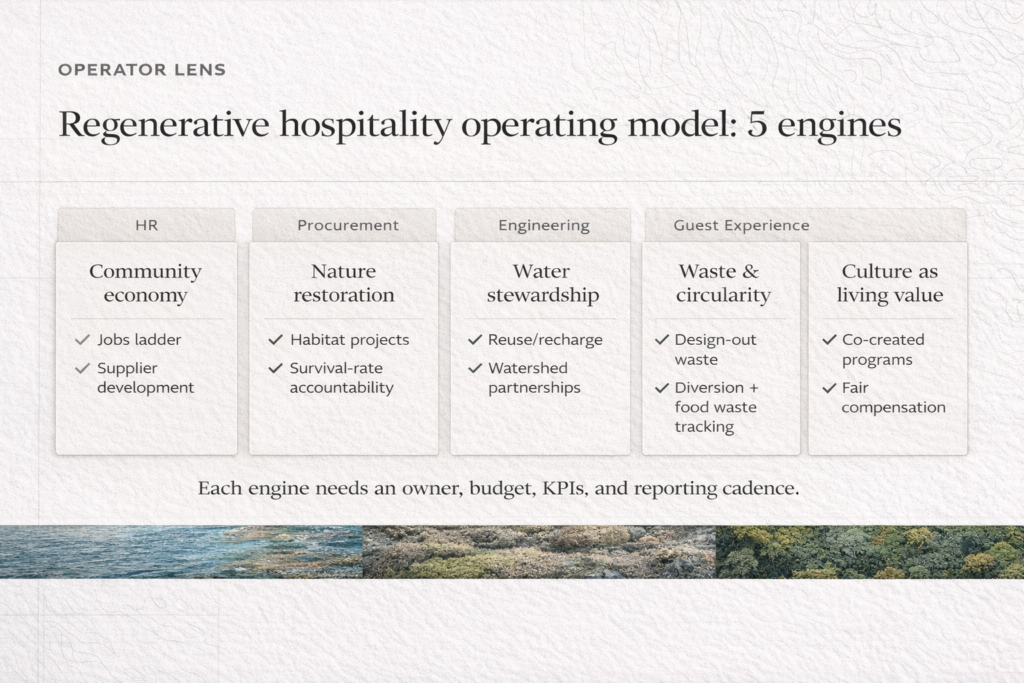
Regenerative hospitality Indonesia operating model: 5 engines
Regeneration is not a single initiative. It is an operating system across five engines—each with operational ownership, budgets, KPIs, and reporting.
Engine 1 — Community economy and livelihoods
- Local employment targets by department (not only entry-level)
- Paid apprenticeships + skill ladders (culinary, wellness, engineering, revenue, leadership)
- Supplier development: structured onboarding for farms, fisheries, crafts, wellness practitioners
- Community benefit funds tied to clear outcomes (education, waste, water, arts)
Investor lens: ask for “local employment” split by role level (entry / supervisor / manager), retention, and promotion rate.
Engine 2 — Nature restoration and biodiversity
- Reforestation / agroforestry partnerships (not token tree planting)
- Riparian restoration and erosion control where relevant
- Reef and coastal restoration partnerships for oceanfront assets
- Wildlife-friendly design and light/noise discipline (biodiversity-friendly operations)
Operator lens: tree planting without survival rates is PR, not regeneration. Require survival rates and maintenance budgets.
Engine 3 — Water stewardship (often the Bali priority)
- Context-based water targets (per guest-night and watershed capacity)
- Rainwater harvesting and greywater reuse where feasible
- Landscape design that reduces irrigation demand
- Watershed partnerships that measure recharge proxies, not only consumption reduction
Design note: water stewardship must be designed into MEP and landscape from day one, not retrofitted.
Engine 4 — Waste and circularity
- Procurement specs to eliminate single-use items
- Back-of-house separation designed into layout and SOPs
- Composting and local circular partners (organic waste to farms, glass recovery)
- Transparent diversion reporting (and food waste metrics)
Engine 5 — Culture as living value (not entertainment)
- Co-created cultural programming with local leaders (fair pay, consent, limits)
- Support for craft economies (quality standards + pricing integrity)
- Preservation contributions (archives, training, ceremonies supported—not commodified)
Regenerative hospitality Indonesia: how to prove net positive impact
Direct answer: Net positive is credible only when it is measurable. In other words, you need a baseline, clearly defined outcomes, KPIs owned by operations (not marketing), and a reporting cadence investors can verify. Without “before” data and explicit metrics, regeneration becomes storytelling—and the market will discount it.
The biggest failure mode in sustainability is measurement theater. Therefore, a credible regenerative model should be built on five practical building blocks:
1) A baseline (“before”)
First, capture the pre-project state: water flows, waste volumes, biodiversity indicators, supplier mapping, and employment capacity. Then, lock the measurement method and frequency so results are comparable over time.
2) A theory of change
Next, explain why actions lead to outcomes. For example: composting → improved soil health → higher farm yields → increased local procurement → stronger livelihoods. As a result, every initiative has a logic chain that can be tested, not just described.
3) KPIs tied to operations (not storytelling)
Most importantly, track KPIs that are owned by the GM/DOO/Chief Engineer and embedded into SOPs. An investor-grade scorecard for regenerative hospitality Indonesia typically includes:
- Local payroll ratio (% wages paid locally; leadership progression rates)
- Local procurement ratio (% of non-labor spend in-region)
- Water intensity (L/guest-night) + recharge proxy (m³ restored via watershed programs)
- Waste diversion (%) + food waste (kg/cover)
- Biodiversity (habitat restored, native species counts, reef health partner metrics)
- Cultural value (paid collaborations, funds disbursed, documented preservation outputs)
- Guest participation (opt-in rates, donation conversion, learning outcomes)
4) Reporting cadence that matches ownership governance
Equally important, publish on a cadence that matches owner reporting:
- Monthly: utilities KPIs + waste dashboard
- Quarterly: community + supplier development + biodiversity project updates
- Annually: consolidated impact report aligned to recognized standards
5) Third-party alignment (minimum + pathway)
Finally, anchor the minimum bar to recognized standards and show progress against a pathway. For example, use GSTC as the baseline reference, while mapping improvement against the Sustainable Hospitality Alliance pathway to net positive.
Can regenerative hospitality command a premium ADR in Bali?
Direct answer: Yes—when regeneration is built into the product, not added on top. The ADR premium is driven by trust (proof), differentiation (place intelligence), and ease (guests can participate without friction). If regeneration is invisible operationally or vague in claims, it will not convert into rate.
Regenerative models can achieve premium positioning when the guest experience is inseparable from place—architecture, sourcing, rituals, and community connection. That is how “impact” becomes product, not messaging.
How to build a regenerative hospitality project in Indonesia (developer playbook)
Below is the implementation sequence Zenith uses to turn regeneration into an investable system for regenerative hospitality Indonesia projects.
Concept gate — Define the Regenerative Thesis
- What ecosystem are we restoring? (reef, watershed, forest, village economy)
- What is the guest promise tied to place?
- What outcomes will be measured and published?
Feasibility gate — Build the Impact Architecture
- CAPEX + OPEX implications (water systems, waste systems, partnerships)
- Revenue effects (ADR premium, LoS, direct share, membership engine if relevant)
- Risk register (permitting, community, water, waste, seasonality)
Design gate — Design for Operations
- BOH layouts enabling waste separation, recycling logistics, and cold chain for local sourcing
- MEP specs that reduce water and energy intensity
- Materials and procurement specs aligned with standards
People gate — Build the Community Program
- Hiring plan + training academy
- Supplier onboarding + quality assurance
- Shared-value governance (who approves, who audits, who reports)
Opening gate — Launch the Measurement System
- Baseline capture + monthly reporting cadence
- Transparent guest communication (no claims without evidence)
- Quarterly impact review integrated into owner reporting
Quarterly cycle — Publish and iterate
- What worked / what failed / what to improve
- Expand partner network and local enterprise development
- Adjust based on community feedback and measurable outcomes
Investor due diligence: 12 questions that separate substance from greenwashing
- Baseline: Define the starting point—water, waste, biodiversity, and livelihoods—and confirm how each metric is measured (method, frequency, owner).
- Operational ownership: Clarify who owns the KPIs day-to-day (GM / DOO / Chief Engineer) and ensure they are not “marketing-owned.”
- Budget reality: Confirm the annual OPEX budget for regeneration, where it sits (departmental vs. CSR), and whether it is protected in downturn scenarios.
- Supply-chain proof: Review the top 5 suppliers by spend and verify how much procurement is local or Indonesia-based (by % of non-labor spend).
- Local leadership pipeline: Check the plan for leadership development, including training hours, promotion targets, and timelines beyond entry-level hiring.
- Waste system performance: Identify the waste partners and validate the diversion targets for month 6 and month 12 (and how diversion is audited).
- Landscape and micro-climate: Test whether landscape design reduces irrigation demand and improves micro-climate (species selection, soil, shading, evapotranspiration logic).
- Water reuse and recharge: Confirm the reuse/recharge systems (rainwater, greywater, treatment) and the maintenance plan that keeps them working after year one.
- Culture governance: Validate which cultural programs are co-created, how consent is managed, and how partners are fairly compensated (rates, frequency, revenue share if applicable).
- Resilience planning: Review the crisis plan for drought, waste disruption, and community friction—plus decision rights and escalation paths.
- Claims and evidence: List the public claims the project intends to publish and require the evidence pack for each (baseline, KPI results, third-party confirmations).
- Reporting cadence: Confirm the owner/investor reporting cadence (monthly, quarterly, annual) and the exact KPI dashboard that will be delivered.
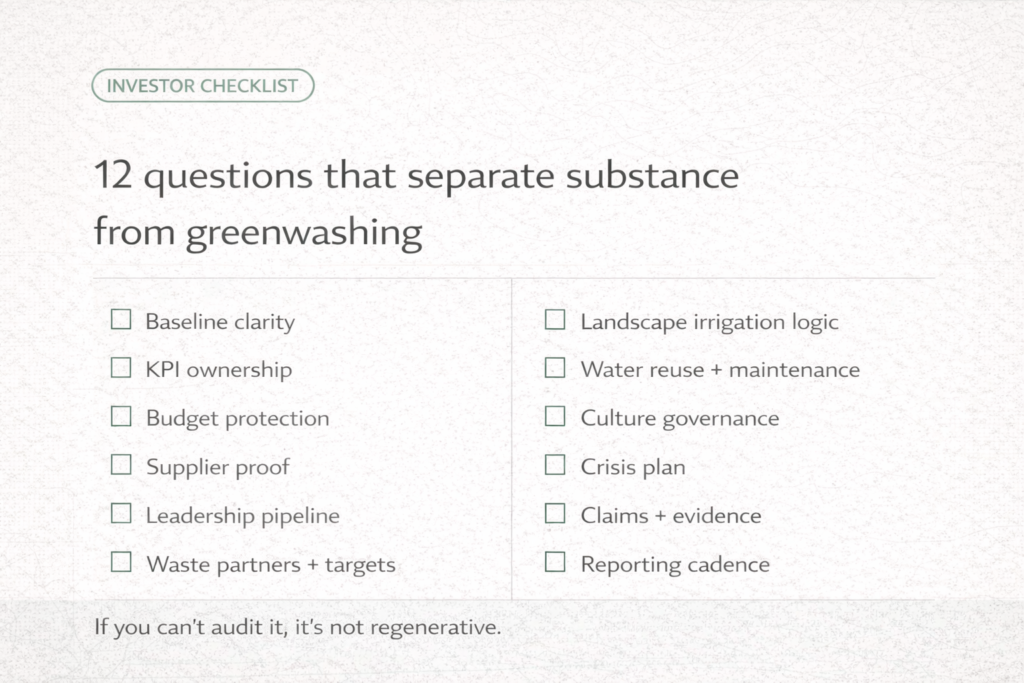
If a project cannot answer these, it is not regenerative hospitality Indonesia—it is sustainability theater.
Where projects fail (and how to avoid it)
- Token initiatives (trees without survival rates; cleanups without system redesign)
- Imported “eco luxury” that ignores local supply chains and capability building
- No operational ownership (ESG delegated to marketing)
- No baselines (no “before” means no proof)
- Overpromising (claims that trigger reputational and regulatory risk)
Zenith’s point of view
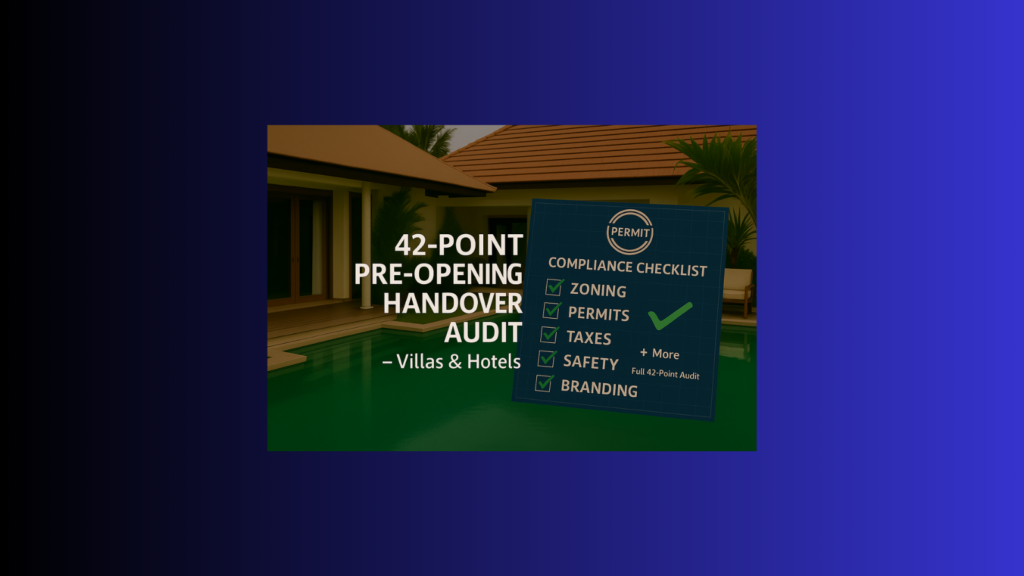
Zenith Hospitality Global designs regenerative hospitality concepts that are operator-first and measurable. If you want a rapid “risk + readiness” view before opening, start with our Pre-Opening Handover Audit Bali — 42-Point Guide.
We integrate regeneration into:
- Product DNA (guest promise + commercial logic)
- Design briefs (MEP, BOH, procurement, materials)
- Pre-opening systems (SOPs, training, vendor onboarding)
- Investor reporting (KPI scorecards + quarterly governance)
CTA — Want an investment-grade regenerative thesis for your project?
If you are planning an eco-resort, wellness retreat, or premium lifestyle asset in Indonesia, we can pressure-test your concept against water, waste, permitting, community governance, and commercial viability—then turn it into a measurable framework that investors trust.
Book a feasibility discussion with Zenith: Contact Zenith Hospitality Global
Related reading (Zenith)
- About Zenith Hospitality Global
- Architect Hospitality Consultant Bali: Design That Opens Right
- Overcrowding in Bali Tourism: 6-Pillar Action Plan from WTTC 2025
- AI in Hospitality Indonesia: How Consultants Protect the Bali Smile
- Zenith Blog
External references (for investors)
- GSTC Industry Standard for Hotels
- Sustainable Hospitality Alliance: Pathway to Net Positive Hospitality
- BPS Bali: Tourism arrivals press release (Jul 2025)
- Bali Governor Regulation No. 36/2023 (tourist levy)
- IFC: Building Green (business case for green buildings)
- WTTC: Bridging the Say-Do Gap
- Booking.com 2025 traveler research
- Reuters: Nature-related financial disclosures explainer
FAQ
What is regenerative hospitality?
Regenerative hospitality is a hospitality model that improves ecosystems, strengthens local economies, and protects cultural continuity—measured through baselines and KPIs, not marketing claims. In regenerative hospitality Indonesia, “net positive” typically centers on water stewardship, waste systems, community livelihood programs, and credible reporting cadence that owners and investors can audit.
Is regenerative hospitality profitable?
Yes—when integrated into product, design, and operations. A credible regenerative model supports ADR premium through trust and differentiation, improves direct demand, and reduces long-term operating volatility tied to water, energy, and waste constraints. It also strengthens license-to-operate, which is often a real driver of speed-to-open and reputational resilience.
What is the difference between sustainability and regeneration?
Sustainability focuses on reducing harm (less water, less waste, less carbon). Regeneration goes further: it restores and improves the local system, aiming for net positive outcomes. The operational difference is proof—regeneration requires baselines, measurable outcomes, and reporting cadence. Without those, “regenerative” becomes a label, not a model.
How do you measure regenerative hospitality impact?
Start with a baseline (“before”), define outcomes and a theory of change, then track KPIs owned by operations (utilities, procurement, HR, community partnerships). Report monthly (utilities/waste), quarterly (community/nature programs), and annually (consolidated impact). Align to recognized baselines like GSTC and net-positive pathways like the Sustainable Hospitality Alliance.
Summary Takeaways
- Regenerative hospitality Indonesia is the investable evolution beyond sustainability—focused on net positive outcomes that can be measured.
- The commercial case is real: ADR premium + demand resilience + reduced long-term operating and reputational risk.
- “Impact” must be built into design, procurement, HR, utilities, and SOPs—then reported on a cadence owners trust.
- Baselines and KPIs are the line between regeneration and greenwashing.
- In Indonesia and Bali, regeneration is increasingly tied to permitting, brand strength, and asset value.
Author
André Priebs is CEO & Co-Founder of Zenith Hospitality Global. He advises developers and hotel owners on concept strategy, pre-opening governance, operating systems, and commercial performance for luxury boutique hotels, lifestyle retreats, and wellness/longevity assets across Indonesia (including Bali).