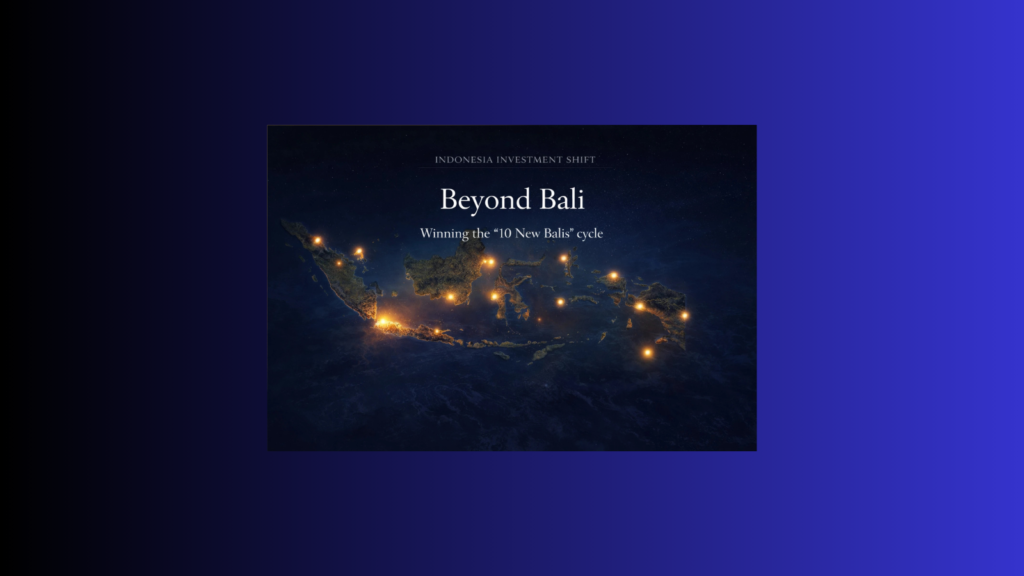
Indonesia is moving into a new hospitality cycle: “beds + breakfast” is no longer enough, and “spa + yoga” is not a wellness concept. The investment opportunity is real, but the winners will be the assets that can prove outcomes, protect safety, and operationalize a culturally authentic wellness proposition at scale. What follows is an investor-grade blueprint for wellness hotel development Indonesia—covering positioning, design, staffing, governance, and measurement—built to command premium rates and repeat stays without drifting into medical-claims risk.
This article is a practical blueprint for wellness hotel development Indonesia: how to position, design, license, staff, and operate credible wellness destinations that command premium rates and repeat stays—without crossing into unsafe or non-compliant “medical tourism cosplay.”
The market reality: wellness tourism is growing faster than tourism overall
Global wellness tourism spending has rebounded strongly post-2020 and is forecast to expand rapidly through 2027. Global Wellness Institute – Global Wellness Economy Monitor
Indonesia’s own wellness tourism baseline (pre-pandemic) already indicated multi-billion-dollar annual spending and a steep growth trajectory—meaning the question is no longer “is there demand?” but “which assets will capture it with credibility?”
At the same time, Indonesian arrivals have recovered materially: official statistics show 13.9M international visitor arrivals in 2024. BPS / DataIndonesia – Statistik Kunjungan Wisatawan Mancanegara 2024 (PDF)
More recent government-reported figures indicate 13.98M arrivals from Jan–Nov 2025. INP Polri – 2025 arrivals summary
That combination—macro travel recovery + structural wellness demand—creates a window for investor-led, operator-grade wellness assets.
The truth bomb: most “wellness hotels” are just spas with yoga
The majority of “wellness” developments fail commercially for the same reason: they build amenities, not a system. Common failure modes:
- No defined wellness philosophy (so the product becomes a menu, not a transformation).
- No clinical governance boundaries (so risks accumulate quietly until a reputational event).
- No outcomes framework (so you cannot justify premium ADR, membership, or repeat).
- No operational engine (so delivery depends on one charismatic practitioner, then collapses).
If you’re planning wellness hotel development Indonesia, you need a product thesis that can be staffed, trained, measured, and repeated—without degrading quality.
Indonesia’s differentiation: cultural wellness is an asset, but only if you treat it professionally
Indonesia has genuine local wellness heritage (e.g., jamu/herbal traditions, Balinese purification rituals, meditation lineages). The differentiation is not “adding culture.” It is translating heritage into a modern guest experience with:
- quality control and sourcing standards,
- safety boundaries,
- consistent practitioner training,
- and a guest-facing narrative that is respectful and non-extractive.
Indonesia’s public health bodies explicitly categorize traditional remedies into tiers (jamu / standardized herbal medicines / clinically tested phytopharmaca), which is useful for how you position products and claims. Kemenkes – classification context
Regulators and BPOM also highlight the scale and formalization of herbal products—helpful when building an investor-safe “local wellness” supply chain strategy. BPOM – Obat Bahan Alam context
The investable signal: Sanur Health & Wellness Tourism Special Economic Zone is a strategic anchor
A practical indicator of direction is the government-linked push for integrated health + wellness infrastructure, exemplified by the Sanur SEZ master plan and international-hospital adjacency. The published project description notes a 42-hectare site, integration with Bali International Hospital, and involvement alongside Mayo Clinic Care Network, indicating Indonesia’s intent to professionalize health and wellness tourism nodes. Sanur Health & Wellness Tourism SEZ overview
This matters to investors because it legitimizes a “credibility corridor” and accelerates demand for properly designed upstream/downstream hospitality assets that can partner (or at least coexist) with regulated care ecosystems.
Positioning framework: choose your lane before you design anything
A credible wellness asset starts with a lane. Mixing lanes creates operational chaos and legal risk. Therefore, lock the lane before concept design and MEP coordination begin.
Lane A — Lifestyle Wellness Resort (low clinical intensity)
- Guest outcome: sleep, stress reduction, movement, nutrition, nature, culture
- Revenue engine: rooms + wellness programming + F&B + retail + memberships (where local demand exists)
Lane B — Performance & Recovery (medium intensity)
- Delivery core: recovery tech, physiotherapy-style modalities, structured movement, measurable baselines
- Commercial upside: stronger local membership potential, typically with higher attachment rates
Lane C — Medical-adjacent Wellness Hospitality (high governance)
- Governance requirement: co-located or partnered clinical services with strict scope-of-practice controls
- Package logic: premium programs—provided that governance and licensing are correct
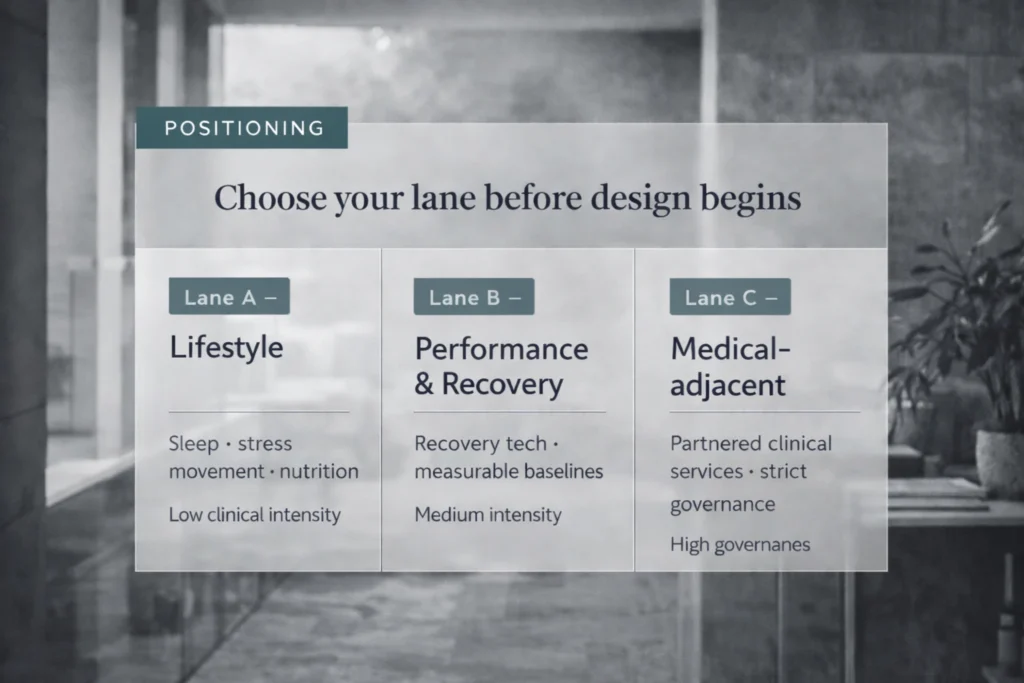
Your lane determines CAPEX, staffing, risk, and brand promise. As a result, “spa + yoga” is not a strategy—it avoids the hard decisions., risk, and brand promise. This is why “spa + yoga” is not a strategy—it avoids the hard decisions.
The credibility stack: what “authentic wellness” actually requires
Use the credibility stack below as your development checklist. If one layer is missing, you get wellness-washing.
- Philosophy + outcomes promise
- Define the transformation in plain language (e.g., sleep reset, metabolic resilience, nervous system regulation).
- Define what you will measure (even if non-medical).
- Program architecture (not a menu)
- Build 3–5 signature programs with clear entry/exit criteria, weekly rhythm, and escalation paths.
- People: credentialing + training + supervision
- Credential framework by modality (who can deliver what; who supervises).
- Backup coverage plan so quality does not depend on one person.
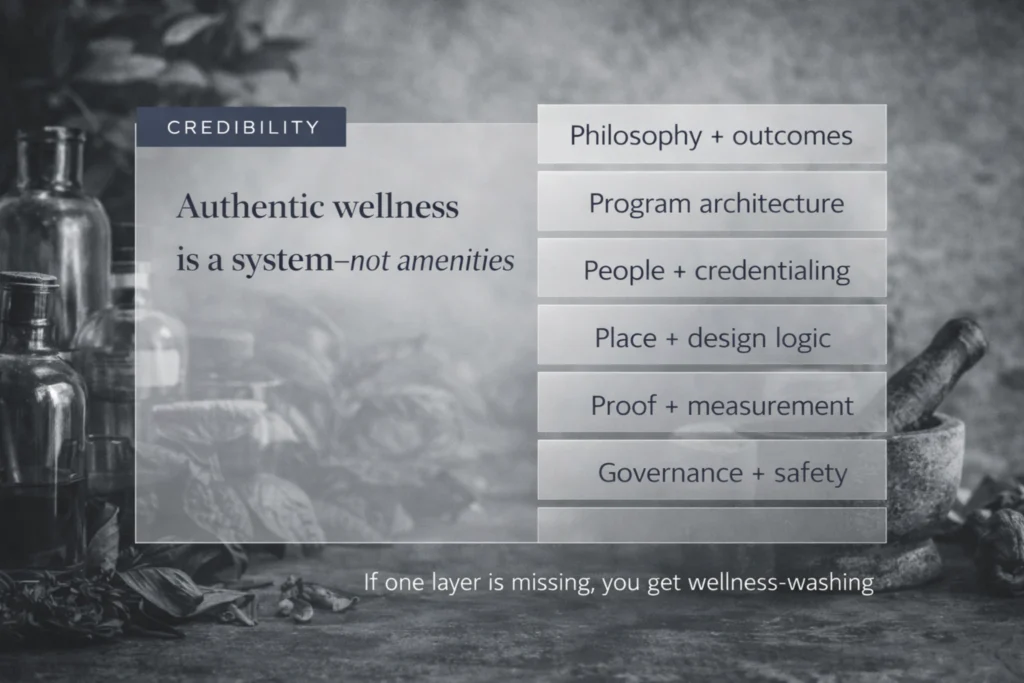
- Place: design that supports outcomes
- Circadian light logic, acoustic strategy, thermal comfort, air quality, biophilia, recovery-friendly rooms.
- Proof: measurement + feedback loop
- Simple, repeatable metrics (sleep quality, HRV where appropriate, stress scoring, adherence, NPS by program).
- Governance: safety boundaries + escalation
- Clear scope-of-practice; referral pathways; incident response; informed consent language where needed.
How to build a credible wellness hotel in Indonesia (step-by-step investor playbook)
This is the operational sequence Zenith uses for wellness hotel development Indonesia—because it prevents expensive redesigns.
1) Product thesis (2 pages, not 200)
- Lane selection (A/B/C)
- Target guest segments
- 3 signature outcomes
2) Program Ladder
- 3–5 programs (3/5/7/14 nights)
- Daily rhythm templates
- Contraindications + safety notes
3) Practitioner & governance map
- Roles, credentials, and who signs off
- Partner model (if clinical elements exist)
4) Space logic from the program
- Arrival/assessment flow
- Recovery zones vs social zones separation
- Treatment room counts based on throughput, not vibes
5) “Non-negotiables” kit
- Sleep system spec (blackout, acoustics, bedding, temperature range)
- Water/air quality targets
- Recovery and movement equipment list (lane-dependent)
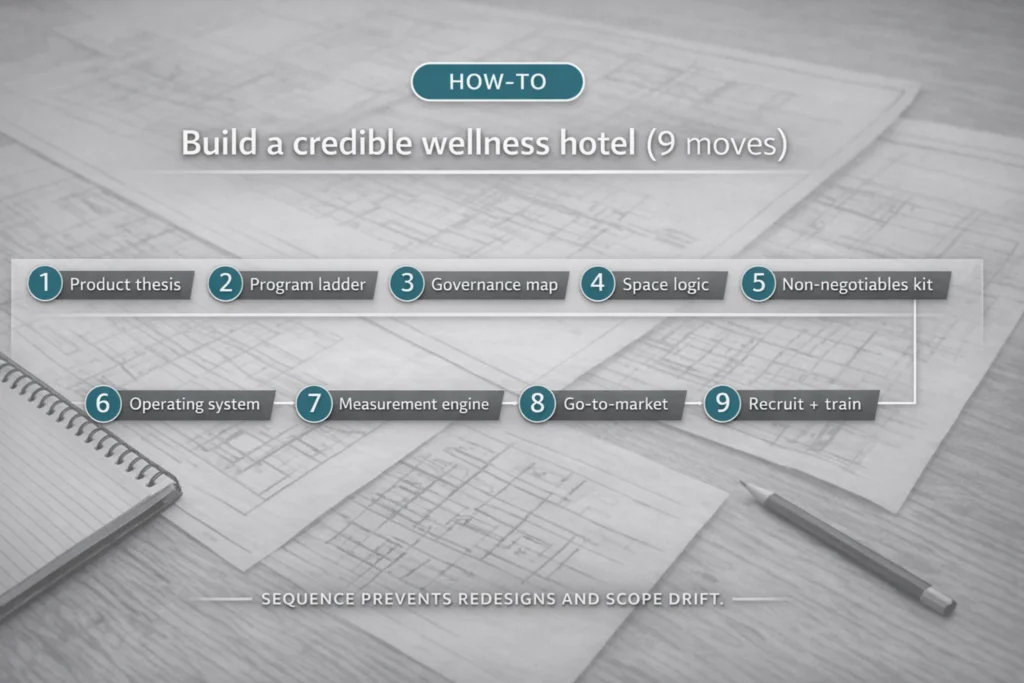
6) Operating system
- SOPs by guest journey
- Quality assurance
- Incident response
7) Measurement engine
- What you measure, how often, who owns it
- Guest-facing reporting that supports premium pricing without medical claims
8) Go-to-market (pricing + packaging + channel strategy)
- Program-led packages (not discounts)
- Partnerships (brands, practitioners, retreat leaders)
- Direct booking logic that protects margin
9) People plan (recruit, train, rehearse)
- Hiring + credential verification
- Training academy approach
- Soft-opening programming calendar + 90-day stabilization plan
Investment logic: where returns come from (and where they don’t)
Wellness assets win when they shift the revenue model from “occupancy dependence” to “attachment dependence.”
What moves NOI:
- Higher total spend per guest (programs + consults + retail)
- Longer average length of stay (structured programs)
- Lower seasonality (wellness demand is less purely holiday-driven)
- Higher direct share (program marketing performs better direct than commodity rooms)
What does not move NOI:
- Adding a bigger spa without program architecture
- Hiring “celebrity” practitioners without training systems
- Copying Western modalities without local differentiation and safety governance
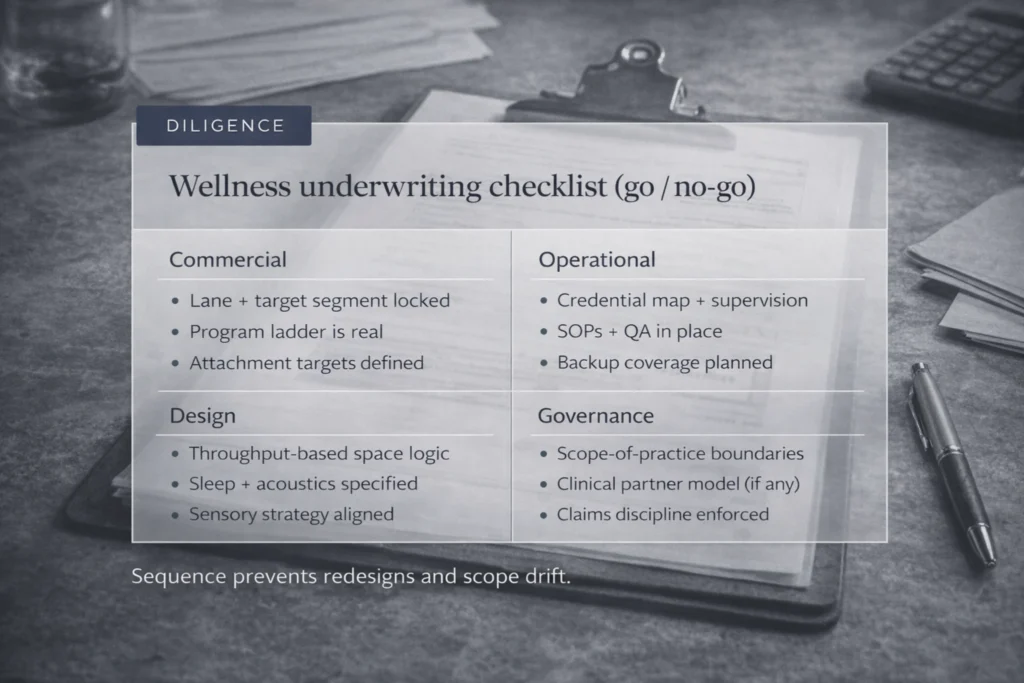
Practical diligence checklist (investor-grade)
Use this as a go/no-go filter in underwriting.
Commercial
- Clear lane + target segment definition
- Program ladder with real weekly rhythm (not brochure copy)
- Attachment targets per guest (by program)
Operational
- Credential map + supervision + backup coverage
- SOP set across guest journey
- Quality assurance + incident response
Design
- Space logic derived from throughput
- Sleep system spec + acoustic plan
- Biophilic and sensory strategy aligned with outcomes
Governance
- Scope-of-practice boundaries
- Partner model for anything clinical
- Claims discipline (marketing language must match capability)
Where Zenith fits
Zenith engineers the complete system behind a credible wellness asset: philosophy, program design, practitioner strategy, facility & equipment logic, measurement, and the operating system that keeps delivery consistent after the founders leave.
If you’re already aligned that “spa + yoga” is not a wellness strategy, you’ll move faster by reading this Zenith baseline: The Wellness Imperative: Why Your Spa Is No Longer Enough
For investors building in Bali specifically, underwriting is shaped by a few adjacent realities:
- Yield and “quality over quantity” destination strategy: Bali Yield Strategy
- Integration beats standalone product shells: The end of the standalone villa: why integrated hospitality is Bali’s future
- Compliance risk is now a real financial line item: Hidden cost of illegal villas in Bali
- Destination pressure and risk framing: Overcrowding in Bali tourism: 6-pillar action plan
FAQ (investors and developers)
1) What is the biggest mistake in wellness hotel development Indonesia?
Most projects build amenities instead of a program system—so they end up with no outcomes, no governance, and no operational engine.
2) Do I need medical licensing to run a wellness resort in Indonesia?
Lifestyle wellness (sleep, movement, nutrition, relaxation) typically does not require medical licensing. If you market medical claims or deliver clinical procedures, you must operate through a properly licensed pathway with an explicit governance model.
3) Why does measurement matter if I’m not a clinic?
Measurement protects your premium pricing story, improves repeat stays, and strengthens partnerships—while keeping you away from medical claims.
4) How do I integrate Indonesian wellness heritage without “tourist theater”?
A professional approach is to treat heritage as a product line: sourcing standards, practitioner training, guest education, and disciplined claims. Where relevant, align communications to recognized traditional remedy classifications. Kemenkes – traditional remedies categories
5) Are there global standards to benchmark an authentic wellness hotel?
Yes. Industry frameworks such as the Wellness Tourism Association Core Wellness Standards for Hotels provide a structured baseline (pillars and practical criteria).
Author
André Priebs is CEO & Co-Founder of Zenith Hospitality Global. Zenith supports owners, developers, and family offices across Indonesia with operator-first hospitality development: Product DNA, concept and space logic, wellness program architecture, governance, pre-opening systems, and commercial performance frameworks. About Zenith
Disclaimer: This article is for investment and hospitality development strategy. It does not provide medical advice and does not replace local legal/licensing guidance.