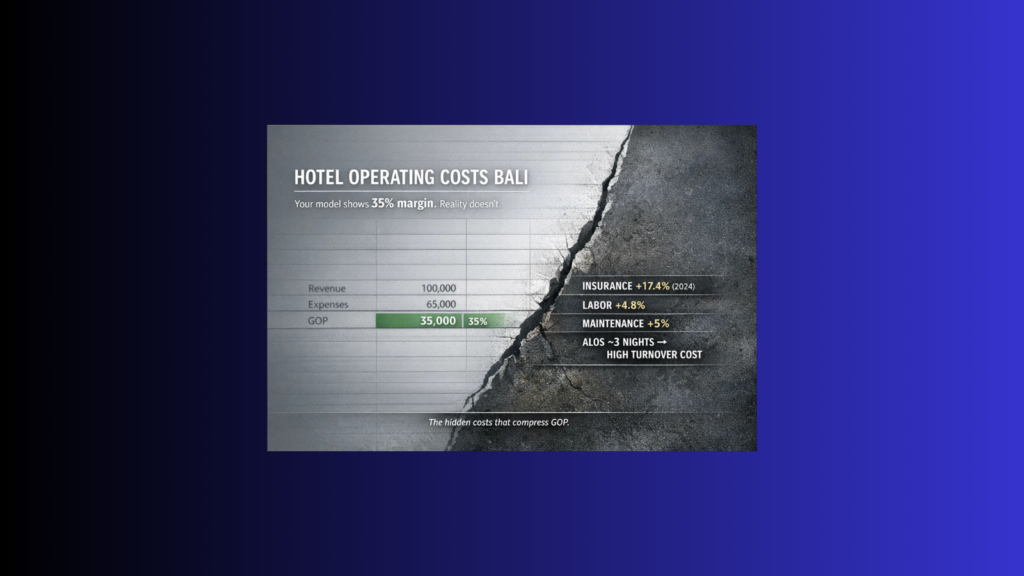

If your current Bali concept still says “4-star resort with pool”, the market is already ahead of you. Niche hotel development Bali is now where the real resilience sits: concepts built specifically for digital nomads, wellness seekers, culture-driven luxury travelers, and—soon—health and recovery guests in Sanur.
Bali has quietly fractured into micro-markets. Generic inventory grinds away at mid-range rates while well-positioned niche villas and resorts quietly post high occupancy and double-digit ROI. Over-supply and moratorium risks in Bali are real; generic assets are paying the price.
If you want an asset that survives the next cycle, you don’t “do a hotel in Bali”. You pick a niche, design for that guest’s life, and build operations around it.
Key Takeaways
- Bali is now a cluster of niches, not one homogenous market. Nomads, wellness guests, luxury seekers and medical travelers behave and spend very differently.
- Niche hotel development Bali consistently outperforms generic stock on occupancy, length of stay and ROI when professionally managed.
- Winning projects start with segment → micro-location → product DNA → design → operating system. Land and renderings come after.
Why niche hotel development Bali beats generic 4-star resorts
Most investors still start with land and architecture. The problem: Bali is already oversupplied with “nice rooms plus pool” in the wrong locations, serving nobody in particular at a discount.
According to the Bali Provincial Statistics Office (BPS) tourism overview for December 2024, star-rated hotels recorded 63.71% occupancy, while non-star hotels sat around 44.15%. On paper, that doesn’t sound terrible—until you compare it with niche villas and small resorts targeting specific segments, where longer stays and premium rates lift both occupancy and ROI.
Analysis of Bali’s digital nomad boom, for example, shows tens of thousands of nomads on the island and a rapidly growing villa segment where long-stay, professionally managed projects can reach strong double-digit returns. A good overview is “Bali’s Booming Digital Nomad Scene and What It Means for Villa Investors in 2025”, which breaks down how mid- to long-stay nomads are reshaping occupancy patterns and ROI.
The punchline: generic hotels are locked into short-stay, rate-competitive dynamics. Niche concepts benefit from:
- Longer average stay
- Higher ADR
- Lower marketing drag (fewer turnarounds, more referrals)
- More resilient demand when one segment softens
Who are Bali’s most valuable guest niches right now?
Bali’s visitor base has split into distinct micro-segments. For investors and developers, four niches matter most:
- Digital nomads & remote professionals – Canggu, Pererenan, parts of Ubud
- Wellness seekers & retreat guests – Ubud, north valleys, east Bali, quieter south coasts
- Culture-driven luxury travelers – Uluwatu cliffs, Ubud river valleys, select jungle/coastal pockets
- Emerging: medical & health tourists – Sanur and the Health SEZ corridor
Each niche has its own economics, behaviors and design logic.
What do digital nomads in Bali actually want?

Short answer:
Digital nomads in Bali want more than “good Wi-Fi and a pool”. They expect private, ergonomic workspaces, reliable 50+ Mbps internet, walkable access to cafés and gyms, programmed community, and healthy food. Projects that integrate co-living, coworking and wellness reliably outperform vanilla villas on occupancy and ADR.
The Leylines article above shows how nomads are now staying 30–90 days, not just a week or two, and how that shift underpins stronger cash flow for professionally managed assets. If you ignore that behavior and design “Instagram rooms” instead of true work-live environments, you lose the segment.
A serious digital nomad hotel or co-living concept in Bali needs:
- Studios / one-bed villas with real workstations (desk, chair, lighting, acoustics)
- A dedicated coworking hub with booths, meeting rooms and call-friendly spaces
- Redundant connectivity and backup power
- On-site or nearby fitness, plunge pool, sauna/ice, yoga deck
- Weekly community programming: founder dinners, skill-shares, mixers
That’s a system, not a decorative lobby table with a “coworking” sign.
What defines a serious wellness retreat guest in Bali?

Short answer:
Wellness travelers come to Bali to repair, not just relax. They are willing to pay premiums for structured programs that combine diagnostics, Balinese healing, movement and conscious cuisine. The most successful retreats treat spa, F&B and programming as one integrated protocol—not three separate departments.
Globally, wellness tourism is now a major force. The Global Wellness Institute’s wellness tourism overview notes that wellness tourism expenditures reached US$894 billion in 2024 and are growing faster than tourism overall. Bali rides that wave with its own blend of yoga, plant-based cuisine, detox retreats, biohacking and traditional healing.
Winning wellness retreats in Bali tend to:
- Offer personalized programs: assessment → daily schedule → integration
- Blend ritual and science – ceremonies, water blessings, herbal treatments + modern diagnostics and recovery tools
- Run F&B as therapy: menus engineered around gut health, inflammation and sleep
- Operate with visible low-impact practices: permaculture, filtered water, minimal plastic, real ESG
Wellness is not a spa menu; it’s an operating system built into architecture, programming and team culture.
How is “luxury” changing for Bali’s high-end traveler?
Affluent travelers are bored with generic marble and champagne. They increasingly prioritize cultural immersion and authenticity over traditional status markers; their strongest memories come from local encounters, not facilities.

In Bali, high-performing luxury properties:
- Use architecture to frame nature and ritual, not show off budget
- Embed local materials, crafts and spiritual logic into every detail
- Run F&B as a story of place, season and producer, not “international all-day dining”
- Curate real access to community—temple ceremonies, farming, crafts—without turning it into a circus
This is where boutique luxury resort Bali strategies merge naturally with niche hotel development Bali: you’re not selling “five stars”; you’re selling a category-defining experience architecture.
Why does Sanur matter for future hotel development?
Sanur is no longer just a calm family beach zone. With the creation of the Sanur Health Special Economic Zone and the new Bali International Hospital, it is evolving into a regional health and medical hub. The official government release on the Sanur SEZ and BIH inauguration frames this as a strategic pillar for Indonesia’s medical and wellness tourism.

For investors, that means demand for:
- Recovery suites and health-adjacent serviced apartments
- Hybrid assets mixing medical, wellness and family comfort
- More defensive cash flow – health travel is less cyclical than pure leisure
If your concept is “standard beach hotel in Sanur”, you’re already behind what the SEZ is building. The smart move is to think in terms of integrated health-hospitality assets with rehab, family facilities and conscious F&B built in.
How do niche villas and hotels in Bali perform versus traditional inventory?
Putting simplified numbers together:
- Star-rated hotels in Bali often sit around the mid-50s to mid-60s percent occupancy range according to BPS tourism reports.
- Non-star hotels are typically down in the low-40s.
- Niche-positioned villas and small resorts can reach higher occupancy and length of stay, especially in digital nomad, wellness, and high-end segments, pushing gross ROI into the 10–15% range when managed properly.
For more context on realistic returns and stress-testing, see The ROI Lie: Deconstructing Hospitality ROI in Southeast Asia.
The pattern is consistent: niche hotel development Bali, when matched to the right micro-market and run professionally, produces better length of stay, stronger ADR and more resilient NOI than generic hotels and villas.
How should an investor choose the right niche for a Bali project?
Here’s the practical 3-step framework you should run before any architectural drawings:
Step 1 – Map the micro-market, not “Bali”
Treat Canggu/Pererenan, Ubud, Uluwatu, Sanur and emerging corridors like Lombok as different countries. Patterns that are true in one zone will destroy you in another.
- Map existing stock: oversupplied vs under-developed concepts.
- Understand local demand drivers: nomads, retreats, weddings, families, medical.
- Study regulation and moratorium status (see our overcrowding and moratorium analysis).
For a parallel view of strategic destination planning, look at our Mandalika tourism growth strategy.

Step 2 – Match location DNA to segment DNA
- Canggu / Pererenan → digital nomads, founders, creative professionals
- Ubud & north valleys → wellness, spiritual journeys, conscious luxury
- Uluwatu / cliffs → design-driven privacy + performance/wellness hybrids
- Sanur → families + health / recovery-driven guests
If the land, access and neighbors don’t support your segment’s daily life (commute, noise, vibe), your concept is wrong, no matter how beautiful the renderings.
Step 3 – Stress-test ROI, operations and regulation
- Can your concept realistically reach the LOS and ADR in your spreadsheet?
- Does your legal structure (PT PMA, business codes, licensing, potential SEZ rules) support what you actually plan to operate?
- Do you have the operating engine (product DNA, SOPs, tech, management) to deliver the promise?
This is where a defensible asset is separated from a pretty shell. If you want to go deeper, read Hotel Product DNA: The Code Behind a Defensible Hotel.
Common mistakes investors make with niche hotel development Bali
- Marketing niche, operating generic
Calling something a “digital nomad resort” while offering weak Wi-Fi, no acoustic privacy and no community design. - Overbuilding facilities, underbuilding product DNA
Giant gyms, rooftop pools, three F&B outlets—without a clear segment or program to fill them. - Ignoring regulation and moratorium logic
Buying in saturated, restricted areas and assuming approvals will “work themselves out” later. - Underestimating service culture and training
You can’t sell “wellness” or “founder community” with generic training and a broken internal culture. - Treating villas as passive investments
Handing keys to a low-discipline operator and expecting top-quartile performance from bottom-quartile operations.
When should you bring in a concept & operations partner like Zenith?
If you already bought land and your architect is drawing without a clear niche, you’re late—but not too late.
A partner like Zenith should ideally enter:
- Before you finalise land (scenario screening by micro-market and niche).
- Before architectural design (space programming from product DNA, not Pinterest).
- Before you assume any ROI (we model realistic LOS, ADR, staffing, and legal structure).
Our typical scope for niche hotel development Bali includes:
- Segment selection and demand mapping
- Concept and product DNA: room/villa typologies, facility mix, F&B, wellness, community
- Financial modelling and ROI stress-testing
- Pre-opening roadmap and operating system (SOPs, recruitment, culture)
FAQ: Niche Hotel Development in Bali
Q1. Is niche hotel development in Bali really less risky than a generic resort?
In many cases, yes—but only when the niche is chosen based on hard data, not fashion. Digital nomad, wellness, cultural-luxury and health-driven concepts in the right locations show higher length of stay, more resilient occupancy and stronger pricing power than generic resorts. The real risk is choosing the wrong niche for the wrong land and executing it poorly.
Q2. What kind of ROI can I expect from a niche Bali villa or small resort?
For well-positioned assets with professional management, a 10–15% gross ROI is realistic in prime sub-markets, especially when targeting long-stay segments like nomads or structured wellness programs. Generic villas often sit below that due to shorter stays, rate competition and weak operations. Final returns depend on land cost, build quality, concept strength and operator discipline.
Q3. Do I need different licenses for a wellness retreat or medical-adjacent project?
Yes. Wellness retreats, clinics and health-adjacent accommodation can fall under different regulatory regimes than standard hotels, especially inside zones like the Sanur Health SEZ. You need early legal structuring around PT PMA, business codes, building permits and health standards before committing to architecture.
Q4. How early should I involve an operator or consultant in my Bali project?
Ideally before you finalize land or architectural plans. The most expensive mistakes come from concepts and layouts that ignore real segment behavior and operational realities. A seasoned consultant/operator helps define segment, product DNA, space programming and financial structure before you pour concrete.
Q5. Can an existing generic hotel be repositioned into a niche concept?
Often yes, but you need brutal honesty about what can and cannot be changed. Structure, circulation and location may cap certain options. You might successfully reposition to nomad co-living or wellness-lite, but not to ultra-luxury. A proper repositioning plan combines market data, architectural constraints, capex planning and a completely new operating model.
Summary Takeaways
- Bali is no longer one market. It’s a mosaic of niches with different economics and expectations.
- Niche hotel development Bali outperforms generic stock when matched to the right micro-market and managed properly.
- The order of decisions matters: segment → micro-location → product DNA → design → operating system.
- Regulatory, legal and community alignment are as critical as renderings and Instagram aesthetics.
- Bringing in a concept and operations partner early converts “vision + land” into a defensible, high-performance asset rather than an expensive experiment.
Call to Action
If you’re sitting on land or an early concept and you’re not sure which niche you should own, this is the moment to fix it—not after construction.
Zenith Hospitality Global works with investors and developers across Indonesia to turn vision, land and capital into niche-driven, operationally credible hospitality assets—from feasibility and product DNA through pre-opening and long-term management.
If you’d like to pressure-test a concept or explore scenarios for a specific site, reach out to discuss a feasibility and concept workshop or our broader hospitality consulting and feasibility services.
About the Author
André Priebs is the CEO and Co-Founder of Zenith Hospitality Global, a Bali-based consulting and management firm helping investors and developers create high-performance hospitality, wellness and longevity destinations across Indonesia. With more than 30 years in luxury hotels and resorts, André specializes in product DNA, operational architecture and ROI-driven asset management.
Connect with André on LinkedIn and learn more about André and Zenith on the About Zenith Hospitality Global page.