Indonesia is sitting on a rare convergence: rising global demand for healthspan-focused travel, strong existing wellness culture, and improving medical tourism infrastructure. Longevity tourism development Indonesia is not “a hotel with a spa.” It’s a medically governed, outcomes-tracked hospitality product designed for wealthy guests who want measurable improvements—delivered through luxury, privacy, and compliance.
TL;DR (Key Takeaways)
- Longevity tourism is medical + lifestyle protocols + luxury hospitality, with measurable outcomes.
- Indonesia’s strongest near-term wedge is Bali + Sanur Health & Tourism SEZ and premium long-stay formats.
- Winners will be those who build clinical governance + partner model + data/privacy discipline, not just marketing.
- The investable formats are 2–4 week programs, repeat cycles, and hybrid resort + day-clinic revenue.
What is longevity tourism (and why it’s not “wellness tourism”)?
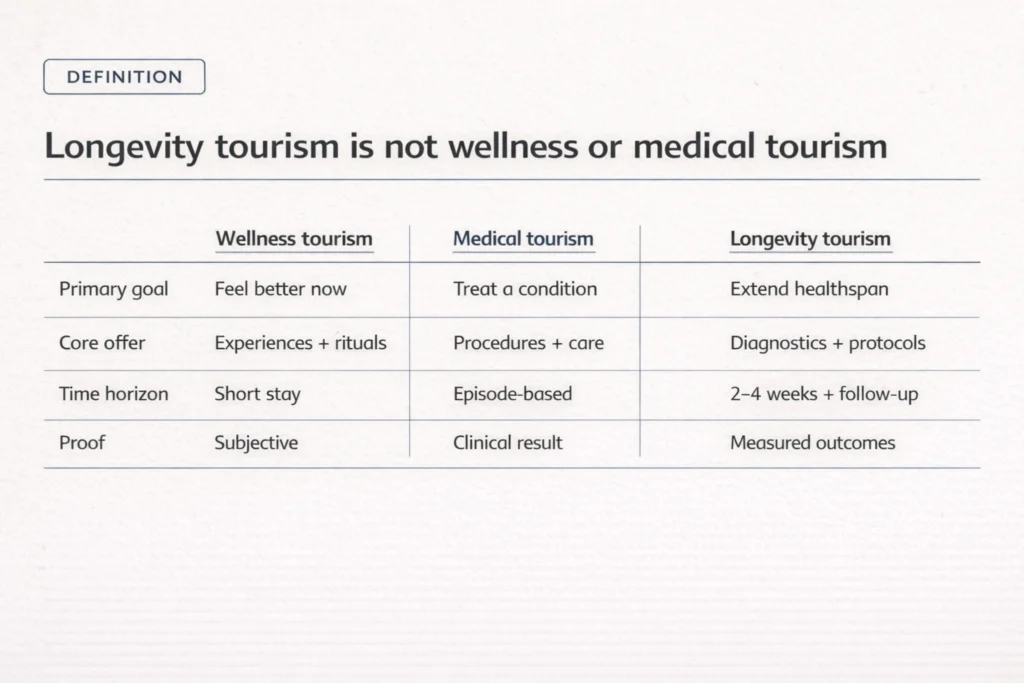
Longevity tourism sits between wellness tourism (experience-led) and medical tourism (treatment-led). It combines:
- Advanced diagnostics (baseline labs, biomarkers, body composition, risk screening)
- Medical supervision (scope-of-practice clarity, informed consent, referral pathways)
- Evidence-based protocols (nutrition, training, sleep, stress, recovery)
- Measurement & tracking (pre/post outcomes, dashboards, follow-up coaching)
- Luxury hospitality delivery (environment + service standards that make compliance easy)
Therefore, this distinction matters commercially: longevity guests pay for precision + credibility + outcomes, rather than ambiance alone.
External references (authority):
- Global wellness tourism scale context: Global Wellness Institute (GWI)
- Ageing tailwinds: World Health Organization – Ageing and health
Why investors are paying attention now
Three demand forces are compounding:
- Wealthy aging populations want longer, healthier years (healthspan) — and will pay for it.
- The luxury market is shifting from “spa weekends” to programmed, data-led health travel.
- The buyer expects structure: diagnostics → plan → execution → tracking → repeat.
The result: longevity tourism is becoming a premium subcategory inside the broader wellness economy.
Why Indonesia can win this category
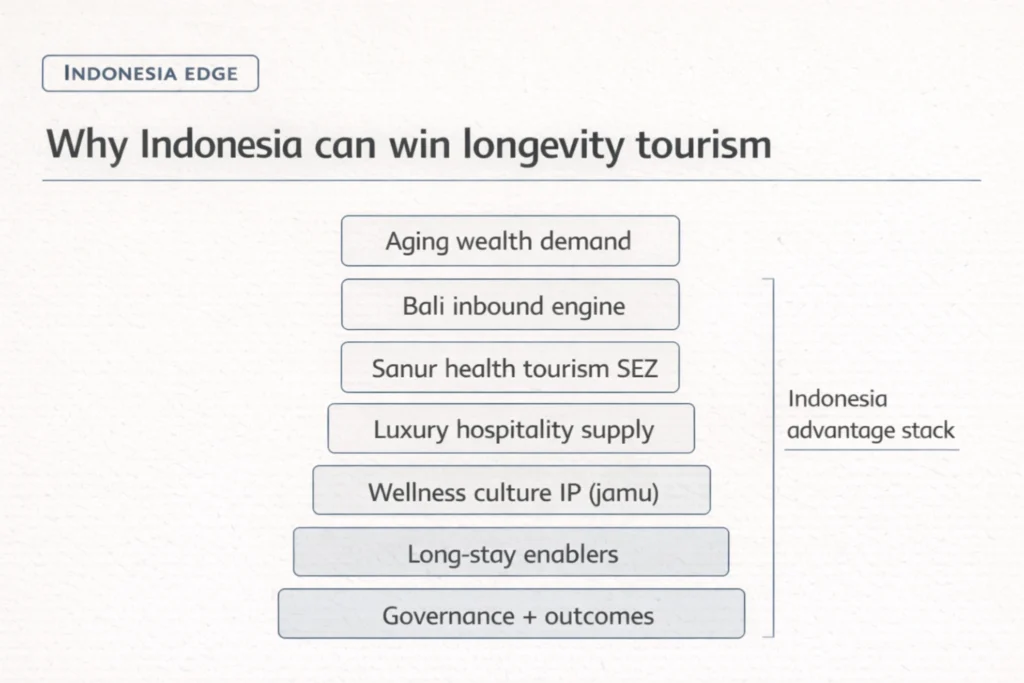
In practice, Indonesia’s advantage is not one single factor—instead, it’s the stack.
1) Bali already has the global top-of-funnel
Bali is one of the few destinations in the region where you already have:
- consistent international arrivals,
- established luxury supply chains,
- deep wellness ecosystem,
- long-stay demand (remote work + seasonal living),
- and investor-grade hospitality talent pools.
External reference (official): Bali visitor statistics: BPS Bali
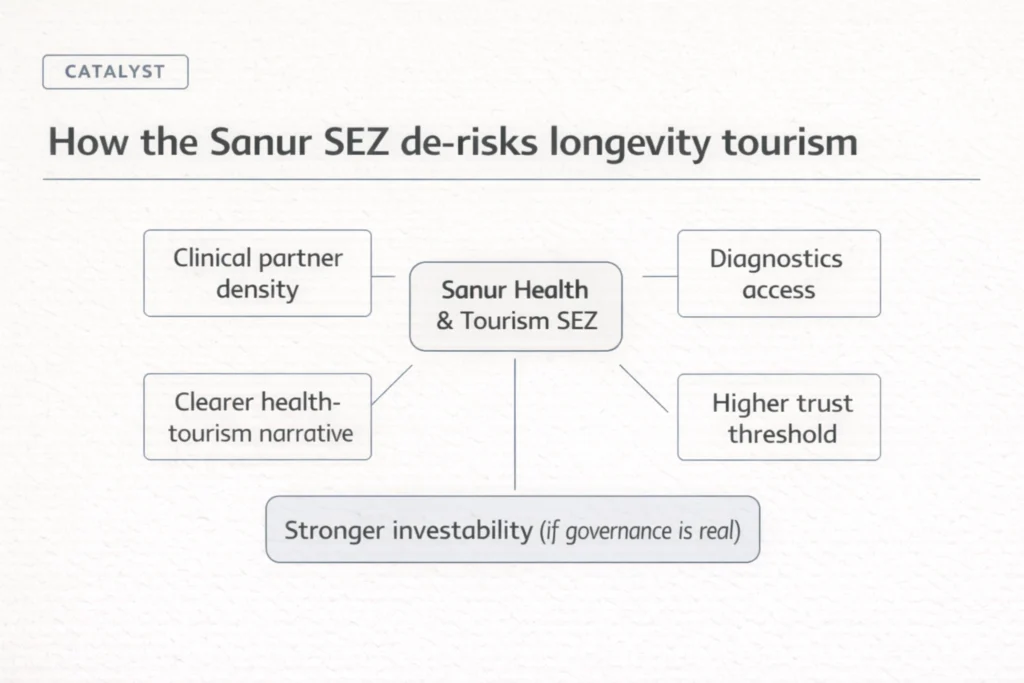
2) A structural catalyst exists: Sanur Health & Tourism SEZ
Moreover, the Sanur health tourism Special Economic Zone is a major signal: Indonesia is not only allowing health tourism—it is also designing infrastructure for it.
External references (official):
- KEK Sanur regulatory base: JDIH – PP 41/2022 (Sanur SEZ)
- Immigration enabler for long-stay demographics: Indonesia eVisa (Second Home)
3) Cultural wellness IP creates differentiation (when used responsibly)
Additionally, Indonesia’s wellness traditions (e.g., jamu culture) can become a place-based moat—rituals, nutrition, retail, and storytelling—provided that clinical claims remain evidence-based.
External reference: UNESCO on jamu culture: UNESCO ICH listing
Longevity tourism development Indonesia: the investable operating models
Model A — Resort + Medical Partner (recommended for speed + risk control)
- Hospitality operator runs the resort and program logistics
- Licensed medical partner runs diagnostics and physician oversight
- Clear scope boundaries, shared protocols, shared QA
Best for: Investors who want credibility without building a full hospital-grade clinical entity.
Model B — Medical-wellness campus (higher capex, stronger moat)
- On-site clinic infrastructure integrated into the resort
- Heavier licensing, deeper governance, larger compliance perimeter
Best for: SEZ-aligned projects with strong capital base and long-term brand intent.
Model C — Resort + “Day Clinic” hybrid (revenue stabilizer)
- Targets both international guests and local HNW/expat residents
- Drives weekday utilization and builds repeat cycles
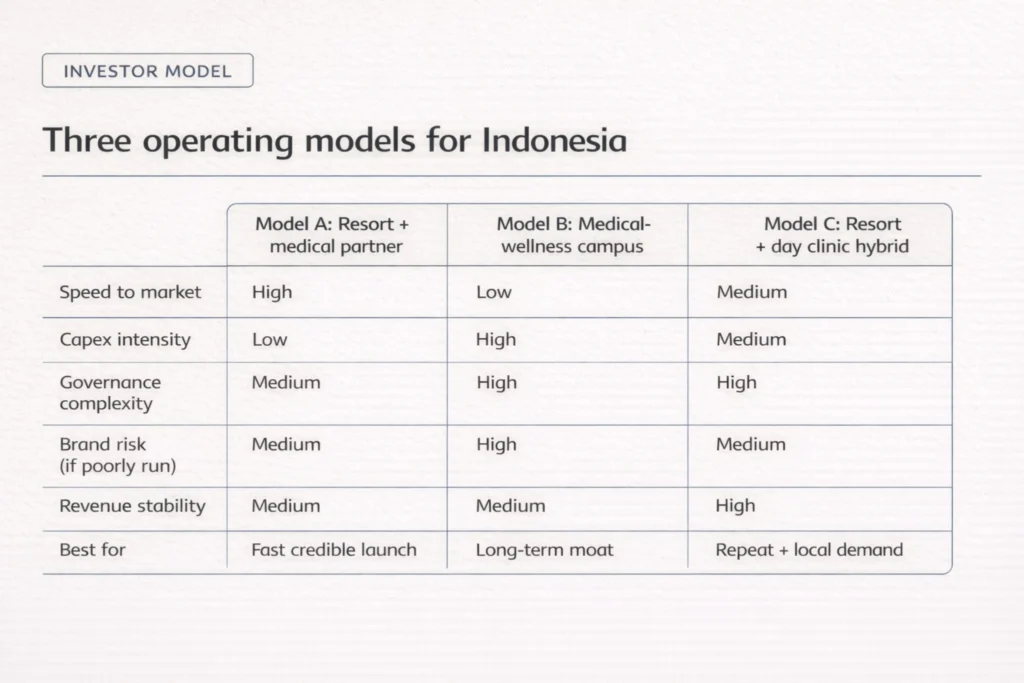
Best for: Bali nodes with strong resident HNW density and repeat visitation.
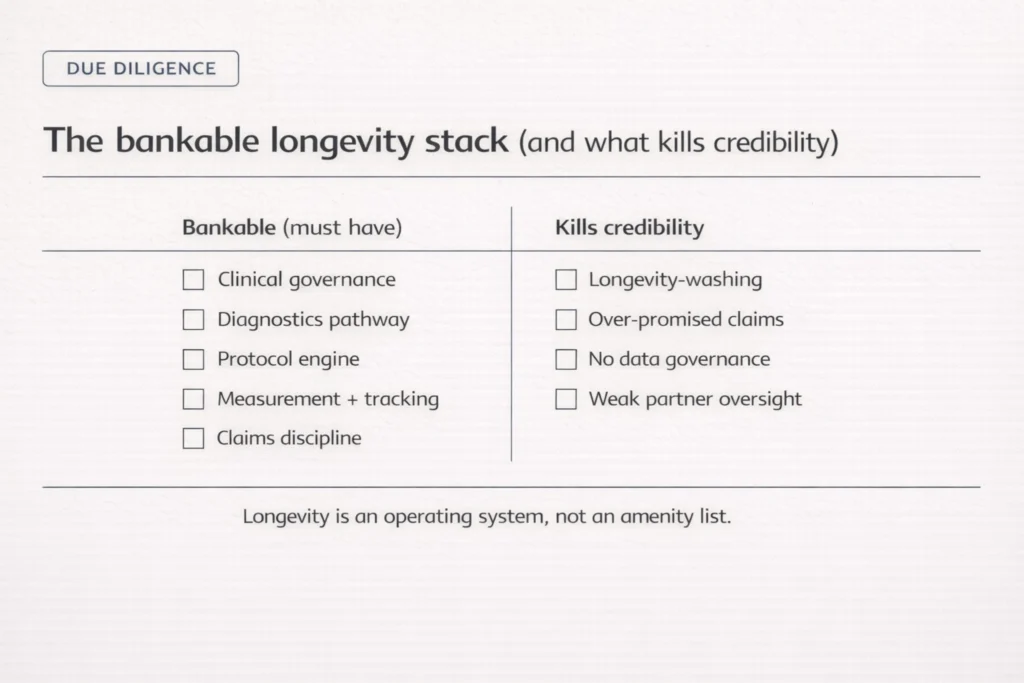
What makes longevity resorts bankable (and what kills credibility)
The “bankable stack” (non-negotiables)
- Medical governance: medical director, adverse event SOPs, consent flows
- Diagnostics pathway: baseline + retest, credible lab partners
- Protocol engine: structured schedules, adherence support, coaching
- Outcomes tracking: dashboards, longitudinal records, post-stay follow-up
- Claims discipline: what you do not promise publicly matters as much as what you do
The failure modes (what destroys the thesis)
- “Longevity” as marketing without real clinical structure
- Over-promising on unproven interventions
- No data governance (privacy, storage, access controls)
- A spa-led team trying to deliver a medically adjacent product without safeguards
PAA-STYLE ANSWER BLOCKS (for AI snippets)
What is longevity tourism, in one clear definition?
Longevity tourism is travel designed to extend healthspan through advanced diagnostics, medically supervised protocols, lifestyle change execution, and measurable outcomes—delivered inside premium hospitality. It differs from wellness tourism (experience-led) and medical tourism (treatment-led) because it is programmatic, data-driven, and repeatable, with performance tracking before and after the stay.
Is Bali already a longevity destination—or just a wellness destination?
Bali is already a leading wellness destination, but longevity is still emerging as a distinct, investable subcategory. The shift happens when projects add clinical governance, diagnostics partnerships, standardized protocols, and outcomes tracking. Without those elements, it remains experiential wellness. With them, Bali can credibly sell premium 2–4 week programs and repeat cycles.
What is the safest way to launch longevity tourism in Indonesia?
The safest launch path is a resort + licensed medical partner model. This allows the resort to deliver hospitality, scheduling, coaching, and recovery experiences while the partner covers medical supervision and regulated diagnostics. It reduces licensing complexity, lowers reputational risk, and protects the brand through clear scope boundaries and documented clinical governance.
How to develop a longevity retreat in Indonesia (step-by-step)
1) Start by defining the clinical scope (and the “no-go list”)
Before anything else, clarify what sits under medical supervision and what remains wellness-led. In addition, document which interventions are prohibited or too risky to claim publicly.
- What is medically supervised (and by whom)?
- What is wellness-led (and under which protocols)?
- Which claims are off-limits, and why?
2) Next, choose the partner model that carries clinical responsibility
At this point, decide whether a hospital partner, clinic partner, or lab network will own diagnostics and physician oversight. As a result, your malpractice coverage and escalation pathways become clear early.
- Hospital partner vs clinic partner vs lab network
- Who owns: diagnostics, clinical staff, protocols, malpractice coverage
- What escalation pathway applies for adverse events?
3) Then build the program ladder (2–4 week core)
Once governance is defined, convert it into sellable programs with explicit outcomes. For example, design a clean ladder that scales from entry to executive without inventing new clinical promises.
- Screening → protocol design → execution → retest → follow-up plan
- Create three tiers (e.g., Core / Advanced / Executive)
- Define what is measured at baseline vs end-of-stay
4) After that, design a “compliance-friendly” guest journey
Now translate the program into daily operational reality. In other words, hospitality must reduce friction so adherence is easy.
- Rooms, F&B, movement, recovery, and scheduling engineered for adherence
- Hospitality becomes the delivery vehicle for consistency
- Service flow must support privacy, timing, and fatigue control
5) Simultaneously, install measurement + tracking from day one
To protect credibility, measurement cannot be an afterthought. Instead, build your outcome dashboard and retesting logic into the operating model.
- Outcome metrics and dashboards (pre / post)
- Retention logic: annual retest + remote coaching subscription
- Data capture rules and auditability (who records what, when)
6) Finally, lock governance + risk controls
At the finish line, formalize the controls that prevent “longevity-washing.” Consequently, your claims, consent, and incident response become board-level disciplines.
- Consent flows, incident escalation, claims guardrails
- Data protection and access controls aligned with Indonesia PDP expectations
- Partner QA cadence: case reviews, protocol updates, and compliance checks
7) With the system defined, underwrite the commercial model
Only now should you finalize pricing and capacity economics. This sequence avoids design-led assumptions that later collapse under clinical reality.
- Package pricing + length-of-stay mix
- Occupancy ramp and seasonality stress test
- Add-on revenue: diagnostics tiers, outpatient day services, retail
Zenith POV: why most developers get this wrong
Most projects start with design and “wellness amenities.” Longevity requires the reverse order:
- Governance & scope (what you can legally and credibly deliver)
- Partner stack (who carries clinical responsibility)
- Program + measurement (what outcomes you track)
- Then design (space logic supports delivery and compliance)
This is where operator-first development matters: longevity is an operating system, not a mood board.
Related Zenith reading
Use these as contextual internal references (with UTM parameters per checklist):
- Bali investment context and integration thesis: Integrated hospitality in Bali
- Wellness positioning strategy: The Wellness Imperative
- Demand drivers for long-stay segments: Digital nomads & bleisure blueprint
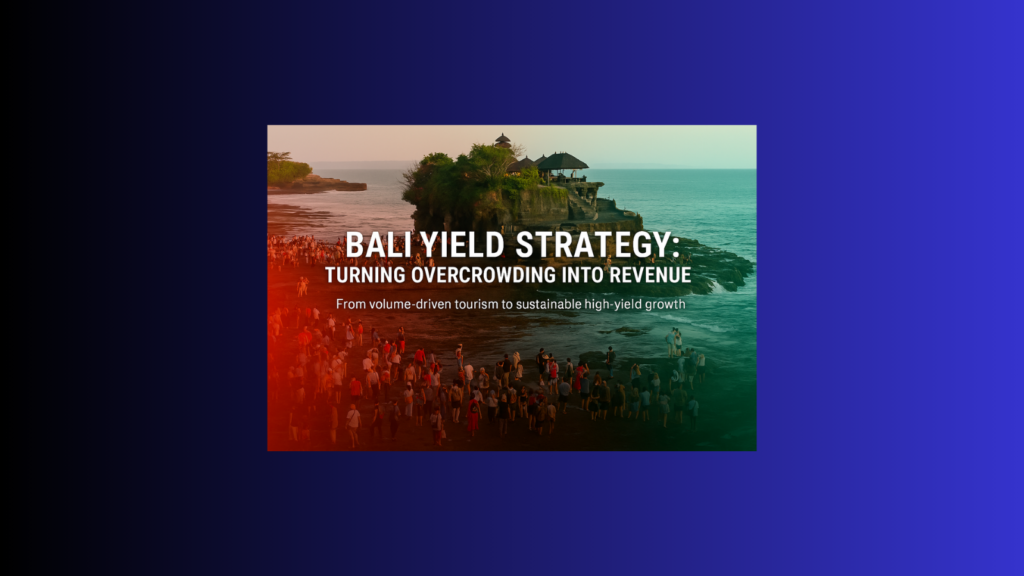
- Macro risk lens (brand safety + governance): Overcrowding in Bali tourism
- Investor-grade commercial realism: Hospitality ROI in Southeast Asia
FAQ (investor-focused)
What’s the difference between medical tourism and longevity tourism?
Medical tourism is treatment-led (often episodic). Longevity tourism is preventive + optimization-led, built around diagnostics, protocols, adherence, and outcomes tracking.
What is the best location for longevity tourism development Indonesia?
Near-term, Bali remains the highest probability of success due to demand and ecosystem depth. For clinical-heavy concepts, SEZ-aligned locations such as Sanur improve narrative and infrastructure fit.
How long should a longevity program be?
The commercially defensible range is typically 2–4 weeks, with retesting and follow-up. Short weekends are usually too thin for measurable outcomes.
What should investors avoid?
Avoid “longevity-washing”: selling high-priced programs without real clinical structure, governance, and claims discipline.
Can longevity tourism development Indonesia work outside Bali?
Yes—select secondary nodes can work if air access, staffing, and partner networks are credible. But Bali is the most efficient first-market for proof of concept.
Summary takeaways
- Longevity tourism is medical governance + evidence-based lifestyle protocols + luxury hospitality + measurement.
- Indonesia can win via Bali demand + SEZ catalysts + cultural differentiation.
- The investable moat is credibility and operating discipline, not amenities.
- The fastest credible launch path is usually resort + licensed medical partner.
- Longevity tourism development Indonesia is real—but only for teams that treat it as an operating system.
Call to action
If you are underwriting a longevity retreat, a health optimization resort, or a medical-wellness campus in Indonesia, Zenith can support from concept to investability: partner model design, program ladder, governance, space logic, and commercial underwriting—built to stand up to investor scrutiny.
Author
André Priebs
CEO & Co-Founder, Zenith Hospitality Global
Operator-first hospitality consultancy and operating partner for luxury boutique hotels, lifestyle retreats, and wellness/longevity assets in Indonesia.