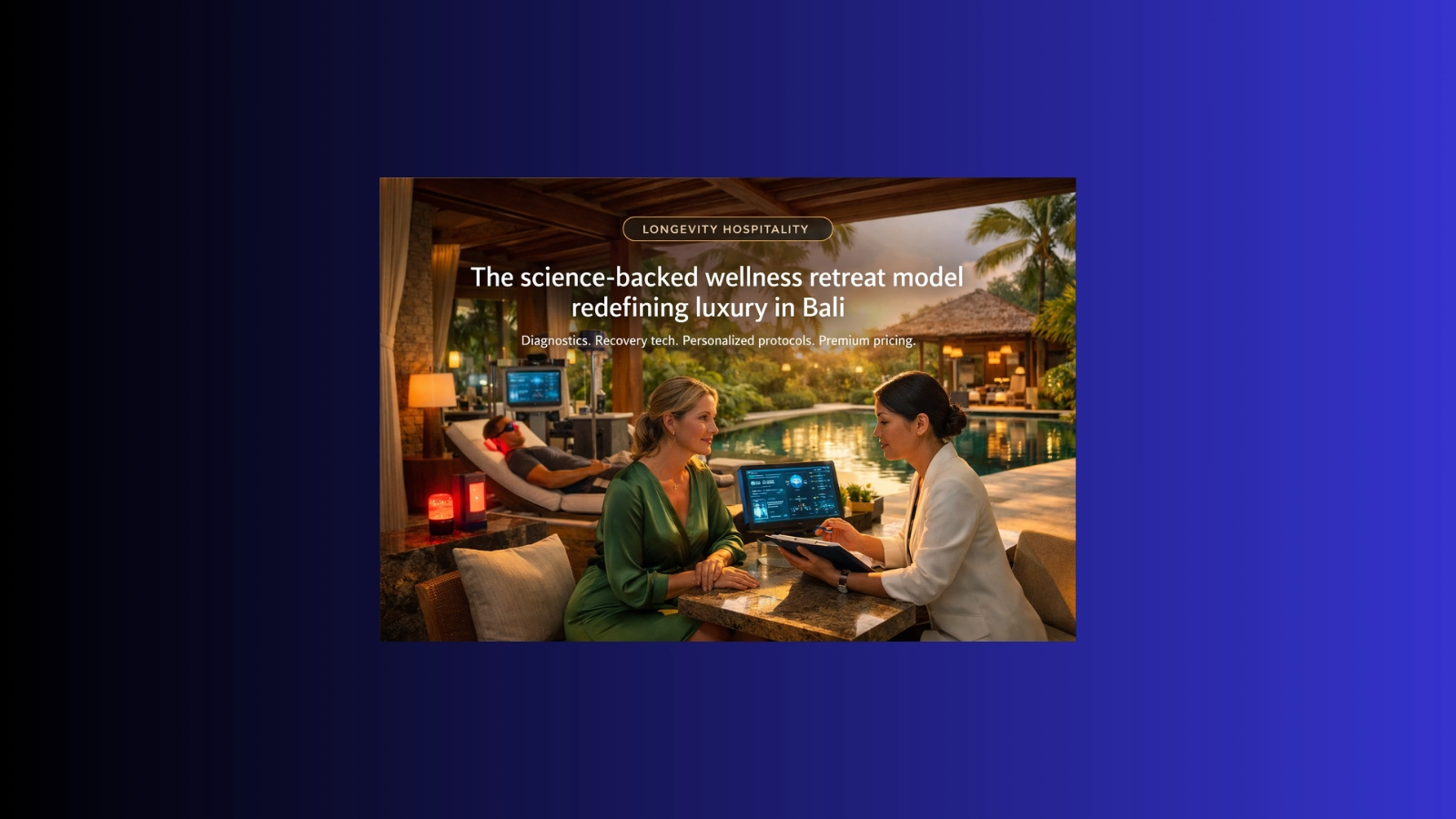
Longevity biohacking retreat development Bali is moving from niche concept to serious hospitality investment category. The model combines medical diagnostics, advanced recovery technology, personalized protocols, and luxury hospitality into one high-yield product. It is not a better spa. It is a structured health-optimization business wrapped in premium hospitality.
That distinction matters because the revenue logic is different. Guests are no longer paying only for a room, a massage, or a wellness mood. They are paying for measurement, expert interpretation, guided intervention, and a more credible promise of results. That is why well-designed longevity retreats can command rates that would look aggressive in a conventional resort context.
The market backdrop supports the shift. Grand View Research’s biohacking market analysis projects strong long-term growth in the category, while the Global Wellness Institute’s wellness economy reporting continues to show that wellness travelers spend materially more than average tourists. For Bali, this creates a clear opportunity: convert destination wellness demand into a science-backed, high-ticket retreat model with stronger pricing power and deeper guest spend.
The truth bomb is simple. Most projects in this category do not fail because demand is missing. They fail because the concept is designed backwards. Developers buy technology before defining the medical boundary, the governance structure, the staffing model, and the guest journey. In longevity hospitality, the real asset is not the machine. The real asset is the operating system behind it.
For readers already following Zenith’s work in wellness, this article sits naturally alongside our thinking on Bali wellness investment strategy, the future of wellness tourism in Bali, and why licensing mistakes still destroy otherwise good hospitality concepts.
TL;DR / Key Takeaways
- Longevity biohacking retreat development Bali is becoming a distinct hospitality and wellness asset class, not a spa add-on.
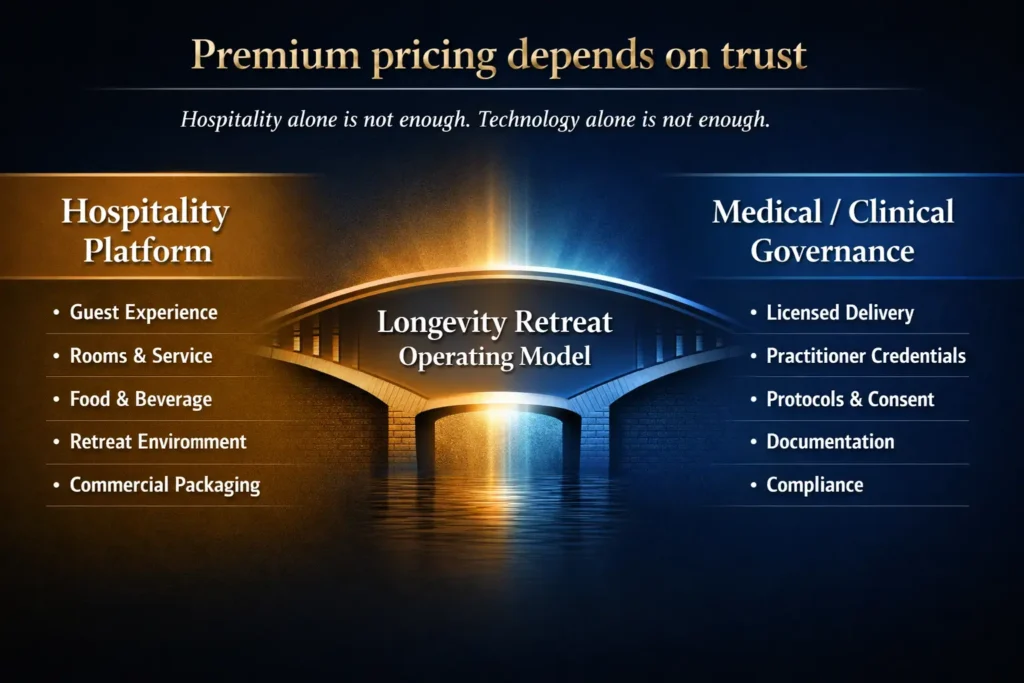
- Premium pricing works only when diagnostics, medical governance, and luxury delivery are integrated into one coherent model.
- Bali has strong destination advantages, but weak licensing, poor scope control, and gadget-led planning will destroy credibility quickly.
- The winning concept is a health-optimization platform with a hospitality wrapper, not a resort with more equipment.
- Investors should underwrite this category as a hybrid model with room revenue, diagnostics, therapies, and continuity revenue.
Why is longevity hospitality becoming an investable category?
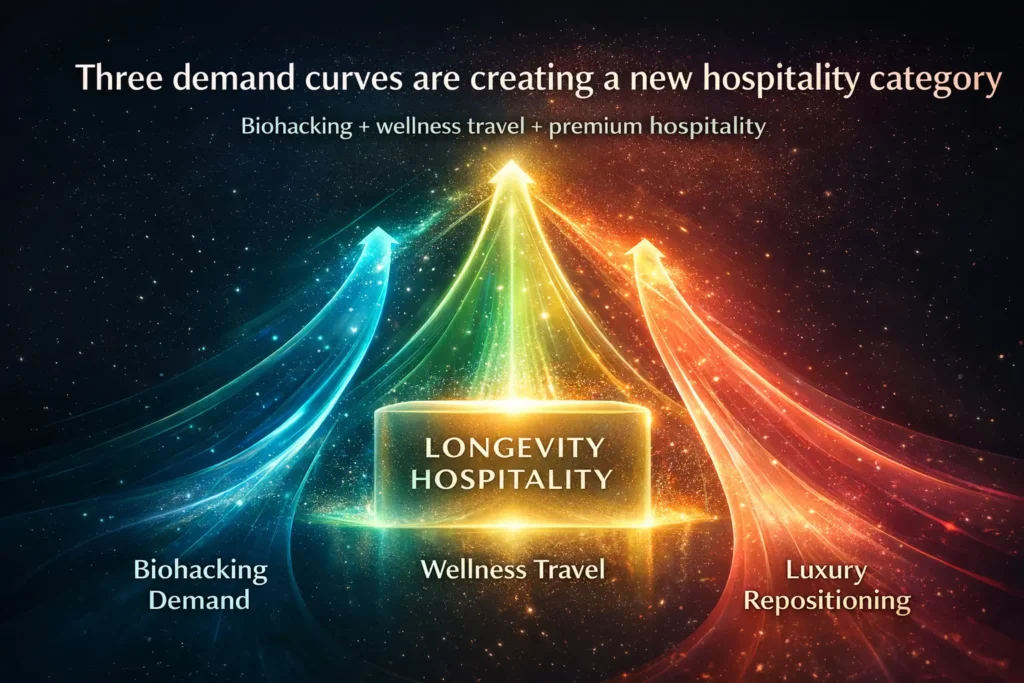
A direct answer: the category now sits at the intersection of two established demand curves. One is the growth of wellness travel. The other is the rise of consumer willingness to pay for diagnostics, recovery technologies, and personalized health optimization. When those two curves meet inside a premium resort environment, pricing power expands.
That is the commercial logic behind longevity biohacking retreat development Bali. Traditional luxury hospitality monetizes stay, dining, and perhaps spa. Longevity hospitality adds higher-value consult time, testing, protocol-based treatments, and post-stay continuity. That is a materially better revenue stack.
Global proof points already exist. High-end operators are showing that affluent guests will pay for a structured health journey if the program feels clinically serious, professionally supervised, and operationally smooth. This is not theory anymore. It is an emerging premium segment with real price elasticity.
What makes a longevity retreat different from a luxury spa?
A direct answer: a longevity retreat starts with assessment and ends with a protocol. A luxury spa starts with treatments and ends with relaxation. That difference changes everything.
In a spa model, the guest buys comfort, mood, and sensory recovery. In a longevity model, the guest buys structure: baseline diagnostics, expert review, targeted interventions, and a personalized plan. The guest expects a higher level of evidence, more credible practitioners, and more disciplined programming.
That is why longevity biohacking retreat development Bali should never be positioned as “spa plus gadgets.” Once a concept promises optimization, resilience, recovery metrics, metabolic clarity, sleep improvement, or longevity support, the operator enters a different trust category. The commercial upside is higher, but so is the execution burden.
What does the winning program stack actually include?
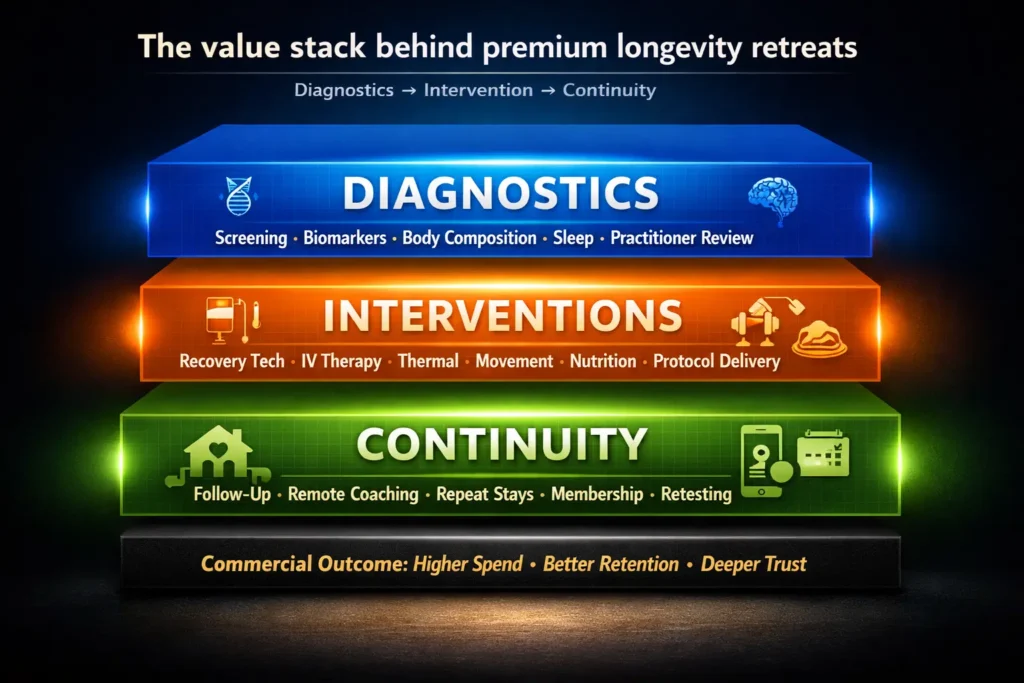
A direct answer: the strongest model combines diagnostics, interventions, and continuity. Remove one layer, and the concept becomes either generic wellness or badly governed medical theater.
1. Diagnostics
Diagnostics are the anchor of credibility. This can include blood markers, body composition, metabolic inputs, sleep-related screening, health history, performance baselining, and practitioner interpretation. The guest must feel that the program is built around them, not around a pre-packaged menu.
This is where the pricing story begins. When the guest sees that the retreat is not generic, the higher spend becomes easier to defend.
2. Interventions
Interventions are the visible layer: recovery therapies, light-based systems, compression, breathwork, movement, thermal exposure, IV support where legally structured, nutrition, and guided recovery protocols. The exact stack will vary, but the principle stays the same: each intervention must connect back to a defined goal.
In strong longevity biohacking retreat development Bali concepts, the therapies are not random. They are sequenced.
3. Continuity
Continuity is often underbuilt, and that is a commercial mistake. The best retreats do not end at checkout. They convert the guest into a longer-term client through follow-up, remote guidance, repeat testing, protocol refreshes, memberships, or future-stay planning.
Without continuity, the retreat remains a high-ticket one-off. With continuity, it becomes a higher-lifetime-value wellness business.
What are the clearest market signals today?
A direct answer: the market is already validating both the consumer demand and the positioning logic.
Canyon Ranch remains one of the clearest global examples. Its high-ticket longevity programming shows that guests will pay ultra-premium rates when diagnostics, expert consultations, and personalized intervention are bundled into one premium retreat experience.
In Bali, the most relevant live signal is Cocoon Medical Spa’s retreat model within REVĪVŌ Wellness Resort. Cocoon publicly positions medical wellness retreats around advanced diagnostics, tailored wellness planning, and biohacking-oriented therapies. That does not mean every operator should copy the model. It means Bali already has a visible in-market case proving that the category is operationally possible.
For investors, this matters. It reduces the argument that the category is too early for Indonesia. It also raises the bar. Once the market has a visible benchmark, weak concepts become easier to spot.
Why is Bali structurally strong for longevity retreat development?
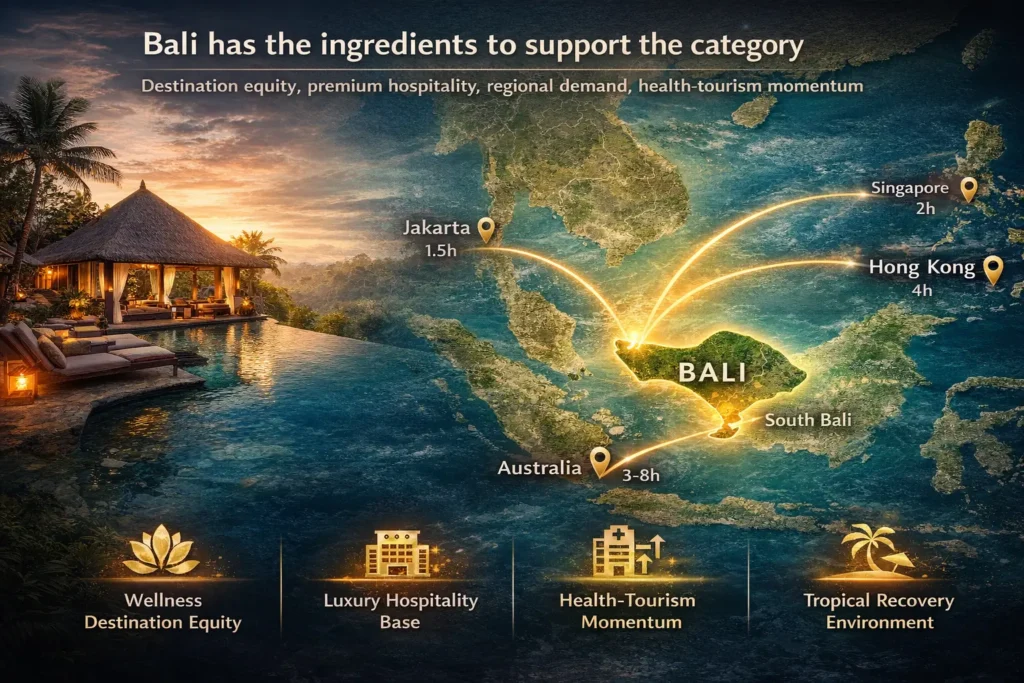
A direct answer: Bali combines destination wellness equity, luxury hospitality capability, and improving health-tourism infrastructure in one market.
The destination already has strong global recognition in wellness. Ubud, Nusa Dua, and selected South Bali zones are associated with recovery, nature, yoga, retreat culture, and premium stays. That gives longevity biohacking retreat development Bali a softer customer acquisition runway than less-established markets.
The policy direction is also supportive. The Indonesian government has openly positioned Bali as part of a broader health and wellness tourism push. Recent state-level signals around Sanur’s medical-tourism ecosystem and Bali’s wellness infrastructure make the destination more credible for hybrid medical-hospitality concepts. Two relevant public references are the Ministry of Health’s update on NgoerahSun Wellness & Aesthetic Center and the official announcement on KEK Sanur and Bali International Hospital.
That does not remove project-level risk. It simply means the macro narrative is now more supportive than before.
What is the biggest mistake in longevity biohacking retreat development Bali?
A direct answer: defining the technology stack before defining the legal and clinical boundary.
This is the most common strategic error. Developers get excited by the visual layer of the concept: cryotherapy chambers, red light systems, HBOT, IV lounges, recovery pods, and high-design treatment suites. But if the project team has not yet decided what is medical, what is wellness, what is aesthetic, and who is licensed to deliver each component, the concept is already unstable.
In longevity biohacking retreat development Bali, technology should be the output of the operating model, not the starting point. First define scope. Second define governance. Third define staffing. Then define flow. Only then should equipment selection begin.
That is where Zenith’s operator-first angle matters. Good concepts are not built from mood boards. They are built from guest journey logic, risk management, staffing reality, and commercial sequencing.
How does Indonesian regulation shape the operating model?
A direct answer: once medical acts enter the guest journey, the operator is no longer designing a normal spa or wellness department. The project becomes a governed health-service interface.
Indonesia’s health framework is not a small detail here. Medical professionals require lawful practice permissions, and delivery of regulated acts must sit inside the correct legal and operational structure. The Ministry of Health guidance on STR and SIP and the broader implementation framework under UU No. 17 Tahun 2023 make the direction clear: compliance, practitioner licensing, and lawful place-of-practice logic cannot be improvised.
Practically, that means IV therapy, injections, clinical diagnostics, physician review, and other regulated health acts should not be treated as hospitality add-ons. In many cases, the safest structure is a hospitality concept paired with a licensed medical partner or tightly governed medical delivery model.
This is also why our Bali licensing analysis for foreign investors remains relevant. The concept may feel modern, but Indonesia still rewards disciplined structuring and punishes shortcuts.
What should investors actually underwrite?
A direct answer: not just ADR, and not just spa revenue. The correct lens is a hybrid hospitality-health utility model.
The basic revenue stack usually includes:
- accommodation or retreat package revenue
- diagnostics and assessment revenue
- treatment and therapy revenue
- follow-up, membership, coaching, or repeat-stay revenue
That mix is why longevity biohacking retreat development Bali can outperform conventional wellness positioning. But the CapEx and Opex are also heavier. Clinical-grade rooms, privacy requirements, technical uptime, practitioner payroll, legal structuring, and operating governance all increase the complexity profile.
The underwriting must therefore reflect both upside and friction. The upside is strong spend per guest and higher ancillary capture. The friction is that this category is unforgiving if governance is weak or if the guest experience feels medically confusing, commercially opportunistic, or operationally disjointed.
The Zenith framework: the 6 pillars of longevity biohacking retreat development Bali
To avoid a gadget-led concept, Zenith would frame longevity biohacking retreat development Bali around six pillars.
| Pillar | What it means |
|---|---|
| Product DNA | Clear category position, target guest, promise, and program architecture |
| Medical Boundary | What is medical, wellness, aesthetic, or recovery, and how each layer is governed |
| Facility Logic | Diagnostics, consult, therapy, recovery, and circulation planned as one operating system |
| People & Credentials | Right medical, wellness, and hospitality talent mix with defined responsibilities |
| Commercial Model | Package ladder, ancillary revenue, membership logic, and price-defense strategy |
| Compliance & Claims | Licensing, consent, documentation, contraindications, emergency logic, and marketing discipline |
This framework matters because it forces the project team to solve the real problems in the right order. In Bali, the difference between a credible longevity retreat and an expensive wellness fantasy is usually not design quality. It is system quality.
That is also consistent with Zenith’s broader approach across concept work, hospitality feasibility studies, and architect-facing hospitality brief development.
How should the facility be designed so the concept actually works?
A direct answer: as a flow, not as a loose collection of rooms.
The guest journey should feel coherent from entry to exit. That usually means:
- intake and pre-screening
- consult and assessment
- treatment or intervention
- supervised decompression or recovery
- nutrition, movement, or coaching touchpoint
- protocol summary and next-step planning
That sequence has direct design implications. Consult rooms need privacy. Diagnostic rooms need clean logic. Recovery zones need the right sensory control. Staff circulation needs to support supervision without making the guest feel institutionalized. Back-of-house storage, consumables handling, sanitation, and emergency response planning need to be invisible but operationally strong.
This is where many projects lose discipline. They design the concept as if the guest only sees the front stage. In reality, longevity biohacking retreat development Bali depends on the quality of the hidden stage.
How should the staffing model be built?
A direct answer: closer to a boutique clinical-wellness platform than a conventional spa department.
A credible model may include:
- clinical governance lead or medical director
- physician consult capacity
- licensed nurses for regulated procedures
- nutritionist
- movement or performance coach
- recovery specialist
- therapist or bodywork team
- operations leadership trained for sensitive, medical-adjacent journeys
- technical support for equipment uptime and calibration
That staffing mix changes cost assumptions. It also changes training requirements. The concept cannot rely on hospitality warmth alone. The team must be able to support informed consent, guest confidence, protocol sequencing, and safe escalation.
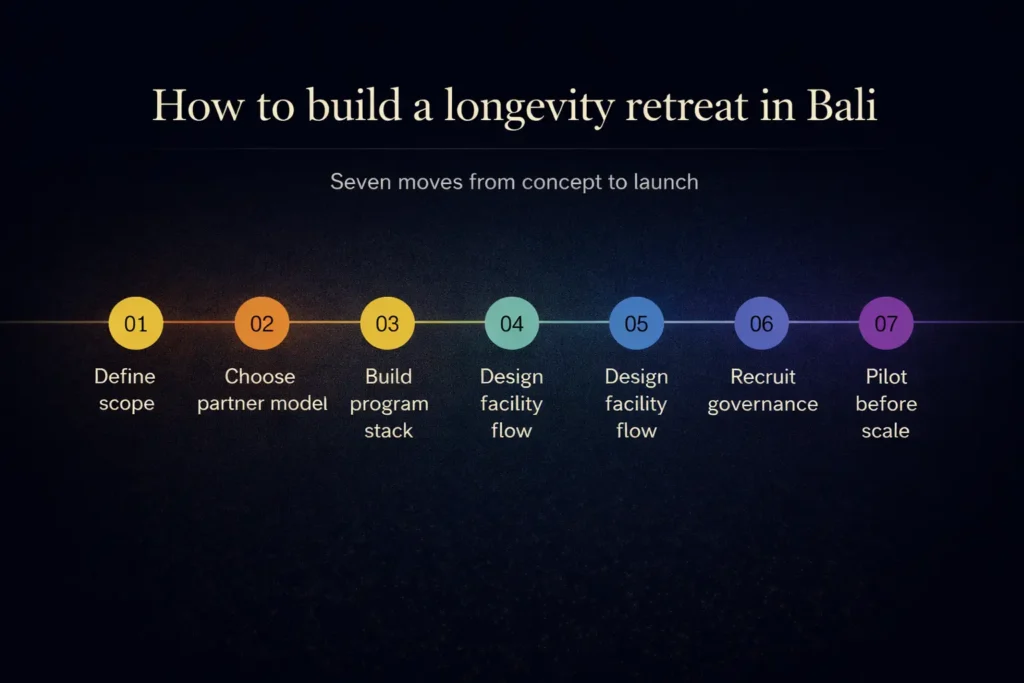
How to execute longevity biohacking retreat development Bali
- Define the scope boundary first. Separate medical, wellness, recovery, and aesthetic layers before design begins.
- Choose the right partner model. Decide whether medical delivery sits under a licensed clinic partner, a separate entity, or another compliant structure.
- Build the program architecture. Start with diagnostics, then interventions, then continuity. Do not build a menu first.
- Design for supervision and flow. Consult, diagnostics, therapy, recovery, and staff circulation must work as one operating sequence.
- Recruit governance leadership early. Clinical oversight should exist before procurement and before marketing claims are drafted.
- Create a claims-control framework. Market only what can be safely delivered, documented, and defended.
- Pilot before scaling. Run a controlled launch, measure guest response and operational friction, then refine the model before full commercial rollout.
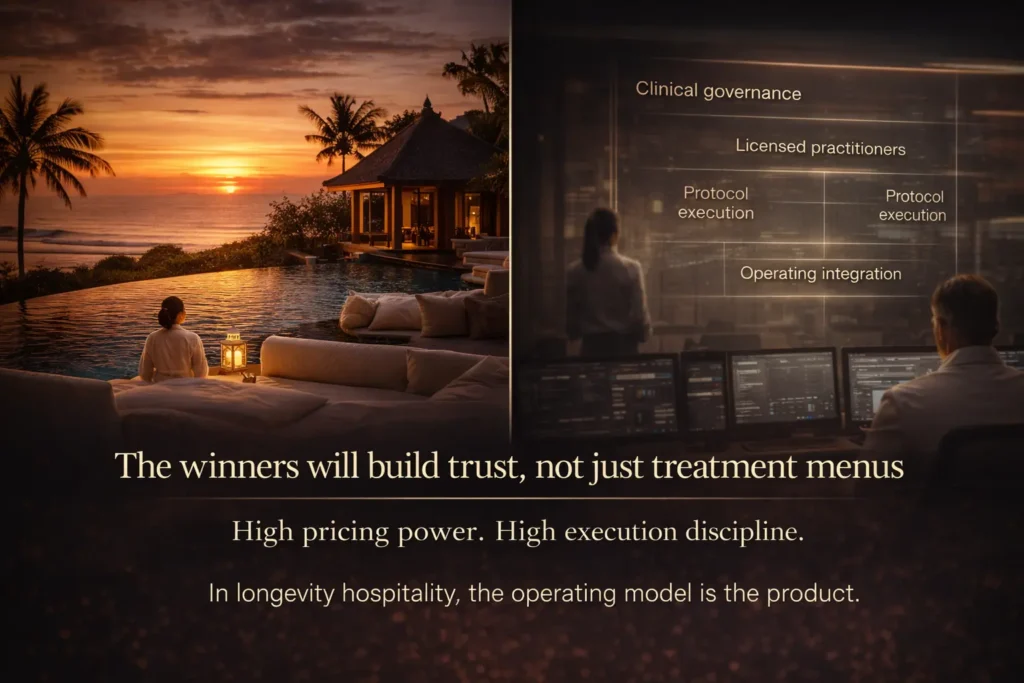
Zenith’s view
Zenith’s position is direct. Longevity biohacking retreat development Bali is one of the most promising frontiers in premium hospitality, but it is also one of the easiest categories to get wrong expensively.
The projects that win will not be the ones with the longest treatment menu or the most fashionable devices. They will be the ones that integrate diagnostics, governance, programming, staffing, and commercial logic into one clear guest proposition.
In Bali, the destination is already strong enough. The gap is not market interest. The gap is disciplined execution. That is why the right starting point is not equipment sourcing. It is product DNA, operator-grade flow, medical-hospitality structuring, and a financial model that reflects the real complexity of the asset.
FAQ
Is longevity biohacking retreat development Bali commercially viable at the luxury end?
Yes, but only when the offer is built around a credible high-spend journey rather than around isolated treatments. The most viable models combine premium room or package revenue with diagnostics, guided interventions, and post-stay continuity. That creates a stronger revenue stack than a standard wellness retreat. The risk is that many projects overestimate pricing power before they have earned trust. Premium rates are possible, but only when governance, practitioner quality, and guest experience all support the promise.
Can a Bali retreat legally offer IV therapy and medical diagnostics inside a hospitality setting?
It can, but not casually. Once the concept includes regulated health acts, the project must sit inside the right legal and operational structure. That typically means licensed professionals, compliant practice logic, proper documentation, and often a formal medical partner rather than a hotel acting alone. This is why structuring comes before design. The wrong legal model does not just create compliance risk. It weakens investor confidence and long-term brand defensibility.
What is the biggest operating risk after opening?
The biggest risk is not occupancy. It is governance drift. That includes unclear service boundaries, weak documentation, poor contraindication screening, overclaiming in marketing, staff working outside proper scope, and inconsistent guest handling across medical-adjacent touchpoints. In a normal resort, these are serious but often containable problems. In a longevity retreat, they can quickly become reputational, legal, and commercial problems at the same time.
What should operators prioritize in pre-opening?
Operators should prioritize concept scope, staffing structure, clinical governance, room programming, and claims discipline before they focus on visual brand storytelling. Too many projects try to launch with beautiful design and vague promises. The better approach is to define the operating model first, test the guest journey second, and only then finalize the outward-facing positioning. In this category, clarity is not a nice-to-have. It is part of the product.
Summary Takeaways
- Treat longevity biohacking retreat development Bali as a hybrid hospitality-health asset class, not as a premium spa variant.
- Do not procure technology before the medical boundary, licensing path, and staffing model are defined.
- Underwrite diagnostics, therapies, and continuity revenue together, not just room revenue and spa revenue.
- Design the facility around guest flow, supervision, privacy, and back-of-house logic.
- Use Bali’s wellness destination strength as an advantage, but do not rely on destination halo to cover weak governance.
- Build the concept around trust, evidence discipline, and operator-grade delivery if you want premium pricing to hold.
Author
André Priebs
CEO & Co-Founder, Zenith Hospitality Global
André advises owners, developers, and investors on luxury boutique hotels, lifestyle retreats, and wellness and longevity assets across Bali and Indonesia. Zenith’s work in this space covers concept creation, medical-hospitality partnership structuring, pre-opening governance, operating systems, staffing design, and commercial modeling for high-complexity wellness projects.
Call to Action
If you are evaluating longevity biohacking retreat development Bali for a new build, land acquisition, or repositioning brief, the concept should be structured before design and procurement lock you into the wrong operating model.
Read next: