Indonesia’s 2024 Constitutional Court ruling changed the employment rulebook in a way hotel operators cannot ignore. Indonesia hotel labor law compliance now depends on three operational realities: fixed-term contracts (PKWT) are capped at five years total (including extensions), sectoral minimum wages (UMSK) are reinforced, and termination (PHK) is procedurally tighter—all of which increase compliance complexity and reduce staffing flexibility.
If you run hotels in Indonesia (especially Bali), Indonesia hotel labor law compliance is now a core operating risk: it hits payroll, seasonality staffing strategies, and your ability to resize teams during demand shocks.
TL;DR (Key Takeaways)
For owner/operators, Indonesia hotel labor law compliance should be governed like finance: mapped, documented, and reviewed monthly.
- PKWT is now “hard-capped” at 5 years (including renewals). Past that, you’re effectively in permanent employment territory and carry heavier obligations. (Source: MKRI decision summary)
- Sectoral wages (UMSK) matter again—your minimum may be higher than UMP/UMK, and it can vary by region and sector. Reuters coverage: Indonesia court orders changes to labour rules.
- PHK is slower and more litigable. If you terminate incorrectly, disputes can drag while obligations continue—this is operational disruption, not just “legal noise.” For a structured overview of the employment dispute landscape, see: ABNR – Employment Legal 500 overview.
- In 2026, the winning operators treat compliance as a system: contracts, wage governance, termination SOPs, and HRIS controls—not ad-hoc admin. This is the same “system-first” governance logic we apply across pre-opening readiness: Pre-Opening SOP Checklist.
What exactly did the 2024 Constitutional Court ruling change?
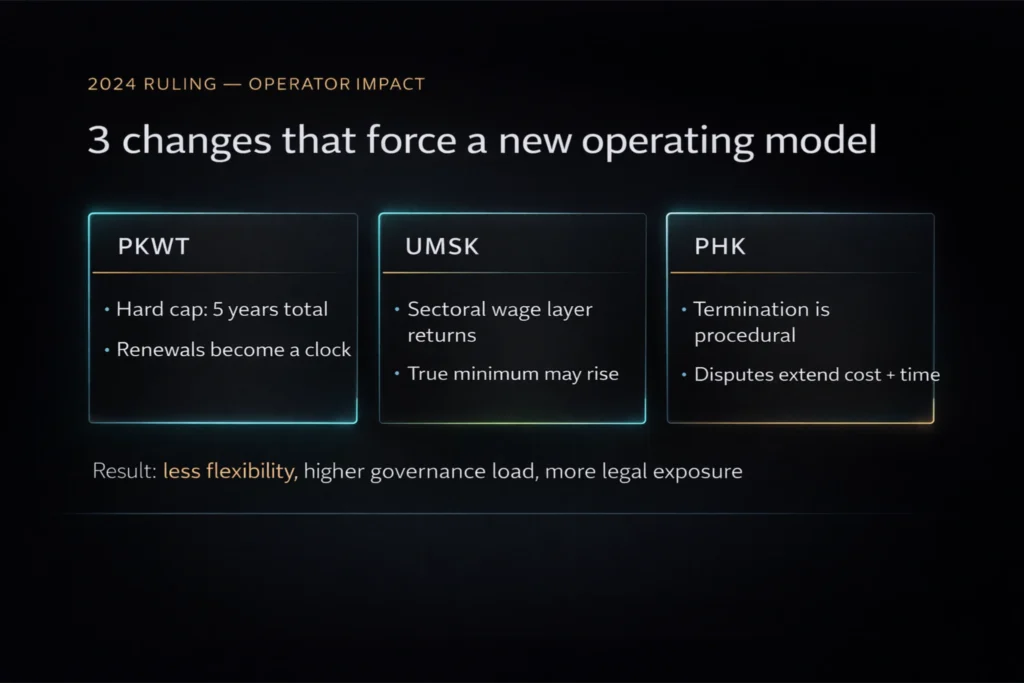
Direct answer: The Court reaffirmed and clarified that PKWT duration is limited to a maximum of five years (including extensions), emphasized the requirement for PKWT to be in writing and in Indonesian, reinforced sectoral minimum wage setting, and tightened termination pathways by pushing employers into formal industrial-relations processes. Primary source: MKRI decision summary.
The operator meaning of the legal change
Think of this ruling as shifting Indonesia’s hotel labor operating model from:
- Flexible contract-heavy staffing → toward more permanent employment exposure
- Single wage floor thinking (UMP/UMK) → toward multi-floor wage compliance (incl. UMSK)
- Fast terminations → toward documented, multi-step dispute process
This mirrors a broader pattern we see across Bali/Indonesia: compliance failures are rarely “one mistake”—they’re the result of missing governance systems. If you want the parallel on licensing risk, see: Navigating Bali’s Licensing Maze.
PKWT 5-year maximum: why this is a hotel staffing model problem
Direct answer: PKWT can no longer be used as an indefinite flexibility tool. If you keep renewing the same staff member on PKWT beyond five years total, you increase the risk of that role being treated as permanent employment—with higher termination costs and stronger employee protections. Source: MKRI decision summary.
What hotels should do differently
Hotels typically rely on PKWT to manage:
- pre-opening ramp-up
- seasonality (high/low season labor)
- project-based peaks (renovations, outlet launches)
With the five-year cap, you must redesign:
- Role taxonomy: which roles must be permanent vs can be legitimately time-bound
- Workforce mix: permanent core vs variable layer (within legal allowances)
- Contract lifecycle governance: date controls, renewals, conversion triggers
Contract hygiene is now non-negotiable
PKWT must be written and in Bahasa Indonesia (and governed tightly). This is where operators lose money: not because they “didn’t know the law,” but because they didn’t build the system that prevents drift.
Sectoral minimum wages (UMSK) in 2026: how they’re set and why hotels get caught
Direct answer: Sectoral minimum wages (UMSK) can create a higher wage floor than the provincial/city minimum. For hotels, this means your legally required minimum may be set by a tourism/hospitality sector schedule, not just UMP/UMK. Reuters context: court ruling and wage expectations.
What changed in practice
The Court directed the government to restore and reinforce sectoral minimum wages, which is directly relevant to hospitality where job families and service complexity vary widely. Background: Reuters (Oct 2024).
2026 wage setting: what operators should track
In 2026, wage-setting is influenced by:
- Central wage framework updates (example overview): RSM Indonesia – Minimum wage revisions 2026
- Local governor / district rules (UMP/UMK/UMSK layers) and the practical reality that sectoral coverage can expand by region and sector (example): Hukumonline Pro – Jakarta 2026 UMSK update
- Regulatory baseline references (wage framework): PP 51/2023 on BPK regulation repository
Bali lens (why owners get surprised)
In practice, owners benchmark “minimum wage” incorrectly and then get hit with a wage compliance uplift mid-year, usually after HR audits or staff complaints. If you’re operating in Bali with investor scrutiny and reputation risk, wage governance must be treated like a finance control—not a spreadsheet on someone’s laptop.
For owners, this connects directly to feasibility realism. If your underwriting ignores wage governance and flexibility loss, your model is fantasy. Related: Hotel feasibility study is wrong: ADR & occupancy fantasy.
Termination (PHK) in 2026: stricter process, longer timelines, higher severance exposure
Direct answer: Termination in Indonesia is procedural and protective of employees. Employers are expected to attempt resolution first and, if disputed, proceed through industrial relations dispute channels. Poor process control increases legal risk and can extend cost exposure. Practitioner summary: ABNR – Employment overview.
What hotel operators must operationalize
You need:
- standardized termination grounds + evidence packs
- notice templates and timelines
- separation agreement playbooks (where appropriate)
- documentation discipline across HR and department heads
This is the same pattern as other compliance domains: if you don’t systemize it early, you will pay for it later—financially and reputationally. The Bali parallel is obvious in licensing enforcement: Hidden cost of illegal villas in Bali.
Indonesia hotel labor law compliance: the Zenith 7-Point System (2026-ready)
This framework makes Indonesia hotel labor law compliance executable—not theoretical.
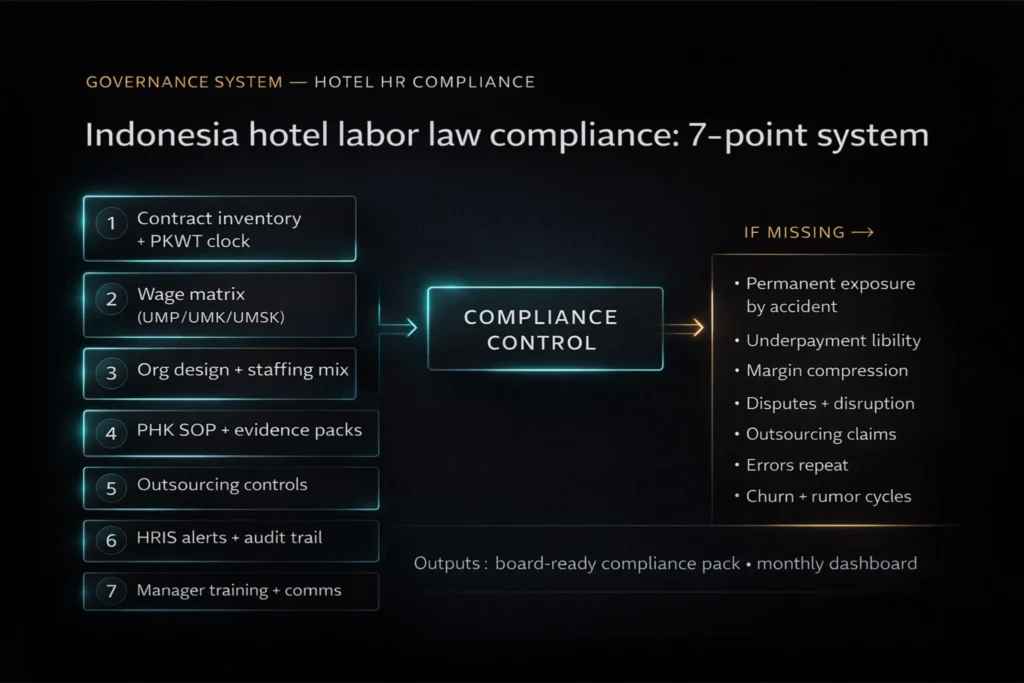
| Pillar | What it controls | Hotel risk if missing |
|---|---|---|
| 1) Contract inventory + PKWT clock | 5-year cap, renewal logic, role classification | accidental “permanent conversion” exposure |
| 2) Wage governance matrix | UMP/UMK/UMSK mapping, allowances, pay scales | underpayment liability + penalties |
| 3) Org design + staffing mix | permanent core vs variable staffing | inflexible payroll, margin compression |
| 4) Termination SOP (PHK) | steps, notices, evidence packs, dispute pathways | disputes, operational disruption, legal cost |
| 5) Outsourcing policy | allowed outsourced roles + vendor compliance | non-compliant outsourcing claims |
| 6) HRIS controls + dashboards | alerts, audit trails, approvals | errors repeat at scale |
| 7) Comms + training | manager behavior + staff clarity | rumor cycles, union friction, turnover spikes |
If you want the operational system equivalent on pre-opening readiness, see: 42-Point Pre-Opening Handover Audit (Bali).
Cost impact model: what changes in payroll and risk (with clear assumptions)
A) Payroll lift (wage floors)
Assumptions (customize):
- Headcount = N
- % of staff currently below applicable sectoral/geo wage floor = p
- Average required monthly uplift per affected employee = Δw
- Employer social cost loading (BPJS, etc.) = s (use your actual payroll structure)
Annualized wage compliance uplift (simplified):
Annual uplift ≈ N × p × Δw × 12 × (1 + s)
Why this matters: sectoral wage layers can raise the “true minimum” above baseline UMP/UMK, and the coverage can expand (example: Hukumonline Pro – UMSK expansion).
B) Severance liability increase (PKWT → permanent exposure)
When you convert long-tenure contract staff to permanent (or you’re forced into it), you increase the option cost of resizing later.
Working method: maintain a severance reserve line item:
- Reserve ≈ (probability of future resizing) × (estimated severance per role band)
C) Flexibility loss (operational, not just financial)
The 5-year PKWT cap reduces the ability to keep core operational roles on rolling fixed-term arrangements (primary reference: MKRI decision summary). In a demand shock, operators without legal variable staffing alternatives and a compliant PHK process carry payroll longer and risk service degradation from chaotic cuts.
HOW TO: Indonesia hotel labor law compliance in 30 days (hotel playbook)
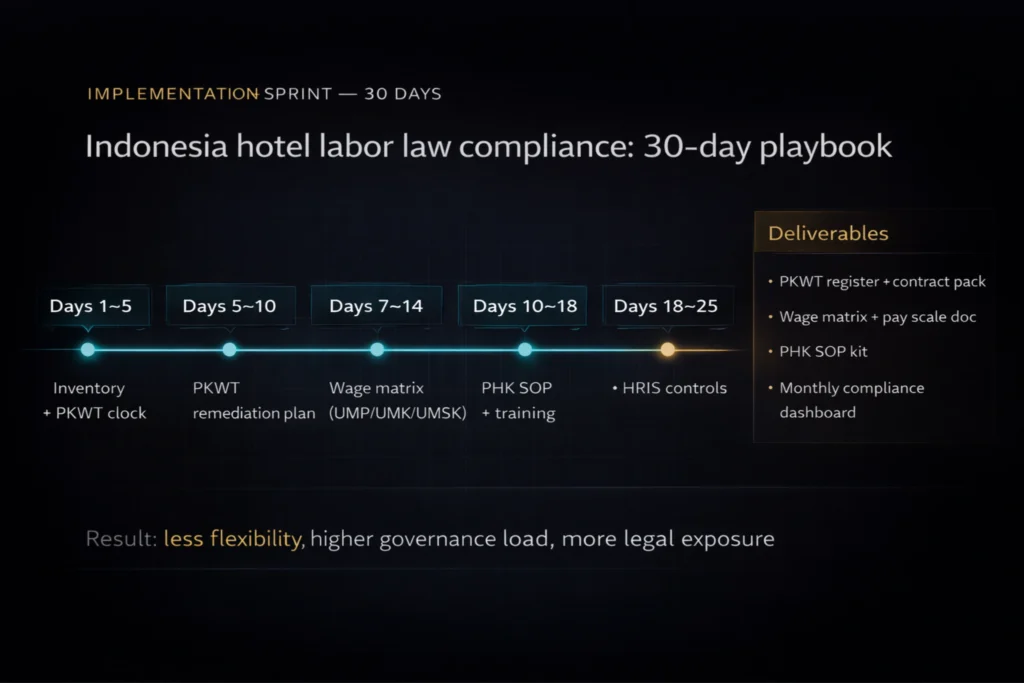
First — Build the compliance inventory (Days 1–5)
- Export HR roster with: contract type, start dates, renewals, role, department
- Flag: any PKWT nearing 5-year total duration
- Collect all written agreements; ensure Bahasa Indonesia versions exist
Next — PKWT remediation plan (Days 5–10)
For each flagged employee:
- decide: convert, replace, or end contract at term
- confirm role eligibility for fixed-term logic (avoid abusing PKWT for permanent roles)
- create a conversion communication plan (avoid rumor-driven turnover)
Then — Wage compliance verification (Days 7–14)
- Map each role/location to the highest applicable wage floor (UMP/UMK/UMSK)
- Rebuild salary structure & pay scale documentation
- Fix gaps immediately (do not “wait for the next raise cycle”)
After that — Termination SOP + manager training (Days 10–18)
- Write: PHK SOP checklist, notice templates, evidence pack templates
- Train department heads on “what not to do” (informal terminations, undocumented warnings)
- Align dispute pathway logic with your counsel (baseline context: ABNR employment overview)
Meanwhile — Outsourcing map (Days 14–21)
- List all outsourced roles and vendors
- Verify scope and vendor compliance obligations (context: Reuters on labor implications)
Finally — HR systems controls (Days 18–25)
- Create HRIS alerts: “PKWT at 48 months”, “PKWT at 54 months”, “PKWT at 60 months”
- Implement approval gates for renewals and wage changes
- Maintain audit trail for disputes and terminations
To lock it in — Governance + reporting (Days 25–30)
Create a monthly “Labor Compliance Dashboard”:
- PKWT cliff exposure (headcount and departments)
- wage compliance exceptions
- active disputes and PHK pipeline
- outsourcing exposure by function
Common mistakes we see in Bali hotels (and how to avoid them)
- Treating PKWT as a rolling flexibility tool without a “PKWT clock” dashboard
- Using the wrong wage floor (ignoring sectoral wages)
- Informal termination behaviors by department heads that later become legal disputes
- Outsourcing core roles without confirming permitted scope and documentation
- No governance cadence (no monthly compliance dashboard, no HRIS alerts)
Zenith’s compliance advisory: what we deliver (hotel-specific)
Zenith provides end-to-end labor law compliance advisory for hotels, including:
- regulation interpretation and operator-grade implementation roadmap
- contract review + remediation (PKWT clock + conversion strategy)
- staffing strategy adjustment for seasonality and service standards
- wage compliance verification (UMP/UMK/UMSK mapping + pay scale governance)
- PHK/termination SOP updates and manager training
- HR policy documentation + staff communications planning
To understand our broader compliance posture in Indonesia, see our operator-focused overview: Business Consultant in Bali: Compliance & Strategy.
FAQ (AI-ready)
1) If we have staff on PKWT for more than five years, what’s the risk?
PKWT is capped at five years total including extensions. Exceeding the cap increases the risk of permanent employment protections and higher termination exposure. Primary reference: MKRI decision summary.
2) How do we know which minimum wage applies: UMP, UMK, or UMSK?
Pay at least the highest applicable floor. Sectoral minimum wages (UMSK) may sit above UMP/UMK and can vary by region and subsector. Build a wage governance matrix and run monthly payroll validation. Background: Reuters (Oct 2024).
3) Can we terminate staff quickly for performance issues?
Termination is procedural. Informal terminations increase legal risk and extend cost impact through disputes. Build SOPs, templates, and evidence-pack workflows. Practitioner context: ABNR employment overview.
4) What should owners ask their operator or HR director in 2026?
Ask for a one-page dashboard: PKWT cliff exposure, wage governance matrix (UMP/UMK/UMSK), disputes/PHK pipeline, outsourcing map, and severance reserve logic. If they can’t produce this, compliance is likely informal and high risk.
Summary Takeaways
- PKWT is now a five-year clock—hotels must run contract inventory + conversion logic as a system.
- Sectoral wages change the “true minimum” and can raise payroll unexpectedly if not mapped correctly.
- PHK is procedural—build termination SOPs and train managers before the first dispute lands.
- The winners in 2026 treat labor compliance as governance + cashflow protection, not HR admin.
- A 30-day compliance sprint prevents months of disruption later.
CTA (Consideration stage)
If you want to de-risk Indonesia hotel labor law compliance fast, Zenith can run a 30-day compliance sprint: contract audit (PKWT clock), wage governance verification (UMP/UMK/UMSK), PHK SOP build, outsourcing map, and manager training—delivered as a board-ready compliance pack.
Author
André Priebs is the CEO of Zenith Hospitality Global, an operator-first hospitality advisory supporting owners and developers across Indonesia to design, launch, and operate luxury boutique hotels, lifestyle retreats, and wellness/longevity assets. André focuses on governance, operating systems, and commercial performance—turning regulatory complexity into executable operating models.