A hotel Product DNA is one of the most important control documents in hospitality development, but most projects do not define it before the design process starts.
Most hotel projects do not become weak because the architect failed. They become weak because the owner, developer, and commercial team never defined the product before architecture, interiors, branding, and commercial assumptions started moving ahead.
That failure usually appears later. The project has beautiful renders, expensive materials, a premium-sounding name, and no clear answer to the questions that matter most: Who is this for? Why would that guest choose it? How will the service work? What will the guest remember? Where will the profit come from beyond the room? What operating model supports the promise?
Zenith calls that missing system the hotel Product DNA.
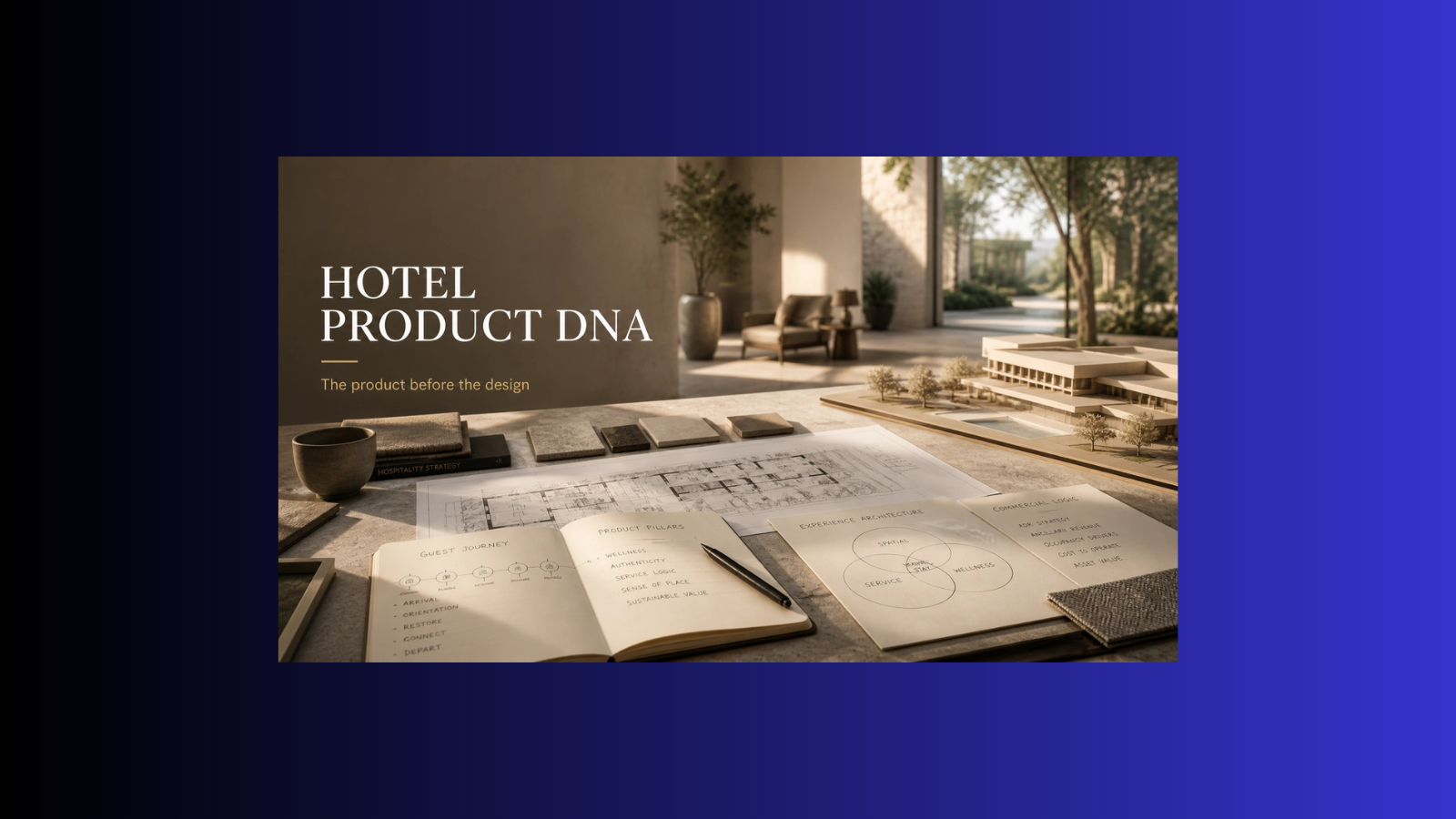
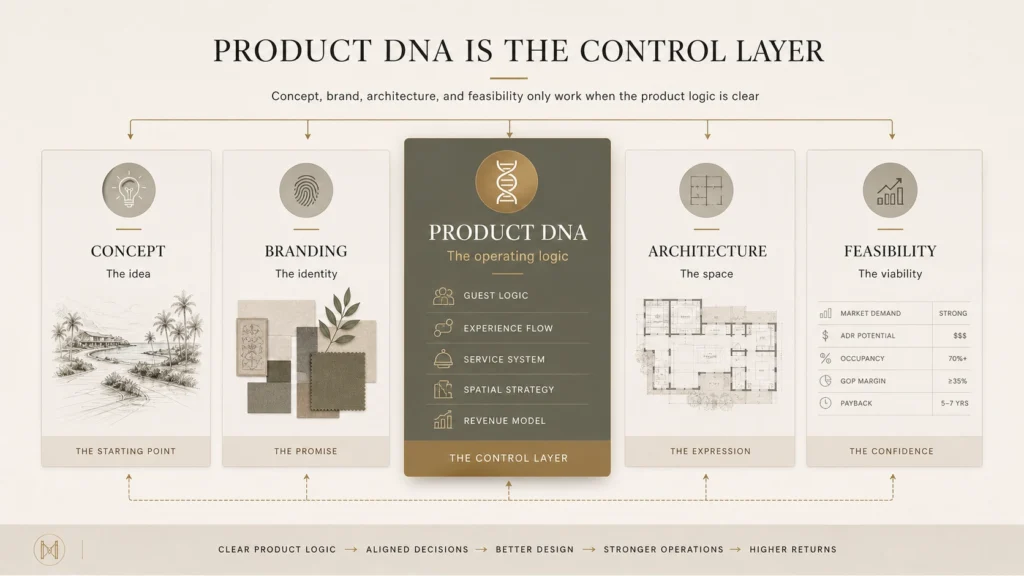
A hotel Product DNA is not a mood board, brand story, room list, or architectural concept. It is the pre-design operating blueprint that aligns the target guest, guest journey, service logic, spatial brief, F&B personality, wellness integration, and commercial model before the project moves too far into design.
For owners, developers, investors, and family offices, this matters because the most expensive hospitality mistakes often happen long before opening. In many cases, capital gets committed before the product has been properly defined.
At Zenith Hospitality Global, we see the hotel Product DNA as one of the most important owner-side control points in hospitality development.
Key Takeaways
- A hotel Product DNA is the pre-design operating blueprint for a hotel, resort, retreat, or lifestyle hospitality asset.
- It is not the same as branding, architecture, feasibility, or interior design. Instead, it governs how those disciplines should work together.
- A real hotel Product DNA aligns target guest, experience architecture, service logic, spatial brief, F&B, wellness, and commercial model.
- In Bali, weak Product DNA is becoming more expensive because demand remains active, premium supply is increasing, and the market is moving toward higher compliance and professional standards.
- Without Product DNA, a project may still open. However, it will be harder to defend ADR, guest loyalty, ancillary revenue, operating consistency, and long-term asset value.
Why This Topic Matters Now
Bali still has strong demand visibility.
BPS Bali reported 6,948,754 direct foreign tourist arrivals in 2025, up 9.72% compared with 2024. In February 2026, Bali’s star-rated hotels recorded a 55.44% room occupancy rate, up from 51.62% in February 2025.
These figures confirm that Bali remains a major hospitality market. However, demand alone does not make every project investable.
For owners and investors, the more relevant question is not whether Bali has tourists. The real question is whether a specific asset has a clear enough product, operating model, and commercial thesis to compete when similar-looking projects enter the market.
That pressure is increasing. Horwath HTL’s 2026 Bali market update reports an active pipeline of 5,641 rooms across 45 hotels, with most new development concentrated in Canggu, Jimbaran/Uluwatu, and Ubud. The same update notes that premium rate categories represent more than half of pipeline rooms.
Therefore, premium design language is no longer enough.
As more projects chase upper-tier guests with similar visual codes — natural materials, wellness cues, tropical minimalism, curated F&B, and “community” language — defensibility has to come from something deeper.
It has to come from product logic.
That is where a hotel Product DNA becomes critical.
What Is a Hotel Product DNA?
A hotel Product DNA is the pre-design operating blueprint that defines what the hotel is, who it is for, how it works, and how it makes money.
It comes before architecture, interiors, branding, operator search, SOP development, and pre-opening execution.
A strong hotel Product DNA answers:
- Who is the target guest, in operational and commercial terms?
- What promise does the hotel make?
- Which experience should the guest move through?
- Which service behaviors, rituals, and standards must support that promise?
- What spatial logic does the product require?
- What F&B, wellness, recovery, retail, membership, or local-community role does the asset need?
- What revenue logic makes the product investable?
- What should the operator protect after opening?
This is not a decorative document. It is a control document.
Academic service-design literature supports the same underlying principle. In hotels, service design is not only about visible service features. It requires product and process to work together, including the service environment, delivery process, employees, and customer experience. Source: Service Design in Hotels: A Conceptual Review.
That is the practical foundation of Product DNA: the hotel must function as a system, not as a collection of attractive spaces.
For related owner-side thinking, see Zenith’s article on Bali off-plan villa investment versus professional management, which explains why real hospitality performance depends on more than sales decks and asset presentation.
The Core Problem: Most Projects Start Too Late
Many hospitality projects start with the wrong sequence.
They begin with land, room count, architecture, renders, investor decks, or an assumed ADR. Only later does the team ask who the guest is, what the product promise means, how the service will work, and which operating model can actually deliver it.
By then, too much has already been locked.
The lobby may sit in the wrong place. The spa may be too small or commercially weak. The restaurant may have no local market logic. The back-of-house may fail to support the service promise. The villas may photograph well but ignore the real stay pattern. The brand story may sound good but lack operating behavior behind it.
This is why a project can look premium and still feel generic after opening.
A weak project often has a concept. It may even have a good concept. However, it does not yet have a hotel Product DNA.
Product DNA vs Concept, Branding, Architecture, and Feasibility
A hotel Product DNA is often confused with adjacent work. That confusion creates expensive mistakes.
| Discipline | What It Usually Answers | What It Does Not Fully Answer |
|---|---|---|
| Concept | What is the idea, theme, or mood? | How does the asset operate and monetize the idea? |
| Branding | What is the name, identity, tone, and story? | Can the experience and service deliver the story? |
| Architecture | What is the physical form and spatial composition? | Which guest, operating model, and revenue logic should the space serve? |
| Feasibility | Is the project financially and market viable? | What is the full experience system and operating behavior behind the numbers? |
| Product DNA | Who is the asset for, what does it promise, how does it work, and how does it make money? | It does not replace architecture, branding, feasibility, or operations; it governs them. |
Feasibility remains essential.
HVS describes hotel feasibility and market studies as tools to validate development or repositioning decisions, understand market demand and revenue potential, evaluate product type, positioning and scale, forecast revenues and costs, and identify risks early.
However, feasibility becomes stronger when the product thesis is clear. A model built around a vague concept is still a model built on weak logic.
That is why Product DNA and feasibility should support each other. The feasibility study tests whether the market and financial logic are viable. Meanwhile, the hotel Product DNA defines the product and operating logic that makes the numbers believable.
For many owners, this work should happen before heavy design development, operator negotiation, and pre-opening planning. It also connects directly to Zenith’s hospitality advisory work for owners and developers who need product, operating, and commercial clarity before committing capital.
The Six Layers of a Real Hotel Product DNA
A usable hotel Product DNA should contain at least six aligned layers.
1. Target Guest and Demand Thesis
“Luxury traveler” is not a target guest.
A serious hotel Product DNA defines the guest in operating terms:
- trip purpose;
- source markets;
- booking behavior;
- stay length;
- seasonality;
- rate tolerance;
- non-room spend potential;
- wellness, F&B, cultural, family, or retreat motivations;
- reason to choose this asset over the comp set.
This is where many projects are weakest. They define a buyer or investor story, but not a guest thesis.
As a result, the owner may be building for an imagined market rather than a specific guest segment with real booking behavior, pricing tolerance, and experience expectations.
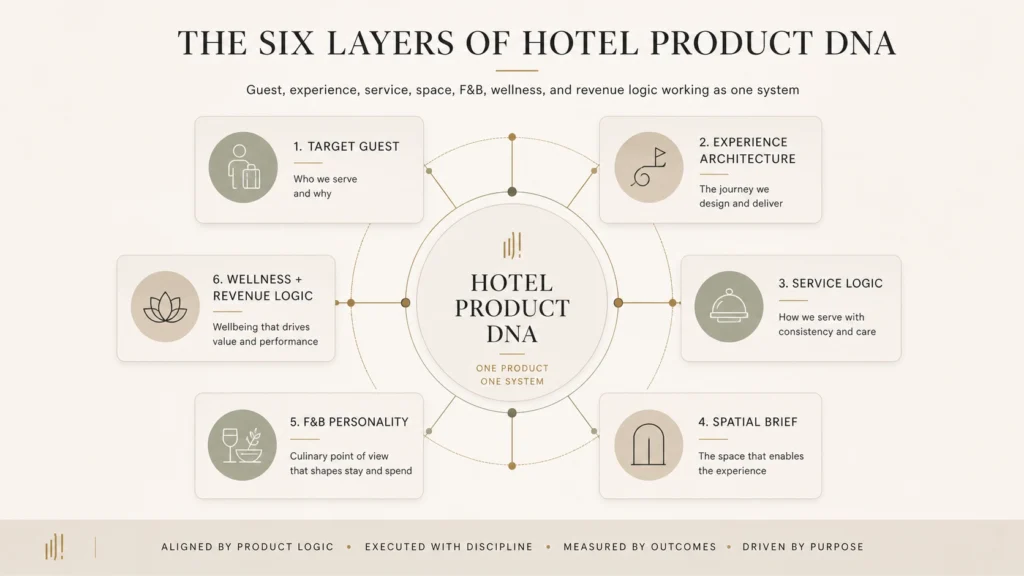
2. Experience Architecture
A hotel is not experienced as a rendering. It is experienced as a sequence.
Arrival, welcome, check-in, room entry, first meal, first sleep, morning rhythm, pool behavior, spa journey, concierge interaction, departure, and post-stay communication all shape the product.
Research on full-service hotels categorizes customer experience into functional, affective, and social dimensions. It also links experience to brand trust, brand affect, and loyalty. Source: Customer experience and brand loyalty in the full-service hotel sector.
That matters commercially. If the guest journey lacks intentional design, the hotel may rely too heavily on décor and location.
A strong hotel Product DNA defines what the guest should feel, do, understand, spend on, and remember at each major stage of the stay.
3. Service Logic and Staffing Model
The Product DNA must define how service behaves.
Words such as “warm,” “personalized,” or “intuitive” are not enough. They sound good, but they do not tell a team how to act.
The document should define:
- what staff notice;
- what they remember;
- what they never interrupt;
- which rituals are scripted;
- where discretion matters;
- how departments hand off guest information;
- how the team handles recovery when something goes wrong.
A strong hotel Product DNA gives the future GM and pre-opening team a service logic before SOPs are written.
This is critical because service standards cannot be fixed only through training manuals. They must connect to the product promise, staffing model, physical flow, and guest profile.
4. Spatial Brief Connected to Operations
Architecture should express the Product DNA, not invent it alone.
If the product is a retreat, the spatial rhythm must support decompression. If the product is a lifestyle club, the flow must support energy, social density, and programming. If the product is longevity-led, circulation, privacy, clinical boundaries, recovery areas, and guest education must be resolved early.
A beautiful space that fights the operating model becomes expensive friction.
For that reason, owners should define Product DNA before schematic design. Once the wrong spatial logic is locked, the future operator may have to manage around problems that should have been prevented at concept stage.
5. F&B Personality and Outlet Logic
F&B is often treated as an amenity. In a strong hospitality product, it should form part of the asset’s identity and revenue architecture.
A real Product DNA defines:
- who the outlet serves: guests, members, residents, locals, destination diners, or all of them;
- whether the restaurant needs to be a destination in its own right;
- how breakfast supports the brand promise;
- whether beverage, events, classes, retail, chef collaborations, or producer partnerships matter;
- how F&B contributes to total revenue and positioning.
Without this logic, F&B becomes generic hospitality filler.
For boutique hotels, lifestyle resorts, and wellness retreats, this is a major commercial issue. A restaurant may look good, but without a defined role it may fail to create local relevance, guest loyalty, or meaningful ancillary revenue.
6. Wellness Logic and Monetization
In current hospitality, wellness cannot be reduced to “spa included.”
The Global Wellness Institute reported wellness tourism at USD 893.9 billion in 2024, already 136% of its 2019 level, with projected 9.1% annual growth from 2024 to 2029.
For owners, the implication is not “add wellness.” Instead, the owner needs to define the wellness role precisely.
Is wellness a soft amenity? A retreat program? A recovery engine? A membership driver? A medical-wellness layer? A spa revenue center? A sleep proposition? A community programming tool?
Each answer requires a different spatial brief, staffing model, partner structure, liability boundary, menu architecture, pricing logic, and guest promise.
A serious wellness hospitality asset therefore needs wellness logic inside the Product DNA, not as a late-stage add-on.
Why Bali Makes Weak Product DNA Expensive
Bali is not only a demand story. It is now a quality, compliance, and differentiation story.
The Bali Government Tourism Office announced a Bali Kerthi compliance audit initiative for tourism accommodation licensing and quality standards, referencing the goal of quality and dignified tourism under Bali’s cultural tourism standards. Indonesia’s tourism ministry has also described Bali Kerthi Compliance as a program evaluating accommodation providers through administrative compliance, business standards, and sustainability. Sources: Bali Tourism Office and ANTARA News.
This matters for hotel development because vague products are harder to professionalize.
If the concept is unclear, operating standards become unclear. If standards remain unclear, training, licensing, quality control, and guest delivery become reactive.
There is also a cultural dimension.
UNESCO describes Bali’s subak system as reflecting Tri Hita Karana, the philosophy that brings together the spirit, the human world, and nature. Source: UNESCO World Heritage Centre.
For hospitality projects in Bali, this should not be used as decorative copy. If a project claims cultural sensitivity, wellness depth, community value, or environmental stewardship, those claims must appear in design decisions, operating practices, guest education, local relationships, and commercial restraint.
In Bali, shallow concept language is easy to write and hard to defend.
A strong hotel Product DNA helps prevent that gap.
What Strong Product DNA Looks Like in Practice
Strong Product DNA does not mean copying famous hotels. Instead, it means understanding why coherent hotels work.
Capella Ubud, Bali
Capella Ubud describes itself as a unique tented camp in the forest, inspired by early European settlers from the 1800s and designed by Bill Bensley as a tribute to the spirit of adventure. Its accommodation mix is tightly aligned: twenty-two one-bedroom tents and one two-bedroom lodge, each with a private pool. Source: Capella Ubud.
The point is not tents. The point is coherence.
Setting, architecture, room format, storytelling, privacy, and resort programming all support the same product promise.
Buahan, A Banyan Tree Escape
Buahan’s proposition is explicit: an adults-only jungle hotel where walls and doors dissolve, built around quiet, nature, reconnection, and a slower pace. It operates with 16 private villas and offers cultural, wellness, village, foraging, and nature-led experiences. Source: Buahan, A Banyan Tree Escape.
Again, the strength is not the phrase “no walls, no doors.” The strength is that the guest filter, spatial experience, service pace, programming, and rate logic all point in the same direction.
Desa Potato Head Bali
Desa Potato Head positions itself as a village for music, art, food, and cultural exploration. Its regenerative narrative extends into waste transformation, craft, Indonesian producers, product design, community waste, organic farming, and social infrastructure. Sources: Desa Potato Head Bali and Potato Head Regenerate.
That is Product DNA in practice. It is not a tagline. It is an operating system.
These examples are not templates to copy. They show that strong hospitality products work when guest, space, service, programming, and revenue logic reinforce each other.
The Zenith View: Product DNA Is an Owner-Side Control Document
From Zenith’s operator-first perspective, a hotel Product DNA is not a creative luxury. It is owner-side risk control.
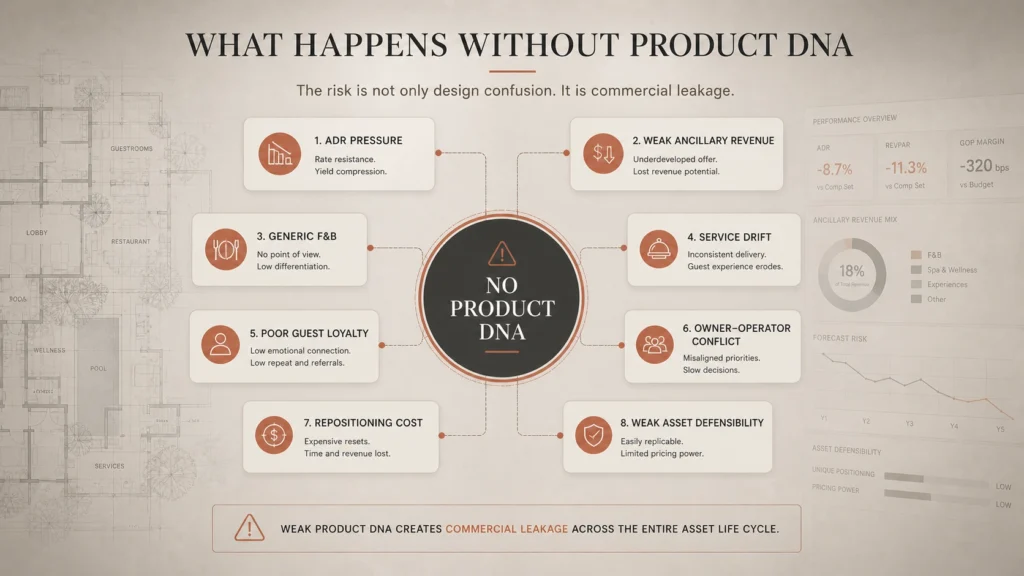
It protects the project from five common failure patterns:
| Failure Pattern | What Happens Without Product DNA |
|---|---|
| Design-before-product | Architecture becomes the strategy, instead of serving the strategy. |
| Guest ambiguity | The project targets everyone and becomes meaningful to no one. |
| Service drift | Departments improvise standards after opening. |
| Weak ancillary revenue | F&B, spa, wellness, retail, and programming are added late instead of designed as revenue engines. |
| Owner-operator conflict | The operator inherits a product that cannot deliver the financial promise in the deck. |
A real hotel Product DNA should become a governance gate.
If a design decision, brand idea, service ritual, F&B concept, wellness offer, or operator proposal does not strengthen the Product DNA, the owner should challenge it.
This is where Zenith’s operator-first hospitality advisory approach differs from generic concept writing.
The objective is not to produce attractive language. The objective is to help owners make better capital, design, operating, and commercial decisions before the project becomes expensive to correct.
Operational Implications
Product DNA changes how the project gets built.
Before schematic design, the owner should define the target guest, product promise, guest journey, service logic, F&B role, wellness role, and commercial model.
Before interiors, the team should define how guests move, where emotional moments occur, how privacy works, how staff circulate, and where service recovery happens.
Before hiring, the owner should define the GM profile, department logic, training priorities, service behaviors, and operating standards.
Before opening, the pre-opening team should test the hotel Product DNA against SOPs, recruitment, pricing, channel strategy, membership logic, partnerships, and guest communication.
If these questions get answered only during pre-opening, the project is already late.
This is especially important for boutique hotels, wellness retreats, branded residences, villa-led hospitality assets, and lifestyle resorts where the product cannot rely only on a global brand standard.
For more related owner-side thinking, see Zenith’s blog archive on hospitality development, asset performance, and hotel investment strategy.
Commercial Implications
Weak Product DNA usually shows up commercially in predictable ways:
- ADR pressure because the product is hard to defend;
- heavy reliance on location and design photography;
- weak direct booking story;
- generic F&B with low local pull;
- spa or wellness spaces with poor utilization;
- unclear upsell logic;
- higher training burden;
- inconsistent reviews;
- owner frustration with operator performance;
- post-opening repositioning costs.
The investment issue is not only whether the hotel can open. The real issue is whether the asset can sustain pricing power and guest preference after the opening effect fades.
A strong hotel Product DNA does not guarantee performance. No document can do that.
However, it gives the asset a better chance of converting capital expenditure into defendable guest value, operating clarity, and commercial performance.
That is the difference between building a hotel that looks good in year one and building a hospitality asset that still has a reason to exist in year five.
What To Do Before Committing Capital
Before committing to full design development, owners and developers should complete a Product DNA review.
At minimum, this review should answer:
- Who is the target guest, and what evidence supports that thesis?
- What is the promise, and can the operating model deliver it?
- What are the three to five signature guest moments?
- Which service behaviors must be trained?
- Which spatial decisions are non-negotiable?
- What F&B and wellness roles are required?
- Which revenue streams exist beyond rooms?
- What operator profile fits the product?
- What should be excluded because it dilutes the concept?
- What must be tested before design is frozen?
If these answers are not clear, the project may have a concept. However, it does not yet have a hotel Product DNA.
FAQ
What is a hotel Product DNA?
A hotel Product DNA is the pre-design operating blueprint that defines the target guest, product promise, experience architecture, service logic, spatial requirements, F&B and wellness roles, and commercial model. It is not the same as branding, architecture, or feasibility. Instead, it aligns those disciplines before capital is locked into design and construction.
Is Product DNA the same as a hotel concept?
No. A concept usually describes the idea, theme, mood, or positioning of the hotel. Product DNA goes deeper. It defines how the concept works in operation, who it serves, how guests move through the experience, what staff must deliver, which spaces are required, and how the asset creates revenue and defendable value.
When should Product DNA be created?
Product DNA should be created before schematic design, interior design, operator search, and pre-opening planning. If the owner creates it after architecture is already fixed, it becomes a correction exercise rather than a strategic blueprint. The earlier it is defined, the more it can influence CAPEX, spatial logic, guest journey, staffing, and commercial performance.
Why is Product DNA important for hotel investors?
Product DNA matters because investment returns depend on more than rooms, location, and design. A hotel must attract the right guest, justify its rate, generate ancillary revenue, deliver consistent service, and remain differentiated after opening. Product DNA helps investors test whether the asset has a clear commercial and operating logic before they commit more capital.
Does every boutique hotel need Product DNA?
Yes, especially boutique hotels. Large brands often have standards, systems, guest definitions, and operating playbooks. Independent boutique hotels usually have more freedom, but also more risk. Without a clear Product DNA, the asset can become overdesigned, under-systemized, and commercially vague.
Can Product DNA improve hotel feasibility?
Yes. A hotel feasibility study becomes stronger when the product thesis is clear. Without Product DNA, feasibility assumptions may rely on generic ADR, occupancy, and positioning logic. With Product DNA, the owner can test a more specific guest, rate, revenue, staffing, F&B, wellness, and operating model against market reality.
Can Zenith create or review a Product DNA?
Yes. Zenith helps owners, developers, and investors define or review Product DNA before design, repositioning, operator selection, or pre-opening. This work is especially relevant for boutique hotels, wellness retreats, lifestyle resorts, villa-led developments, and mixed-use hospitality assets where guest logic, spatial logic, operating model, and commercial performance must align.
Summary Takeaways
A hotel Product DNA is not a creative slogan. It is the strategic and operating logic behind the asset.
It defines who the hotel is for, why the guest should choose it, how the experience works, what the service model must deliver, how the space should behave, and how the business makes money.
In Bali, this discipline is becoming more important because demand remains active, while competition, compliance expectations, and premium supply pressure continue to rise.
The projects most at risk are not always the cheapest ones. Often, they are the expensive ones with beautiful design and weak product definition.
A concept can describe the mood of a hotel. A hotel Product DNA explains how the hotel will win, operate, and endure.
CTA
Before you freeze architecture, appoint an operator, or build a financial model around a generic concept, speak with Zenith Hospitality Global about a Product DNA review.
Zenith helps owners, developers, investors, and family offices define the product, guest logic, spatial brief, operating model, and commercial direction before capital decisions become difficult to reverse.