
Most hotel failures happen before opening day. Not because the architect missed a detail—because the owner treated construction completion as “ready to operate.” Hotel pre-opening management Bali is the disciplined program that prevents that mistake: licensing closure, systems commissioning, staffing, SOPs, training, vendor contracting, and a controlled soft opening—before you sell nights at scale.
If you’re within 12 months of opening in Bali or Indonesia, this is your decision-grade roadmap.
Executive summary (read this first)
- “Practical completion” is not “operational readiness.” A hotel opens on systems and people, not on finishes.
- Bali/Indonesia adds compliance gating items (OSS/NIB/TDUP + PBG/SLF) that can delay or restrict operations if mishandled.
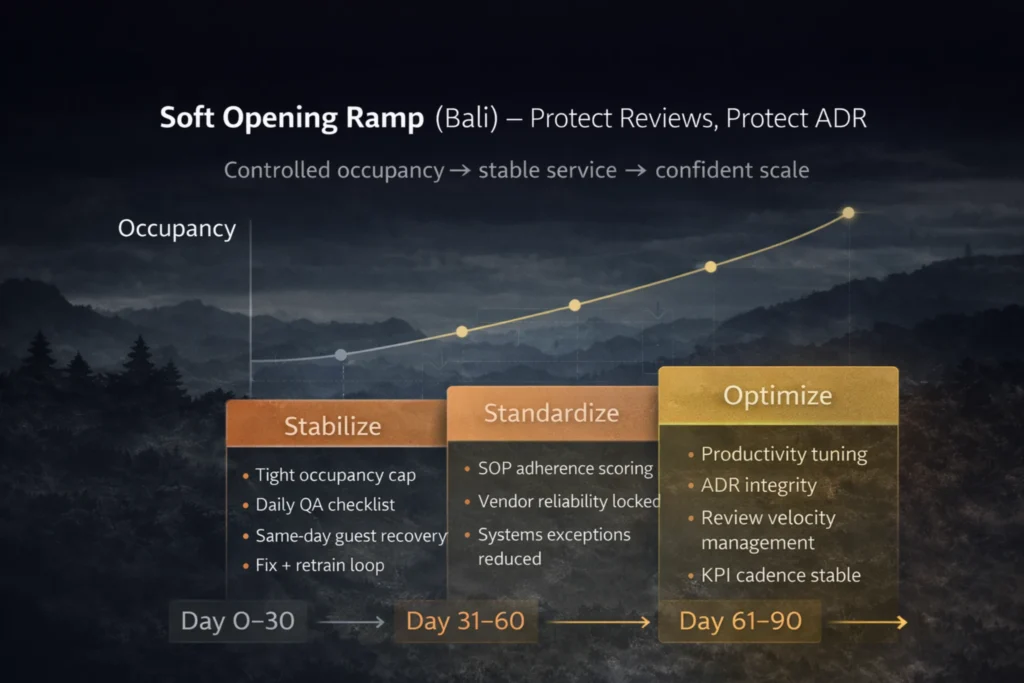
- The first 30 days set your online reputation—and influence ADR trajectory for the first year.
- Serious pre-opening runs 6–12 months: staffing, training, SOPs, systems, commissioning, vendor contracts, soft opening, and commercial launch.
Why hotel pre-opening management Bali prevents failure before opening day?
Because they start selling nights before they can deliver consistent service. The pre-opening gap typically shows up as:
- Staff hired late and trained under pressure
- PMS/POS not integrated (manual workarounds, billing errors, lost revenue)
- Licensing and certificates “in progress” (legal and operational exposure)
- Vendor contracts incomplete (stock-outs, inconsistent quality)
- No rehearsal of the guest journey (teams improvise on day one)
Pre-opening is where operational failure gets baked in. Your goal is to remove improvisation before guests arrive.
If you want a focused SOP lens first, see Zenith’s guide: Pre-Opening SOP Checklist: The Blueprint of Hotel Success.
What is hotel pre-opening management in Bali?
Hotel pre-opening management is the structured program that turns a finished building into an operational hotel—covering:
- Licensing and compliance (OSS/NIB/TDUP and local requirements)
- Building readiness (PBG/SLF alignment, commissioning, handover discipline)
- Systems (PMS/POS/channel/payment integrations)
- Staffing, training, SOPs, and operational rehearsals
- Vendor sourcing and contracts
- Soft opening and stabilization
- Commercial launch (website/OTAs/sales/PR/rate architecture)
In practice, hotel pre-opening management Bali is the bridge between a finished asset and a functioning business—where reputation and ADR are won or lost.
It is not admin. It is risk control and performance engineering.
For the Bali compliance lens, see: Navigating Bali Licensing Maze: Why Investors Get It Wrong.
What makes Bali/Indonesia pre-opening harder than most markets?
Bali adds three friction points:
- Regulatory sequencing is non-negotiable. OSS-based business licensing is foundational and must match your actual activity (start with the official OSS portal).
- Building compliance gates occupancy and use. PBG/SLF alignment must reflect hospitality use; mismatches can stall opening (reference the PUPR SIMBG service portal).
- Workforce compliance is operational risk. BPJS obligations must be embedded into onboarding and documentation discipline (see BPJS Ketenagakerjaan’s reference PP 44/2015 (English)).
Construction complete vs operational ready: what’s the difference?

| “Construction complete” (developer lens) | “Operational ready” (operator lens) |
|---|---|
| Rooms look finished | Rooms function under load (hot water, AC, drainage, internet) |
| MEP installed | MEP commissioned, tested, and maintainable |
| Licenses “in progress” | Licenses closed, displayed, and audit-ready |
| Staff “to be hired” | Team onboarded + trained + rehearsed |
| Systems “ordered” | PMS/POS/channel/payment integrated + stress-tested |
| Marketing “launching soon” | Commercial engine live + rate strategy + distribution ready |
If you want the handover side in detail, use this operator tool: Pre-Opening Handover Audit Bali — 42-Point Guide.
When should you start pre-opening in Bali?
A practical timeline for Bali/Indonesia:
- T-12 to T-9 months: GM + core leadership, licensing roadmap, systems selection, opening budget
- T-9 to T-6 months: vendor sourcing, SOP architecture, recruitment pipeline, commissioning plan
- T-6 to T-3 months: SOP build, system configuration, training design, commercial build
- T-90 to T-30 days: full recruitment, departmental training, mock ops, stock build, soft-opening plan
- T-30 to opening: rehearsals, audits, final certificates, content and distribution live
- Opening to T+30 days: controlled ramp, daily QA, review response protocol, KPI governance

If you compress this, you don’t “save time”—you shift risk into guest experience and early reviews.
What permits and certificates typically gate a Bali hotel opening?
While requirements vary by classification, scope, and scale, most openings are gated by:
- OSS business licensing and registrations (including NIB and relevant tourism business registrations such as TDUP where applicable—see the tourism registration reference here).
- Building compliance (PBG and SLF alignment with hospitality use—reference SIMBG).
- Workforce and operational compliance (BPJS registration—see PP 44/2015 (English)).
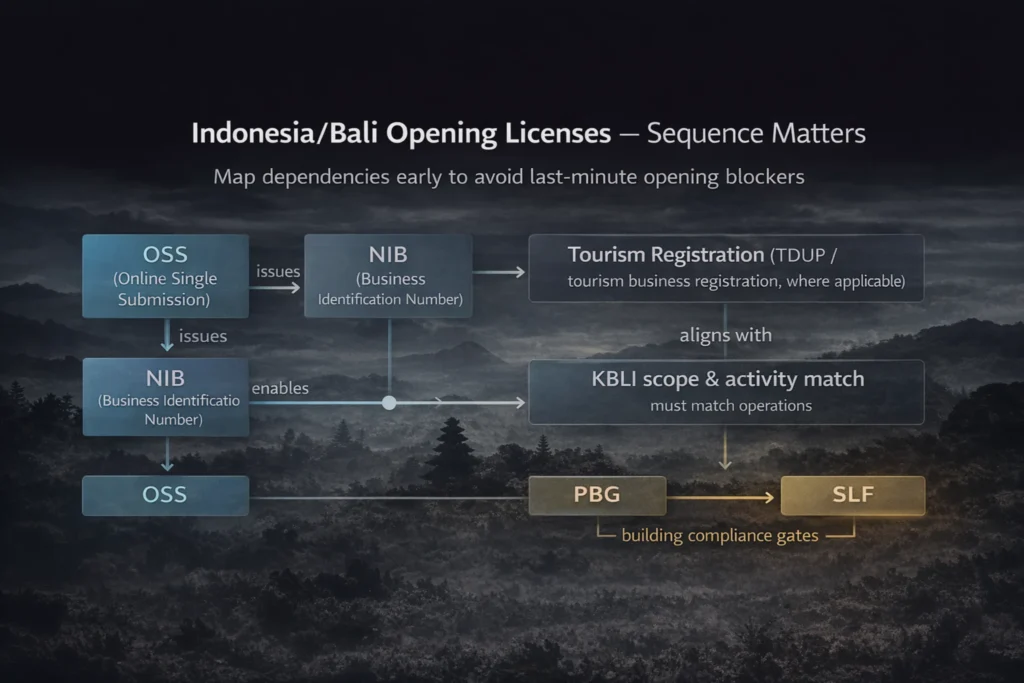
If this isn’t mapped early and owned by one accountable lead, it becomes a last-minute blocker.
How to run hotel pre-opening management Bali in 6 stages
This is the execution model behind the checklist:
- Governance + Definition of Ready
Build the dependency-based plan, owners, budget gates, and pass/fail opening criteria. - Licensing roadmap (OSS/NIB/TDUP) + compliance calendar
Sequence approvals early, track expiries, and keep documentation inspection-ready. Start from the official OSS portal and map every dependency. - Handover + commissioning under load
Close snags, collect as-builts/O&M manuals/warranties, and commission MEP systems as an operating hotel—not a construction site. - Systems integration (PMS/POS/channel/payment) + stress testing
Integrate end-to-end and run simulated “real week” operations before day one. - People + SOPs + training + rehearsal
Recruit in time, publish SOPs, run mock operations, and certify readiness (pass/fail) per department. - Soft opening + stabilization sprint
Ramp occupancy in phases, capture feedback daily, fix and retrain fast, and protect review velocity.
The 100-Point Pre-Opening Checklist (Bali/Indonesia)
A) Governance, scope, and risk control (1–10)
- Lock opening date only after licensing and commissioning milestones are mapped.
- Appoint a single accountable pre-opening owner (GM or pre-opening director).
- Build the integrated pre-opening Gantt (workstreams + owners + dependencies).
- Confirm concept, service level, and target guest profile (drives staffing and SOP depth).
- Define department org chart and productivity assumptions.
- Set pre-opening budget and contingency, with spend gates.
- Define the “Definition of Ready” for opening (pass/fail criteria).
- Establish weekly governance: risks, blockers, decisions, approvals.
- Create an issue log: licensing, contractors, vendors, IT, HR, procurement.
- Define reputation protection plan: QA, guest recovery, and review handling.
B) Legal, permits, and Bali compliance (11–25)
- Confirm legal structure (PT PMA vs local) and ownership documentation.
- Validate KBLI classification and business scope (hotel, villa, restaurant, spa, events).
- Obtain NIB via OSS and ensure data matches actual use and operating scope.
- Register tourism business requirements (e.g., TDUP where applicable—see registration reference).
- Verify land legality + zoning alignment with hospitality use.
- Close environmental approvals (SPPL/UKL-UPL/AMDAL as applicable).
- Confirm PBG status and scope alignment (track via SIMBG).
- Obtain SLF prior to occupancy/operations where required (reference SIMBG).
- Register tax items: NPWP (national) + local hotel/restaurant tax readiness (region-specific).
- Register workforce compliance: BPJS Kesehatan + BPJS Ketenagakerjaan (reference PP 44/2015 (English)).
- Prepare mandatory certificate displays and compliance board for FOH.
- Confirm music licensing approach if applicable (public performance).
- Alcohol licensing pathway if relevant to your concept and segmentation.
- Data privacy policy for guest data and marketing (especially CRM and profiling).
- File and archive every approval with expiry dates + renewal calendar.
C) Building handover and engineering readiness (26–40)
- Conduct a formal handover audit (developer/GC to operator).
- Create a defect/snags list, owners, deadlines, and retest plan.
- Collect as-built drawings, O&M manuals, warranties, and vendor contacts.
- Commission HVAC under load (guest-room and public area performance).
- Test electrical load, backup generator, and automatic transfer switch.
- Verify water pressure, hot water delivery, and isolation valves.
- Commission sewage/IPAL; confirm no odor, no backflow, stable operation.
- Confirm grease trap performance (kitchen) and define cleaning schedule.
- Test gas system if used (leaks, shut-offs, storage).
- Test elevators/lifts and confirm inspection certification.
- Fire system test: alarms, detectors, hydrants, sprinklers, pumps.
- Emergency lighting and exit signage test.
- Deep clean after snag closure; prepare rooms for operational setup.
- Create preventive maintenance plan from day one (critical assets first).
- Stock critical spares (“attic stock”) and maintenance consumables.
D) Technology stack and systems integration (41–50)
- Select PMS aligned to positioning and scale; finalize contract and support SLA.
- Configure PMS: rate codes, room types, taxes, packages, policies.
- Integrate channel manager + booking engine + payment gateway; test end-to-end.
- Deploy POS across outlets; load menu, modifiers, recipes, taxes.
- Configure night audit, finance exports, and user permissions.
- Install robust Wi-Fi and test coverage across rooms, lobby, pool, outlets.
- Deploy access control/locks; test every door and override process.
- CCTV installation, recording retention, and incident workflow.
- Data backups + cybersecurity basics (MFA, firewall, password policy).
- Run “systems stress week”: simulated check-ins, walk-ins, refunds, outages.
E) Brand, distribution, and commercial engine (51–60)
- Define positioning statement and rate architecture (BAR, packages, value adds).
- Build opening period pricing logic (soft opening vs full opening).
- Website live at least ~90 days pre-opening with booking capability.
- OTA listings live: content, policies, photos, mapping, amenities.
- Content library: hero images, room photography plan, F&B and wellness story.
- Sales pipeline: local corporate, event planners, travel agents, DMCs.
- Pre-launch PR plan: media list, story angles, soft opening invitations.
- Guest communications templates (pre-arrival, upsell, confirmations, WhatsApp etiquette).
- Review platform setup (Google and TripAdvisor) with escalation + response SOP.
- Launch calendar: ads, partnerships, opening events, influencer policy.
F) People plan, recruitment, and HR compliance (61–75)
- Hire GM/DOO early; define leadership KPIs.
- Recruit Heads of Department with clear competency profiles.
- Finalize org chart and payroll bands (market-relevant for Bali).
- Define hiring plan by department and week.
- Set HR policies: contracts, discipline, leave, grievance process.
- Embed BPJS registration into onboarding workflow and checklists.
- Foreign staff: work permits/KITAS pathway if applicable (plan early).
- Build recruitment channels: local networks, vocational schools, referrals.
- Define uniform requirements and order lead times.
- Staff facilities readiness: lockers, meals, dorms/transport if offered.
- Create staffing rosters and shift models (opening month + stabilization).
- Set payroll process and approval rules.
- Train managers on labor compliance and documentation discipline.
- Onboard engineering early to learn the building before guests arrive.
- Lock training calendar tied to staffing start dates (no last-minute compression).
G) SOPs, training, and operational rehearsal (76–85)
- Publish SOP architecture by department (FO, HK, F&B, Eng, Sec, Spa).
- Draft job task checklists (day-one minimum viable standards).
- Train FO on PMS flows, payment, deposits, refunds, overbooking.
- Train HK on cleaning standards, inspection scoring, linen control.
- Train F&B on recipes, service sequence, POS, allergy and hygiene.
- Train engineering on PM schedules, fault logging, and response SLAs.
- Run “guest journey rehearsals”: arrival → room → outlet → checkout.
- Run crisis drills: fire, medical, power outage, water outage, guest incident.
- Implement QA: daily checklist discipline + weekly audits + corrective actions.
- Final readiness assessment: pass/fail per department before public opening.
H) Procurement, vendors, and stock build (86–92)
- Vendor list finalized with SLAs and escalation contacts.
- Contract laundry, linen, chemicals, pest control, security, transport.
- Establish ordering and receiving process (GRNs, quality checks).
- Build par levels for linens, amenities, minibar, cleaning supplies.
- F&B supplier onboarding and receiving standards (quality + hygiene).
- Spa/wellness supplier list if applicable (consumables, retail).
- Opening stock build completed and logged in inventory controls.
I) Finance, controls, and reporting (93–97)
- Pre-opening budget + actuals tracking (weekly).
- Banking, petty cash, safe controls, and approval matrix.
- Accounting setup: chart of accounts, payroll, tax reporting process.
- Daily revenue report template (Occ/ADR/RevPAR + outlet performance).
- KPI governance: daily stand-ups during opening month.
J) Soft opening and reputation protection (98–100)
- Execute phased soft opening (controlled occupancy ramp; invite list).
- Daily guest feedback capture + same-day recovery protocol.
- Post-opening “stabilization sprint” for 30 days: fix, retrain, tighten SOPs.
CTA (Decision-stage)
If you’re 12 months (or less) from opening, a checklist alone won’t save you. You need owners, deadlines, dependencies, verification, and rehearsals.
Book a Zenith Pre-Opening Readiness Review (Bali/Indonesia). We audit licensing status, handover/commissioning, systems integration, staffing & training, SOP completeness, vendor readiness, and the soft opening plan—then deliver a decision-grade roadmap to open cleanly and protect ADR.
If you prefer to explore the supporting frameworks first, start here: Zenith Blog.
FAQ (Bali / Indonesia)
What is the single biggest pre-opening mistake in Bali?
Opening (or marketing aggressively) before the guest journey is rehearsed and stable. Owners confuse a finished room with a functional room—and confuse “staff hired” with “staff ready.” When operations start under pressure, teams improvise, errors multiply, and early reviews harden into a reputation problem. In Bali, the risk is amplified by licensing and compliance sequencing: delays or mismatches can force last-minute workarounds that guests immediately feel.
Do I really need a soft opening in Bali?
Yes—if you care about reputation protection and ADR trajectory. A phased soft opening lets you test service under real conditions while controlling volume and complexity. You can identify failure points (check-in flow, housekeeping pace, breakfast bottlenecks, POS/PMS issues, maintenance response time) before full pay guests arrive at full scale. The soft opening is not a marketing party; it’s a controlled operational simulation with real consequences and fast fixes.
How does pre-opening affect ROI and valuation?
Pre-opening quality impacts your first-year stabilization: occupancy ramp, ADR integrity, cost control, and review velocity. Weak pre-opening typically triggers higher refunds/comping, more rework and contractor call-backs, higher staff turnover, and heavier discounting to offset poor reputation. Strong pre-opening protects pricing power, reduces avoidable cost leakage, and accelerates NOI stabilization—directly supporting valuation, refinancing narratives, and investor confidence.
What SOPs must exist on day one?
At minimum: front office check-in/out and payments, housekeeping cleaning and inspection standards, maintenance response SLAs and escalation, F&B receiving/hygiene/service sequence (plus allergy handling), safety and emergency response, and guest complaint recovery. Without these, each department invents its own version of “service,” which creates inconsistency, guest frustration, and a staff culture built on shortcuts.
What are the most important handover deliverables from the contractor?
As-built drawings, O&M manuals, warranties, vendor contacts, commissioning results, and a preventive maintenance plan—plus formal closure and retesting of all snags. If engineering receives an asset without documentation and commissioning proof, the hotel starts life in reactive mode. That leads to avoidable failures (hot water, AC, drainage, power stability) that immediately hit guest experience and team morale.
Summary Takeaways
Hotel pre-opening management Bali is a governance and execution program—not a checklist exercise.
- Hotel pre-opening management Bali is a governance and execution program—not a checklist exercise.
- Treat OSS licensing and building compliance (PBG/SLF) as schedule-critical gating items, not admin.
- Don’t compress training and rehearsals into the last weeks—improvisation becomes your default standard.
- Soft opening is a reputation protection tool, not a marketing event.
- Demand evidence: commissioning logs, system stress-tests, SOP standards, and pass/fail readiness gates.
About the author
André Priebs is the CEO of Zenith Hospitality Global, an operator-first hospitality consultancy and execution platform supporting luxury boutique hotels, lifestyle retreats, and wellness/longevity assets across Bali and Indonesia. Zenith’s work spans Product DNA, pre-opening governance, SOP systems, org design, training, and commercial performance.