
If you’re specifying a hotel in Bali, hotel materials tropical climate Bali is not a design topic—it’s a financial one. Salt air, relentless humidity, monsoon rains, and equatorial UV will corrode, rot, mildew, delaminate, and fade anything that isn’t specified for tropical exposure. The result is not just aesthetic decline. It is operational disruption, emergency capex, guest complaints, and revenue loss—often while you’re already open.
This guide is built for owners, architects, and designers who need hotel materials tropical climate Bali decisions to survive real operations—not just look good on day one.
If you’re building your capex plan and operating reserves, this pairs well with 2026 Hotel Budget Indonesia: OPEX, CAPEX & Wellness.
Key takeaways (read this in 30 seconds)
- Bali punishes common “portfolio materials”: mild steel, untreated timber, indoor adhesives, and non-UV-stable coatings fail fast.
- The cost is not the replacement item—it’s shutdowns, access complexity, labor intensity, reputation damage, and lost ADR.
- Marine-grade metal specs (316/316L) + moisture design (vapor barriers, waterproofing) + mold/UV-rated finishes are baseline, not upgrades.
- Zenith pressure-tests materials against Bali exposure zones and converts design intent into durable, locally buildable specs with lifecycle costing.
Hotel materials tropical climate Bali: Why is Bali so destructive to hotel materials?
Bali combines four forces that accelerate material failure:
- Humidity that keeps assemblies wet most of the year
- Coastal salt aerosols that accelerate corrosion
- UV that degrades coatings, plastics, sealants, and stains
- Biological attack (mold/termites) that targets organics and damp interiors
Mold is not a “housekeeping issue.” It is a building-physics outcome driven by moisture and humidity control. ASHRAE’s position paper on limiting mold and dampness is a good baseline reference: Limiting Indoor Mold and Dampness in Buildings (ASHRAE). If you want a plain-language overview of the same reality, see the EPA guidance: EPA Mold Course (Chapter 2).
Operator reality: The “material decision” is rarely the finish itself—it’s the maintenance system you just accidentally committed to for 10–15 years.
In practice, hotel materials tropical climate Bali must be selected as systems (substrate + detailing + installation + maintenance cycle), not samples.
What are the most common failure modes in Bali hotels?
Hotel materials tropical climate Bali: Why does metal corrode so fast near the ocean in Bali?
Salt-laden air drives corrosion and quickly exposes the weakness of mild steel, low-grade fasteners, and incorrect stainless selection. In tropical coastal conditions, 316/316L stainless and marine-grade aluminum should be the default for exterior applications. “Equivalent” substitutions (often 304 stainless) are a predictable failure mode.
If you need a solid reference that is explicitly written for tropical island conditions, start here: Facility Designers Guide for Tropical Islands (US DOI). For a stainless-specific corrosion overview, see: Stainless Steel Corrosion (NEMA).
What it looks like on property: flaking painted steel, rust bleeding through stone, frozen hinges, balcony connection deterioration, stained façades, and “premium” railings that look cheap in 12–18 months.
Why do wood and fabrics mildew or rot in humid hotels?
In persistent humidity, organic materials hold moisture. Untreated or incorrectly detailed timber swells, warps, or rots; natural fabrics mildew; and “warm” design palettes become a housekeeping and guest complaint loop. If you don’t engineer drying pathways, you are designing a future defect list.
Why do adhesives, caulking, and flooring systems fail in the tropics?
Heat + moisture stresses indoor-grade adhesives and sealants. Failures show up as delamination, hollow tiles, lifting vinyl, warped wood floors, and moisture migration behind wall finishes. Most failures are not “bad luck”—they are substrate and moisture-design failures.
Why do finishes fade and crack so quickly in Bali’s sun?
Equatorial UV degrades many coatings faster than teams expect. Even “premium” coatings can require shorter reapplication cycles depending on exposure, orientation, and surface temperature.
The hidden killer: “small defects” that become renovation events
In tropical assets, the jump from minor issue to major disruption is fast—especially when leaks meet concealed cavities, steel reinforcement, or guest-facing finishes. This is why waterproofing and moisture detailing must be treated as investment protection, not a line-item to compress.
What are the best hotel materials for a tropical climate in Bali?
The best-performing hotel materials in Bali are those that resist salt corrosion, persistent humidity, UV, and mold—typically dense stone/porcelain for floors, tropical hardwoods only where properly detailed and sealed, 316/316L stainless or marine aluminum for exterior metalwork, fiber-cement/composites for “wood looks,” and robust waterproofing + vapor control in all wet interfaces.
Operator note: “Best” is not a brand—it’s a system: substrate + detailing + installation capability + maintenance interval.
Durable material choices for Bali’s environment (what actually survives)
The goal is to achieve design intent with hotel materials tropical climate Bali can actually sustain under humidity, salt air, and UV.
Floors & wet areas: dense stone and porcelain over “romantic” materials
Dense stone and porcelain are resilient against water, UV, and cleaning regimes, making them strong baseline choices for high-traffic hospitality zones.
Outdoor timber: tropical hardwoods only, and only with correct detailing
If timber is essential to the concept, use durable species and design for drainage, ventilation, and re-oiling cycles. Otherwise, you are buying future failure.
Exterior metals: make 316/316L the default, not the exception
Exterior metals must be marine-grade. Substituting cheaper grades is a predictable failure pathway—especially in guest-facing, safety-critical, and hard-to-replace elements.
“Wood look” without wood risk: composites and fiber-cement
Engineered panels can replicate design intent while resisting water, pests, and rot.
Concrete and masonry: waterproof and protect against reinforcement corrosion
Reinforced concrete in wet tropical conditions must be protected; otherwise spalling and corrosion risk increases dramatically.
Bali lens: your specification must change by exposure zone
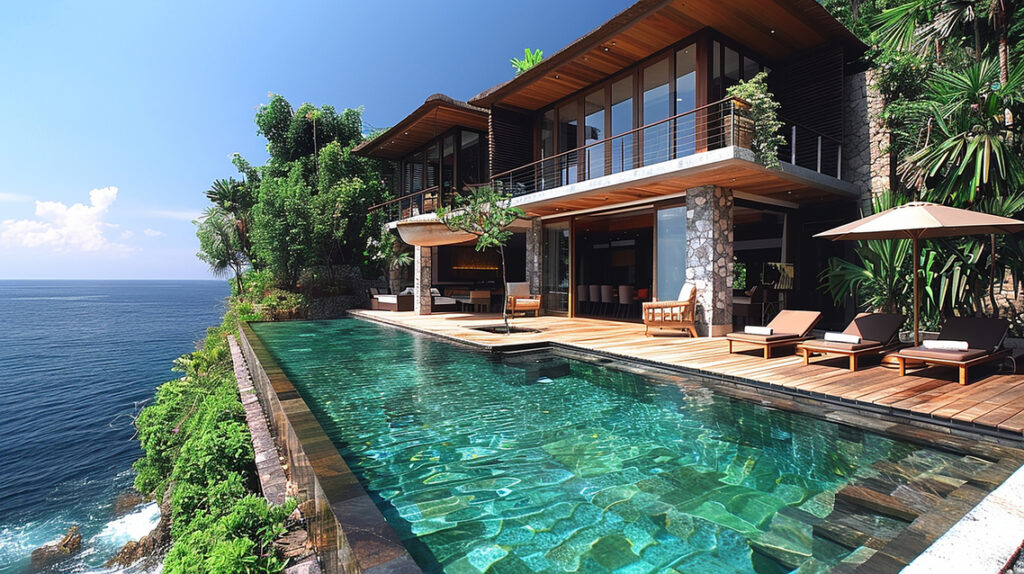
Not all Bali projects are equal. A cliff-front Uluwatu site has different stressors than inland Ubud.

| Exposure zone | Dominant stressors | Specification implication |
|---|---|---|
| Coastal (salt air) | Salt aerosols + wind-driven rain + UV | Default to 316/316L, marine aluminum, robust coatings, corrosion-aware detailing |
| Inland (dust + humidity) | Humidity + biological growth + dust abrasion | Mold-resistant finishes, sealed assemblies, drainage-first details |
| Highland / jungle edges | Humidity + rainfall + organic load | Ventilation paths, rapid drying potential, conservative palette |
If your investment thesis already feels squeezed, material failure becomes one of the silent NOI leak mechanisms that shows up later. See: Bali’s Real-Estate Bubble: Oversupply Threatens ROI.
The “Millions” mechanism: how bad material choices destroy hotel economics

Material failure costs more than replacement. It creates compound losses:
- Emergency capex (unplanned, non-negotiable)
- Operational disruption (closures, noise, scaffolding, access restrictions)
- Guest sentiment impact (visible decay signals “cheap” even in luxury)
- ADR pressure (discounting to compensate for compromised experience)
- Team bandwidth drain (engineering + housekeeping trapped in patch cycles)
Investor reality: this is preventable NOI leakage—designed into the asset at specification stage.
Zenith’s climate-smart material strategy (how we protect the investment)
Zenith bridges design intent and tropical operational reality using a disciplined review process:
1) Tropical durability analysis
We rate each proposed material against Bali stressors: salt, humidity, UV, mold risk—then flag predictable failure points early.
2) Lifecycle costing (not capex-only decisions)
We model maintenance frequency, cleaning chemistry, replacement cycles, and disruption cost—then compare whole-life options so the “cheap” spec cannot hide.
3) Local sourcing and capability alignment
We only approve assemblies that can be installed and maintained reliably in Bali—because “perfect spec, wrong capability” is another silent failure mode.
4) Preventive detailing package
We specify the things that stop tropical buildings from self-destructing: vapor barriers, waterproofing continuity, drainage planes, ventilation cavities, corrosion breaks, and UV-protective finish systems.
5) Approved tropical alternatives (same aesthetic, better survival)
When a design element is unrealistic (example: untreated exterior steel), we provide alternatives that maintain the concept but remove the maintenance trap.
If you’re coordinating architect + operator alignment in DD, see: Architect Hospitality Consultant Bali.
Is 304 stainless steel acceptable for Bali hotel exteriors?
For coastal or salt-exposed Bali hotel exteriors, 304 stainless is typically a false economy. Treat substitutions to 304 as a predictable corrosion risk unless the component is low-exposure and easily replaceable.
Practical rule: If it is exterior, safety-critical, guest-visible, or hard to replace once open—treat 316/316L as the baseline.
Zenith Material Risk Scorecard (use this in design meetings)
Score every major material system (0–5 per factor). Anything under 18/25 needs redesign.
Factors (0–5 each):
- Corrosion resistance (salt + moisture)
- Moisture tolerance (rot, swelling, delamination)
- Mold/biological resistance
- UV stability (color + surface integrity)
- Maintainability in Bali (labor, access, parts, capability)
Operator-first rule: If you cannot explain the maintenance cycle in one sentence, you do not understand the spec.
How to specify hotel materials for Bali’s climate (step-by-step)

Step 1 — Classify your exposure zones (coastal / inland / highland)
Document salt air exposure, wind direction, rainfall load, and direct sun on façades.
Step 2 — Build the wet map
Identify every wet interface: bathrooms, balconies, planter boxes, pool edges, roof penetrations, parapets.
Step 3 — Lock the non-negotiables
- Marine-grade metals for exteriors
- Continuous waterproofing strategy
- Vapor control under slabs and wet-area assemblies
- Mold-resistant interior finish strategy
If you want a deeper technical anchor for the moisture/mold logic behind this step, start with ASHRAE’s mold/dampness position document and the EPA’s moisture control guidance.
Step 4 — Approve materials only as systems (not samples)
A tile sample is meaningless without adhesive spec, substrate, waterproofing layer, grout, and movement joints.
Step 5 — Validate local installation + maintenance capability
If the system requires rare tools, foreign supervision, or imported consumables, treat it as high-risk.
Step 6 — Price lifecycle cost and disruption, then choose
Select based on whole-life cost and operational continuity—not mood boards.
What is the single most expensive material mistake in Bali hospitality?
The most expensive mistake is specifying materials that force frequent intrusive repairs in guest-facing areas—especially façades, balconies, bathrooms, and pool decks—because replacement while operating carries compounded costs: shutdowns, access/scaffolding, guest dissatisfaction, and ADR erosion. The item cost is small; the disruption cost is where “millions” happens.
Summary Takeaways
- In Bali, material selection is a financial decision, not a styling decision.
- If your designer is not specifying for salt + humidity + UV, you are buying future emergency capex.
- Treat 316/316L and marine aluminum as baseline for exterior metals; don’t allow “equivalent” substitutions.
- Approve assemblies as systems (substrate → waterproofing → adhesive → finish), not samples.
- Lifecycle cost is the truth: maintenance frequency and disruption dominate long-term NOI.
- Treat hotel materials tropical climate Bali as an NOI protection strategy, not an interior styling decision.
CTA — Want Zenith to pressure-test your material schedule before you build?
If you’re in schematic design, DD, or pre-tender, Zenith can run a Bali climate durability + lifecycle cost review of your material schedule and key assemblies—flag failure points, propose tropical-safe alternates, and align design intent with operational reality.
Request a review via: Business Consultant in Bali
FAQ
How much more do “tropical-proof” materials cost upfront?
Usually less than teams fear—because the smart move is not “upgrade everything,” it’s upgrade the failure points (exteriors, wet zones, sun-exposed surfaces, hard-to-replace components). The capex delta is often modest compared to the cost of one major rectification while operating. Lifecycle costing is the only honest way to decide.
Do we really need 316/316L stainless for Bali hotel exteriors?
If your building is in a coastal catchment, exposed to onshore wind, or uses exterior metalwork that stays damp, 316/316L is typically the correct baseline. Treat 304 substitutions as high-risk unless the component is low-exposure and easily replaceable.
Can we use timber in luxury Bali design without it becoming a maintenance nightmare?
Yes—if you treat timber as a managed system: durable species, correct drainage and ventilation detailing, sealing strategy, and a documented re-oiling cycle. If the operator cannot sustain that cycle, replace timber looks with composites or stone and preserve the design intent without the failure.
What’s the biggest mistake designers make with bathrooms in Bali hotels?
Approving finishes as aesthetics instead of assemblies. Bathrooms need continuous waterproofing logic, correct substrates, compatible adhesives/grouts, movement joints, and planned drying/ventilation. Treat bathrooms like wet engineering, not interior decoration.
How do we align materials with Bali’s maintenance reality?
Assume maintenance budgets and discipline will be imperfect. Therefore, eliminate high-frequency failure points and specify robust, locally serviceable systems. Align every major assembly with local capability for installation and upkeep.
About the Author
André Priebs is the CEO of Zenith Hospitality Global, an operator-first hospitality consultancy focused on luxury boutique hotels, lifestyle retreats, and wellness/longevity assets in Bali and Indonesia. Zenith supports owners, developers, and design teams with concept and Product DNA work, design-to-operations alignment, pre-opening systems, and commercial performance—so the project opens right and stays profitable.
Further reading: Zenith Blog and Bali Boutique Hotel Brand Strategy.