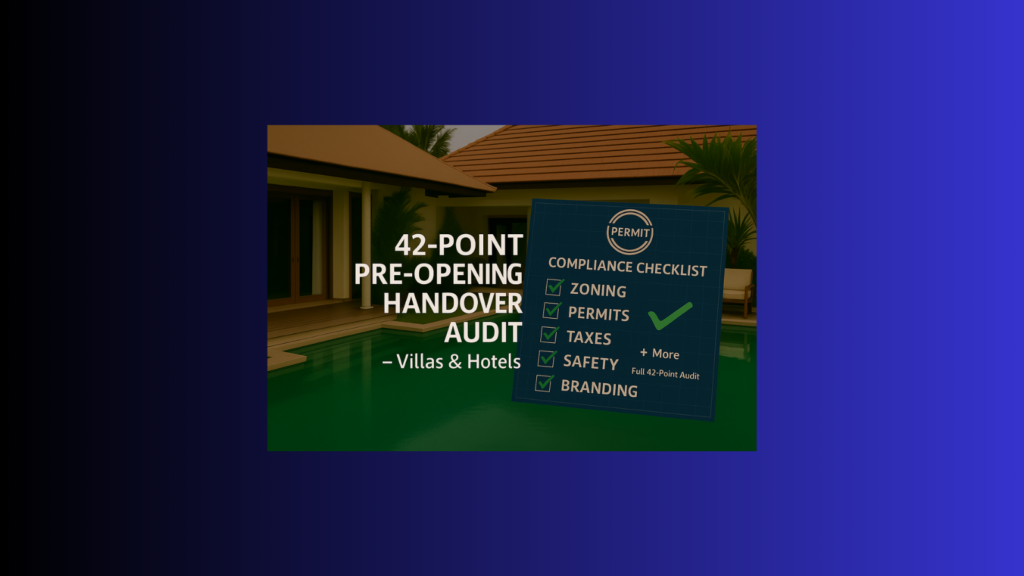
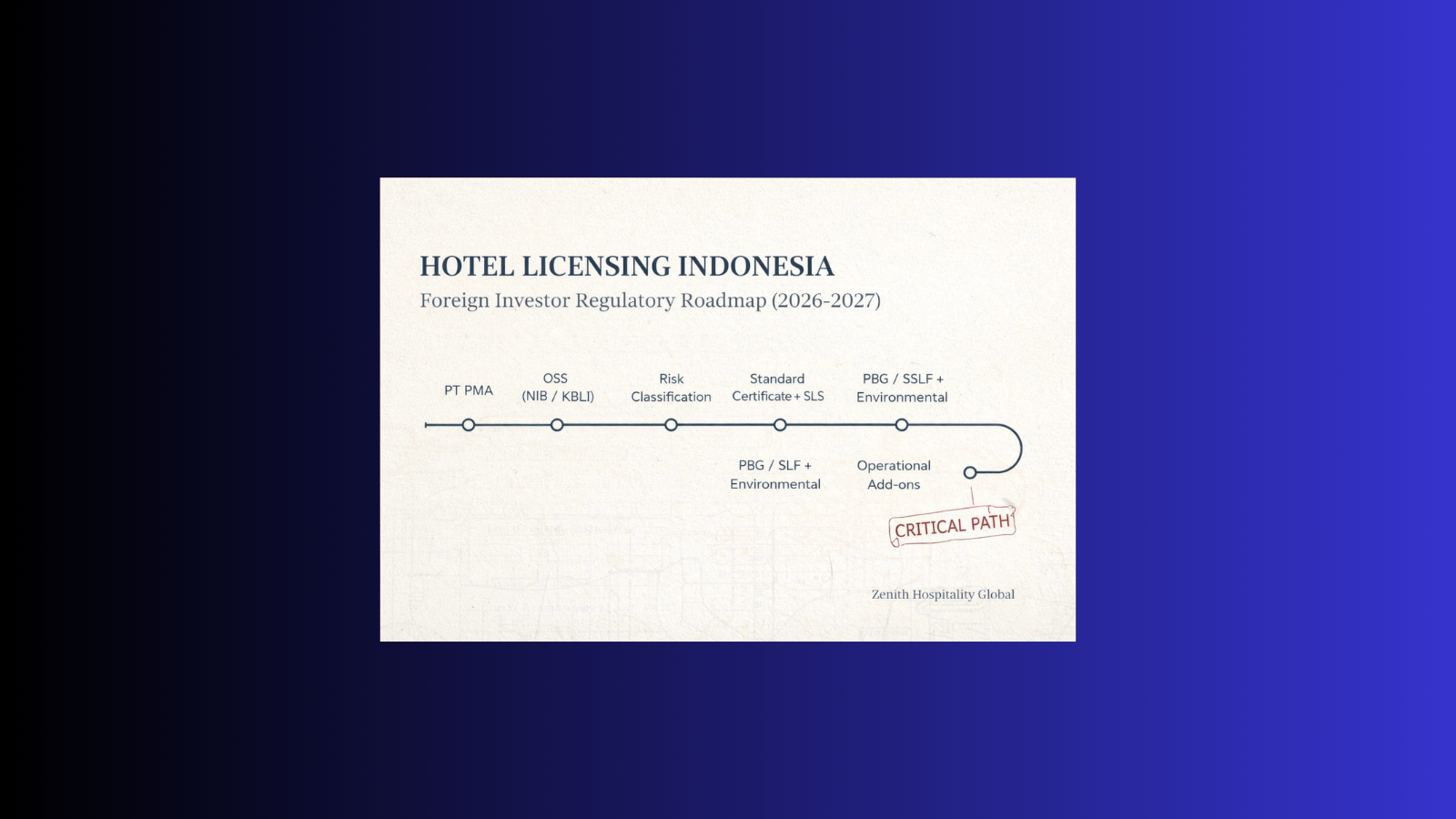
Hotel licensing Indonesia foreign investor is not “hard” — it’s sequential. If you miss the sequence, your project can end up in the worst possible state: land secured, capex spent, construction progressing, but commercial operations blocked because the legal stack does not match the asset, zoning, and risk category.
This guide is for foreign investors, developers, and legal advisors searching hotel licensing Indonesia foreign investor and needing a complete, practical roadmap — from PT PMA structuring to OSS RBA licensing to provincial enforcement in Bali and Jakarta. In short, treat licensing like a critical path, not paperwork.
If you want the short version first, treat licensing like a critical path rather than paperwork. In practice, that mindset prevents most avoidable delays.
TL;DR — Key Takeaways
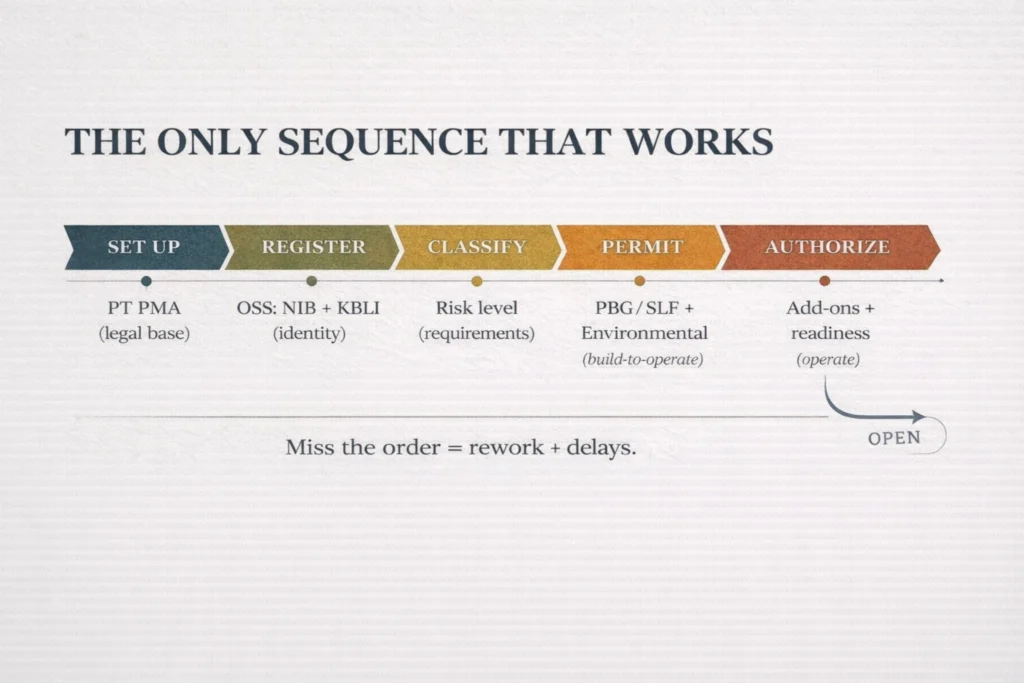
- Hotel licensing Indonesia foreign investor is a multi-permit stack, not one license: PT PMA → OSS (NIB/KBLI) → risk-based approvals → building + environmental + health/safety certificates → tourism operational readiness.
- Under OSS RBA, licensing requirements depend on risk level; medium/high risk typically requires a Standard Certificate + Sanitary Certificate (SLS) in addition to the NIB.
- Bali enforcement is tightening (and OTA consequences are real); investors must align zoning, permits, and tourism licensing early.
- Expect licensing to be a critical path (often 6–12 months+ depending on asset type, environmental triggers, and local processing).
For related reading, start at the Zenith Blog.
What is the real “hotel licensing” problem foreign investors underestimate?
Most investors underestimate that hotel legality in Indonesia is controlled by alignment — entity structure (PT PMA), OSS registration (NIB + correct KBLI), risk-based licensing (Standard Certificate + SLS where required), and building/environmental approvals (PBG/SLF + AMDAL/UKL-UPL/SPPL). If any layer is missing or mismatched, operations can be delayed, restricted, or de-listed from major channels.
Additionally, this risk increases when the licensed activity (KBLI), zoning, and building classification drift out of alignment during design changes.
What this means in practice:
You can have a “company” and still have no legal pathway to operate if your KBLI doesn’t match the actual accommodation model (hotel vs serviced apartment vs villa rental), or if zoning/building approvals don’t match how you intend to monetize the asset.
If you’re building in Bali, read: Navigating Bali’s licensing maze: why investors get it wrong.
Set Up — PT PMA as the Operating Entity: the legal base for hotel licensing Indonesia foreign investor
If you are a foreign investor, PT PMA (foreign investment company) is generally the legal vehicle for operating a hotel business in Indonesia. From there, the OSS system issues your business identity and routes the rest of the licensing stack. As a result, PT PMA setup becomes the foundation for the entire compliance sequence.
What you must lock early
- Shareholding + governance: shareholder composition, director/commissioner structure.
- Investment plan logic: realistic phasing (construction timeline + opening date + capex schedule).
- Correct KBLI mapping: your business classification must match your asset and monetization model.
A helpful reference overview: Indonesia licensing requirements (International Trade Administration).
Why this matters commercially
Banks, investors, and institutional partners increasingly want to see a clean entity + permit stack early because it signals exitability, operability, and reduced shutdown risk.
Register — OSS RBA to Get NIB + KBLI
OSS RBA is Indonesia’s national online licensing gateway. Once your PT PMA is ready, you register in OSS to obtain your NIB (Business Identification Number). Importantly, the NIB is your core business identity and becomes the anchor for risk-based licensing requirements and approvals. Therefore, errors in KBLI selection or risk classification tend to cascade into delays later.
Start here: OSS (Online Single Submission) portal.
Practical checklist (OSS fundamentals)
- Register the entity and apply for NIB
- Ensure KBLI codes reflect your actual hotel/accommodation model
- Confirm your licensing risk level under OSS RBA (low / medium / high)
- Use OSS as the control hub to track certificate issuance and compliance status
Classify — Risk Level and Required Certificates
Indonesia classifies hotel and lodging businesses by risk level, which determines which permits are required. In other words, the same “hotel” concept can face a different license stack depending on scale, facilities, and operating model. Consequently, the fastest path is to confirm your risk category early and build the permit sequence around it.
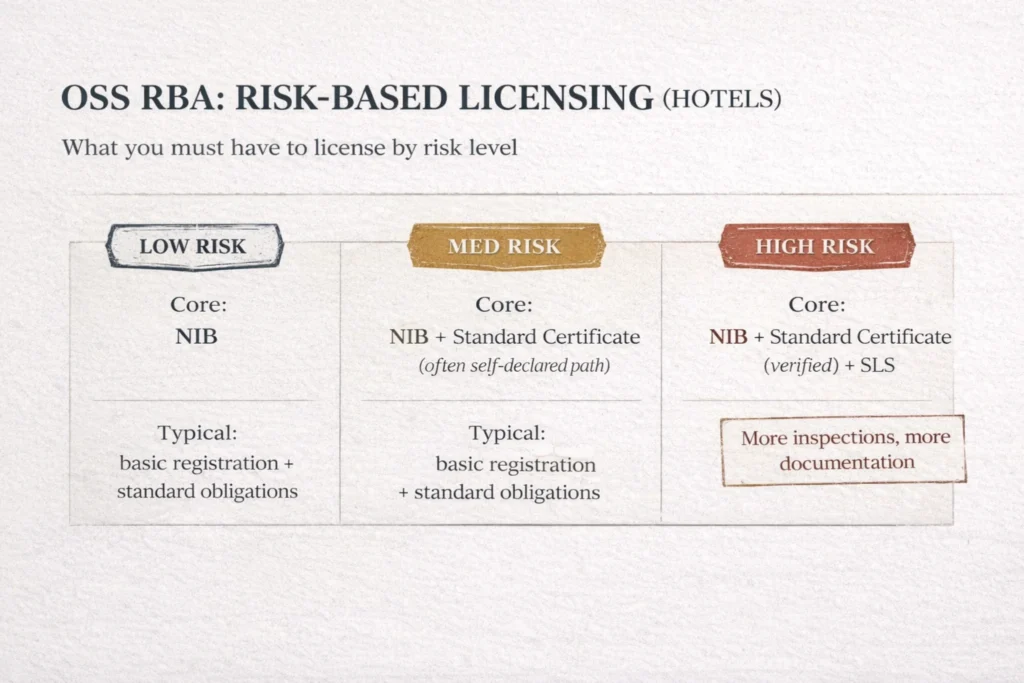
Typical OSS RBA outcomes for accommodation
- Low-risk: NIB only (e.g., some non-star villas / hotels ≤60 rooms).
- Medium-risk: NIB + (often) “unverified” Standard Certificate + SLS.
- High-risk: NIB + verified Standard Certificate + SLS.
What is the “Standard Certificate” in hospitality?
The Standard Certificate (tourism business certification) verifies key operational standards and is issued via the applicable tourism oversight pathway.
What is the SLS and why do hotels get stuck here?
The Sanitary Certificate (SLS / Surat Laik Sehat) typically requires health-office inspection after submission through OSS, and it frequently becomes a time-driver in pre-opening.
A practical explainer that mirrors the OSS categories: Airbnb Responsible Hosting — Indonesia licensing overview.
Permit — Building, Occupancy, and Environmental Approvals
This is where many projects fail because investors assume: “Construction is progressing, so permits are fine.” However, in Indonesia, legality requires specific approvals and sequencing. For that reason, building and environmental compliance should be treated as pre-opening critical path items, not late-stage paperwork.
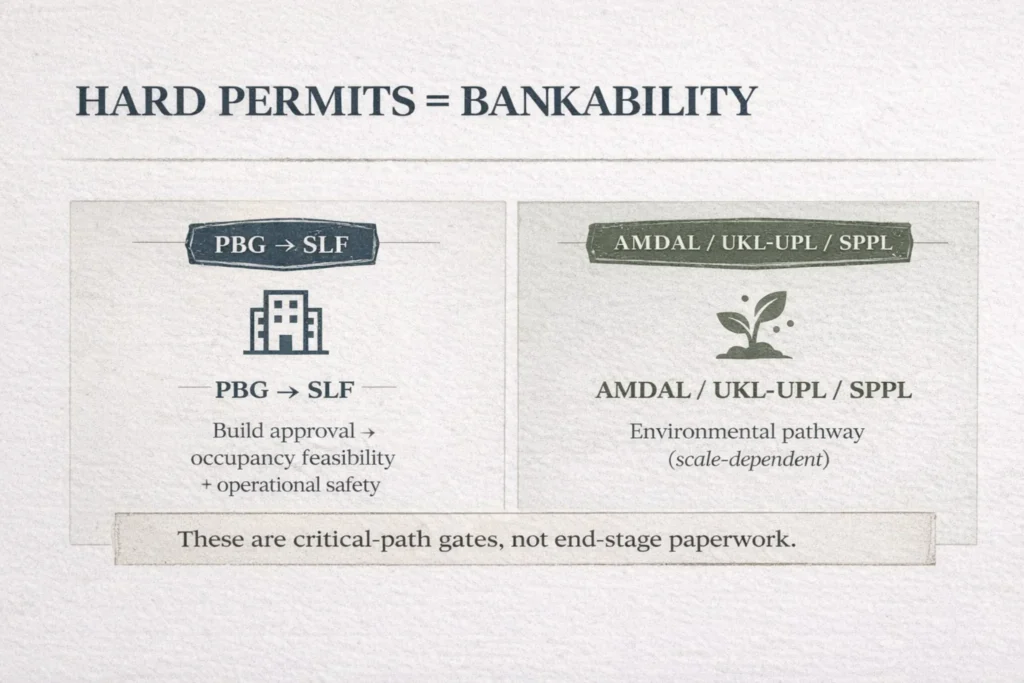
Building approvals (PBG) + operational safety (SLF)
Any new construction or renovation requires a PBG and later an SLF (operational safety / occupancy feasibility). Treat this as non-negotiable for bankability and opening-readiness.
Environmental approvals (AMDAL / UKL-UPL / SPPL)
Large developments generally require an AMDAL; mid-scale often needs UKL-UPL; small projects may file SPPL. Decide the pathway early and integrate it into the critical path.
Authorize — Operational Certificates and Revenue Add-ons
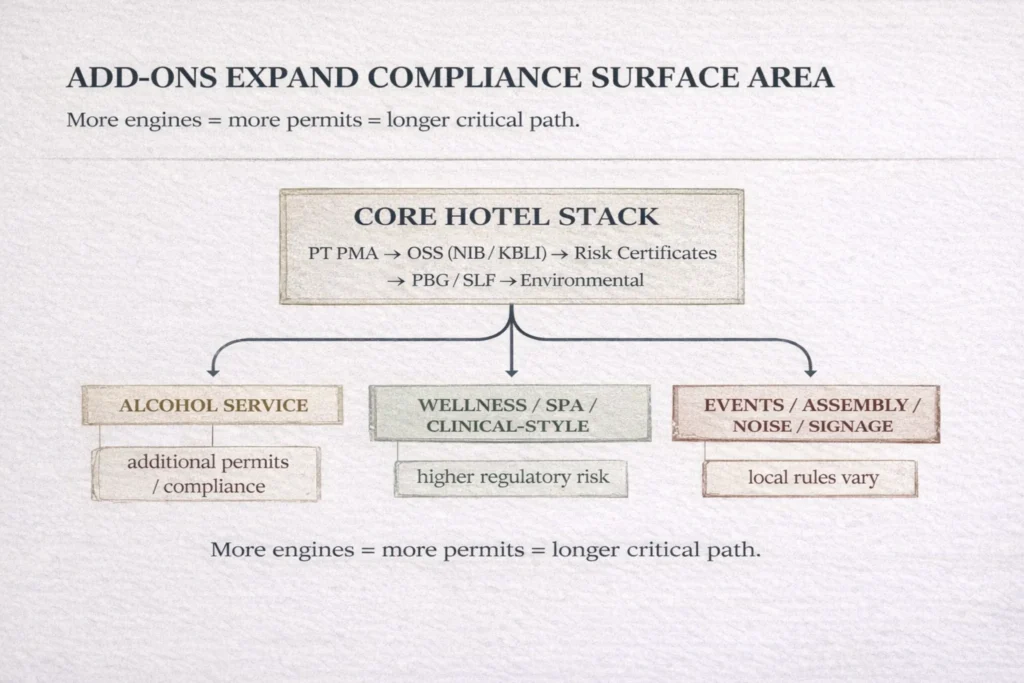
Hotel licensing becomes materially more complex once you add revenue engines. For example, bars, wellness, and events each introduce additional approvals or inspections depending on setup. Moreover, every add-on increases compliance surface area, which is why operators should plan the licensing stack around the commercial program from day one.
- Bars / alcohol service (may require additional licensing depending on setup)
- Wellness / spa / clinical-style offerings (higher regulatory risk; scope control matters)
- Events / noise / signage / assembly elements (local rules vary)
Rule: every additional commercial engine adds compliance surface area.
For broader compliance content, see the Zenith Blog.
Bali vs Jakarta: what is different in practice?
Bali: stricter visibility + faster enforcement pressure
Bali is a high-enforcement environment for tourism accommodation legality. Therefore, zoning and permit alignment must be validated early — otherwise you risk operational restrictions and channel consequences.
Direct reference: Circular Letter No. 4/2025 on licensing registration for tourism accommodation (PDF).
Jakarta: more institutional scrutiny and documentation discipline
Jakarta tends to be more documentation-driven for corporate-grade developments. As a result, tolerance for informal “gaps” is lower, especially when financing, auditors, or institutional partners are involved.
Simple comparison table: Bali vs Jakarta (licensing reality)
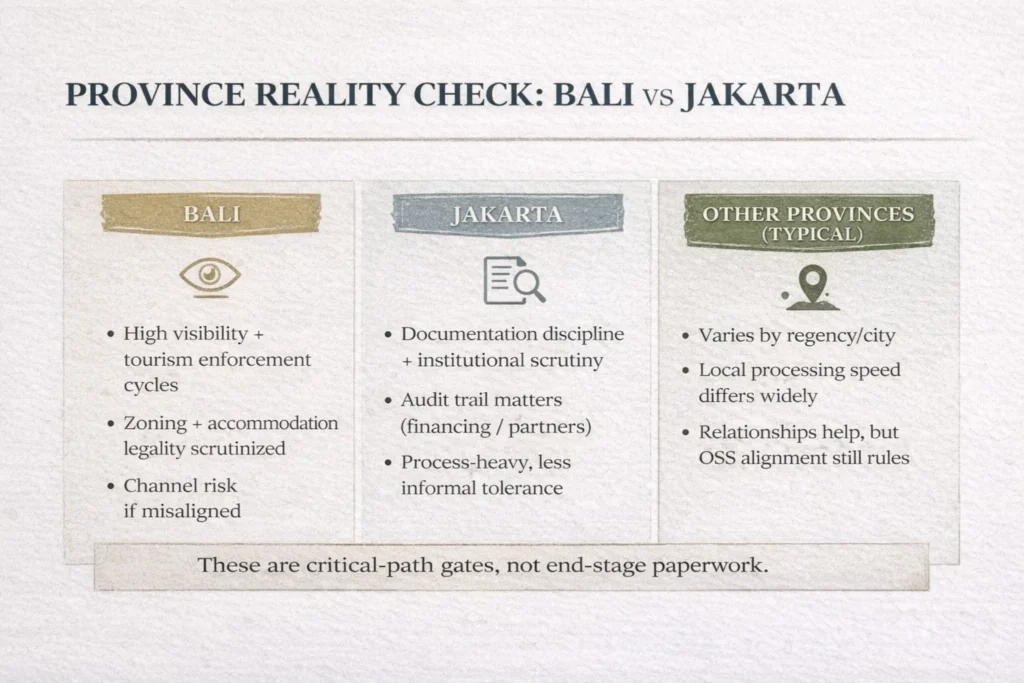
| Topic | Bali | Jakarta |
|---|---|---|
| Enforcement pressure | High visibility; tourism-driven enforcement cycles | High documentation discipline; corporate compliance expectations |
| Common failure mode | Zoning mismatch + incomplete permit stack | Documentation gaps + operational readiness proofs |
| Investor risk | OTA delisting / operational shutdown | Permit delays affecting opening and financing milestones |
New build vs acquisition vs conversion: the licensing routes are not the same
A greenfield build typically requires end-to-end approvals (zoning alignment → PBG/SLF → environmental → OSS certificates). An acquisition can inherit permits only if permits match the current use and ownership structure. A conversion (e.g., villa → hotel) often triggers higher risk because zoning, building classification, and tourism licensing must be realigned.
If you want the Bali-specific conversion reality, start here: Navigating Bali’s licensing maze.
How To: Hotel licensing Indonesia foreign investor (a practical 10-step execution sequence)
This is the execution sequence we use to prevent rework and delays:
- Asset classification decision: define the operating model (hotel / resort / serviced residence / villa rental).
- Zoning + land use check: confirm the property can legally host tourism accommodation in that district.
- Entity strategy: confirm PT PMA structure, shareholders, governance, and capex staging.
- KBLI mapping workshop: select correct KBLI codes for accommodation + supporting activities.
- OSS setup + NIB issuance: obtain NIB through OSS.
- Risk classification confirmation: confirm whether you trigger Standard Certificate verification + SLS.
- Building approval (PBG) + construction governance: align design docs to permitting.
- Environmental pathway selection: AMDAL vs UKL-UPL vs SPPL; integrate consultants early.
- Operational certificates: complete Standard Certificate + SLS inspection and issuance.
- Pre-opening compliance lock: verify SLF, local taxes, and add-on permits (e.g., alcohol).
Reality check: foreign hotel developers should allow 6–12 months+ just for licensing, depending on the project.
What changed in 2024–2026, and what it signals for 2027?
Indonesia has been streamlining processes while tightening enforcement. At the same time, regulatory updates have codified risk-based licensing and increased supervision. As a result, mismatches are more likely to surface earlier in the project lifecycle.
For a legal interpretation lens: Herbert Smith Freehills Kramer — new Indonesian investment rules (2025).
2027 expectation (practical forecast):
Expect OSS to become more data-integrated across ministries and local governments, increasing the chance that mismatches (zoning, building classification, tourism licensing) surface earlier — and enforcement becomes more systematic.
Common pitfalls (and how to avoid them)
- Wrong KBLI = wrong business
If KBLI doesn’t match reality, the licensing stack becomes fragile. - Treating permits as “paperwork,” not a critical path
Your schedule, financing milestones, OTA distribution, and exit value depend on this. - Building first, legal alignment later
This is how projects get trapped in a sunk-cost problem. - Assuming “local workaround” beats national systems
OSS centralization reduces tolerance for mismatches over time.
If you want a broader Indonesia development lens, see: Indonesia emerging destination hotel investment: the “10 New Balis” opportunity.
What Zenith does differently: licensing as an investor-grade operating system
Zenith treats licensing as a governance system that protects:
- financing readiness
- construction legality
- operational launch dates
- auditability and exit value
We coordinate PT PMA structuring guidance, OSS RBA navigation, permit sequencing, certification coordination, and compliance monitoring — so the project stays bankable and operationally real.
Explore more resources: Zenith Hospitality Blog.
FAQ (Hotel licensing Indonesia foreign investor)
1) What is the minimum legal setup to operate a hotel as a foreign investor?
In most cases you need a PT PMA, then register via OSS RBA to obtain the NIB and correct KBLI. Your risk category then determines additional certificates (Standard Certificate and SLS where applicable) plus building and environmental approvals (PBG/SLF and AMDAL/UKL-UPL/SPPL as applicable).
2) How long does hotel licensing take in Indonesia?
A realistic planning range is often 6–12 months or more, depending on new build vs acquisition vs conversion, environmental pathway, local permitting speed, and inspection scheduling for certificates. Treat licensing as a critical path, not paperwork.
3) Is Bali stricter than other provinces?
Bali is a high-enforcement environment for tourism accommodation legality. Zoning and permit alignment must be validated early — otherwise you risk operational restrictions and channel consequences.
4) What is the biggest risk after opening?
Ongoing compliance is underestimated: renewals, reporting, inspections, tax registrations, and maintaining alignment between actual operations and licensed activities. Non-compliance can trigger sanctions including suspension, fines, or license revocation.
Summary Takeaways
- Treat hotel licensing Indonesia foreign investor as a sequenced critical path, not a document pack.
- Before design and construction, lock zoning + operating model + KBLI to avoid rework.
- Under OSS RBA, the risk category determines whether you need Standard Certificate verification + SLS beyond the NIB.
- As a rule, plan 6–12 months+ for licensing-heavy projects and align financing milestones accordingly.
- In Bali, expect tighter enforcement and build your compliance stack for auditability and channel resilience.
Call to Action
If you’re early in planning, a 60–90 minute licensing roadmap session can save months of rework. Zenith can map your full permit sequence (PT PMA → OSS RBA → PBG/SLF → environmental → certificates) and identify the true critical path for your asset and province.
Start here: Zenith Hospitality Global.
AUTHOR
André Priebs — CEO, Zenith Hospitality Global
Operator-first hospitality advisory for luxury boutique hotels, lifestyle retreats, and wellness/longevity assets across Indonesia and SE Asia — focused on Product DNA, pre-opening governance, operating systems, and commercial performance.