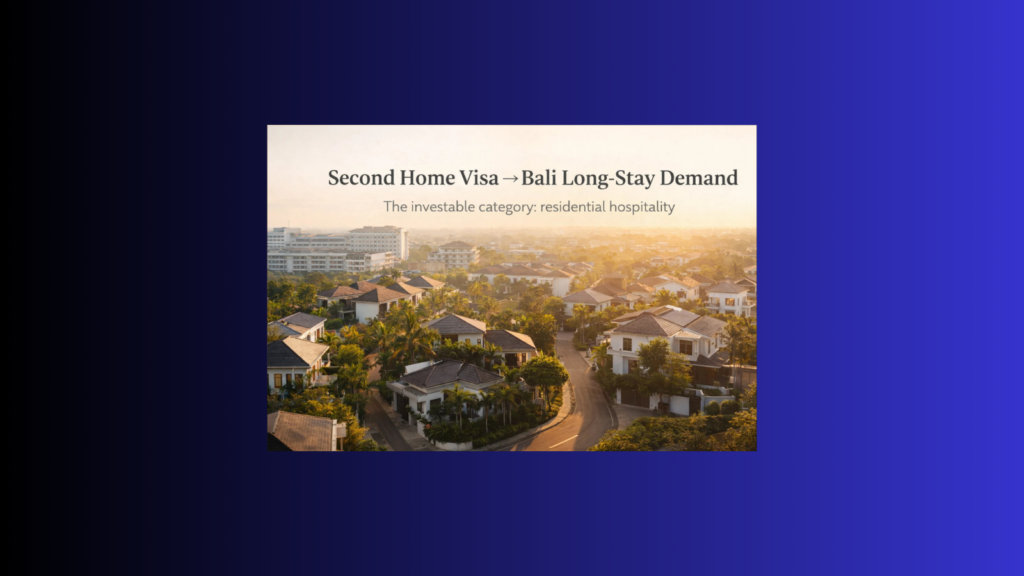

Bali’s most profitable developers are no longer optimizing for presale velocity. They are optimizing for brand equity, operating performance, and long-term asset value—because in today’s Bali/Indonesia reality, “sell fast, move on” increasingly produces operationally non-viable properties that underperform after opening. This is exactly what a hotel developer brand strategy addresses: treating hospitality as a long-term operating business, not a construction product.
This is the core of a hotel developer brand strategy: treating hospitality as a long-term operating business, not a construction product.
TL;DR (for developers + asset managers)
- If your business model ends at handover, your project can win presales and still lose long-term.
- In Bali, oversupply pressure + tighter controls + more sophisticated buyers are forcing a new playbook.
- A modern developer approach integrates concept, governance, operator alignment, and asset management—before you pour concrete.
If you want the Bali context on supply pressure and ROI compression, read: Bali’s real-estate bubble: oversupply threatens ROI.
Why do presales “succeed” while the asset fails after opening?
Direct answer (40–60 words):
Presales measure marketing momentum, not operational viability. Many Bali projects sell because the brochure story works—but after opening, fragmented ownership, weak governance, late operator selection, and uncontrolled discounting can destroy service consistency and ADR. You can deliver the building perfectly and still create a structurally weak hospitality business.
The traditional Bali development pattern is familiar:
- Sell off-plan
- Deliver units
- Collect final payment
- Exit

This model can optimize development margin, but often creates post-opening realities that are hard to reverse:
- inconsistent service standards
- owner conflict / fragmented decision-making
- operator churn or amateur self-management
- reactive discounting (“rate wars”)
- weak reinvestment discipline and capex disputes
- investor disappointment and reputational damage
Why Bali hotel development strategy must shift now (not later)?
1) Policy direction is tightening—and uncertainty itself is risk
Bali’s government has repeatedly signaled stronger controls on new accommodation development to address overbuilding and overtourism. Developers should treat this as a planning and bankability issue, not a media headline. See: Reuters coverage on Bali’s hotel/villa construction restrictions discussion.
2) Buyers are getting smarter: governance + management are becoming “bankability”
In a crowded market, buyers increasingly want operational certainty: real standards, real management, and credible positioning. One very clear market signal is the premium paid for branded residences and brand-linked governance models.
3) Oversupply punishes generic product
When too much similar inventory hits the market, the default outcome is rate competition. To defend ADR, you need differentiation, standards, and operator-grade execution—not just design aesthetics.
What does “hotel developer brand strategy” actually mean in Bali?
It is not a logo exercise. It is a business model shift where the developer designs the project around repeatable demand, operational excellence, and controlled standards.
A practical definition:
- Brand = promise + system (not visuals)
- Operations = the valuation engine (not an afterthought)
- Governance = the control layer that prevents drift and discounting
- Asset management = compounding discipline over time

If you want a governance-first view of why many hospitality projects fail at the top, see: Hotel management contract misalignment: fix it now.
Hotel developer brand strategy vs presale-and-exit: what changes in practice?
| Dimension | Presale-and-exit (“sell fast”) | Hold-and-build (“build brands”) |
|---|---|---|
| Primary KPI | Presales velocity | RevPAR, GOP, reputation, valuation |
| Governance | Fragmented (many owners) | Centralized (asset-led decisioning) |
| Operator alignment | Optional / late | Early + contractually structured |
| Product DNA | Often superficial | Drives design, ops, and commercial |
| Outcome risk | High post-opening collapse risk | Value compounds over time |
This is why a hotel developer brand strategy is a business model, not marketing.
Do branded and professionally managed assets really command a premium in Bali?
Direct answer (40–60 words):
Yes, because the premium is “priced trust.” Brand affiliation and professional management reduce execution risk for buyers, improve guest experience consistency, and protect ADR. That combination improves perceived and actual bankability—especially in an oversupplied market where generic units compete on price and suffer volatile occupancy.
For a Bali-specific market reference, review Horwath HTL / C9 Hotelworks: Bali Hotel & Branded Residences Report (PDF).
The Bali trap: selling ROI narratives instead of building operating truth
In Bali, it has been common to sell off-plan units with ROI narratives, then discover at opening that the asset cannot deliver those returns after:
- distribution costs and commissions
- staffing reality and payroll inflation
- seasonality
- utilities and maintenance
- rate competition
- weak governance and inconsistent standards
If you want a hard reset on “ROI storytelling vs operating reality,” read: Hospitality ROI in Southeast Asia: the ROI lie exposed.
What “brand-building” actually requires (not optional extras)
1) A differentiated concept with commercial edges
Not “nice design.” A defensible concept that answers:
Why will guests choose us here, at this price, next year and in 5 years?
2) A defined operating model before design is locked
Service level, staffing logic, outlet economics, maintenance logic, guest flow, and noise/privacy rules are not decoration. They are unit economics.
If you need a pre-opening execution backbone, use: Pre-opening SOP checklist: the blueprint of hotel success.
3) A professional operator partnership model
Institutional outcomes require institutional alignment:
- KPI regime and reporting cadence
- budget governance
- performance tests
- incentive alignment (profit matters, not just topline)
4) Asset management discipline (post-opening compounding)
Asset management is what prevents drift into discounting. It keeps the operation aligned with ownership objectives and forces decisions early—before bad habits become permanent.
How do you build this shift into your deal structure?
Direct answer (40–60 words):
You hardwire alignment beyond handover. That can mean developer retention (equity), revenue share, performance-linked earn-outs, or operator incentives tied to GOP/NOI—not vanity metrics. The structure must protect standards, enforce reinvestment, and prevent “sell-out then discount-out.”
How to shift from selling units to building brands (Bali/Indonesia playbook)
Step 1 — Decide your real objective (development margin vs asset value)
- If your objective is margin-only, be honest about the exit—and price risk accordingly.
- If your objective is long-term value, accept that you are building a business, not a product.
Output: written investment thesis (3–5 lines) + target hold period + return hierarchy.

Step 2 — Build the “Concept-to-Operations” spine before schematic design
Lock the non-negotiables early:
- target guest segments
- pricing power thesis
- service level and staffing logic
- outlet strategy (F&B/wellness/experiences)
- access, flow, privacy, acoustics, maintenance logic
Output: Product DNA / Operating Narrative brief that designers must follow.
Step 3 — Choose the right operator pathway (and structure it owner-first)
Common pathways in Bali:
- white-label operator (owner brand, operator runs)
- branded operator (flag + systems)
- hybrid (owner brand + third-party operator + tight governance)
Output: operator scorecard + draft deal terms + governance matrix.
Step 4 — Engineer your unit economics (not brochure ROI)
Model:
- ADR bands (conservative/base/upside)
- occupancy seasonality by segment
- distribution costs
- staffing and payroll reality
- utilities and maintenance
- reserve funding
- compliance costs
Output: three-scenario operating model with covenant-style triggers.
Step 5 — Design governance for a multi-owner environment (if you sell units)
If you sell units, you must engineer:
- owner association decision rights
- capex funding logic
- rental pool rules
- performance accountability
- brand standards enforcement
Output: governance term sheet + operating rules addendum.
Step 6 — Install asset management discipline from day 1 post-opening
- KPI cadence (weekly/monthly/quarterly)
- budget governance
- pricing guardrails
- guest experience QA routines
- repositioning triggers
Output: asset management dashboard + 12-month value plan.
Where Zenith fits (authority angle, Bali-first)
Zenith supports developers transitioning from transactional builds to brand-building platforms by integrating:
- concept development and portfolio differentiation
- operating model design (pre-opening systems, SOP architecture)
- operator partnership structuring and governance
- asset management strategy and long-term value optimization
If your project also requires licensing/compliance and investor structure alignment, start here: Business consultant in Bali: compliance & strategy for success.
FAQ (Bali/Indonesia)
1) Is a hotel developer brand strategy only for luxury projects?
No. In Bali, brand strategy is primarily about positioning clarity and operating discipline, not décor. Even midscale or lifestyle assets benefit because the market punishes generic supply. If you lack differentiation, you compete on price. If operations are weak, you lose reviews, ranking, and repeat demand—then ADR collapses.
2) What’s the fastest way a presale-led project fails after opening?
Usually through misaligned governance: many owners, no binding standards, weak operator selection, inconsistent reinvestment discipline, and reactive discounting. The property starts chasing occupancy at any cost, quality slips, and rates fall. In oversupplied pockets of Bali, that spiral accelerates quickly.
3) Do branded residences really increase value in Bali?
The market strongly signals yes. Brand-linked standards and professional management reduce execution risk and stabilize guest experience delivery. In Bali, where buyers increasingly care about bankability and reliable performance, that “trust layer” can translate into a meaningful pricing premium. Reference: Horwath HTL / C9 Hotelworks report (PDF).
4) Should developers in Bali partner with operators early or after construction?
Early. Operator input affects design-to-operations feasibility: back-of-house sizing, staffing flow, outlet economics, acoustics, maintenance logic, and guest journey. If you wait until late stages, you lock in expensive operating inefficiencies. Early alignment is a margin decision.
5) What external data should I use to sanity-check demand and market timing?
Use official and reputable sources first: BPS Bali tourism statistics for historic inbound patterns, and macro spend outlook like WTTC Indonesia visitor spend projections. Then pressure-test your submarket comp set and your positioning—not just “Bali demand.”
Summary Takeaways
- Presale velocity is not profitability; in Bali it can hide operational fragility.
- A hotel developer brand strategy is concept + governance + operator alignment + asset management.
- Brand-linked standards and professional management are increasingly priced as “trust” in buyer behavior.
- If you sell units, governance is not optional—engineer enforceable standards or expect drift.
- The long-term winners in Bali will defend ADR through differentiation and execution, not inventory volume.
Call to Action
If you are developing in Bali/Indonesia and want to move beyond build-and-flip economics, Zenith can pressure-test your project’s concept, operating model, and operator structure—so your asset performs post-opening, not just in the brochure.
Author
André Priebs is the CEO of Zenith Hospitality Global, advising developers and owners across Bali/Indonesia on concept strategy, pre-opening systems, operator partnership structuring, and asset performance. Zenith is operator-first: we design projects to win in real operations—service consistency, commercial performance, and long-term value creation.