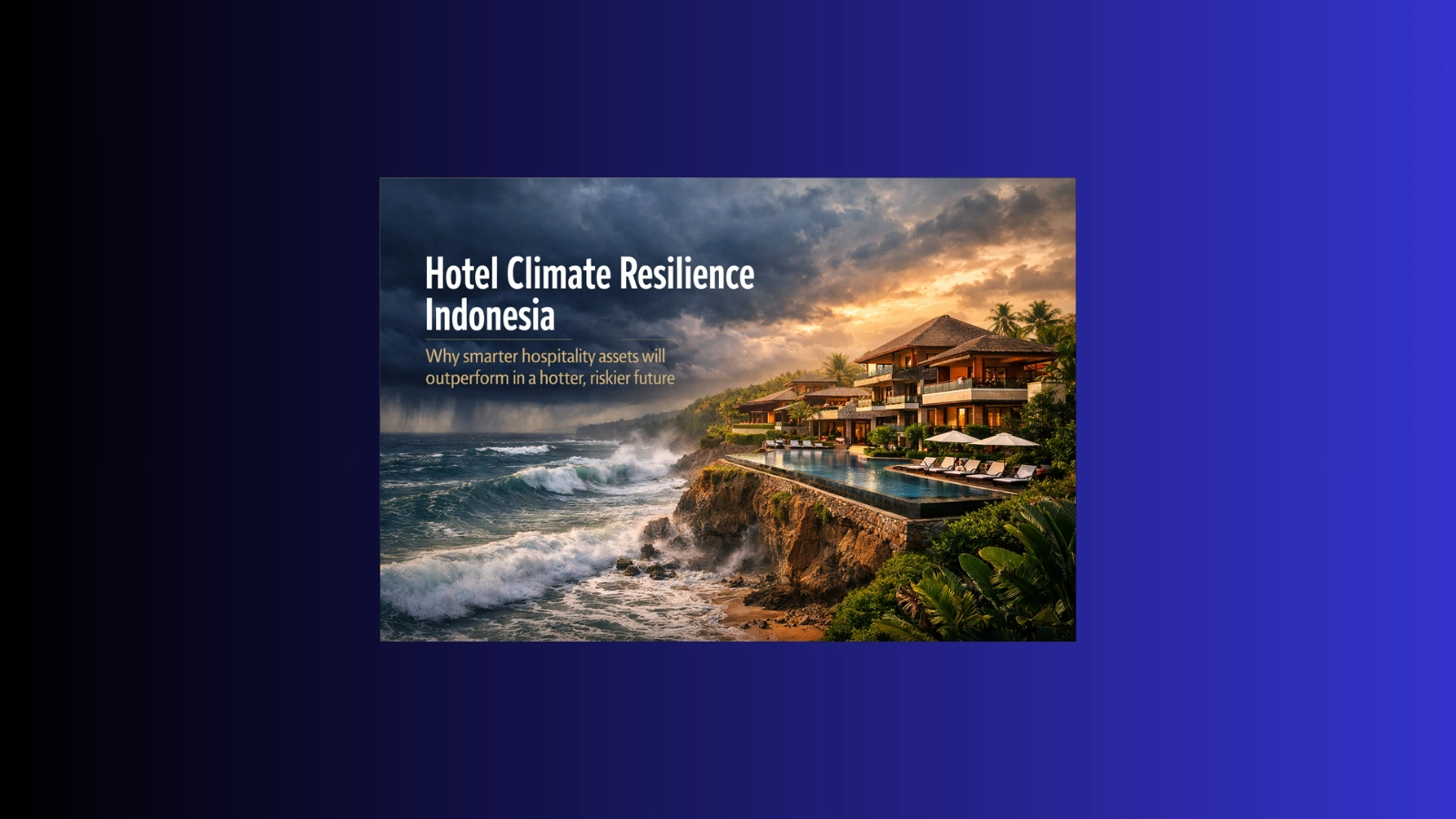
Climate risk is now part of hospitality underwriting. Hotel climate resilience Indonesia is no longer a sustainability side topic for ESG slides. It is a hard investment question for developers, foreign investors, and asset managers holding hotel assets for 20 to 30 years.
Indonesia’s environmental risk profile is becoming more material, not less. Rising sea levels, heavier rainfall, coastal erosion, coral reef degradation, water stress, and higher heat loads are already affecting site viability, infrastructure reliability, and long-term destination quality. For hotel investors, that changes how land should be screened, how design briefs should be written, and how capital expenditure should be phased.
TL;DR
- Climate-blind hospitality projects risk becoming stranded assets long before the building reaches the end of its physical life.
- In Indonesia, hotel resilience starts with micro-location, not branding.
- The winning projects will combine smarter site selection, resilient design, water and energy security, and phased adaptation planning.
If you already follow Zenith’s work on Bali hotel feasibility and commercial logic, integrated hospitality models, and pre-opening asset readiness, this is the next layer of the same conversation: protecting asset value before risk is locked into the land, the concept, and the engineering brief.
Why is hotel climate resilience Indonesia now a serious investment issue?
Direct answer: Climate risk now affects the physical durability, operating stability, insurability, and exit profile of Indonesian hotel assets. That means hotel climate resilience Indonesia is an investment protection issue, not just an environmental positioning exercise.
A 20 to 30 year hotel hold period is long enough for today’s climate pressures to become tomorrow’s balance sheet problem. A beach resort can have strong demand and still become a weak asset if the shoreline retreats, the drainage fails, access roads flood, or insurers start pricing the site more aggressively.
This is especially important in Indonesia because the country is structurally exposed. It has thousands of inhabited islands, extensive coastline, and a tourism economy concentrated in exactly the kinds of environments that climate volatility hits first. According to a World Bank policy note on disaster resilience in Indonesian cities, coastal flooding exposure is expected to rise significantly as sea levels increase.
The uncomfortable truth is simple: a hotel can be legally sound, beautifully designed, and commercially attractive at opening, then still underperform later because climate risk was not properly priced into site selection and design.
What climate risks matter most for hotel climate resilience Indonesia?
Direct answer: The most material climate risks for hotel assets in Indonesia are coastal flooding and erosion, extreme rainfall and landslides, marine ecosystem degradation, water scarcity, and rising heat loads. The mix changes by site type, but the risk is already operationally relevant.
1. Coastal flooding, sea-level rise, and erosion
For coastal hotels, sea-level rise is only part of the story. The bigger issue is the combination of rising baseline sea level, stronger surge exposure, shoreline retreat, drainage overload, and saltwater intrusion.
Research referenced in our working pack highlights that major Bali tourism zones such as Kuta, Seminyak, Sanur, and Canggu sit inside highly vulnerable coastal corridors. That matters because those are exactly the locations where investors often feel most commercially confident. Confidence in demand does not remove physical exposure.
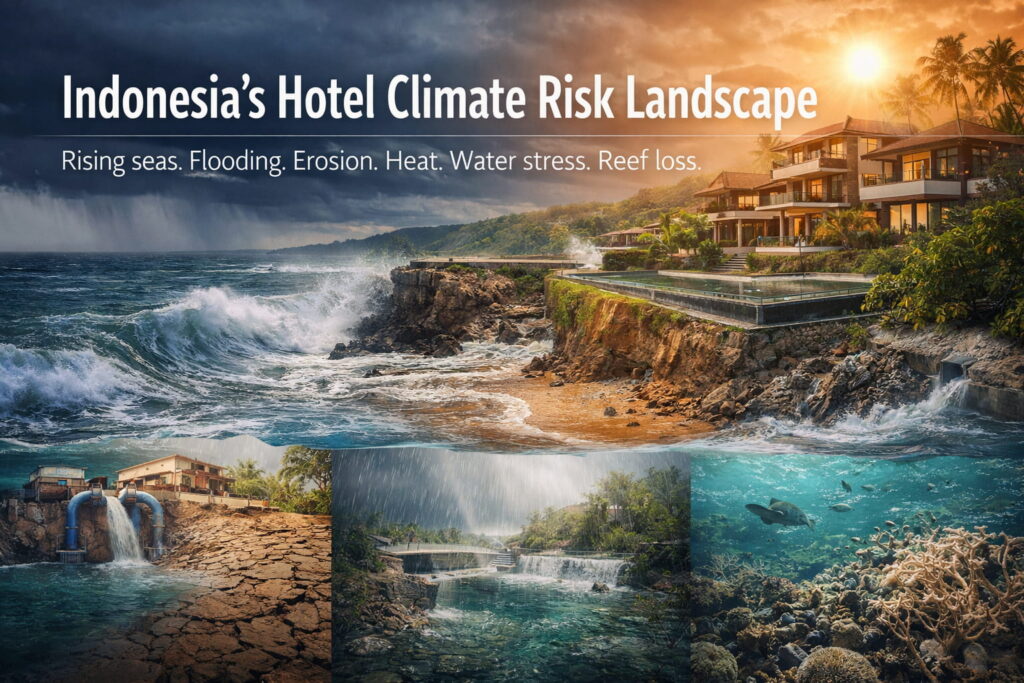
A recent Reuters report on coral bleaching and climate stress in Bali also reinforces how vulnerable marine-facing destinations are becoming. In parallel, a Mongabay report on Bali’s coastal erosion highlighted measurable shoreline loss over a relatively short period.
2. Extreme rainfall, flooding, and landslides
Hotels are not only exposed to sea. They are exposed to water movement across the site, around the site, and toward the site.
Heavier rainfall can overwhelm road access, site drainage, retaining systems, and nearby infrastructure. On inland and hillside sites, the key risk is often not inundation but runoff, slope instability, and disrupted access. This is why a visually attractive elevated site can still be a poor climate-risk decision if hydrology and civil design are weak.
3. Coral reef degradation and marine tourism decline
For marine hospitality, ecosystem health is part of commercial performance. Reef degradation reduces destination quality, weakens the guest experience, and can undermine premium positioning in dive, wellness, and leisure-led coastal markets.
The Bali bleaching data reported by Reuters is important not only as environmental news, but as tourism risk. If a hotel’s value proposition depends on marine beauty, marine biodiversity, or ocean-based recreation, then ecosystem decline becomes a direct revenue issue.
4. Water scarcity and groundwater pressure
Water stress is already one of the clearest hospitality risks in Bali and other tourism-intensive zones. Research from the Overseas Development Institute on climate risks in Indonesia’s water sector notes that tourism hotspots such as Bali are already experiencing water stress, with large operators often able to secure deeper groundwater access while surrounding communities face shortages.
For hotels, this affects far more than utilities. It affects room count viability, pool and spa operations, irrigation logic, laundry design, landscape ambition, and community acceptance. In luxury and wellness, water misuse also becomes a brand risk.
This is one reason climate resilience should sit inside the same strategic discussion as wellness and longevity hospitality planning. A wellness-led asset with weak water strategy is not a credible long-term product.
5. Extreme heat and infrastructure stress
As heat increases, cooling loads rise. That changes HVAC sizing, energy costs, shading strategy, guest comfort, and long-term operating margins.
The climate research we reviewed points to rising temperature pressure across Indonesia through the 2050s. For hotel investors, heat is not a future comfort issue. It is a design, capex, and opex issue now.
Which micro-locations matter most for hotel climate resilience Indonesia?
Direct answer: Climate exposure varies sharply by micro-location. Low-lying south coast zones generally carry the highest compound risk, cliff-front sites trade flood risk for geotechnical and access risk, and inland zones reduce sea-level exposure but still require strong drainage, water, and slope analysis.
South coast Bali: strongest market, heaviest compound pressure
The south coast remains commercially powerful. That does not make it low risk.
Low-lying coastal areas face the most obvious combination of shoreline pressure, flood exposure, drainage overload, utility strain, and density-related infrastructure stress. These locations may still justify development, but only with tighter underwriting, stronger engineering, and more disciplined adaptation planning.
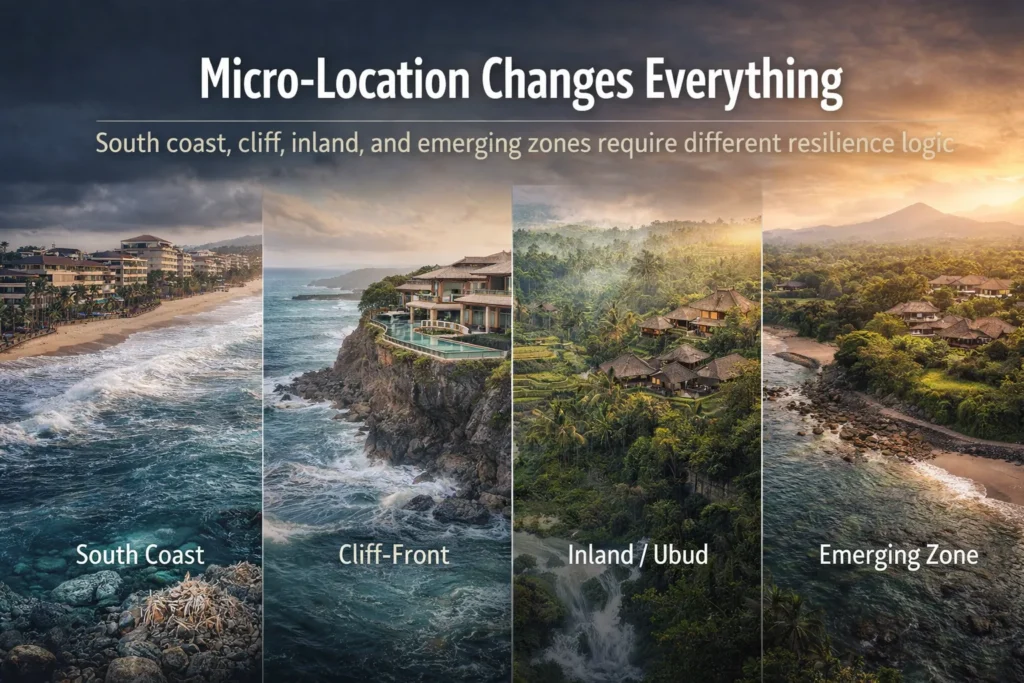
Cliff-front destinations: safer from inundation, not automatically resilient
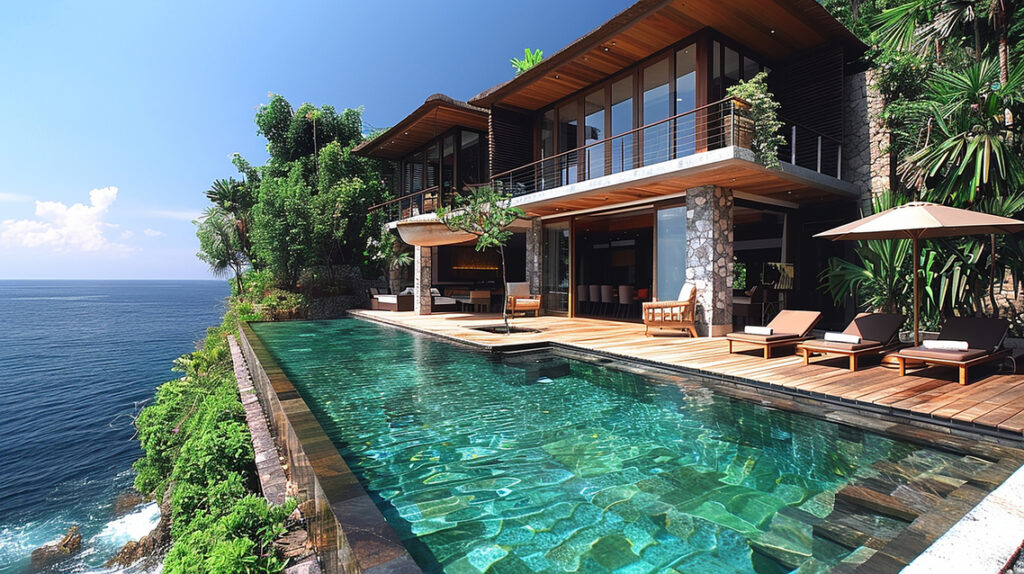
Cliff sites often look safer because they sit higher above sea level. In practice, they simply carry a different engineering burden.
Typical risks include slope movement, retaining failure, road access fragility, salt exposure, wind loads, and complicated drainage behavior during intense rain. The right question is not whether a site is elevated. The right question is whether the site remains stable and operable during weather stress.
Inland Bali and Ubud-type environments: lower sea risk, different resilience logic
Inland hospitality benefits from lower direct exposure to sea-level rise. That is a real strategic advantage.
But inland sites still need to be screened for slope hydrology, landslide pathways, catchment behavior, road resilience, and long-term water availability. Investors should not confuse distance from the coast with immunity from climate risk.
East and north Bali: selective opportunity, site-specific discipline
Lower-density regions may offer smarter long-term positioning in some cases, especially where overdevelopment pressure is lower. But climate resilience still depends on the specific site, not the broad geography.
This is why Zenith’s approach always starts with site-by-site commercial and operational logic, not destination clichés. The same principle applies across regional tourism growth strategies such as Lombok and Mandalika.
How should climate change change hotel underwriting?
Direct answer: Climate exposure should now change underwriting in three areas: site pricing, resilience capex, and downside scenario modeling. If those three items are absent, the feasibility study is incomplete.
A climate-adjusted hotel feasibility model should include:
- location-specific flood, erosion, access, and utility assumptions
- resilience capex in the initial development budget
- reserve planning for adaptation and repair
- higher downside weighting for exposed sites
- insurance friction assumptions where relevant
- terminal value sensitivity if physical risk worsens over the hold period
This is where investors often make the wrong comparison. They compare resilience capex only against opening yield. That is too narrow.
The right comparison is:
- resilience capex versus avoided downtime
- resilience capex versus avoided redesign later
- resilience capex versus lower repair volatility
- resilience capex versus better lender and insurer comfort
- resilience capex versus preserved exit value
A climate-blind project may look cheaper at concept stage. It often looks much more expensive later.
What should developers do before acquiring or designing a hotel site?
Direct answer: Before land acquisition or design lock, developers should run a structured climate resilience screen covering topography, flood pathways, water security, ecosystem dependency, access resilience, and adaptation capex. This should happen early, before concept momentum overwhelms risk discipline.
How to stress-test a hotel site for climate resilience in Indonesia
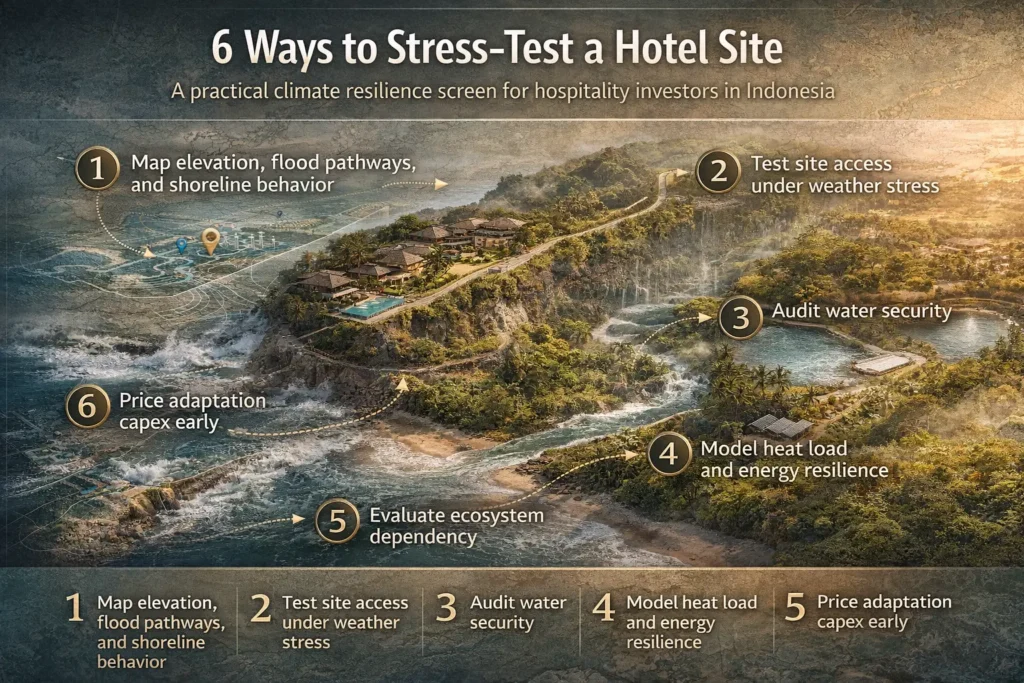
Use the following six-step framework before purchase, concept lock, or final master planning.
1. Map elevation, flood pathways, and shoreline behavior
Do not rely on a beautiful drone shot or a static land survey. Review elevation, runoff behavior, coastal retreat patterns, flood history, and adjacent infrastructure performance.
For coastal sites, today’s beach line is not a long-term guarantee.
2. Test site access under weather stress
A hotel does not need to be flooded to stop operating. One failed access road, one collapsed shoulder, or one inundated utility corridor can disrupt the entire asset.
Map guest access, staff access, supply routes, and emergency egress under severe rainfall and flood scenarios.
3. Audit water security from day one
Model dry-season demand, storage capacity, recycling potential, groundwater dependence, irrigation logic, and backup supply options. In Bali especially, water strategy should sit inside feasibility, not be delegated to late-stage engineering.
4. Model heat load and energy resilience
Assess passive cooling potential, orientation, shading, façade response, HVAC intensity, and backup power needs. A hotter operating environment changes equipment life, utility loads, and operating margins.
5. Evaluate ecosystem dependency
If the hotel depends on reefs, beaches, forest atmosphere, or landscape quality to justify rate, then those ecosystems are part of the asset base. They must be assessed as commercial dependencies, not just environmental background.
6. Price adaptation capex early
Include drainage upgrades, backup systems, water storage, geotechnical stabilization, erosion protection, and monitoring systems in the initial capital logic. Hidden resilience capex is one of the easiest ways to misprice a deal.
What does hotel climate resilience Indonesia look like in practice?
Direct answer: Resilient hotel design in Indonesia means combining safer site planning, stronger drainage, elevated critical infrastructure, passive cooling, durable envelopes, utility redundancy, and water reuse. It is a systems decision, not a single green feature.
In practical terms, that usually means:
- locating electrical rooms, pumps, control systems, and generators above likely flood exposure
- avoiding avoidable basement dependency in vulnerable areas
- designing drainage as a core civil system, not a late-stage afterthought
- reducing heat gain through shading, material selection, ventilation, and orientation
- integrating rainwater harvesting, treatment, reuse, and storage
- using backup power and critical-load planning to maintain operations during outages
- protecting natural buffers where appropriate, including coastal vegetation and mangroves
- designing public areas and guestrooms for faster recovery after weather shocks
This is also where pre-opening discipline matters. Resilience is not just a design issue. It is an operational readiness issue. That is why the same thinking should connect into pre-opening audits and handover control.
Can hotel climate resilience Indonesia improve returns?
Direct answer: Yes. In most serious hospitality projects, resilience is not just defensive capex. It can improve risk-adjusted returns by protecting continuity, reducing repair volatility, strengthening insurer and lender confidence, and preserving exit quality.
The commercial upside usually comes from five areas:
- fewer shutdown days
- lower disruption to guest experience
- lower emergency operating costs
- stronger asset durability over time
- better long-term marketability relative to weaker competing assets
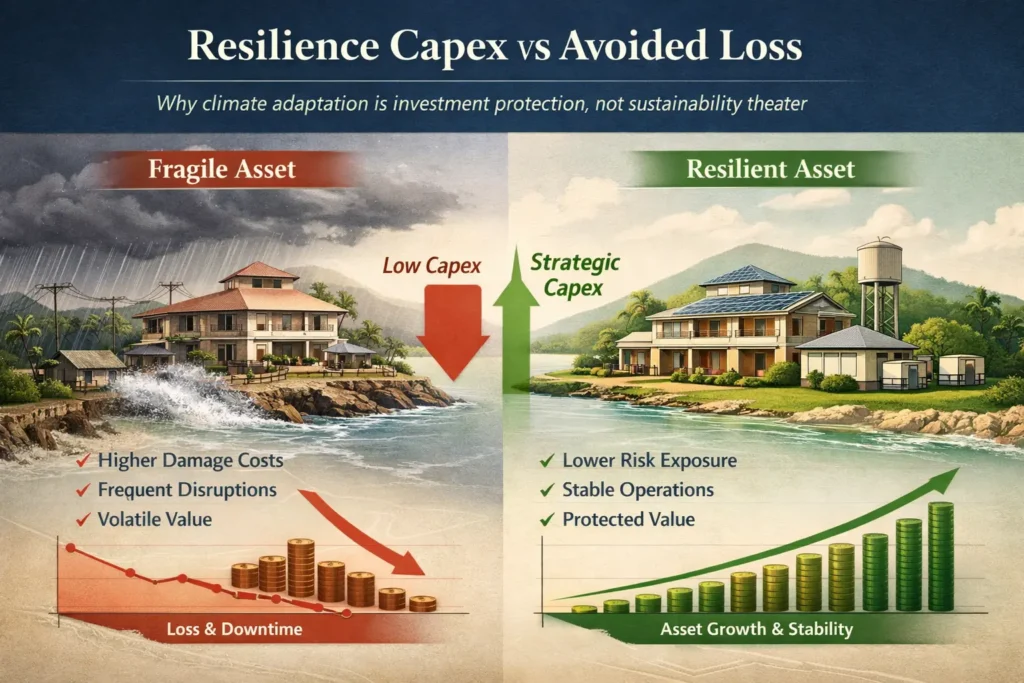
This is exactly why serious investors should treat hotel climate resilience Indonesia as part of strategy, not as a late-stage consultant add-on.
What do investors still get wrong about hotel climate resilience Indonesia?
Direct answer: The biggest mistake is assuming that climate resilience means expensive sustainability theater. In reality, most climate resilience work is about protecting value through better site decisions, better engineering priorities, and better operating continuity.
The second mistake is thinking in broad geographies instead of micro-locations. “Bali” is not one risk profile. “Beachfront” is not one risk profile. “Elevated” is not one risk profile.
The third mistake is separating climate logic from commercial logic. The best hotel investments increasingly combine both.
FAQ
Is hotel climate resilience Indonesia mainly a coastal resort issue?
No. Coastal hotels carry the most visible exposure, but inland assets can also face climate-driven disruption through flooding, landslides, water scarcity, road access failure, and higher cooling loads. The risk profile changes by topography and infrastructure, but resilience planning matters across both coastal and inland hospitality assets.
How should investors model climate change hotel investment risk in Bali?
Investors should build climate risk into feasibility assumptions from the start. That includes site-specific capex, reserve planning, utility resilience, access risk, and downside scenarios for disruption or ecosystem decline. A low-lying coastal hotel and an inland retreat should not carry the same underwriting assumptions, even if both target the same ADR ambition.
Does climate resilience slow down development?
It can add work early, but that is usually a commercial benefit. The real delay comes later when drainage, water, slope, or access problems surface after concept lock or construction coordination. Early resilience work often prevents redesign, budget leakage, and operational compromise.
What should operators do differently after opening?
Operators should treat climate resilience as part of asset management. That means monitoring water use, energy intensity, storm response readiness, drainage performance, guest area heat stress, and any local signs of shoreline or ecosystem deterioration. Resilience is not complete at opening. It becomes a recurring management discipline.
Summary Takeaways
- Hotel climate resilience Indonesia is now an underwriting issue, not a branding issue.
- Micro-location matters more than destination headlines.
- Water security is becoming as important as room design in many Indonesian hospitality assets.
- If a hotel depends on natural ecosystems, ecosystem decline becomes a revenue risk.
- Resilience capex should be compared against avoided loss and preserved value, not just against initial yield.
- The right time to solve climate risk is before land acquisition, concept lock, and MEP value engineering.
Final Thought
The hospitality market will keep rewarding beautiful concepts. But over the next two decades, it will reward durable concepts even more.
A climate-blind hotel may still open well. That does not make it a strong long-term asset.
A resilient hotel is not simply greener. It is more financeable, more operable, and more defensible.
CTA
If you are evaluating a hotel, resort, retreat, or mixed-use hospitality site in Bali or wider Indonesia, Zenith can help you apply a climate-adjusted feasibility lens before the wrong risk is locked into the land, the concept, or the capex stack. Start with Zenith Hospitality Global or review our work across hospitality consulting, integrated hospitality strategy, and destination-scale growth planning.
Author
André Priebs
CEO & Co-Founder, Zenith Hospitality Global
André Priebs advises owners, developers, and investors on luxury boutique hotels, lifestyle retreats, and wellness-led hospitality assets across Bali and Indonesia. His work focuses on concept feasibility, operator-first planning, pre-opening systems, commercial logic, and long-term asset performance. Zenith Hospitality Global brings climate resilience into hospitality strategy through site risk analysis, resilient design logic, utility security planning, and long-horizon asset thinking.