Traditional luxury hospitality was built for older wealth, visible status, and formal service codes. Crypto wealth hospitality Indonesia is different. A younger, digitally native, high-spending traveler is now shaping demand in Bali and wider Indonesia, but many luxury assets still speak the wrong language. They offer polished service and expensive finishes, yet miss what this segment actually values: frictionless tech, community, flexibility, wellness, and cultural relevance.
For developers, luxury brands, and investors, this is not a niche curiosity. It is an early but commercially meaningful guest segment that can influence brand positioning, premium spend, and asset relevance. According to the Henley & Partners Crypto Wealth Report 2025, the world now has 241,700 crypto millionaires, up 40% year on year. Bali is already functioning as one of the clearest lifestyle hubs for this audience.
TL;DR
- Bali is already attracting crypto-native and Web3-connected travelers through lifestyle quality, events, and community density.
- Most luxury hospitality products still target traditional wealth signals, not the values of this younger segment.
- The winning model is not “accept crypto payments.” It is a full concept and operating system built around tech, community, wellness, and local relevance.
Why does crypto wealth matter for hospitality in Indonesia?
Crypto wealth matters because it has created a new class of globally mobile, experience-led travelers with high spending power and different expectations. They are often younger than traditional luxury guests, more flexible in how they live and work, and more likely to choose destinations that combine lifestyle, network access, and operational convenience.
This matters in Indonesia because Bali already offers the ingredients they look for: lifestyle appeal, coworking culture, international social density, wellness infrastructure, and a visible Web3 community. The commercial point is simple. Demand is shifting faster than hospitality product design.
For a broader view on how new guest segments are changing concept logic in Bali, see Zenith’s perspective on integrated hospitality in Bali and our strategic lens on business consulting for hospitality projects in Bali.
Why is Bali already a natural fit for Web3 luxury travelers?
Bali fits because it is more than a destination. It is a networked lifestyle platform.
The island already hosts major crypto and Web3 events. Coinfest Asia continues to position Bali as one of the region’s main gathering points for builders, traders, founders, and institutions. At the same time, Bali’s established coworking, co-living, wellness, and café culture makes it easy for globally mobile travelers to mix work, leisure, and community.
Indonesia’s immigration framework also supports longer-stay behavior. The official Indonesia Immigration E33G remote worker visa page shows a one-year stay permit structure for remote workers, extendable online. For certain internationally mobile professionals and founders, this increases Bali’s appeal as a base rather than just a holiday stop.
The regulatory environment is also becoming more institutional. The OJK announcement on the transfer of digital financial asset and crypto supervision confirms that crypto oversight in Indonesia has moved deeper into the formal regulatory system. That does not remove all uncertainty, but it does reduce the impression that this is still a fringe market.
What does this new luxury traveler actually want?
They want luxury without stiffness.
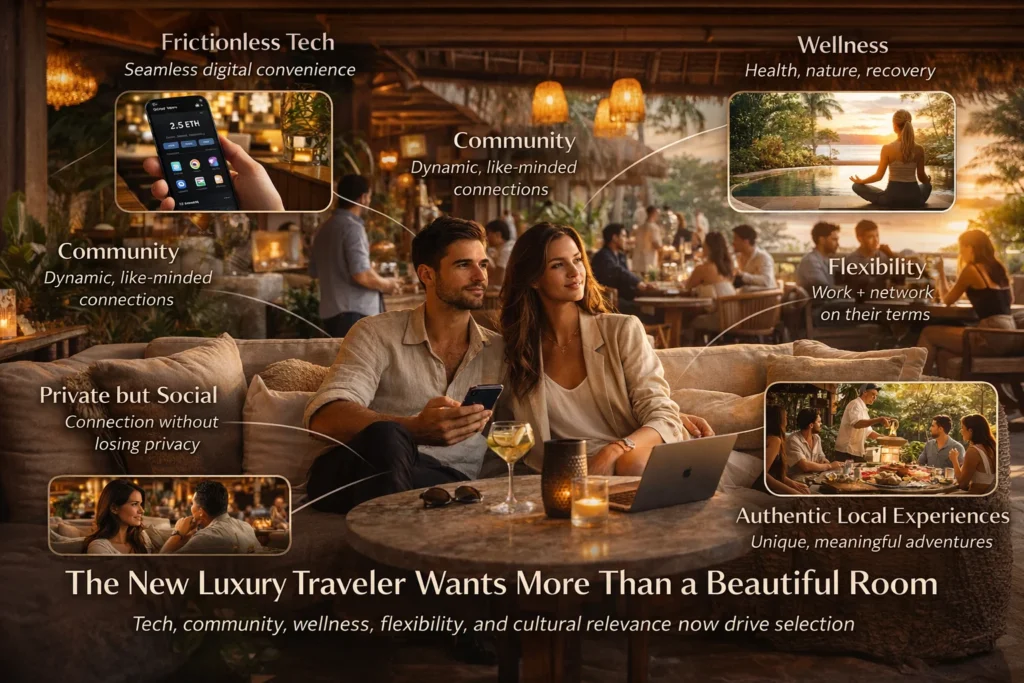
This guest does not usually define luxury through rigid service theater, excessive formality, or obvious status symbols. They are more likely to respond to smooth digital journeys, highly usable spaces, credible wellness, local authenticity, and environments where community can form naturally.
In practical terms, they tend to value:
- frictionless booking and communication
- strong connectivity and digital convenience
- flexible stay patterns
- founder-friendly social spaces
- wellness, recovery, and longevity experiences
- authentic local programming
- privacy without distance
- design that feels current rather than ceremonial
That is why many conventional luxury properties underperform with this segment. The issue is not quality. The issue is cultural fit.
For a related hospitality shift, see our article on why the spa is no longer enough. The same pattern applies here: guest expectations have moved beyond the old amenity model.
Why does traditional luxury often miss this segment?
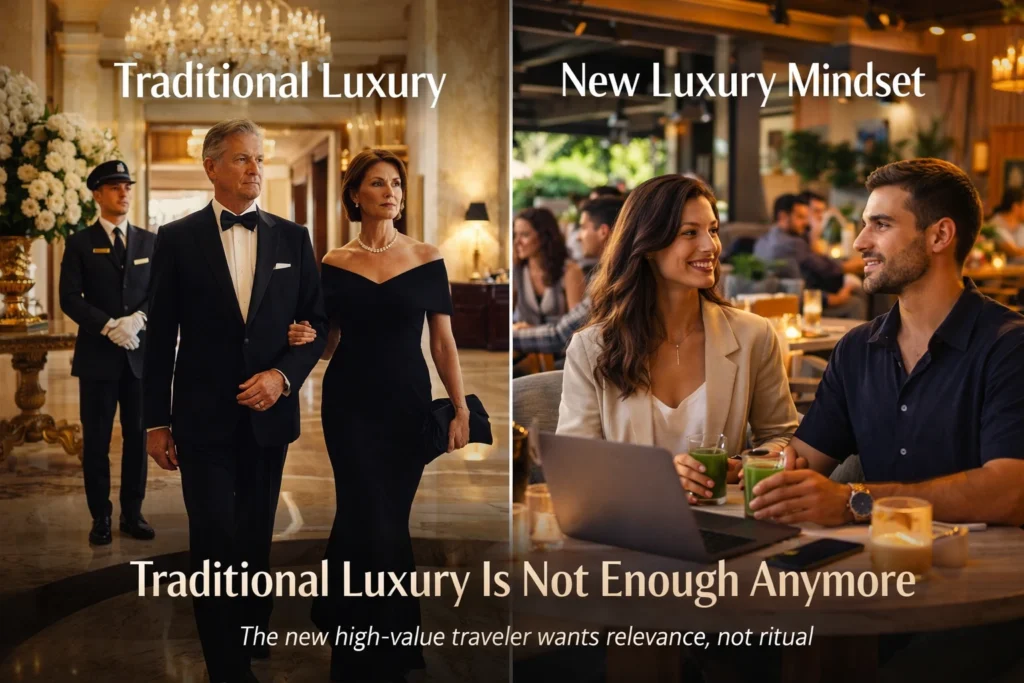
Traditional luxury often misses this segment because it is designed around older codes of value. It assumes that prestige is communicated through ceremony, distance, and visible exclusivity. Crypto-native and Web3-connected travelers often read that as outdated rather than aspirational.
They still want premium standards. They still expect precision, comfort, privacy, and excellent service. But they want those standards delivered in a way that feels modern, intelligent, and socially aware.
A grand marble lobby may look expensive. A highly usable social lounge, discreet founder breakfast, recovery studio, and digitally fluent concierge may create far more real value for this audience.
This is the gap. Many luxury operators are still selling performance of status when this segment is buying relevance, network access, and experience density.
What should developers and brands build instead?
They should build a tech-forward, community-capable, wellness-integrated luxury product with clear cultural positioning.
That does not mean turning a hotel into a crypto gimmick. It means designing the asset around how this guest actually lives. The concept should make it easy to work, recover, connect, and belong.
The 6 pillars of Web3-era luxury hospitality
| Pillar | What it means in practice | Why it matters |
|---|---|---|
| Tech-ready commerce | Selective crypto payment infrastructure, stablecoin readiness, digital concierge | Reduces friction and signals cultural fluency |
| Community infrastructure | Coworking, event space, social lounges, hosted networking | Turns the asset into a node, not just a place to sleep |
| Flexible access logic | Membership, club benefits, selective loyalty architecture, digital identity layers | Builds repeat engagement and belonging |
| Wellness integration | Recovery, fitness, yoga, longevity, nervous-system regulation | Matches how this segment defines modern luxury |
| Authentic local programming | Real Bali culture, local creators, food, rituals, experiences | Prevents the concept from feeling generic or imported |
| Governance and compliance | Payment controls, legal structure, SOPs, risk management | Protects brand integrity and asset value |
This is where Zenith’s operator-first model matters. We do not treat the concept as surface branding. We translate demand shifts into product DNA, guest journey logic, commercial layering, and operating systems. You can see that same thinking in our pre-opening handover audit framework and on our About Us page.
How should a Bali luxury property be redesigned for this traveler?
A Bali luxury property should be redesigned around behavior, not aesthetics alone. The guest journey must support work, social interaction, wellness, and digital convenience from the first click to departure.
At booking stage, the process should be fast, clean, and mobile-friendly. Payment options should be modern, but controlled. In many cases, stablecoin-capable rails are more useful than broad token acceptance.
In the public realm, the property should replace dead formal space with productive social space. That means high-quality café-work zones, meeting pockets, founder tables, member-style lounges, and flexible event capacity.
In-room design should support both recovery and productivity. Strong internet, good acoustics, smart lighting, thoughtful desks, and wellness-oriented amenities matter more than decorative excess.
Programming also matters. A static asset will not hold this segment’s attention. The calendar should include curated founder dinners, wellness mornings, cultural immersions, workshops, artist collaborations, and selective community events.
How to design a Web3-ready luxury hospitality concept in Indonesia
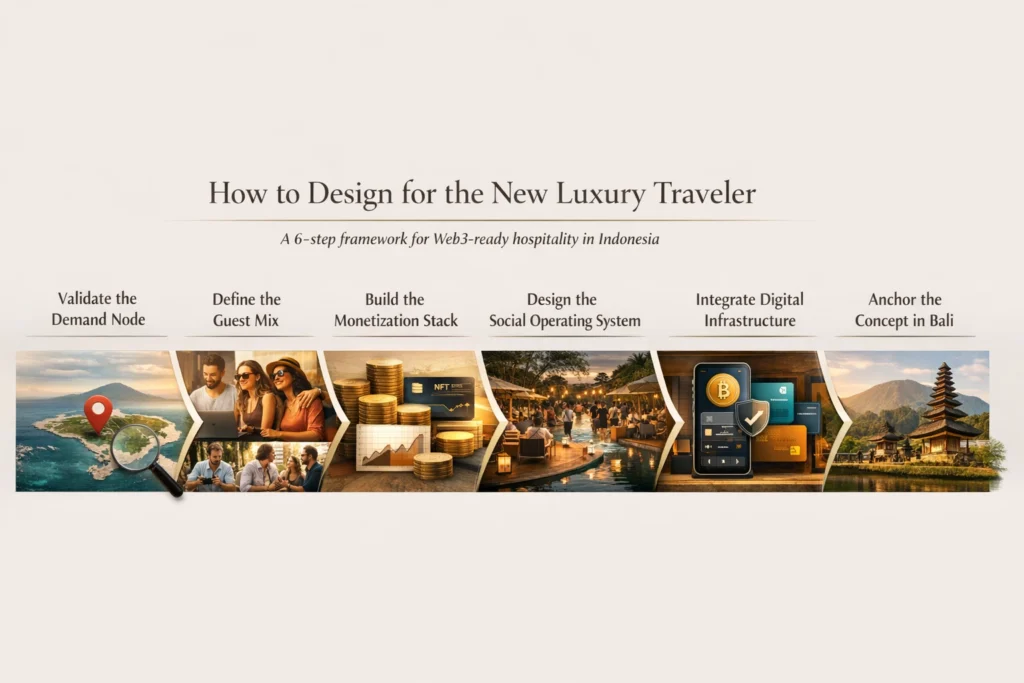
A Web3-ready concept should be built through a structured commercial and operational process, not through trend language. The sequence below is the practical version.
1. Validate the demand node
Start with location logic. Not every Bali site has the same relevance to this traveler. Canggu, Berawa, Nuanu, and selected adjacent nodes already have stronger overlap with founder, creator, and digital community behavior.
2. Define the guest mix clearly
Separate the likely segments. Founder-travelers, leisure crypto investors, remote operators, creators, and long-stay members may overlap, but they are not identical. One property should not try to be everything to everyone.
3. Build the full monetization stack
Do not rely on rooms alone. Layer accommodation with membership, wellness, events, F&B, community programming, and premium add-ons. This is how the concept becomes resilient.
4. Design the social operating system
Community does not happen because the furniture looks social. It needs a programmed rhythm: hosted breakfasts, curated introductions, partner events, salon dinners, and selective collaborations.
5. Integrate compliant digital infrastructure
Crypto-friendly features should be commercially useful and legally disciplined. Finance, SOPs, reporting, and risk controls must be addressed early, not added after launch.
6. Anchor the concept in Bali
A property that copies global startup culture without local grounding will feel thin. Balinese cultural respect, local partnerships, place-based storytelling, and credible destination curation are essential.
What are the biggest mistakes investors and operators will make?
The first mistake is treating crypto as a marketing layer instead of a concept driver. A payment badge, NFT campaign, or one-off event does not create a differentiated hospitality product.
The second mistake is confusing informality with lower standards. This segment does not want weaker service. It wants less stiffness and more fluency. Response time, privacy, product quality, and staff competence still matter.
The third mistake is ignoring governance. Crypto-facing hospitality features sit close to payment systems, compliance exposure, and brand risk. If the backend is weak, the concept can look innovative but operate poorly.
The fourth mistake is building a “crypto bro resort.” That is usually the wrong tone. The stronger position is premium, selective, calm, wellness-aware, and culturally current.
What is Zenith’s strategic view on crypto wealth hospitality Indonesia?
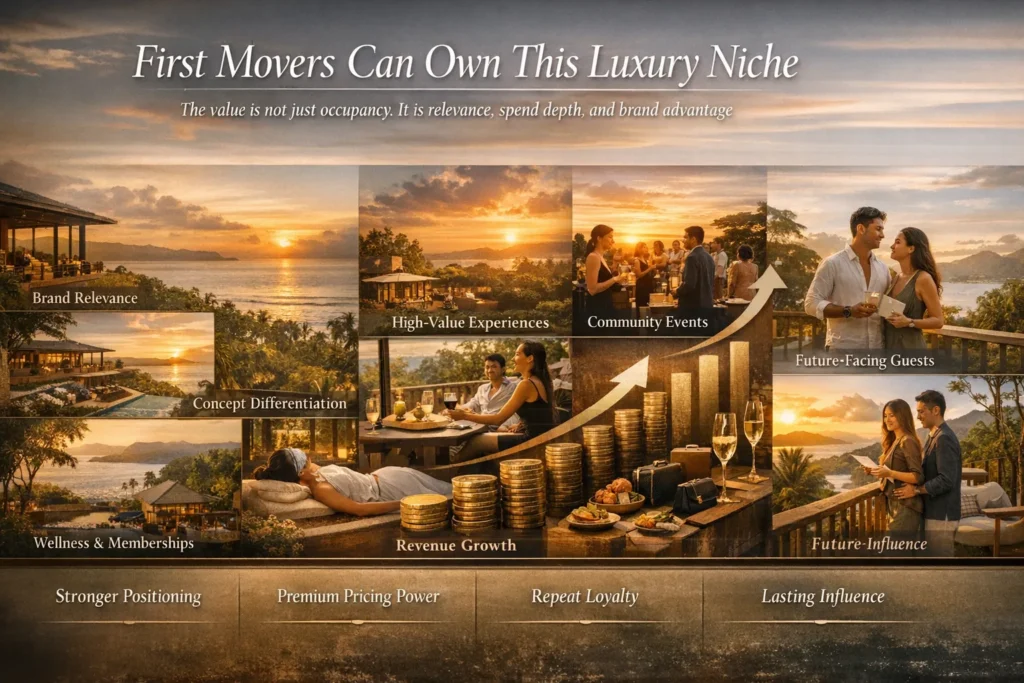
Zenith’s view is that crypto wealth hospitality Indonesia is real, but the market is still early enough for first movers to win. The opportunity is strongest for assets that combine lifestyle relevance with disciplined operating logic.
Our strategic view is also that this segment should not be over-romanticized. It is not a replacement for all luxury demand. It is a high-value layer within a broader future-facing hospitality mix. The point is not to abandon traditional luxury standards. The point is to reinterpret them for a younger wealth cohort.
For developers and investors, the prize is not simply higher room revenue. It is stronger brand relevance, better social visibility, deeper community pull, and a more defensible concept in markets like Bali where standard luxury supply is becoming easier to copy.
FAQ
Is crypto wealth hospitality Indonesia large enough to justify a dedicated concept?
Yes, in the right location and with the right positioning. It is not yet a mass-market segment, but it is already large enough to justify a purpose-built concept in Bali because it combines premium spend, long-stay potential, network effects, and brand amplification. The better play is usually a hybrid luxury concept that quietly understands this culture, rather than a heavily branded crypto-only product.
Do luxury hotels in Bali need to accept crypto payments?
Not necessarily. They need to understand the payment expectations of the guest segment they want to attract. In practice, selective crypto-enabled payment infrastructure or stablecoin capability may be enough. The strategic objective is not novelty. It is reducing friction for the right guest while keeping finance, compliance, and reporting under control.
What matters more for this audience: design, community, or wellness?
All three matter, but they do not play the same role. Community often drives discovery and selection. Design shapes perceived relevance and pricing power. Wellness strengthens spend, retention, and stay quality. The strongest concepts combine all three rather than isolating one. A beautiful asset without social energy feels passive. A social asset without design discipline usually struggles to hold premium positioning.
What operating changes are required to serve Web3-native luxury guests well?
Operators need faster digital communication, more flexible service language, stronger concierge intelligence, event-capable public areas, and staff who understand both privacy and social fluency. SOPs should support a premium but less ceremonial service style. The asset also needs a real calendar, because community-led travelers often choose places that create energy, not just accommodation.
Is Bali the best place in Indonesia for this concept today?
Today, Bali is the clearest lead market because it already combines founder density, lifestyle appeal, wellness supply, international visibility, and a real Web3 event ecosystem. Other destinations in Indonesia may develop over time, but Bali currently offers the strongest concentration of signals needed to support this positioning.
Summary Takeaways
- Crypto wealth is creating a younger, globally mobile luxury traveler with different expectations from traditional high-end guests.
- Bali is already one of the clearest live markets for this segment because it combines lifestyle, community, events, and long-stay appeal.
- Traditional luxury often misses because it over-indexes on ceremony and under-indexes on relevance, flexibility, and social infrastructure.
- The winning concept is not “crypto payment accepted.” It is a full product and operating model built around tech, community, wellness, and authentic local positioning.
- Developers should evaluate this as a concept design and commercial model question, not a marketing trend.
- Investors who move early with a disciplined, culturally literate offer can capture a segment that many legacy luxury assets still do not understand.
- Crypto wealth hospitality Indonesia is no longer a niche discussion; it is becoming a real design and operating question for developers, brands, and investors.
Call to Action
If you are assessing a Bali or Indonesia hospitality concept and want to know whether this guest segment is commercially relevant for your site, capex profile, and positioning, Zenith can help define the right product DNA before design is locked. In this category, value is created at concept stage and lost there too.
About the Author
André Priebs is CEO and Co-Founder of Zenith Hospitality Global, an operator-first hospitality consultancy focused on luxury boutique hotels, lifestyle retreats, and wellness-led assets across Bali and Indonesia. Zenith works across concept DNA, feasibility, pre-opening governance, operating systems, and commercial performance to help developers and investors build more resilient, more relevant hospitality assets.