Bali longevity hospitality will not be won by projects that simply add a better spa, a recovery room, or a few biohacking devices to an existing resort concept.
Most Bali wellness projects will not fail because the spa is weak. They will fail because the owner treats longevity as a marketing layer instead of a different hospitality product category.
Bali longevity hospitality sits at the intersection of preventive health, diagnostics, recovery, hospitality, clinical governance, and long-term guest behaviour. Therefore, it requires a different development brief from the beginning.
For owners and investors, this changes the required partners, staffing model, space planning, risk profile, and revenue logic. It also changes how the asset should be positioned, operated, and monetized.
This article looks at what the longevity economy means for Bali’s next hospitality cycle — not from a tourist perspective, but from an owner, investor, developer, asset manager, and operator perspective.
Key Takeaways
- Longevity is becoming an economic demand driver, not just a wellness trend. Ageing demographics, preventive health, personalized medicine, and higher-value travel are converging.
- Bali has a credible opening, but not through generic retreats. Therefore, the strongest opportunity is clinically credible, hospitality-enabled longevity product.
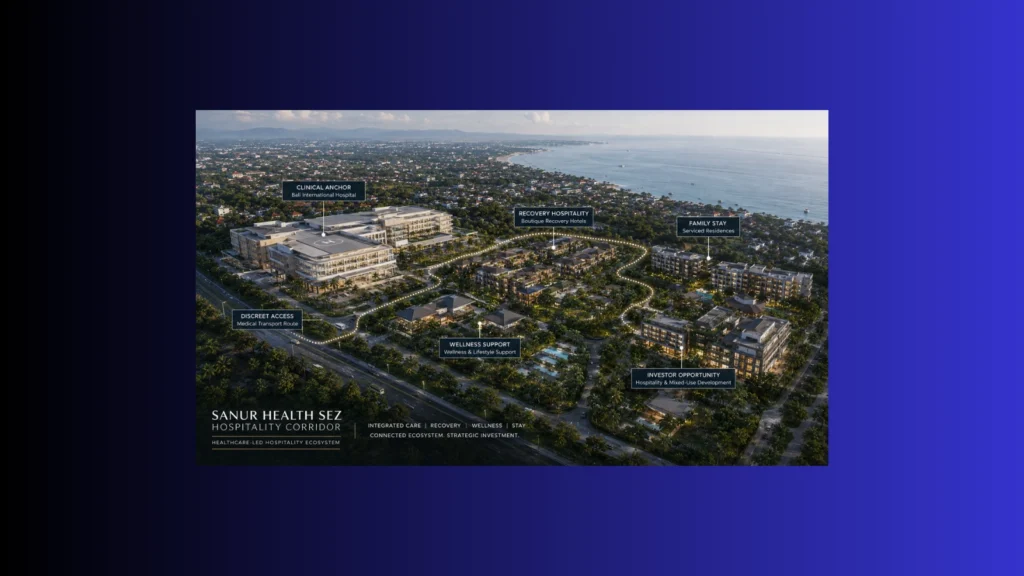
- Sanur changes the conversation. The Sanur Special Economic Zone and Bali International Hospital create a stronger health-tourism platform than Bali had before.
- Owners must design longevity-grade assets from the care pathway backward. Diagnostics, consultation, recovery, F&B, movement, rooms, privacy, data flow, and clinical governance must work together.
- The first winners will be operator-disciplined, not equipment-led. In practice, the advantage will come from product architecture, trust, outcomes, and execution.
Why Bali Longevity Hospitality Matters Now
The ageing base behind the longevity economy is no longer theoretical. According to the World Health Organization, by 2030, one in six people globally will be aged 60 or older. In addition, the global 60+ population is projected to rise from 1 billion in 2020 to 1.4 billion by 2030 and 2.1 billion by 2050.
This matters for hospitality because ageing is not only a healthcare issue. It changes how people spend on travel, housing, food, movement, prevention, recovery, and quality of life.
The AARP Global Longevity Economy Outlook estimates the economic contribution of people aged 50 and older across GDP, employment, and labour income in 76 economies through 2050. As a result, the longevity economy is not a narrow retirement topic. It is becoming a major force in global consumption.
At the same time, wellness has become a major economic category. The Global Wellness Institute reports that the global wellness economy reached US$6.8 trillion in 2024 and is projected to reach US$9.8 trillion by 2029.
For Bali, the commercial question is not whether wellness demand exists. It clearly does.
Instead, the real question is whether the next generation of hospitality assets can move beyond atmosphere, rituals, spa programming, and generic retreat language into credible preventive-health and longevity product.
That is where Bali longevity hospitality becomes commercially relevant.
The Core Problem: Bali Longevity Hospitality Is Not a Spa Upgrade
Longevity is often sold badly because many developers misunderstand it at concept stage.
A typical project starts with normal hospitality logic: land, architecture, villa mix, spa, F&B, branding, and then a wellness layer. Later, the concept deck adds words like longevity, recovery, biohacking, anti-aging, or medical wellness.
That sequence is backwards.
A longevity-grade hospitality asset has to answer harder questions before design is locked:
- What health or recovery problem is the asset built around?
- Which guest segment has the willingness and ability to pay?
- Which services require licensed medical governance?
- Which services remain hospitality or wellness services?
- What diagnostics are included?
- What can the operator measure before, during, and after the stay?
- Which claims are allowed?
- What is the clinical partner model?
- What is the revenue stack beyond rooms?
- How does the guest return after the first visit?
A normal wellness resort can sell relaxation.
By contrast, a longevity asset must sell trust.
That difference is fundamental. It is also why many owners should first revisit the logic behind why a spa is no longer enough before assuming longevity can simply be added to an existing wellness concept.
Why Bali Longevity Hospitality Has a Credible Opening
Bali’s opportunity is not automatic. However, it is credible.
First, the policy direction is becoming clearer. In February 2025, Indonesia’s Ministry of Tourism said Bali has high potential to become a premium destination for aesthetics and wellness and called for medium- and long-term roadmaps to support that ambition, according to Antara News.
Second, infrastructure is improving. President Prabowo Subianto formally inaugurated the Sanur Special Economic Zone and Bali International Hospital on 25 June 2025. The official government release confirms the inauguration of both the Sanur SEZ and BIH in Denpasar, Bali, through the Cabinet Secretariat of the Republic of Indonesia.
Sanur SEZ matters because it gives Bali a more serious clinical-hospitality platform. Public reporting describes the zone as a health-focused development intended to strengthen Indonesia’s medical tourism capacity and reduce outbound medical travel.
In addition, Bali International Hospital already publishes preventive and diagnostic services. Public BIH package pages include executive health screening, radiology services, whole-body MRI screening, and gastroenterology screening packages.
This does not mean Bali has already become a mature longevity destination.
However, it does mean the island now has a stronger base from which a more serious medical wellness hospitality category can emerge.
What Most Owners and Investors Get Wrong
The biggest mistake is assuming that demand for wellness automatically creates demand for a longevity hotel.
It does not.
Wellness and longevity overlap, but they are not the same product.
| Mistake | Why It Matters |
|---|---|
| Treating longevity as a marketing word | Creates credibility risk and weak differentiation. |
| Buying equipment before defining the product | Leads to low utilization and poor ROI on expensive hardware. |
| Designing the resort before designing the care pathway | Creates poor guest flow, weak privacy, wrong room mix, and inefficient operations. |
| Assuming all wellness guests want medical services | Over-medicalizes the experience and can damage emotional appeal. |
| Assuming all medical guests want a resort experience | Underestimates clinical seriousness, trust, and safety expectations. |
| Selling “anti-aging” too aggressively | Creates compliance, reputation, and trust risk. |
| Underwriting only inbound retreat demand | Misses domestic, expat, outpatient, corporate, and repeat-testing demand. |
The stronger development question is not:
“Can we add longevity to this resort?”
A better question is:
What exact longevity corridor can this asset own, and can it operate that corridor safely, credibly, and profitably?
This is also why investors should separate equipment-led biohacking from true product strategy. Zenith has covered this distinction in more detail in our article on biohacking wellness investment in Bali.
The Zenith View: Bali Longevity Hospitality Is an Operating Platform
The operator-first view is simple: longevity hospitality is not a department.
It is an operating platform.
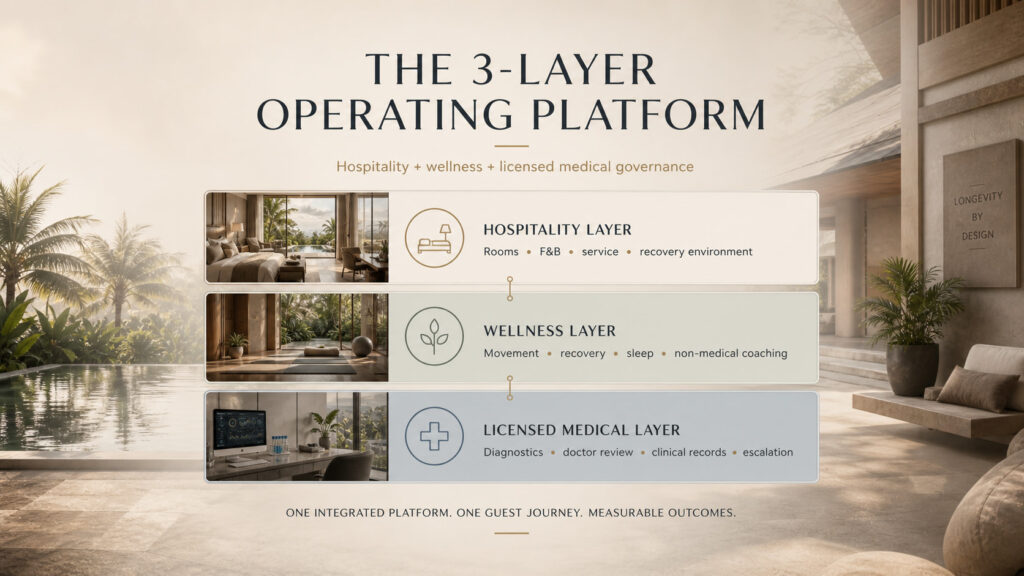
A credible platform has three layers:
| Layer | Role | Ownership Logic |
|---|---|---|
| Hospitality layer | Rooms, guest journey, F&B, service, recovery environment, emotional comfort | Operated by the hospitality team |
| Wellness layer | Movement, recovery, breathwork, sleep support, non-medical coaching, thermal, rituals | Operated by wellness specialists under clear claims boundaries |
| Licensed medical layer | Diagnostics, doctor review, lab work, IV therapy, prescriptions, regulated treatments, clinical records | Operated or governed by licensed medical partners |
The failure point is usually the boundary between those layers.
When the hospitality team markets medical outcomes without clinical governance, the asset creates risk. If the medical partner ignores hospitality flow, the guest experience collapses. When the wellness layer becomes vague, the product loses commercial edge.
Zenith’s view is that a longevity asset must operate as one connected system:
Product DNA → clinical boundary → guest journey → space logic → staffing model → claims governance → revenue architecture → pre-opening readiness.
This is where most design-led or marketing-led concepts are too weak.
For owners still shaping the concept phase, this connects directly to the discipline of boutique hotel Product DNA and concept-first development.
Framework: Wellness Retreat vs Longevity-Grade Hospitality Asset
| Dimension | Wellness Retreat | Longevity-Grade Hospitality Asset |
|---|---|---|
| Core promise | Feel better, rest, reset | Assess, recover, optimize, monitor |
| Main guest need | Relaxation, emotional reset, lifestyle break | Preventive health, healthspan, function, recovery, measurable improvement |
| Evidence level | Often experiential and holistic | Requires diagnostics, clinical input, and documented plans |
| Medical governance | Usually limited or absent | Essential where diagnostics or medical acts are involved |
| Revenue model | Rooms, spa, packages, F&B | Rooms, diagnostics, programs, recovery, memberships, repeat testing, outpatient pathways |
| Design logic | Resort-first | Care-pathway-first |
| Staffing | Spa, wellness, movement, hospitality | Hospitality, wellness, clinical partner, and care coordination |
| Risk | Generic positioning | Clinical, regulatory, data, claims, and liability |
| Defensibility | Atmosphere and brand | Trust, outcomes, governance, repeat use, and partner ecosystem |
This distinction is where the next Bali cycle will likely split.
Many assets will call themselves longevity products. However, fewer will be built to operate as one.
What a Longevity-Grade Bali Asset Actually Requires
A serious longevity asset starts with governance, not aesthetics.
The Department of Health Abu Dhabi Healthy Longevity Medicine Clinic Standard is useful as an international benchmark because it defines the kind of clinical seriousness now emerging in this category. The standard sets out minimum requirements for healthy longevity medicine clinic services, including healthcare facility licensing, clinical governance, staffing, and service requirements.
For Bali developers, the point is not to copy Abu Dhabi.
Instead, the point is to understand the direction of travel. Longevity is moving toward standards.
A credible Bali longevity hospitality asset needs the following components.
1. Clear Clinical Governance
The project must define which entity is legally responsible for medical services, clinical records, doctor review, diagnostics, prescriptions, IV therapy, invasive procedures, medical escalation, and adverse events.
This cannot sit vaguely inside hotel operations.
2. Evidence-Based Service Corridors
The strongest Bali entry points are likely to be specific corridors, not a broad “live longer” promise.
Potential first-wave corridors include:
- executive health screening;
- cardiometabolic optimization;
- digestive and gut-health pathways;
- sleep and nervous-system recovery;
- musculoskeletal and sports recovery;
- women’s health and fertility-support hospitality;
- oncology-supportive recovery;
- post-stress and burnout recovery.
These corridors are easier to explain, package, staff, price, and govern than a vague anti-aging proposition.
3. Diagnostic and Consultation Flow
A longevity-grade stay needs a structured pathway:
- pre-arrival intake;
- screening and contraindication check;
- diagnostics;
- medical or specialist review where required;
- personalized program plan;
- hospitality-enabled recovery stay;
- exit summary;
- follow-up and re-testing pathway.
Without this structure, the property is only selling treatments. It is not selling a longevity product.
4. Hospitality-Grade Recovery Environment
The hospitality layer still matters. In fact, it matters more.
Rooms must support sleep. F&B must support the program. Movement spaces must match the guest’s physiological state. The guest must feel safe, not processed. Privacy must sit inside the layout. Service language must remain calm, precise, and non-theatrical.
This is where Bali can be powerful.
The island already understands atmosphere, ritual, beauty, and emotional recovery. However, the missing layer is often clinical and operating discipline.
5. Claims Boundary
The brand must know what it can and cannot say.
“Supports recovery,” “helps structure preventive health planning,” or “connects diagnostics with hospitality-grade recovery” is very different from promising reversal, cure, or biological age reduction.
In Bali longevity hospitality, careless copy can become a commercial and legal liability.
Operational Implications for Bali Longevity Hospitality
Longevity changes the operating model before the first guest arrives.
| Operating Area | What Changes |
|---|---|
| Product DNA | The asset must define the health corridor, guest profile, program architecture, and claims boundary early. |
| Space planning | Consultation rooms, diagnostic flows, privacy, recovery areas, staff circulation, and guest transitions must be designed upfront. |
| Staffing | The project needs care coordinators, wellness practitioners, nutrition support, movement specialists, and licensed clinical partners. |
| SOPs | Guest intake, contraindications, handover, escalation, incident reporting, consent, and follow-up must be codified. |
| F&B | Menus must support metabolic clarity, recovery, sleep, inflammation management, and program-specific needs. |
| Technology | CRM, medical data boundaries, secure records, program tracking, and post-stay follow-up must stay separate from normal hotel systems where needed. |
| Training | Hospitality teams must understand what not to say, when to escalate, and how to preserve guest trust. |
| Pre-opening | Clinical partner readiness, licensing, insurance, equipment testing, mock guest journeys, and claims review become critical gates. |
A normal hotel pre-opening plan is not enough.
Owners planning this category should treat pre-opening as a performance and risk-control system, not as a checklist exercise. For related operational thinking, see Zenith’s article on the pre-opening SOP checklist for hotel success.
Commercial Implications for Bali Longevity Hospitality
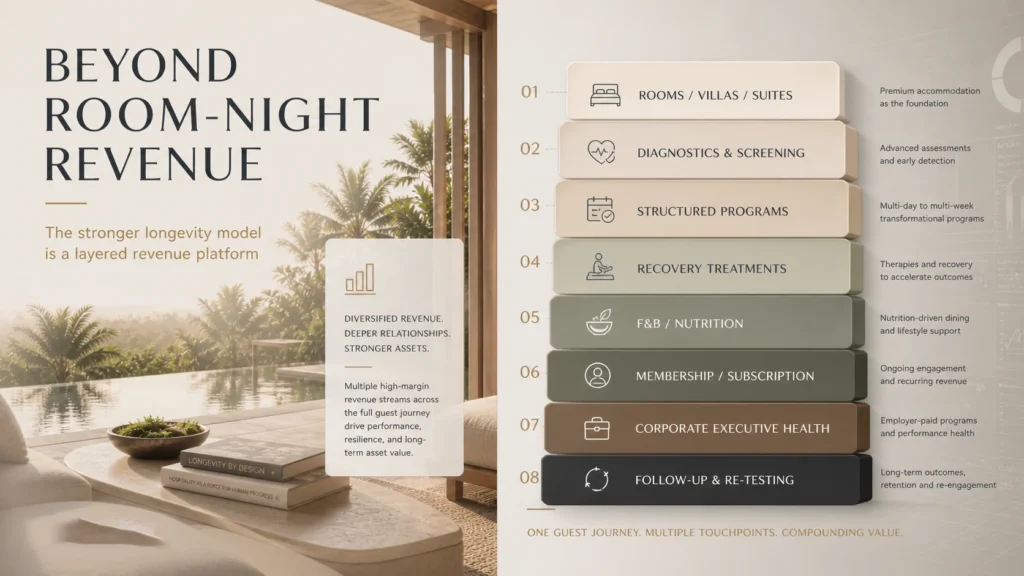
The strongest longevity hospitality model in Bali is unlikely to be a pure room-night business.
Instead, it should work as a layered revenue platform.
| Revenue Stream | Strategic Role |
|---|---|
| Rooms / villas / suites | Premium recovery environment and base stay revenue |
| Diagnostics and screening | High-trust entry point; creates program logic |
| Structured programs | Drives package value and longer stays |
| Recovery treatments | Adds ancillary revenue when medically and operationally governed |
| F&B / nutrition | Supports program integrity and margin opportunity |
| Membership / subscription | Builds continuity with local, expat, and repeat guests |
| Corporate executive health | Creates a high-value B2B demand channel |
| Follow-up and re-testing | Supports repeat use and long-term relationship |
| Specialist referrals | Adds ecosystem value, although not always direct margin |
The commercial opportunity is not only higher ADR.
It is higher total revenue per guest, stronger repeat logic, more defensible positioning, and a clearer reason to travel or return.
However, the model only works if the product is coherent.
A seven-night “longevity package” with weak diagnostics, unclear medical governance, and generic wellness programming will not defend premium pricing for long.
Therefore, owners must connect CAPEX and OPEX planning to product logic from the beginning. Zenith has covered broader owner-side budgeting discipline in 2026 hotel budget Indonesia.
Risks That Can Break the Bali Longevity Hospitality Thesis
1. Talent Constraint
Indonesia’s physician density remains low. World Bank data shows Indonesia at 0.7 physicians per 1,000 people in 2023.
That matters because longevity hospitality is staff-intensive. It needs doctors, nurses, dietitians, physiotherapists, exercise specialists, psychologists or coaches, care coordinators, and hospitality teams who understand the clinical boundary.
The question is not only whether a project has a medical partner. More importantly, the question is whether the partner can staff the promise reliably.
2. Weak Claims and Pseudoscience
Longevity is commercially attractive, but it is also exposed to exaggeration.
If the concept depends on fashionable interventions without evidence, governance, or appropriate medical oversight, the asset may create short-term marketing noise and long-term reputational risk.
3. Wrong CAPEX Logic
Biohacking equipment can look impressive in a pitch deck.
However, that does not make it investable.
Before buying expensive equipment, owners should validate:
- utilization assumptions;
- staffing requirements;
- safety requirements;
- licensing implications;
- treatment duration;
- cleaning and turnover;
- price elasticity;
- maintenance;
- clinical responsibility;
- guest demand by segment.
Hardware is not a strategy.
4. Climate and Thermal Comfort
Older and recovery-oriented guests are more sensitive to heat, dehydration, sleep disruption, and cardiovascular strain.
A Nature Communications study projects major increases in heat exposure for older adults by 2050, with severe implications for Asia and Africa.
For Bali assets, this makes thermal comfort a strategic design issue.
Shade, air quality, hydration points, indoor movement alternatives, sleep engineering, and escalation protocols are not details. They are part of product integrity.
5. Over-Reliance on Inbound Retreat Demand
The revenue model should not depend only on international guests flying in for one-off retreats.
A stronger model includes domestic Indonesians, regional travellers, expatriates, long-stay residents, corporate executives, secondary wellness travellers, and repeat-testing guests.
That broader demand logic is more resilient.
What To Do Before Committing Capital
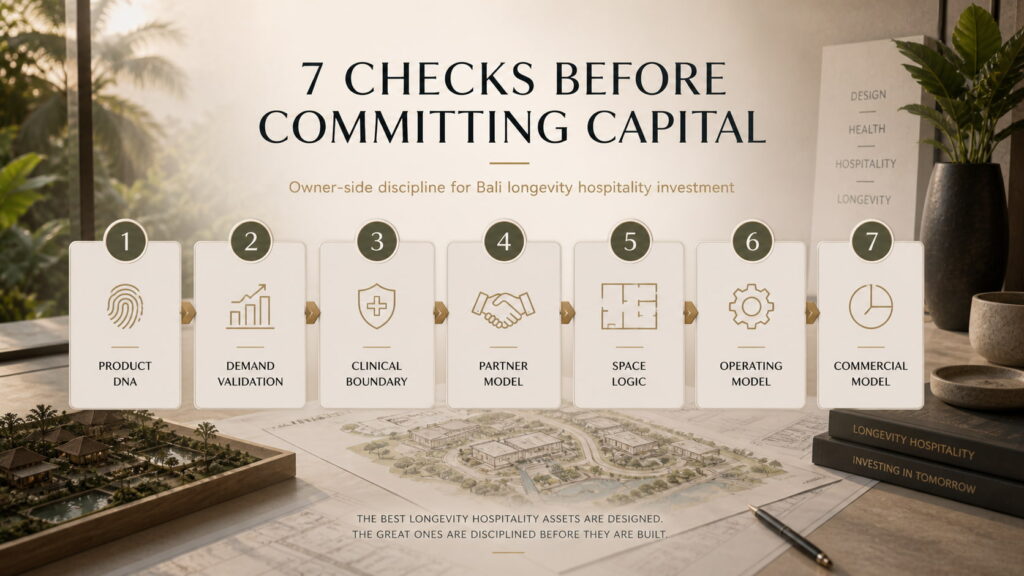
Before committing major CAPEX to a Bali longevity hospitality project, owners and investors should complete seven checks.
| Check | Key Question |
|---|---|
| 1. Product DNA | What exact longevity corridor will this asset own? |
| 2. Demand validation | Who will pay, how often, and for what outcome? |
| 3. Clinical boundary | Which services are medical, and who is legally responsible? |
| 4. Partner model | Is the medical partner licensed, credible, available, and commercially aligned? |
| 5. Space logic | Does the design support diagnostics, recovery, privacy, and guest flow? |
| 6. Operating model | Who staffs, trains, sells, delivers, records, escalates, and follows up? |
| 7. Commercial model | What is the revenue stack beyond rooms, and what assumptions support it? |
If those questions are not answered before design development, the project is likely to become a building in search of a medical wellness concept.
FAQ
Is longevity hospitality the same as wellness hospitality?
No. Wellness hospitality usually focuses on rest, recovery, lifestyle, spa, movement, nutrition, and emotional reset. Longevity hospitality may include those elements, but it also requires stronger structure around diagnostics, preventive health, medical governance, measurable pathways, and follow-up. A yoga retreat or spa resort can be excellent without being a longevity asset. In practice, the distinction matters because the operating model, staffing, claims, liability, guest journey, and revenue architecture are different.
Can Bali become a serious longevity hospitality destination?
Yes, but only through a narrow and disciplined lane. Bali already has global wellness appeal, strong hospitality culture, and emotional recovery value. Moreover, Sanur SEZ and Bali International Hospital add a more credible clinical-health platform. However, Bali will not win by copying generic retreats or making aggressive anti-aging claims. The stronger opportunity is medically partnered, hospitality-enabled preventive health and recovery product with clear service corridors, strong governance, and premium guest experience.
Does a longevity hotel need to be in Sanur?
Not always, but Sanur currently has the strongest health-tourism infrastructure signal in Bali because of the Sanur SEZ and Bali International Hospital. Projects outside Sanur can still work if they have a credible clinical partner model, safe guest pathways, clear escalation protocols, and a product that does not depend on immediate hospital adjacency. However, for more clinical or diagnostic-heavy concepts, proximity to serious medical infrastructure becomes more important.
What are the most realistic first service lines for Bali?
The most realistic first corridors are likely executive health screening, cardiometabolic optimization, sleep and nervous-system recovery, gut and digestive health, musculoskeletal recovery, women’s health support, fertility-support hospitality, and oncology-supportive recovery. These corridors are more investable than broad anti-aging language because they are easier to define, staff, price, govern, and connect to guest outcomes.
What should investors validate before building a longevity asset?
Investors should validate demand, clinical partner capacity, licensing boundaries, target guest profile, pricing, program design, staffing, equipment utilization, insurance, data handling, F&B alignment, and pre-opening readiness. Above all, the project must prove that it can operate the promise safely and profitably. A beautiful concept deck is not enough. Longevity hospitality must be tested as an operating model.
How can Zenith support a longevity hospitality project?
Zenith Hospitality Global supports owners and developers by defining the Product DNA, guest logic, operating model, clinical boundary, spatial implications, commercial strategy, pre-opening roadmap, and governance structure. For longevity hospitality, this means aligning the hospitality, wellness, and licensed medical layers before design and CAPEX decisions go too far. As a result, the project can become more investable, more operable, and more defensible.
Summary Takeaways
Bali has a real opening in the longevity economy, but the opportunity is narrower than the market noise suggests.
The island does not need more generic wellness retreats. Instead, it needs better-structured hospitality assets that can connect preventive health, diagnostics, recovery, emotional comfort, and operating discipline.
For owners and investors, the lesson is clear: longevity cannot be added at the end of the development process. It must shape the product brief from the beginning.
The winners in Bali’s next hospitality cycle will not be the assets that look most futuristic. They will be the assets that can operate trust.
CTA
If you are planning a wellness, medical wellness, or longevity hospitality project in Bali or Indonesia, Zenith Hospitality Global can help define the Product DNA, clinical boundary, operating model, guest journey, commercial logic, and pre-opening path before major capital is committed.
Speak with Zenith before the project becomes too expensive to correct.