
Feasibility consultants say “buy.” Lawyers say “structure it like this.” Architects say “build this.”
But almost nobody is giving you the integrated risk picture—the real Bali hotel investment risk—where market, compliance, operations, and contract structure collide.
As a result, this is the real Bali hotel investment risk: not one “big problem,” but dozens of small assumptions that multiply—until you are locked into a capex-heavy asset with fragile NOI and limited exits.
TL;DR — Key Takeaways (for investors)
- A “good” feasibility study can still be dangerous if it ignores compliance sequencing, labor reality, and operator incentives.
- Oversupply + illegal accommodation leakage can compress ADR and occupancy even when arrivals look strong.
- Your biggest financial risks usually sit inside management agreements, permit stacks, and operating model fragility—not in the land deal.
- If you cannot explain your downside plan, you do not have a plan.
- You need one joined-up risk owner—someone accountable for the whole system, not a single silo.
Why does siloed advice create hidden Bali hotel investment risk?
Siloed advice is dangerous because each specialist optimizes their own domain while assuming someone else is covering the “edges” between domains. In practice, those edges are exactly where projects fail: licensing sequencing that delays opening, operator contract terms that destroy NOI, or a concept that cannot hold ADR when new supply enters the submarket.
A joined-up risk view forces one question: “What breaks first in a downside scenario—and what do we do about it?”
What your advisors typically cover vs. what they miss
| Advisor | What they usually deliver | What often gets missed (where risk lives) |
|---|---|---|
| Feasibility consultant | Market snapshot + projections | Downside stress tests tied to real ops and compliance timing |
| Lawyer | Entity + contracts | Operating reality, enforceability in practice, “paper compliance” risk |
| Architect / designer | Build concept | Operational cost model, staffing intensity, maintainability, service delivery variability |
| Tax / accounting | Tax structure | Cash conversion cycle, OTA mix, wage pressure, leakage channels |
| Contractor / PM | Build execution | Commissioning discipline, handover readiness, safety and guest-impact failures |

If you want a practical illustration of how “pipeline pressure” can quietly destroy returns, read Bali’s Real-Estate Bubble: Oversupply Threatens ROI.
Bali hotel investment risk scenario: what if occupancy drops 10–15% in year 1?
A 10–15% occupancy drop is not a “small miss.” Consequently, it can erase most (or all) of your distributable cash—because fixed costs, debt service, and staffing minimums do not fall linearly with demand.
If your model cannot show (a) your break-even occupancy and (b) your emergency operating mode, you are flying blind.

PAA-style answer: Is Bali hotel occupancy volatile?
Yes. Bali hotel occupancy can be volatile by month and by submarket, influenced by seasonality, flight capacity, price competition, and demand leakage into informal/illegal accommodation. That volatility matters because your cost base is semi-fixed: payroll, utilities, maintenance, and debt service don’t fall quickly when occupancy drops—so NOI can collapse faster than investors expect.
For official accommodation and occupancy references, Bali’s statistics agency (BPS) publishes annual and monthly accommodation occupancy indicators (start here: Room Occupancy Rate Accommodation Bali Province 2024 (BPS)).
Bali hotel investment risk in feasibility: oversupply and illegal accommodation leakage
Oversupply is not just “more competition.” It changes guest acquisition costs, pushes discounting, and accelerates OTA dependency. In Bali, another layer exists: demand that should sit in licensed hotels can leak into unlicensed villa stock, shadow operators, and informal accommodation.

For example, if you want the compliance and enforcement angle in plain English, this matters: Foreigners running unlicensed villas undercut Bali’s hospitality sector (PHRI, via Jakarta Globe).
To see how compliance weakness becomes a financial risk (not a legal footnote), also reference Hidden Cost of Illegal Villas in Bali.
Why licensing sequencing (PBG → SLF → TDUP) is not “admin”—it’s a revenue risk
However, most investors underestimate how licensing sequencing affects cashflow timing and exit options.
- PBG (building approval) mistakes can trigger redesigns or delays.
- SLF (fit-for-use certificate) issues can delay “open-ready” status and insurance/financing readiness.
- TDUP (tourism business registration) misalignment can put OTA distribution and legal operations at risk.

PAA-style answer: What is the most common “paper-safe” risk in Bali?
The most common “paper-safe” risk is having documents that look acceptable to investors but do not hold up under enforcement, renewals, audits, or operational reality—especially when permits, zoning use, or tourism licensing are mismatched. Investors then discover the problem only when they try to insure, refinance, sell, or scale distribution.
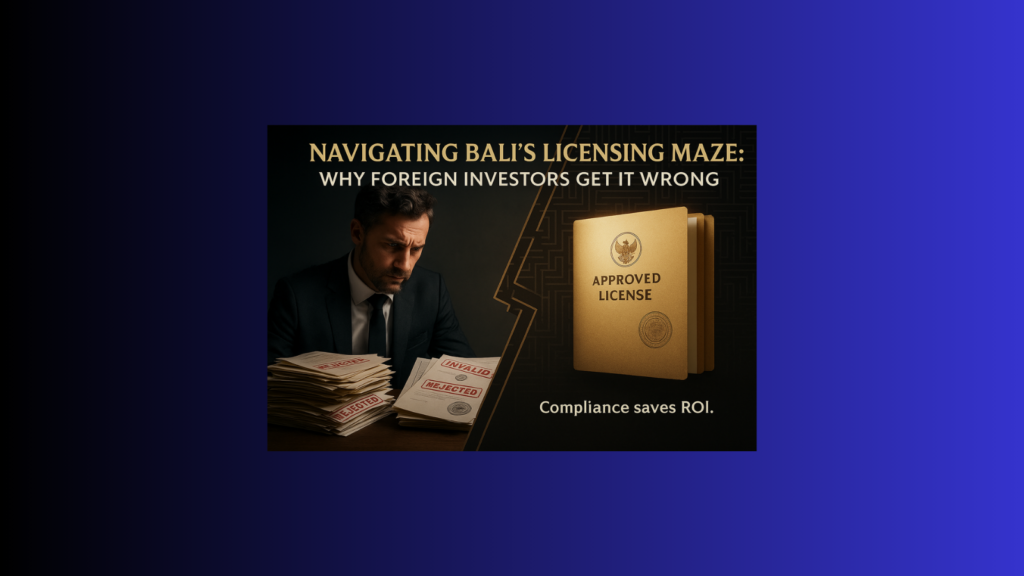
For a deeper licensing map and common investor mistakes, use Navigating Bali’s Licensing Maze: Why Foreign Investors Get It Wrong.
What operator failure really looks like (and why your contract may guarantee it)
Operators do not “fail” dramatically most of the time. They drift.
Common failure patterns:
- Incentives favor top-line growth (occupancy) over bottom-line quality (NOI).
- Brand/standards create cost creep without rate power.
- Under-investment in training leads to service variability → reputation decay.
- Owner and operator roles blur, decision rights fracture, governance weakens.

PAA-style answer: What should investors demand in an operator agreement?
Investors should demand (1) clear performance tests with remedies, (2) transparent budget control and capex approvals, (3) aligned incentive fees tied to profitability (not just revenue), (4) termination rights that are actually usable, and (5) governance that prevents “silent drift.” Without these, your contract can lock you into underperformance while you still carry all asset risk.
If you want a practical “opening discipline” framework that prevents costly readiness gaps, see 42-Point Pre-Opening Handover Audit for Bali Hospitality Properties.
Why your exit strategy is usually the most ignored risk on the cap table
Most investors model the entry. They do not model the exit.
Therefore, exit friction in Bali commonly comes from:
- Oversupplied submarkets (buyers have options).
- Permit or usage ambiguity (buyers demand discounts).
- NOI instability (banks and institutional buyers penalize volatility).
- Non-transferable “value” claims (brand/positioning not defensible).
If you cannot name your likely buyer type today (family office, operator, RE fund, strategic buyer), you are not planning an exit—you are hoping.
The Zenith Integrated Risk Stack (the “one-owner” model)
This is the integrated lens your specialists rarely assemble in one place:
- Market + demand reality (submarket, comps, seasonality, leakage)
- Product DNA + ADR defensibility (why you win when supply grows)
- Compliance and licensing sequencing (PBG, SLF, TDUP, zoning fit)
- Operating model resilience (staffing ratios, service design, SOP depth)
- Commercial engine (channel mix, pricing discipline, revenue strategy)
- Contract governance (operator incentives, controls, remedies)
- Capital plan + downside controls (capex triggers, reserves, covenant strategy)
- Exit architecture (buyer logic, transferability, data room readiness)
For macro context on Indonesia’s travel and tourism economics and the investment narrative many investors lean on, WTTC’s research hub is a useful reference point (start here: WTTC Indonesia Economic Impact Research).
How to run a Bali hotel investment risk audit (before you sign)
Use this as the minimum step-by-step discipline to close the investor education gap.
- First, define downside scenarios
Model at least three cases (Base / Downside / Severe). Stress ADR, occupancy, and ramp-up timing. - Next, map the full permit stack and sequencing
Confirm zoning fit; align PBG, SLF, and TDUP to your intended commercial use. - Then, validate the submarket supply pipeline—not just “tourism growth.”
Identify what is opening near you in the next 12–36 months and how it will pressure rate. - Audit demand leakage channels
Quantify informal accommodation impact and how it affects price elasticity. - Stress-test the operating model
Build a staffing plan tied to service design. Define “minimum viable luxury” standards and the cost of delivering them. - Confirm the commercial engine
Forecast OTA dependency, direct booking targets, and distribution readiness. - Red-team the operator agreement
Pressure-test incentives, budget controls, performance tests, and exit/termination mechanics. - Build a capex + reserve policy
Decide what triggers additional capex, how FF&E reserve is funded, and what happens in a cashflow squeeze. - Design the exit pathway now
Document buyer logic, valuation drivers, and data room requirements. Plan how you will evidence NOI quality.

If you need a partner to own the “whole system” (not just a silo), start with Zenith Hospitality Global or review our positioning and methodology on About Zenith.
FAQ — Bali hotel investment risk (investor + operator lens)
1) Is Bali hotel investment risk higher than other markets in Southeast Asia?
Often yes—because licensing enforcement, informal accommodation leakage, and rapid supply growth can interact in ways that are harder to model. The risk is manageable, but only with strong compliance sequencing, a defensible product DNA, and realistic downside planning.
2) What is the single biggest mistake investors make in Bali feasibility studies?
Treating feasibility as a “green light” instead of a decision tool. If the model is not built around downside cases, compliance timing, and operating resilience, it can produce confidence without protection.
3) What should an operator-focused investor ask before signing a management agreement?
Ask how the operator is incentivized, what happens if they miss targets, who controls the budget, and how quality is enforced at scale. Operator failure is usually “silent drift,” not a dramatic collapse.
4) How do I protect my returns if oversupply grows in my submarket?
You need ADR defensibility (brand/concept strength), distribution discipline, and a cost model that can flex without breaking service quality. Oversupply protection is a strategy, not a belief.
5) What does Zenith actually do differently versus separate consultants?
We integrate market, compliance, operating model, and governance into one investor-grade risk picture—so you can see what breaks first, what it costs, and what decisions prevent it.
Summary Takeaways
- Bali hotel investment risk is systemic: market, compliance, ops, and governance failures amplify each other.
- Downside planning is the real feasibility—not the base-case story.
- Permits and licensing sequencing is revenue timing, not admin.
- Operator contracts can hardwire underperformance if incentives and controls are misaligned.
- If the exit is not designed now, it will punish you later.
Call to Action (Investor-Grade Clarity)
If you are evaluating a Bali hotel or branded residence investment and want a single integrated view of market, compliance, operating resilience, and contract governance, Zenith can run an investor-grade risk review and pre-sign audit.
Start here: Zenith Hospitality Global
About the Author
André Priebs is the CEO of Zenith Hospitality Global, an operator-first hospitality consultancy and future operator focused on luxury boutique hotels, lifestyle retreats, and wellness/longevity assets across Bali and Indonesia. He specializes in Product DNA, pre-opening governance, operating systems (SOPs, org design, training), and commercial performance (ADR, RevPAR, NOI).