AI Personalization in Hospitality: From Guest Data to Lasting Loyalty
What Is AI Personalization in Hospitality?
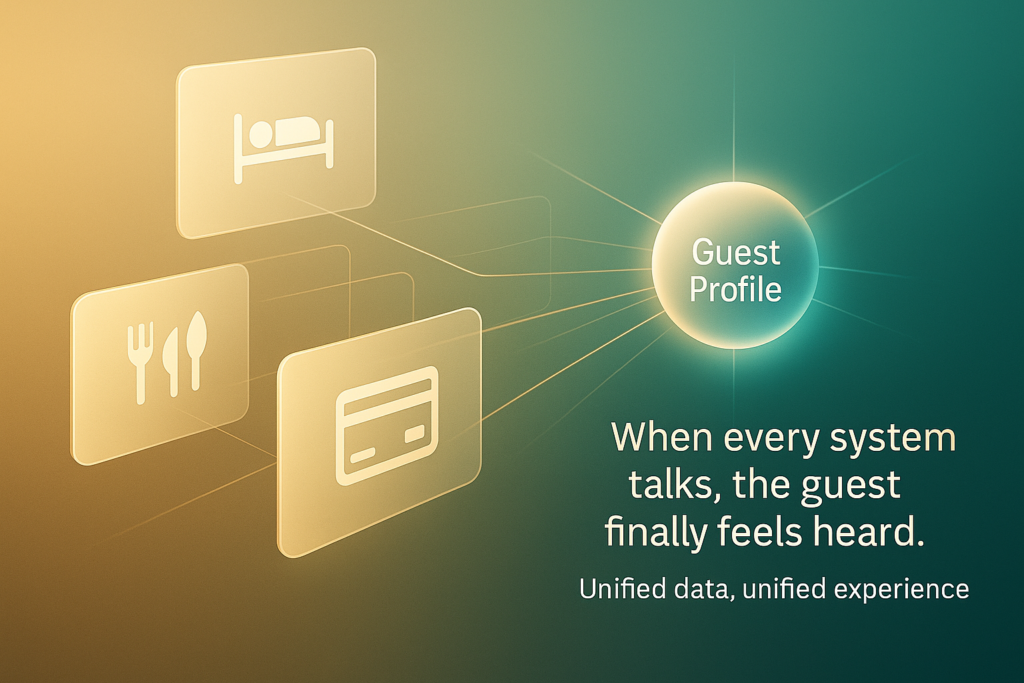
AI personalization in hospitality means tailoring every guest interaction using real-time data. It unites information from booking engines, PMS, POS, and loyalty programs to create a living profile for each traveler — one that continuously learns from behavior and preferences.
In short: it’s the bridge between guest memory and operational precision.
Why Personalization Became the New Luxury?
Today’s guests expect brands to “know them” without being intrusive. According to EHL Insights, over 70 % of luxury travelers choose properties that anticipate needs through data. Meanwhile, McKinsey & Company reports that AI-driven personalization can raise ancillary revenue by 10–30 % and improve retention by up to 15 %.
Traditional “five-star” service is no longer enough; true luxury is emotional accuracy delivered at scale.
Micro-summary: Data-driven empathy has replaced scripted charm as the ultimate differentiator.
From CRM to CDP: The Data Foundation of AI
Before any personalization model works, a property needs a solid data spine — a centralized, clean flow of guest information.
10 Core Data Points
Purpose
Language
Personalized communication
Party type
Anticipate room setup
Arrival time
Staff scheduling
Preferences & allergies
F&B, housekeeping
Temperature & lighting
In-room presets
Booking channel
Upsell logic
Spending pattern
Predictive offers
Loyalty tier
Reward alignment
Previous complaints
Prevent recurrence
Service response time
AI learning loop
Zenith Hospitality Global’s 2025 internal analysis shows that hotels with unified CDPs outperform isolated CRMs by 22 % in repeat bookings.
Micro-summary: Structure first, algorithm second — clean data makes AI feel human.
Practical Use-Cases That Impact Profit
1. Virtual & WhatsApp Concierge
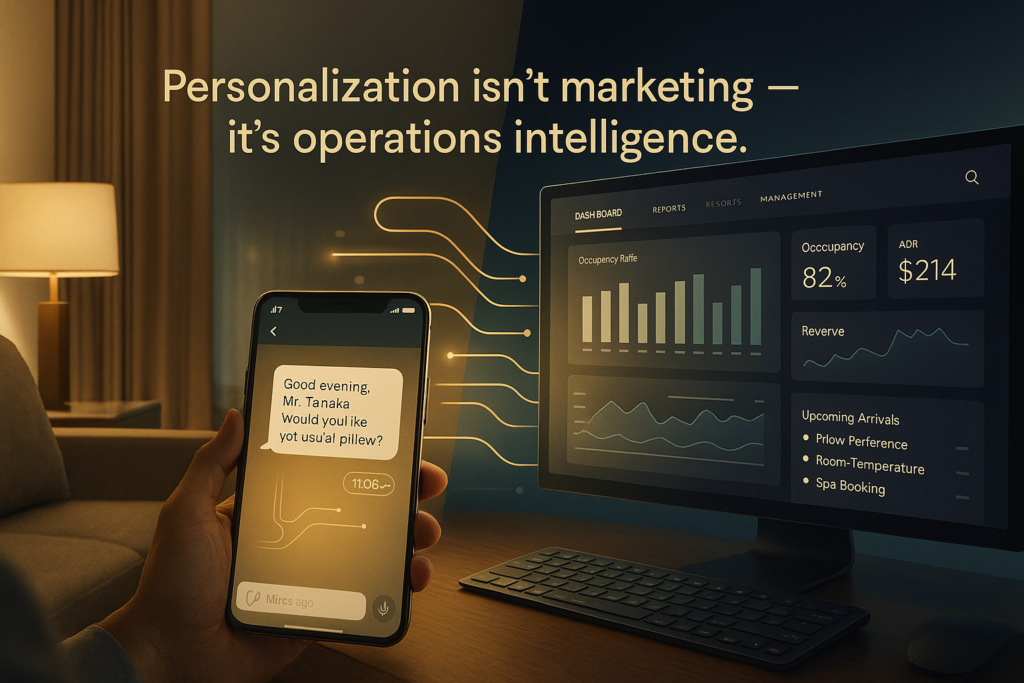
Instant, multilingual responses for check-ins, room requests, and spa bookings. Hotels using WhatsApp service flows achieve faster first-response times (< 60 s) and reduce front-desk load by 35 %.
2. Pre-Arrival Preference Capture
Guests choose pillows, minibar options, and room ambience before arrival; systems sync automatically with housekeeping.
3. Attribute-Based Selling
At digital check-in, guests can pay extra for view, floor, or late checkout. HospitalityNet notes that attribute-based pricing lifts revenue per booking by 5–8 %.
4. Smart Rooms That Learn
AI systems adjust AC, lighting, and media based on previous stays. Hospitality Net reports that Hyatt’s data-driven integration with AWS generated over $40 million in annual uplift through personalized technology initiatives.
Micro-summary: Personalization pays for itself — once preferences become revenue drivers.
Comparing Traditional CRM vs AI Personalization
Traditional CRM
AI Personalization
Data updates
Manual, periodic
Continuous, real-time
Guest segments
Static (demographic)
Dynamic (behavioral)
Communication
Email-centric
Omni-channel (WhatsApp, web, app)
Offer logic
Based on averages
Based on individual value
Outcome
One-size service
Predictive, adaptive service
In short: CRMs record history; AI personalization predicts the next move.
Privacy, Consent & PDPL Alignment in Indonesia
Hyper-personalization only works with transparent governance. Under Indonesia’s PDPL, hotels must:
Collect explicit consent before profiling.
Limit data to declared purposes (e.g., in-room presets, communications).
Allow easy opt-outs and deletion requests.
Purge inactive data after 18–24 months.
WTTC notes that strong compliance enhances brand trust, especially among international guests.
Micro-summary: Respect makes retention sustainable — guests reward hotels that protect their data.
How to Launch a 90-Day AI Personalization Pilot
Scope: One flagship property, three core use-cases.
Step-by-step:
Weeks 1–2: Build a light CDP table (10 fields). Connect PMS, POS, and WhatsApp.
Week 12: Review revenue, engagement, and guest feedback.
Zenith Hospitality Global recommends weekly dashboard reviews tracking upsell attach rate, response speed, and guest satisfaction.
Micro-summary: Start small, measure ruthlessly, then scale with confidence.
Weekly KPI Benchmarks
Metric
Target
Adjustment Trigger
SERP CTR
≥ 3 %
Rewrite title/meta
Avg. Engagement
≥ 45 s
Move key insights higher
Scroll Depth
≥ 60 %
Add jump links / visuals
Upsell Attach Rate
≥ 10–15 %
Test offer sequencing
“Personalization” Mentions
+ 25–40 %
Refine tone & scripts
Micro-summary: Measure what the guest feels, not just what they click.
Summary Takeaways
AI personalization in hospitality turns guest data into emotional precision and ROI.
Unified CDPs outperform siloed CRMs by 20 %+.
WhatsApp and attribute-based selling deliver fastest returns.
PDPL compliance is both legal duty and brand asset.
Start with a 90-day pilot — prove value, then scale.
FAQ
1. What is AI personalization in hospitality? It’s using real-time data and AI to deliver individualized guest experiences across booking, stay, and loyalty stages.
2. How does AI personalization increase revenue? By matching offers to preferences and timing, it boosts ancillary spend and upsell rates by 10–30 %.
3. Can small independent hotels apply this? Yes — using off-the-shelf CDPs and WhatsApp flows without heavy investment.
4. Is AI personalization compliant with PDPL? Yes, if data use is consented, purpose-limited, and easily revoked.
5. What’s the first step to begin? Run a 90-day pilot focusing on WhatsApp concierge, pre-arrival preferences, and attribute upsells.
CTA
Elevate your property’s personalization strategy. Schedule a confidential consultation with Zenith Hospitality Global to design your 90-day AI pilot. 👉 Contact Zenith Hospitality Global
Personalization features described are opt-in. Guest data is processed solely to enhance service delivery and retained under PDPL/GDPR guidelines.
Author:André Priebs – CEO & Co-Founder, Zenith Hospitality Global
Tags:
ai personalization, attribute-based selling, guest experience ai, guest loyalty personalization, hospitality ai, hospitality revenue strategy, hotel data platform, luxury hotel personalization, pdpl indonesia, whatsapp concierge