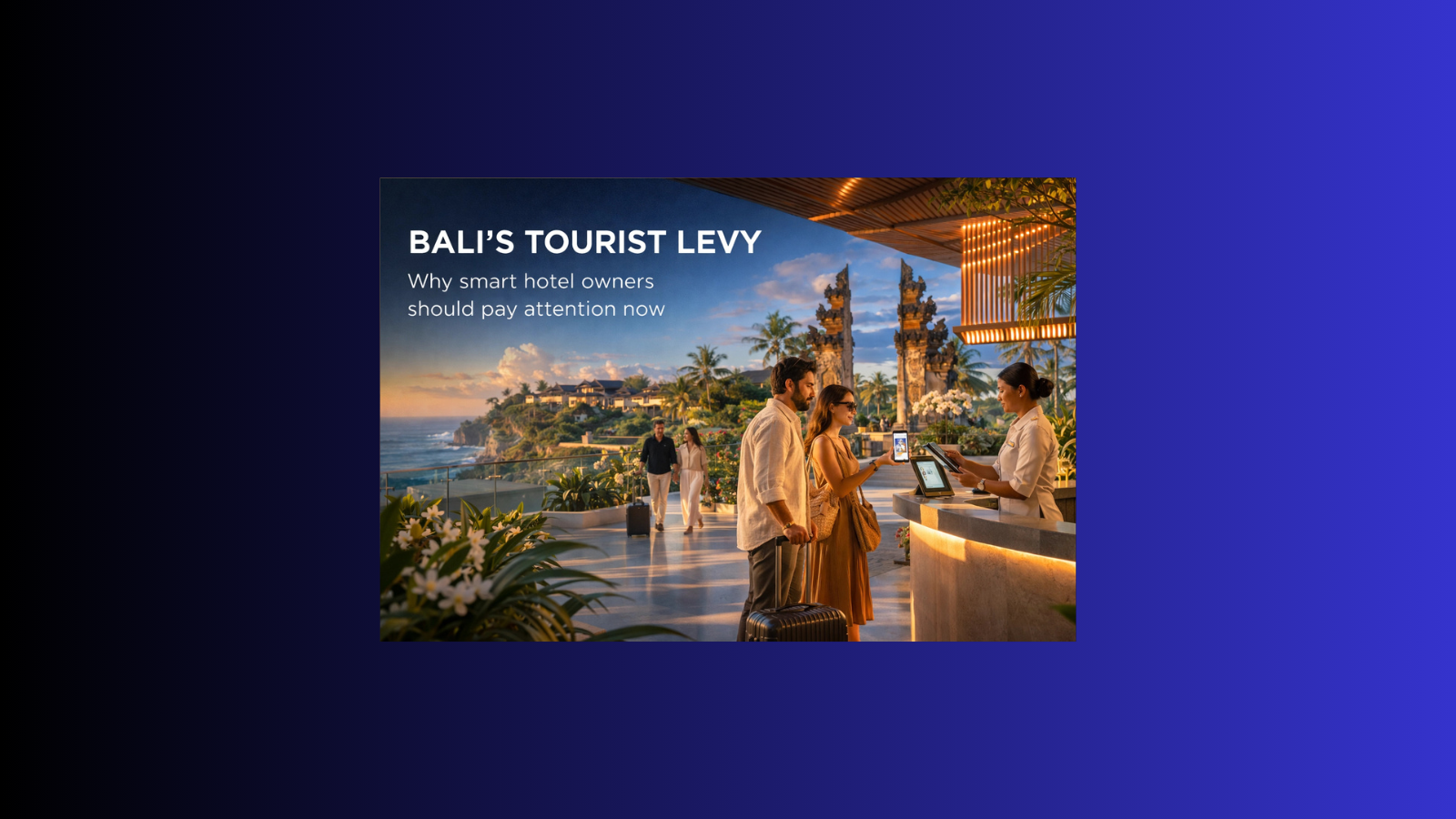
Bali tourist levy hotel strategy is now a critical issue for hotel owners, investors, and operators. Most of the market still treats Bali’s tourist levy as a minor arrival tax, but that is the wrong read. The real story is not the IDR 150,000 itself. The real story is that Bali has started using regulation, enforcement, and destination policy to shift from volume tourism toward higher-value tourism.
The levy is not important because it is expensive. It is important because it signals a wider move toward quality-over-quantity tourism. Hotels that are compliant, differentiated, experience-rich, and built for higher-yield demand should benefit. Hotels that depend on weak product, weak compliance, and pure volume are exposed.
TL;DR
- Bali’s foreign tourist levy has been in force since 14 February 2024 at IDR 150,000 per international visitor.
- The levy is not important because it is expensive. It is important because it signals a wider move toward quality-over-quantity tourism.
- Hotels that are compliant, differentiated, experience-rich, and built for higher-yield demand should benefit.
- Hotels that depend on weak product, weak compliance, and pure volume are exposed.
- Owners should treat this as a strategy issue covering positioning, compliance, pricing, and long-term underwriting.
What is Bali’s tourist levy?
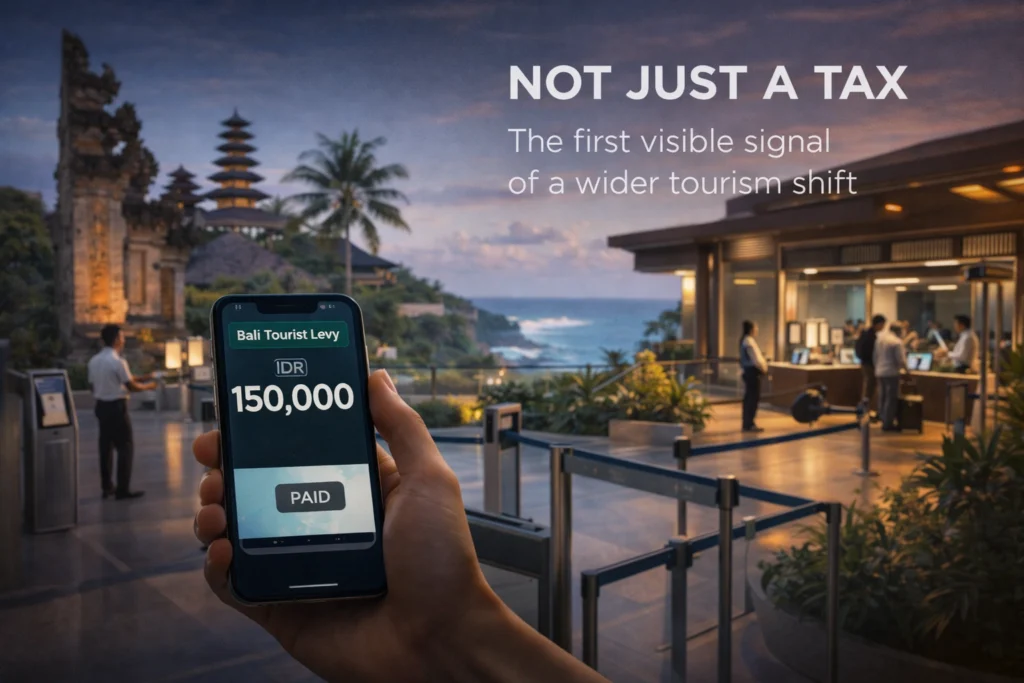
Bali’s foreign tourist levy is a one-time IDR 150,000 fee charged to international visitors entering Bali. It is separate from visa-on-arrival charges and is intended to be paid through the Love Bali payment system.
The official logic behind the levy is clear. As outlined by the Bali Hotels Association, the revenue is tied to cultural preservation, environmental protection, waste management, and tourism-supporting infrastructure. That matters because it shows the levy is not being framed as a narrow tax measure. It is being framed as a destination-management tool.
For hotel owners, that distinction matters. Taxes can usually be absorbed. Policy direction cannot.
Why does the levy matter more than most operators think?
Because the levy is a signal.
Most operators look at the number and conclude that it is too small to matter. That is a shallow reading. The real importance of the levy is that Bali is showing a willingness to shape tourism through regulation, compliance, and destination control. Once a government starts moving in that direction, owners should assume that this is not the final intervention.
That is why a proper Bali tourist levy hotel strategy is not about whether guests can afford another USD 10 equivalent. It is about understanding what kind of tourism Bali wants more of, what kind it wants less of, and which hotel models fit that future best.
This is also why the levy should be read together with the broader shift in Indonesia’s tourism messaging. The national conversation is increasingly about better visitors, better spending, better experiences, and stronger destination quality. That wider operator-first lens is exactly the kind of strategic positioning Zenith discusses in its About Us page and on the main Zenith Hospitality Global homepage.
Is Bali really shifting from volume tourism to value tourism?
Yes, but not in a simplistic way.
Bali is not trying to eliminate growth. Bali is trying to improve the quality of growth. That means the future is less about total arrivals at any cost and more about yield, behavior, compliance, infrastructure pressure, and destination quality.
This is already visible in how the market is discussed. Public targets still mention large visitor numbers, but reporting such as Jakarta Globe’s coverage of Bali’s 2026 targets shows that the language around those targets is increasingly focused on tourism quality rather than raw volume alone. For hotel owners, that means the competitive landscape is becoming more selective.
The winners in a quality-tourism environment are not always the biggest operators. They are usually the operators with the strongest alignment between product, guest mix, commercial strategy, and compliance discipline.
That is the core strategic message behind the levy. It also aligns with the broader premium-travel direction reflected in coverage of Indonesia’s First Class Indonesia campaign, which is centered on higher-value travelers and stronger destination yield.

What does the market data tell hotel owners?
The most important data point is not that Bali recovered. It is how Bali recovered.
Bali’s hotel recovery has been increasingly rate-led, not just occupancy-led. That is critical. A rate-led recovery means the market is starting to reward pricing power, positioning, and product quality more aggressively than before. Industry analysis such as the Horwath HTL Bali Hotels & Branded Residences Report 2024 supports that direction of travel.
For owners, this changes the conversation. The old question was: “Can we fill rooms?”
The new question is: “Can we protect yield, convert the right guest, and sustain profitability as regulation becomes stricter and competition becomes more quality-sensitive?”
This is why a strong Bali tourist levy hotel strategy must sit next to revenue strategy. You cannot discuss policy separately from ADR, RevPAR, TRevPAR, market mix, and product design. That same logic sits behind Zenith’s thinking in pieces like The Wellness Imperative in Hospitality and The Future of Wellness Tourism 2025, where yield quality and product strength matter more than generic demand optimism.
Which hotels are best positioned for this shift?
The answer is straightforward.
Hotels, resorts, and villa operators that are legally compliant, operationally disciplined, clearly differentiated, culturally and environmentally literate, and able to generate spend beyond the room are better positioned for the next cycle.
This includes luxury boutique hotels, design-led resorts, wellness and longevity concepts, curated lifestyle retreats, high-quality branded villa product, and experience-rich hospitality assets with strong guest programming. These assets fit the direction of travel because they align with higher-value guests and with the destination story Bali increasingly wants to tell.
This does not mean every hotel needs to become “luxury.” It means every serious operator needs a stronger value proposition. Weak middle-market product with no defensible identity is the real danger zone. That is why articles such as Bali Boutique Hotel Brand Strategy, Biohacking Wellness Investment Bali, and Wellness Tourism Boom: Opportunities Beyond Yoga Retreats are increasingly relevant to owners thinking about repositioning.

Which hotels are exposed?
The exposed group is also clear.
The greatest risk does not sit only with “budget hotels” as a category. The greatest risk sits with undifferentiated, low-margin, weakly compliant assets that depend on discounting, shallow guest loyalty, short booking windows, and minimal ancillary revenue.
These assets are vulnerable because they get squeezed from multiple sides: limited pricing power, rising operating costs, guest expectation inflation, stronger regulatory pressure, and increasing competition from better-designed product.
If Bali keeps moving toward a value-tourism model, owners who rely on low-quality volume will have less room to hide. Even if demand remains strong in aggregate, the economics of weak product can still deteriorate.
That is why Bali tourist levy hotel strategy is ultimately an asset-quality question. It is also why owners should be careful with overly optimistic underwriting, a point Zenith has already made in Hotel Feasibility Study Is Wrong: ADR & Occupancy Fantasy, and why market selection matters, as discussed in the Bali Lombok 2026 Opportunity Map.
Why this is only the beginning
Owners should not assume the levy is the final move.
It is better understood as the opening stage of a broader regulatory shift. Once a destination begins using policy to improve tourism quality, it usually does not stop at one fee. Over time, that logic can extend into stronger enforcement, environmental compliance, zoning pressure, digital payment requirements, capacity management, or additional taxation mechanisms.
Some public discussion has already touched on more aggressive tourism-control models. For example, Bali Expat reported discussion around a possible daily tax model. Whether every idea becomes law is not the point. The point is that tighter intervention is now part of the policy conversation.
That means investors and operators should stop treating regulation as background noise. Regulation is becoming part of hotel strategy in Bali.
What should hotel owners do now?
A serious response should be commercial and operational, not emotional.
1. Re-segment your demand around value, not just occupancy
Audit your guest mix by source market, length of stay, booking lead time, ancillary spend, and total profitability. Stop treating all occupied room nights as equally good.
The future belongs to assets that attract the right guest, not simply more guests.
2. Rebuild your product around stronger differentiation
Culture, wellness, sustainability, experience design, and programming can no longer sit as decorative branding language. They need to be operationally real.
Owners should ask a simple question: does the guest experience justify premium pricing and support a higher-value market position?
If the answer is vague, the product is vulnerable.
3. Treat compliance as commercial infrastructure
Licensing, levy process, tax hygiene, payment systems, guest communication, and digital operating discipline should now be treated as revenue protection.
Compliance is not just legal defense. In Bali, it is increasingly part of competitive advantage.
4. Upgrade revenue strategy
A quality-tourism market rewards operators who understand pricing architecture, not just rate setting.
That means stronger control over ADR by segment, stay-pattern strategy, channel mix, package logic, ancillary monetization, and TRevPAR, not just room revenue.
5. Add a policy-risk layer to underwriting
Any current investment memo or operating plan should now include a formal regulatory sensitivity layer.
That layer should test stronger levy enforcement, new compliance obligations, environmental regulation, capacity pressure, and future tourism-control measures.
If this is missing, the model is incomplete.
How to build a practical Bali tourist levy hotel strategy
Step 1 — Audit current exposure
Review your current guest mix, pricing quality, compliance position, ancillary capture, and dependency on discount-led occupancy.
Be honest. Is the asset genuinely well-positioned, or is it simply surviving because Bali demand is still strong?
Step 2 — Define the target guest more precisely
Not every source market behaves the same way. Not every guest segment creates the same profit.
Clarify which segments fit your product best based on spend depth, stay length, experience fit, channel economics, and repeat potential.
Recent reporting from Jakarta Globe on tourist spending patterns reinforces why this matters: higher-spend segments do not just bring more arrivals; they create better economics.
Step 3 — Upgrade the product promise
Translate “quality tourism” into real guest-facing product.
That can include stronger cultural integration, better wellness programming, more distinctive culinary identity, cleaner sustainability execution, and more thoughtful service design.
The point is not to follow trends. The point is to build a more defensible asset.
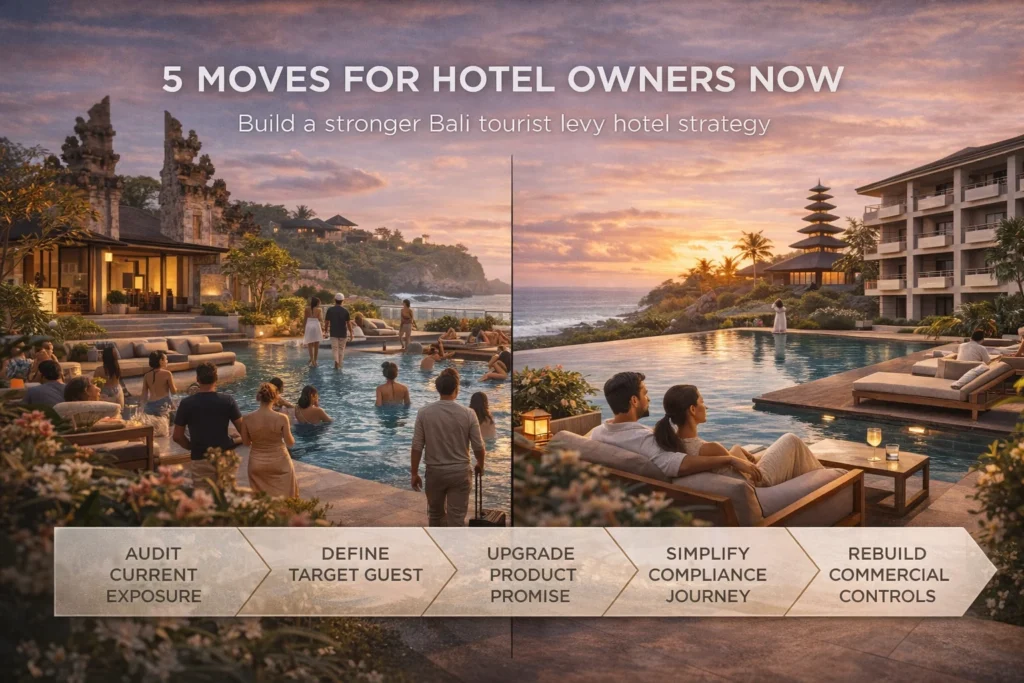
Step 4 — Simplify the compliance journey
Make levy guidance, payment explanation, licensing status, and guest communication simple and frictionless.
The more regulation exists, the more important it becomes to remove operational confusion.
Step 5 — Rebuild commercial controls
Track the metrics that actually matter in a value-tourism environment: ADR, RevPAR, TRevPAR, ancillary spend per guest, average stay length, source-market profitability, repeat ratio, and margin by segment.
If the dashboard is weak, strategy will be weak.
FAQ
Does the Bali tourist levy reduce demand by itself?
Not materially at current levels.
IDR 150,000 is too small to be a major barrier for serious international travelers. The bigger issue is what the levy represents. It signals a wider policy direction toward stronger destination control, better visitor quality, and tighter alignment between tourism growth and Bali’s cultural and environmental priorities.
What does the levy mean for hotel investors?
For investors, the levy is an early indicator of a more actively managed destination.
That affects underwriting. Projects that depend on weak differentiation, low-quality demand, and regulatory ambiguity now carry more downside. Projects that are compliant, experience-rich, and built for stronger yield are more aligned with Bali’s direction.
What should operators change first?
Operators should start with three areas: guest segmentation, compliance workflow, and revenue architecture.
First, know which guests actually create profit. Second, make the levy and all guest-facing regulatory touchpoints simple. Third, shift from occupancy obsession toward yield control and spend conversion.
Could Bali introduce more tourism controls after this?
Yes, that is plausible.
Whether the next step is a higher levy, better enforcement, stricter compliance rules, or some other destination-management mechanism, owners should assume that the current levy is not the final policy move. That is exactly why a formal Bali tourist levy hotel strategy matters now.
Summary Takeaways
- Bali’s tourist levy matters more as a signal than as a cost item.
- Bali is moving toward a more selective, higher-yield tourism model.
- Premium, compliant, differentiated assets are better positioned than weak volume-dependent product.
- Revenue strategy and policy strategy now need to be integrated.
- Owners should underwrite future regulatory tightening, not assume current rules are the final state.
- The right response is stronger positioning, stronger compliance, and stronger commercial control.
Call to Action
If your hotel, resort, villa project, or wellness concept in Bali still depends on old volume assumptions, now is the time to review it properly.
Zenith Hospitality Global helps owners, investors, and operators translate regulatory shifts, yield pressure, and market change into decision-grade strategy, concept positioning, feasibility logic, pre-opening structure, and operating discipline. A good starting point is the main Zenith Hospitality Global homepage, the firm’s About Us page, and the article Hotel Feasibility Study Is Wrong for owners who need to stress-test assumptions.
About the Author
André Priebs is the CEO of Zenith Hospitality Global, an operator-first hospitality advisory and management platform focused on luxury boutique hotels, lifestyle retreats, and wellness/longevity assets across Bali and Southeast Asia.
His work spans product DNA, feasibility and underwriting, pre-opening governance, operating systems, service architecture, and commercial strategy for owners, developers, and operators seeking to build stronger hospitality assets in complex emerging markets.