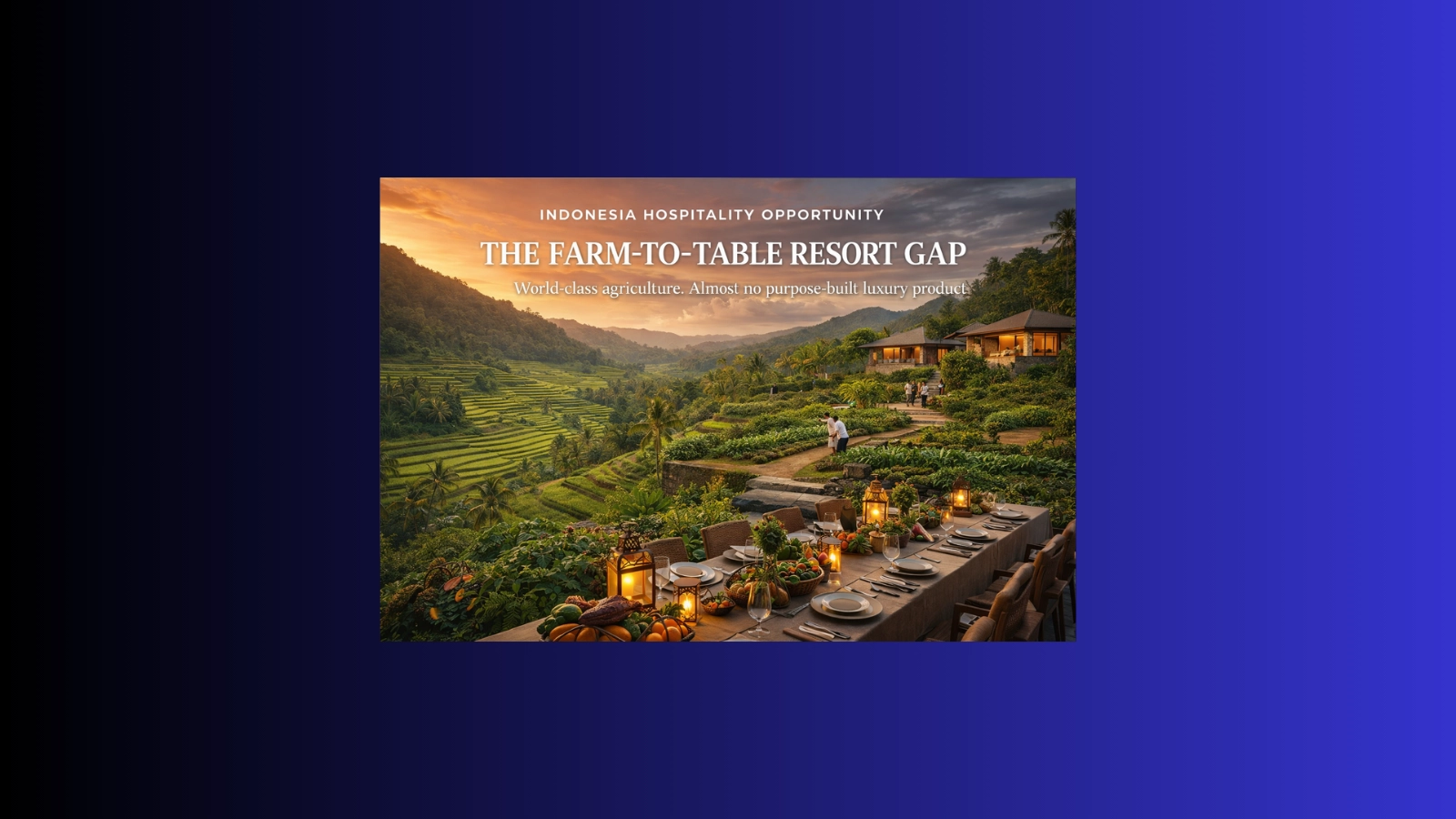
Agritourism resort development Indonesia is still a major white space. The global market is growing fast, premium travelers increasingly want grounded and experience-led hospitality, and Indonesia already has the agricultural assets to support the category. Yet most hospitality developers still default to another villa project, another pool, and another generic lifestyle concept.
That is the gap.
Indonesia has volcanic soils, rice terraces, spice routes, coffee estates, cacao, tropical orchards, and a deep agricultural identity. It also has a tourism narrative increasingly linked to rural experience, sustainability, and community participation. But almost nobody is building a true luxury agritourism resort around those ingredients.
For developers, foreign investors, family offices, and F&B entrepreneurs, this is not a small niche. It is a concept gap with real commercial logic. The opportunity is not simply to build a hotel near farmland. The opportunity is to create an integrated farm-to-table hospitality product with premium ADR potential, stronger non-room revenue, and a more defensible brand story than another standard resort formula.
Why does agritourism resort development Indonesia matter now?
Because the demand trend is already moving, but the local product pipeline is not.
Globally, agritourism has become more relevant as travelers look for immersion, education, local food systems, and experiences tied to place rather than generic luxury. Indonesia is unusually well positioned for that demand. It already has internationally recognized agricultural landscapes, strong culinary identity, and a tourism ecosystem that can support premium storytelling.
The strategic problem is that Indonesian hospitality development still tends to start from real estate typology, not from product DNA. Developers ask how many keys to build before asking what the guest can only experience there.
That is exactly why agritourism resort development Indonesia deserves attention now. In a crowded market, the projects with the strongest long-term pricing power are usually the ones that feel hardest to copy.
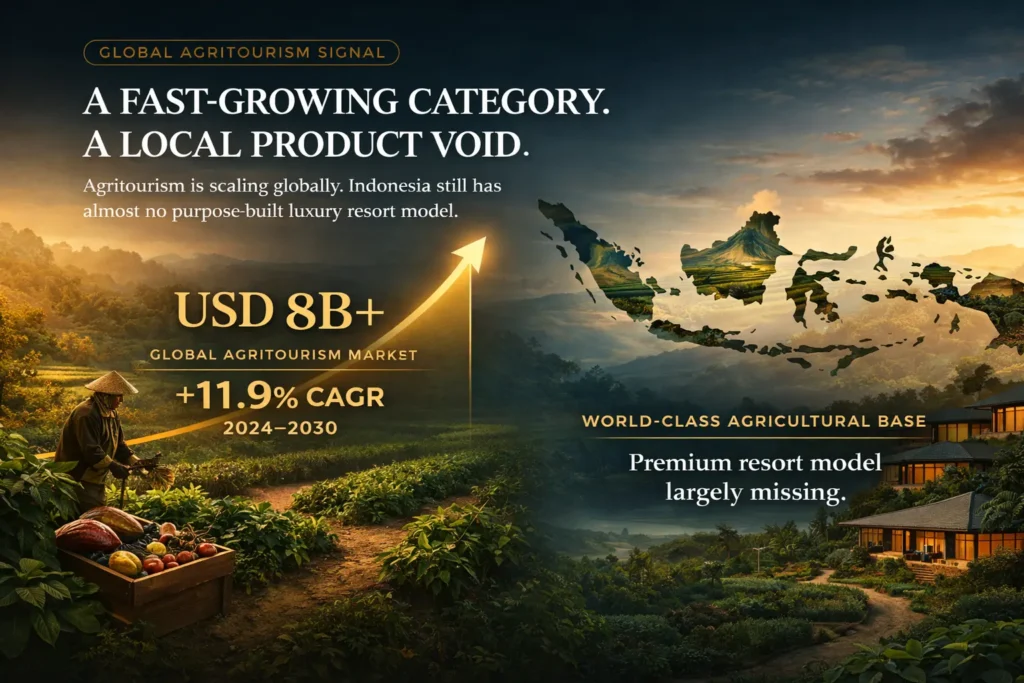
What is Indonesia missing today?
Indonesia is not missing agricultural beauty. It is missing purpose-built agritourism hospitality.
There are rural stays, tourism villages, farm visits, café-led experiences, and isolated wellness retreats. But there are very few serious hospitality products that combine accommodation, agriculture, culinary programming, workshops, and retail into one coherent operating model.
That matters because a real farm-to-table resort is not just a scenic location. It is a system. The land informs the kitchen. The kitchen informs the guest experience. The guest experience informs the brand. The brand then supports pricing, loyalty, and non-room spend.
Without that integration, the concept stays shallow.
Why is Indonesia so well suited to a farm-to-table resort model?
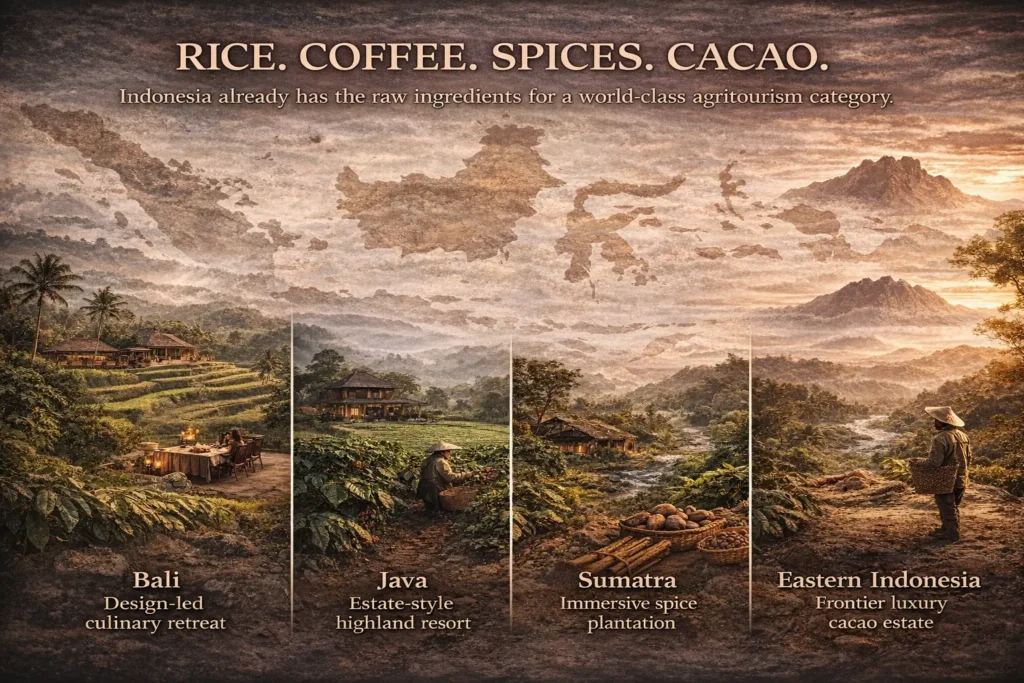
Because the country already has the core ingredients that many other markets have to manufacture.
Bali offers globally legible rice terraces and a strong wellness and culinary audience. Java offers coffee, tea, altitude, vegetables, and broader agricultural scale. Sumatra offers coffee and spice stories with real global recognition. Across the country, the agricultural narrative is already authentic.
The issue is not whether Indonesia has enough agricultural depth. It does.
The issue is whether a developer can translate that depth into a premium hospitality product instead of reducing it to landscaping and mood.
A proper farm-to-table hotel concept in Indonesia should not begin with villas around a view. It should begin with crop logic, harvest rhythm, kitchen identity, guest programming, service flow, and revenue architecture.
What can investors learn from global agritourism benchmarks?
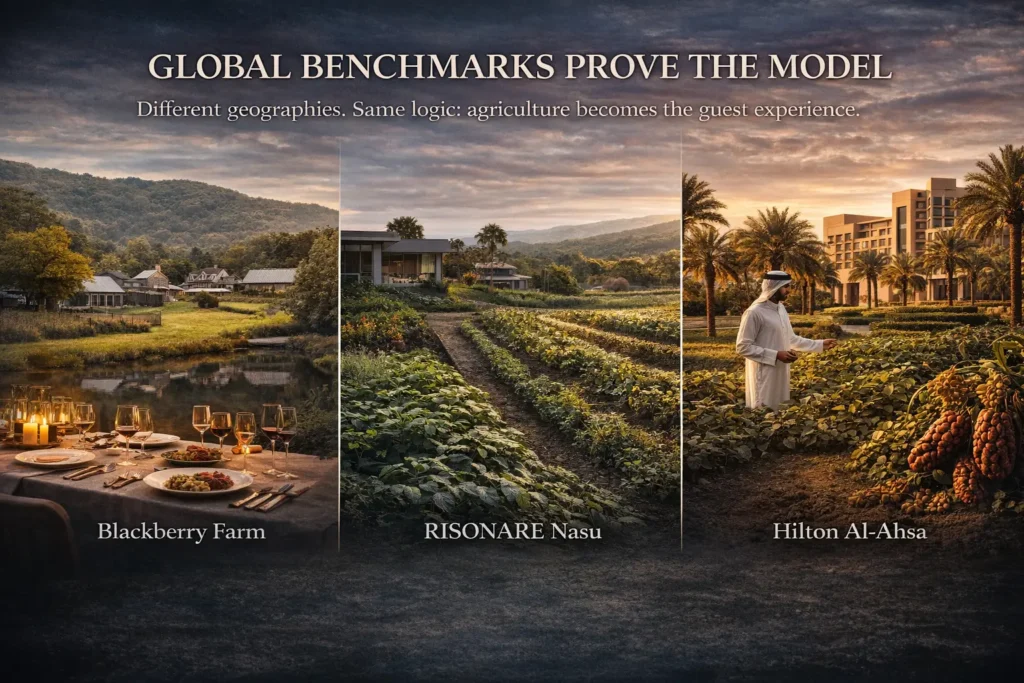
The key lesson is simple: agriculture must be part of the business model, not just part of the scenery.
Properties such as Blackberry Farm, RISONARE Nasu, and Hilton’s announced Al-Ahsa Agritourism Resort show the same pattern. The strongest projects do not treat agriculture as a decorative backdrop. They build the stay around land, food, learning, and memory.
That is why these assets can command premium positioning.
The benchmark takeaway for Indonesia is not to copy foreign aesthetics. It is to understand how the stack works:
- land as a real operating input,
- food as a destination engine,
- experiences as a paid programming layer,
- retail as margin and memory,
- and hospitality as the orchestrator.
What should the product actually include?
A viable agritourism resort development Indonesia model should integrate multiple layers from the start.
1. A real agricultural anchor
This could be coffee, cacao, spices, rice, herbs, orchards, or a curated mixed-farm system. It must be real enough to shape the identity of the property.
2. A strong culinary engine
The F&B program should not be an afterthought. It should be one of the main reasons to visit. That means flagship dining, produce-driven menus, tasting moments, chef-led events, and visible links between land and plate.
3. Guest experiences tied to the farm
Harvest participation, coffee or spice tastings, cooking classes, fermentation workshops, farm walks, and field-based rituals should be part of the product calendar.
4. Wellness adjacency
Agritourism and wellness fit naturally together. Slow mornings, botanical therapies, healthy menus, nature immersion, movement, and recovery can strengthen the guest proposition without forcing the concept into a clinic or retreat model.
5. Retail and take-home products
Coffee, spices, preserves, cacao products, oils, ceramics, books, and branded pantry items can create additional spend and extend the guest relationship beyond checkout.
6. Local producer integration
The strongest model is rarely total self-sufficiency. It is a curated producer ecosystem. The property grows some, sources some, interprets all of it well, and makes the network visible to the guest.
Why is another villa project the wrong answer?
Because standard resort supply is already crowded, while concept-led rural luxury remains underbuilt.
A conventional villa development may still sell. But in many parts of Indonesia, especially Bali, it no longer differentiates itself automatically. Too many projects compete on visuals, not on product depth. That weakens pricing power and increases dependence on marketing, discounts, and OTA dynamics.
By contrast, agritourism resort development Indonesia can create a more defensible position because it combines place, food, story, and activity into one operating thesis. It is harder to replicate. It is also easier to talk about clearly in sales, PR, social content, and investor materials.
This is the same strategic logic behind strong concept-led hospitality more broadly. We have written before about how weak concept definition often undermines otherwise attractive assets in hospitality feasibility studies in Bali and Indonesia. The same issue applies here. Beautiful land does not protect a weak product.
How does the business model work?
The business model works best when the asset is not underwritten as a room-only story.
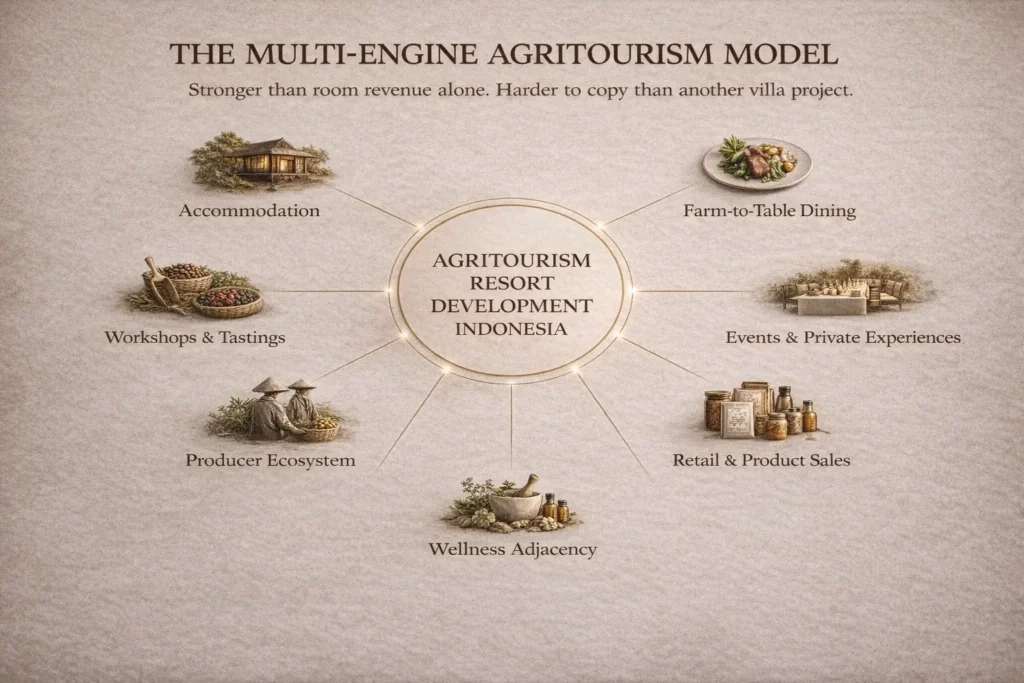
A farm-to-table resort can generate revenue from:
- accommodation,
- destination dining,
- private events,
- workshops and classes,
- tastings,
- day experiences,
- retail,
- and seasonal packages.
That matters because it reduces dependence on one single line of revenue.
For many investors, that is the real attraction of agricultural tourism Indonesia as a hospitality format. The concept can produce a stronger mix of resident and non-resident spend, especially if the F&B and programming are strong enough to pull local or regional demand.
The mistake is to assume that more revenue lines automatically mean better economics. They do not. They only become valuable when the concept is designed correctly and operated with discipline.
What are the right site archetypes?
Not every rural site is right for agritourism. The concept is highly sensitive to location logic.
Bali uplands
Bali is the easiest global gateway because it already has distribution power, strong awareness, and a cultural landscape people immediately understand. It is commercially attractive, but it also carries land pressure and a higher risk of superficial concept execution.
Java highlands
Java may offer one of the strongest long-term operator plays. The agricultural logic can be deeper, the sense of discovery can be stronger, and the land story can feel less diluted by mainstream hospitality patterns.
Sumatra coffee and spice regions
These are powerful for origin-led concepts, but access, education, and operating standards become more demanding. The upside is stronger authenticity. The challenge is execution.
Mixed-produce secondary locations
There may also be opportunities in less obvious regions where produce, water, climate, and community interface support a differentiated concept. But those sites need more feasibility rigor, not less.
The wrong site is simply beautiful agricultural land. The right site is land where hospitality, service flow, water, access, labor, and agricultural identity can reinforce each other.
How to structure agritourism resort development Indonesia properly
A serious agritourism project should be structured in a disciplined sequence.
Step 1: Start with the agricultural thesis
Define the crop and land story first. Coffee, cacao, spices, rice, orchards, or a mixed edible landscape will shape the brand, guest experience, and operating calendar.
Step 2: Test site viability like an operator
Assess water, slope, climate, access, zoning, service circulation, utilities, labor availability, and environmental constraints. A compelling view is not enough.
Step 3: Build the product DNA before design hardens
Map how agriculture connects to dining, guest rituals, workshops, retail, staffing, and seasonality. Architecture should support the concept, not guess it.
Step 4: Underwrite dual revenue streams
Model accommodation separately from non-room engines. Dining, events, workshops, tastings, and product sales should each have logic, assumptions, and seasonality.
Step 5: Design the guest journey around harvest cycles
The property should feel different across the year. Planting, harvesting, wet season, dry season, and local celebration periods should inform the programming calendar.
Step 6: Build governance and compliance early
Land structure, licenses, environmental implications, community engagement, and operating permissions should be addressed upfront. This is especially important in Indonesia, where legal and development misalignment can destroy value later.
Here, an operator-first approach matters. At Zenith, we focus on concept, feasibility, operating logic, pre-opening governance, and commercial reality rather than just visual positioning. Accordingly, that same approach sits behind our work on hotel licensing and foreign investor risk in Indonesia and our broader thinking on hospitality concept development and commercial performance.
What are the biggest risks?
The biggest risk is fake authenticity.
When the farm layer is too thin, the project slips into themed hospitality rather than a credible agritourism product. Likewise, if the luxury layer is underdeveloped, the asset starts to feel like a weak farmstay instead of a premium resort. More importantly, when the operating model lacks depth, the owner is left with a beautiful story but a fragile P&L.
Other major risks include:
- land and zoning issues,
- water and climate volatility,
- crop failure and seasonal inconsistency,
- labor complexity,
- culinary execution risk,
- and community misalignment.
In addition, there is a strategic risk of overbuilding the room inventory. A concept like this usually performs better when the key count stays disciplined and the non-room engines are strong. Otherwise, once the asset becomes too accommodation-heavy, the agricultural story begins to dilute.
For that reason, agritourism resort development Indonesia should be treated as a concept-led hospitality business, not as a rural real estate play with a farm attached.
What makes the concept financially interesting?
It can be more resilient than a standard boutique resort if the product is designed correctly.
In commercial terms, the appeal usually comes from three factors:
- premium positioning,
- stronger ancillary spend,
- and a clearer story for destination demand.
A guest who comes for the full experience is not only buying a room. In many cases, that same guest also buys tasting menus, workshops, farm activities, retail, private dining, and seasonal events. As a result, revenue per guest can increase while dependence on pure occupancy can decrease.
From an owner’s perspective, that does not remove risk. However, it can improve business resilience when compared with a standard product that relies mainly on rooms and generic F&B.
This is also why a proper hospitality feasibility study matters before capital is committed. Ultimately, the concept is only as strong as the assumptions behind land reality, pricing logic, operating capacity, and market fit.
How should developers think about the F&B opportunity?
The culinary engine is not secondary. It is central.
In many agritourism concepts, the restaurant becomes one of the strongest commercial engines in the asset. It can attract local diners, destination visitors, private groups, culinary events, and media attention. It also gives the farm meaning in the eyes of the guest.
A weak restaurant weakens the whole concept.
A strong one creates:
- local relevance,
- non-resident spend,
- higher guest satisfaction,
- stronger content and PR value,
- and a more defensible premium position.
For F&B entrepreneurs specifically, this is where farm-to-table hotel concept thinking becomes highly attractive. The project is not just an accommodation business. It can also be a culinary platform, a retail platform, and a brand platform.
Is this aligned with Indonesia’s tourism direction?
Yes, but the premium execution layer is still missing.
Indonesia has already pushed tourism villages, community-based tourism, and more distributed tourism development. That creates a favorable backdrop for rural and agriculture-linked hospitality. A premium agritourism resort would not replace that agenda. It would be the high-end expression of it.
The opportunity is to build a concept that respects local agriculture, creates economic participation, and still delivers a polished hospitality experience for a premium market.
That is a better long-term story than another generic resort product trying to compete only on visuals.
FAQ
Is agritourism resort development Indonesia only relevant for Bali?
No. Bali is the easiest entry point because it already has strong tourism visibility, international distribution, and agricultural landscapes that global travelers immediately recognize. But Java, Sumatra, and other regions may offer stronger long-term fundamentals depending on crop identity, site scale, water, labor, and access. The right answer depends on product logic, not just destination fame.
Can an agritourism resort in Indonesia achieve premium ADR?
Yes, but only if agriculture is embedded into the product and not treated as scenery. Premium ADR comes from concept depth, culinary credibility, programming, service quality, and emotional distinctiveness. A project that simply places guest rooms near farmland will struggle. A project that turns land, food, ritual, and storytelling into a coherent hospitality proposition has a much stronger chance of supporting premium rates.
What is the main operator challenge in a farm-to-table resort?
The operator challenge is integration. Rooms, agriculture, culinary, workshops, staffing, seasonality, service design, and compliance all need to work together. This is more complex than running a standard boutique hotel. It requires stronger SOPs, a clearer pre-opening plan, tighter product DNA, and more discipline in staffing and scheduling.
Is agritourism resort development Indonesia more resilient than a normal boutique resort?
Potentially, yes. The resilience comes from diversified revenue and a more distinctive market position. The asset can monetize rooms, dining, events, workshops, retail, and seasonal experiences rather than depending almost entirely on occupancy. But that resilience only appears when the concept is designed correctly and the operations are strong enough to deliver consistently.
What should an investor do first?
Start with feasibility, not land acquisition alone. Test crop logic, site viability, access, utilities, climate, labor, guest promise, concept fit, and dual revenue assumptions before design development starts. This is the stage where the biggest value is created or destroyed.
Summary Takeaways
- Agritourism resort development Indonesia is a real concept gap, not a theoretical niche.
- Indonesia already has the agricultural assets. What is missing is disciplined hospitality product design.
- The winning model is not a hotel beside a farm. It is an integrated land-food-experience business.
- The strongest commercial upside comes from combining premium accommodation with dining, workshops, events, and retail.
- The biggest strategic mistake is building another generic resort when the market is ready for something far more place-specific.
- Feasibility, product DNA, and operating logic should come before design freeze and long before opening.
How Zenith approaches this category
Zenith Hospitality Global approaches agritourism resort development Indonesia as an operator-first concept and feasibility challenge.
We help owners and developers:
- identify land and site archetypes suited to agriculture-led hospitality,
- shape the product DNA around crops, culinary programming, and guest experience,
- map the operating model across rooms, F&B, retail, and activities,
- build the pre-opening governance needed to launch correctly,
- and underwrite the dual revenue logic that makes the concept commercially more resilient.
In other words, we do not see agritourism as a decorative theme. We see it as a serious hospitality format that requires concept discipline, operational realism, and a clear commercial thesis.
To understand how we think more broadly about hospitality strategy, visit Zenith Hospitality Global and explore the Zenith Hospitality Global blog.
Author
André Priebs
CEO, Zenith Hospitality Global
André advises owners, developers, and investors on luxury boutique hotels, lifestyle retreats, and wellness-led hospitality assets across Indonesia. His work focuses on concept development, feasibility, operating systems, pre-opening governance, and commercial performance. At Zenith Hospitality Global, that means helping turn attractive land and ambitious ideas into hospitality businesses that can actually perform.
Final call to action
If you are evaluating rural land, exploring a farm-to-table hotel concept, or testing agritourism resort development Indonesia as an investment thesis, this is the stage where concept discipline matters most.
Read more from the Zenith Hospitality Global blog, review our perspective on hospitality feasibility and concept strategy, or contact Zenith when you are ready to structure the project properly rather than guess your way into the wrong product.
If you want, next I will update the SEO metadata pack and the merged JSON-LD so the same internal UTM structure is reflected consistently.