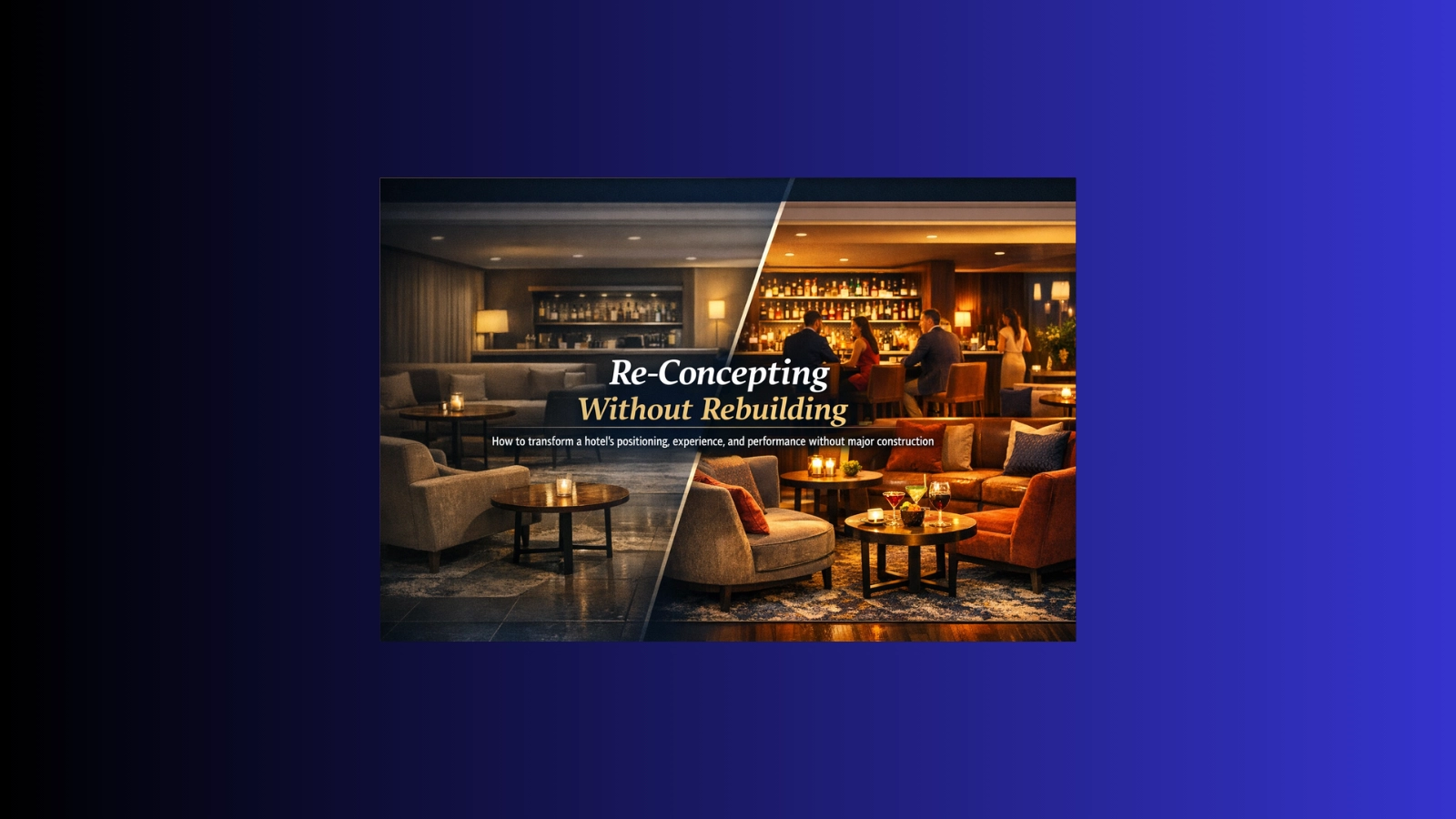
Full renovation is expensive, disruptive, and often unnecessary. For many underperforming assets, hotel repositioning without renovation is the smarter move: change the concept, sharpen the positioning, rebuild the service culture, and improve the commercial engine without major structural work.
That matters even more in Bali and Indonesia. Many properties still have decent bones, workable room stock, and attractive locations, but they are mispositioned, operationally inconsistent, or commercially weak. Recent Bali tourism data from BPS shows that demand is still present, but not every property is capturing it equally.
The uncomfortable truth is simple: many hotels do not have a building problem. They have a relevance problem.
Why do hotels underperform even when the asset is still physically usable?
Because guests do not buy walls. They buy relevance, consistency, and emotional fit.
A hotel underperforms when its concept no longer matches demand, its service promise is vague, or its guest experience lacks clarity. In practice, that shows up as weak ADR, unstable occupancy, poor review sentiment, soft F&B capture, and a heavy dependence on discounting.
This is why hotel repositioning without renovation is often more effective than rebuild-first thinking. If the physical shell is broadly workable, the highest-return move is usually not demolition or full refurbishment. It is re-concepting: deciding who the hotel is for, why guests should choose it, and how the team should deliver that promise every day.
For adjacent context, this sits directly beside Zenith’s broader market view on Bali’s real-estate bubble and oversupply risk and the shift toward integrated hospitality in Bali.
What is hotel repositioning without renovation?
Hotel repositioning without renovation is a capital-light transformation strategy that improves market relevance and operating performance without major structural changes.
It usually includes five things:
- a new target guest and value proposition
- a redesigned guest journey and experience signatures
- a service culture reset through training and leadership cadence
- an F&B and programming rethink
- a soft-goods and perception refresh
This is not cosmetic staging. It is a commercial and operational reset.
The goal is to change how the asset is perceived, priced, experienced, and remembered. Done properly, that can improve rate integrity, guest satisfaction, ancillary spend, and NOI far faster than a heavy capex cycle.
Why is hotel repositioning without renovation often a better investment than rebuilding?
Because full renovation creates three immediate pressures: high capex, trading disruption, and execution risk.
Owners often default to visible construction because it feels decisive. But if the real problem is concept-market mismatch, major works can become an expensive distraction. You spend heavily, lose time, disrupt trading, and still reopen with an unclear product.
A more rational question is this:
What is the minimum capital required to materially improve pricing power and demand quality?
That is where capital-light transformation becomes powerful. Research from Cornell on online reputation and hotel performance, JLL on lifestyle hotels in Asia Pacific, and the Global Wellness Institute on wellness tourism and spending points in the same direction: guest perception, service quality, F&B relevance, reputation management, and lifestyle or wellness integration can move commercial performance without structural rebuild.
In Bali, this is especially relevant because submarket performance is highly uneven. Horwath HTL’s Bali Hotel & Branded Residences 2025 report shows that the market still produces strong results for the right product in the right segment. The issue is often not “no demand,” but “wrong offer.”
What actually changes performance in a cost-effective hotel transformation?
The best-performing capital-light turnarounds do not try to fix everything. They fix the few levers that guests feel immediately and operators can control daily.
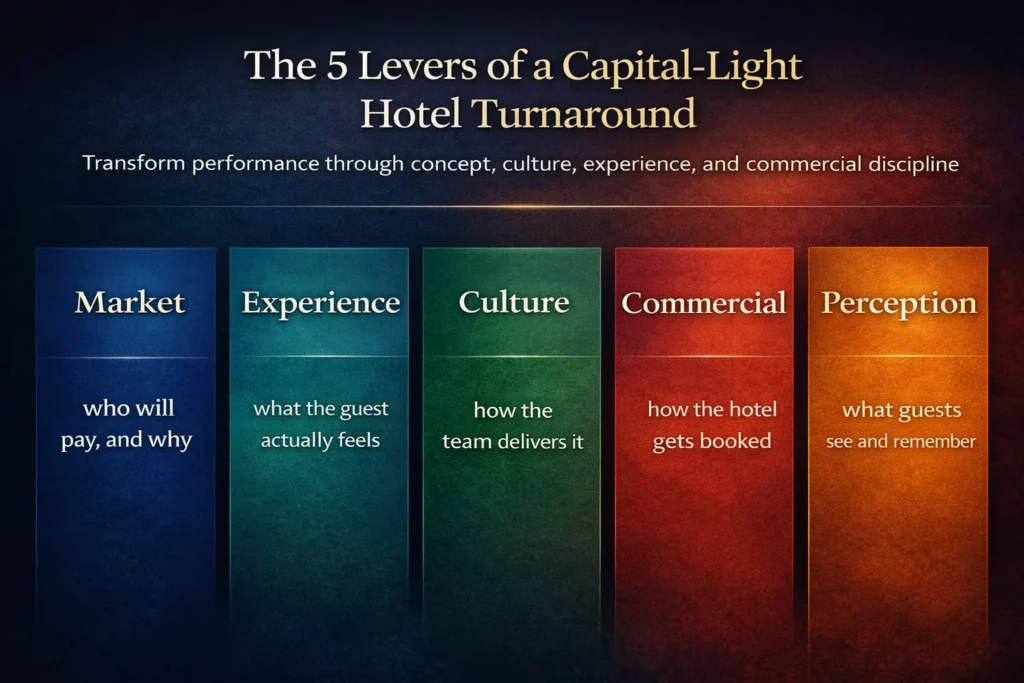
The 5 levers of a capital-light hotel turnaround
1. Market system: who will pay, and why?
A hotel cannot outperform if it is trying to appeal to everyone. The first move is to define the target guest, the stay occasion, and the willingness-to-pay logic.
Is the property a design-led couples retreat, a wellness-forward hotel, a social lifestyle hub, a family-oriented resort, or an extended-stay hybrid? Until that is clear, every downstream decision becomes diluted.
This is one of the biggest problems in Bali: many assets look attractive in photos but have no sharp commercial identity.
2. Experience system: what does the guest actually feel?
A concept only becomes real when it is translated into moments. Arrival, check-in, room first impression, sleep quality, breakfast, bar energy, wellness touchpoints, and departure all need to feel intentional.
That does not require moving walls. It requires design discipline in service, atmosphere, sequencing, and storytelling.
3. Culture system: how will the team deliver it every day?
Culture is not a soft topic. It is delivery infrastructure.
Hotels win or lose repositioning through daily behaviors: greeting quality, complaint recovery, product knowledge, response speed, upsell fluency, and consistency across shifts. The logic behind the service-profit chain, together with hospitality training research such as this boutique hotel training study and this hotel service training study, reinforces the link between employee support, service quality, and guest outcomes.
This is why training must sit at the center of any serious hotel repositioning without renovation strategy.
4. Commercial system: how will the hotel get booked at the right price?
A hotel concept refresh fails if the commercial engine still tells the old story.
That means pricing logic, channel mix, direct booking journey, review management, photography, OTA content, CRM, and launch messaging all need to reflect the new positioning. Cornell’s work on social media and lodging performance makes the commercial case clearly: stronger online reputation can support better ADR, occupancy, and RevPAR outcomes.
5. Perception system: what can guests see, touch, and remember?
The fastest visual gains usually come from selective, guest-facing updates:
- textiles and bedding
- art and styling
- lighting layers
- uniforms
- scent and sound
- signage and wayfinding
- tabletop and amenity presentation
These interventions are far cheaper than structural renovation, but they can materially change perceived quality when tied to a clear concept.
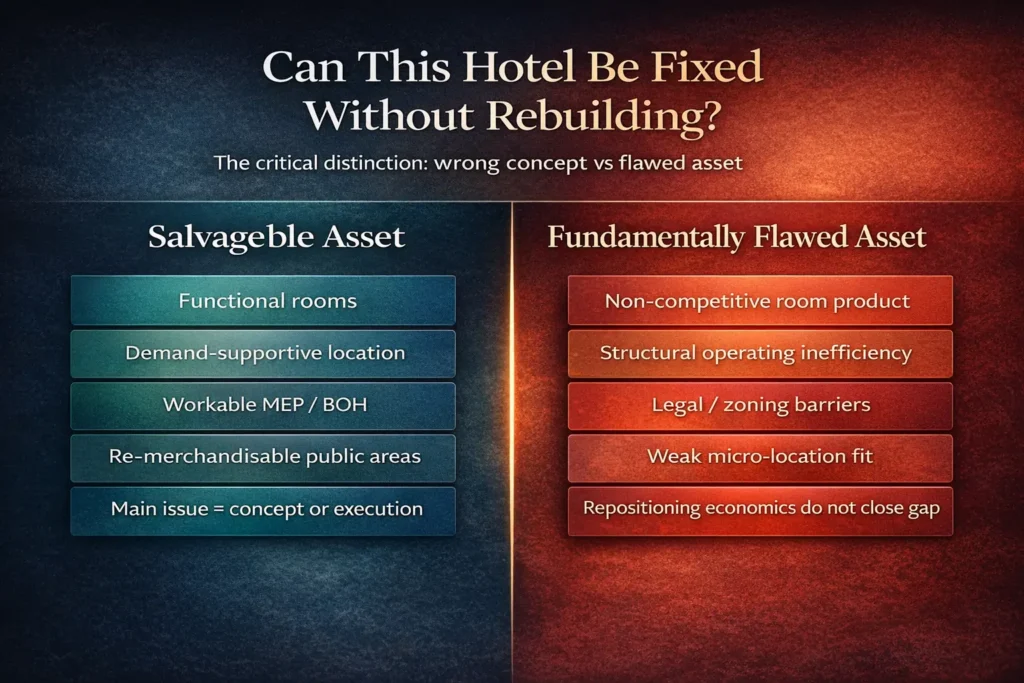
How do you know whether a hotel can be repositioned without rebuilding?
Start with the core distinction that most owners avoid:
Wrong concept, salvageable asset
versus
Fundamentally flawed asset
A hotel is usually salvageable when:
- rooms are functional for the intended market
- the location still has demand logic
- back-of-house and MEP are workable
- public areas can be re-merchandised without structural change
- the main problem is weak positioning or poor execution
A hotel is much harder to save when:
- room sizes are non-competitive
- circulation or BOH makes operations inefficient every day
- legal, zoning, or licensing issues block the intended use
- the micro-location does not support the desired market
- the cost to close the comp-set gap approaches rebuild economics
For Bali investors, that assessment is essential. Colliers’ Bali hotel market research has repeatedly flagged rising competition, alternative accommodation pressure, and shifting guest preferences across the island’s hospitality market. In oversupplied submarkets, a generic hotel with acceptable physical condition can still underperform badly if the concept is weak.
This is also why any transformation plan should sit alongside compliance and market-fit review, not just creative brainstorming. Zenith’s perspective on that is consistent with our broader work around compliance and concept strategy in Bali and the legal risk behind assets with weak foundations, such as those covered in our analysis of the hidden cost of illegal villas in Bali.
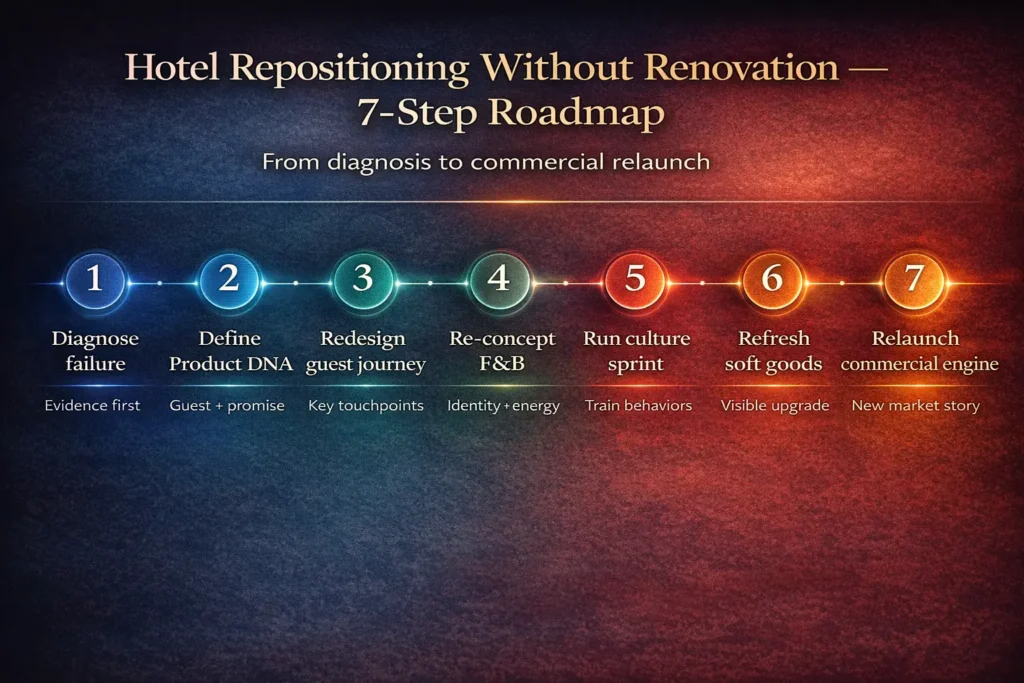
How To: Execute hotel repositioning without renovation in 7 steps
Step 1 — Diagnose the real failure
Do not start with design mood boards. Start with evidence.
Review ADR trend, occupancy quality, source markets, channel mix, review themes, F&B capture, labor productivity, guest complaints, and competitor mismatch. Separate physical pain points from concept pain points.
Step 2 — Define the new Product DNA
Write a one-page positioning thesis:
- who the guest is
- why they stay
- what emotional promise the hotel makes
- what the hotel is not
- what price logic the concept must support
This becomes the operating brief for every department.
Step 3 — Redesign the guest journey
Identify five to eight moments that must become signature. In most hotels, the high-impact sequence is:
- pre-arrival
- arrival and first 15 minutes
- room first impression
- sleep experience
- breakfast
- social or wellness touchpoint
- departure
Guests rarely remember “the renovation.” They remember how the stay felt.
Step 4 — Re-concept F&B and programming
Many underperforming hotels have restaurants that are physically acceptable but commercially weak. The issue is often not layout. It is culinary identity, menu architecture, service rhythm, atmosphere, local relevance, and programming.
JLL’s Asia Pacific lifestyle hotel analysis supports the argument that food, beverage, and social energy are not secondary. They are part of the product.
Step 5 — Run a service culture sprint
Train around the new promise, not generic hospitality language.
That means:
- service standards
- empowerment rules
- product knowledge
- complaint recovery
- upsell behaviors
- leadership cadence
- daily QA routines
No concept change survives old behaviors.
Step 6 — Refresh soft goods and sensory cues
This is the capital-light physical layer of the repositioning:
- linens and textiles
- lighting scenes
- art and styling
- menus and collateral
- scent and sound
- uniforms
- wayfinding and guest signage
The aim is not “make it prettier.” The aim is to make the new concept visible.
Step 7 — Relaunch the commercial engine
Reset the market-facing story:
- website copy
- image selection
- OTA text
- review response cadence
- paid and organic content
- launch campaign
- pricing logic
- direct booking journey
If the market still sees the old story, the repositioning has not happened.
What should owners spend on a cost-effective hotel transformation?
The right answer is not a single number. It is an investment ladder.
Zero-to-low capex moves
These are the first actions when cash is tight but change is urgent:
- target guest reset
- offer architecture
- service recovery discipline
- review management
- revenue management reset
- training and empowerment sprint
- new brand narrative and copy
Moderate capex moves
These are the highest-value physical interventions short of structural works:
- soft-goods refresh
- lighting and styling improvements
- signage and wayfinding
- restaurant atmosphere redesign
- amenity and packaging upgrades
- uniform redesign
- localized art and concept cues
Higher but still non-structural moves
These make sense when the concept needs a stronger anchor:
- soft reflagging or brand conversion
- public-space activation
- destination dining identity
- wellness integration without medical infrastructure
- stronger social programming platforms
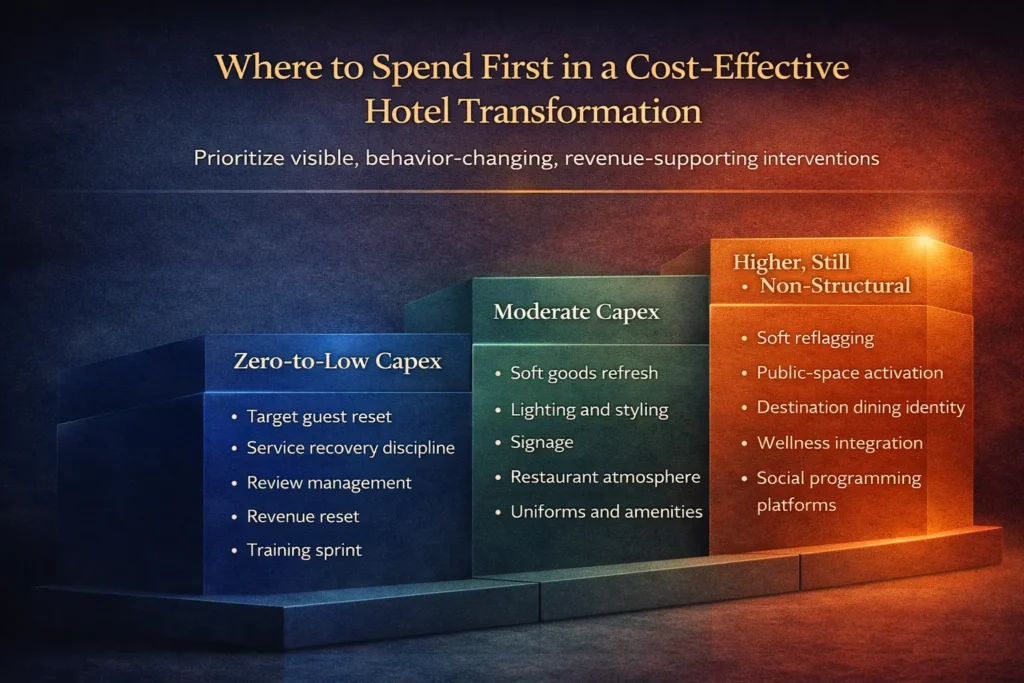
The operating principle is simple: do not spend evenly. Spend where guests notice it, teams can sustain it, and pricing power improves.
Why is Bali especially suited to hotel repositioning without renovation?
Because Bali has many assets with decent physical bones and weak conceptual discipline.
Demand is still real. But competition is intense, guest expectations are rising, and generic positioning is punished quickly. Bali also benefits from strong overlap between lifestyle travel, social hospitality, and wellness demand.
That is important because wellness does not always require a spa-heavy rebuild. The Global Wellness Institute continues to show that wellness tourism captures disproportionate spend relative to trip volume. In plain terms, hotels can capture wellness value through better sleep, movement, recovery, food, rituals, and environment without building a hospital-grade facility.
For owners in Bali, this creates a powerful transformation logic:
- fix concept before capex
- use wellness selectively, not theatrically
- build local relevance into F&B
- improve review performance quickly
- trade up experience without rebuilding the shell
That is the essence of hotel repositioning without renovation in a crowded island market.
What KPIs prove that the repositioning is working?
Owners should not judge the transformation by aesthetics. They should judge it by operating evidence.
| System | KPI | Why it matters |
|---|---|---|
| Market | Segment mix and channel mix | Shows whether the hotel is attracting the intended guest |
| Commercial | ADR, RevPAR, and direct booking share | Shows whether pricing power is improving |
| Experience | Review score and review themes | Shows whether guest perception is changing |
| F&B | F&B revenue per occupied room | Shows whether the concept is driving ancillary spend |
| Culture | QA scores, mystery audits, service recovery compliance | Shows whether training is translating into behavior |
| Profitability | GOP flow-through on incremental revenue | Shows whether the transformation is economically real |
A useful underwriting formula remains:
Incremental annual room revenue = change in RevPAR × keys × 365
Incremental GOP = incremental revenue × flow-through
Payback period = capex ÷ incremental GOP
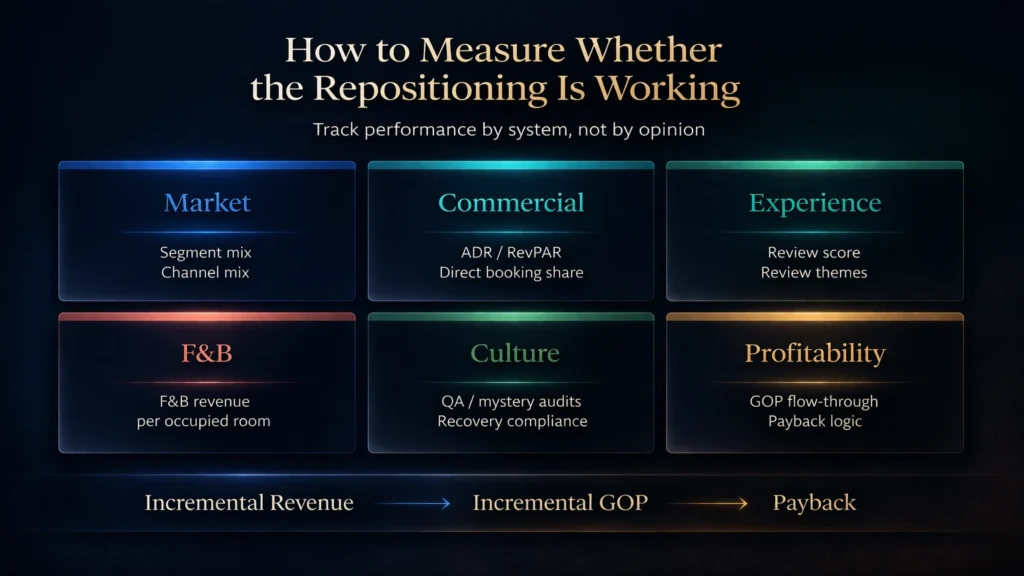
That discipline is what separates a real capital-light turnaround from a cosmetic refresh.
FAQ
Can hotel repositioning without renovation really improve ROI?
Yes, when the core issue is concept-market mismatch, weak service culture, or poor commercial execution rather than structural obsolescence. In those cases, a sharper concept, stronger reputation management, more relevant F&B, and better staff delivery can improve ADR, ancillary revenue, and margin without major construction. The return usually comes from better demand quality, not from adding more physical product.
What is the biggest mistake owners make during a hotel concept refresh?
They change the visual layer but leave the operating layer untouched. New photos, new cushions, and a new logo do not fix indifferent service, unclear standards, weak menu strategy, or poor review handling. Guests notice that gap immediately. The hotel looks repositioned online but feels unchanged on property. That destroys credibility and limits pricing power.
When should an owner avoid hotel repositioning without renovation?
Avoid it when the asset has structural or legal constraints that materially block competitiveness: non-functional room sizes, severe MEP failure, circulation problems, zoning issues, or a micro-location that does not support the desired market. In those cases, concept work alone will not close the gap. First solve operability and legal viability.
How long does a capital-light hotel turnaround usually take?
A disciplined repositioning can often move from diagnosis to relaunch in roughly 8 to 20 weeks, depending on procurement, team readiness, and the scope of soft-goods work. The strategic and operational reset can happen quickly. The key is sequencing: diagnose first, define the Product DNA, train the team, refresh the visible cues, then relaunch the commercial engine.
Is Bali still a good market for capital-light hotel transformation?
Yes, but only for owners willing to differentiate. Bali remains demand-rich, yet oversupply and category blur punish generic assets. That is precisely why repositioning can work so well here. A property with good bones and weak identity can often gain more from sharper positioning, better F&B, stronger reviews, and a clearer guest journey than from spending heavily on construction alone.
Summary Takeaways
- Many underperforming hotels do not need rebuilding; they need a sharper concept and a stronger operating engine.
- Hotel repositioning without renovation works best when the asset has good bones but weak market relevance.
- The highest-ROI levers are usually positioning, service culture, guest journey, F&B identity, review performance, and selective soft-goods refresh.
- In Bali, crowded competition makes identity and execution more important than physical condition alone.
- Owners should underwrite transformation through RevPAR, F&B capture, review performance, and GOP flow-through, not visual appeal.
- The wrong renovation can waste capital. The right capital-light turnaround can materially improve performance at a fraction of rebuild cost.
Call to Action
If your hotel has decent physical bones but weak performance, do not jump straight to a full renovation budget.
Start with diagnosis.
At Zenith Hospitality Global, we help owners, investors, and operators assess whether an asset needs rebuilding, selective capex, or a full concept-and-culture reset. That includes concept repositioning, guest journey redesign, F&B re-concepting, service culture transformation, operational structuring, and commercial relaunch.
You can also explore related Zenith thinking on hospitality ROI in Southeast Asia, co-living vs hotels for long-stay demand, and biohacking and wellness investment in Bali.
Author
André Priebs
CEO, Zenith Hospitality Global
André Priebs is CEO of Zenith Hospitality Global, an operator-first hospitality consultancy and management partner focused on luxury boutique hotels, lifestyle retreats, and wellness-driven assets across Bali and Indonesia. He advises owners, investors, and developers on concept creation, pre-opening governance, operating systems, commercial performance, and capital-light turnarounds.