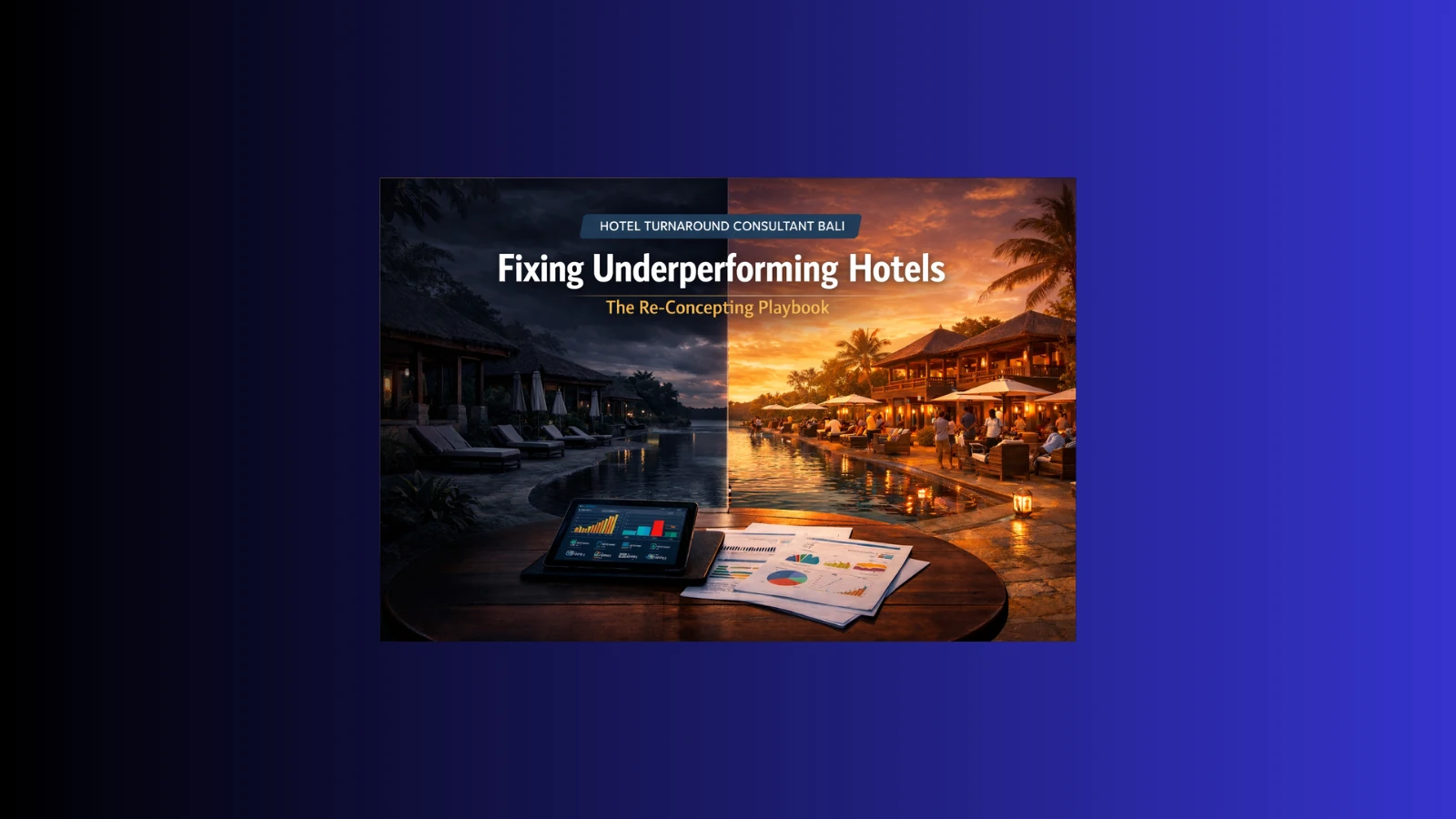
A weak hotel in a healthy market is rarely a pricing problem. It is usually a concept problem, an operating model problem, a commercial execution problem, or a combination of all three. That is exactly why a serious hotel turnaround consultant Bali owners can trust does not start with discounts or cosmetic upgrades. The work starts with diagnosis, then re-concepting, then disciplined execution.
Bali remains one of Southeast Asia’s strongest hospitality markets, but that strength is precisely why underperforming hotels stand out. Horwath HTL reported a strong 2024 market with roughly 75% average occupancy, ADR around IDR 2.4 million, and RevPAR around IDR 1.8 million, while international arrivals continued rising in 2025 even as official occupancy indicators showed pressure in parts of the market. In other words: demand exists, but weak assets are getting exposed faster. If your hotel is missing budget, cutting rate is usually the wrong first move.
The correct sequence is: diagnose the gap, re-define the guest promise, reset the operating model, and rebuild commercial traction without destroying ADR integrity.
Many Bali hotels opened in the 2020–2023 cycle with optimistic underwriting, generic positioning, or weak operating discipline. Now they are facing softer occupancy than forecast, ADR pressure, high OTA dependency, inconsistent guest reviews, and poor flow-through to profit. In a market shaped by new supply, villa competition, and rising guest expectations, generic hotels get punished. s is the playbook.
If you are already trading and still missing budget, a hotel turnaround consultant Bali engagement should start with a quantified diagnostic sprint, not marketing activity.
Why do hotel turnarounds fail in Bali?
Most hotel turnarounds fail because owners attack symptoms instead of causes. They cut rates, repaint public areas, run shallow promotions, or change the GM without fixing the asset’s strategic mismatch. That may create short-term activity, but it rarely restores profit quality.
In Bali, this mistake is even more expensive because the market is crowded, highly visual, review-driven, and increasingly fragmented. Horwath HTL has highlighted ongoing pipeline growth, while Colliers has pointed to the combined effect of villa competition, changing guest mix, and pressure on traditional hotel performance. Weak concepts no longer hide behind market growth. : a struggling hotel usually does not need cheaper pricing. It needs a sharper reason to exist.
That is why owners reviewing distressed or marginal assets should also understand adjacent market pressures, including Bali’s oversupplied villa ecosystem and shifting yield logic. We covered those structural dynamics in our analysis of integrated hospitality in Bali, our article on Bali yield strategy, and our broader review of overcrowding in Bali tourism. tel underperformance?
A serious turnaround begins by classifying the problem correctly. In practice, most underperforming hotels fall into four buckets.
1. Concept and positioning failure
The hotel is too generic, too broad, or aimed at the wrong guest. It is selling “nice rooms in Bali” in a market where guests can choose from branded resorts, lifestyle stays, villas, wellness retreats, and hybrid hospitality products. If the property is not the obvious best choice for a specific guest, it becomes a commodity.
2. Operating model failure
The hotel cannot profitably deliver the experience it is promising. This usually shows up as poor housekeeping consistency, maintenance drift, noise complaints, weak service recovery, low breakfast satisfaction, or a F&B concept that is busy but financially irrelevant. Cornell research has shown that reputation scores directly influence ADR, occupancy, and RevPAR, which means experience failure is not a soft issue. It is a revenue issue. guest offer may be viable, but the sales and distribution engine is weak. The property is too dependent on OTAs, direct conversion is poor, content is weak, channel mapping is sloppy, packages are generic, and review response is inconsistent. A Bali-based OTA economics study cited in the research shows the importance of measuring net contribution, not just gross room revenue, particularly when commissions sit in the 15%–20% range.
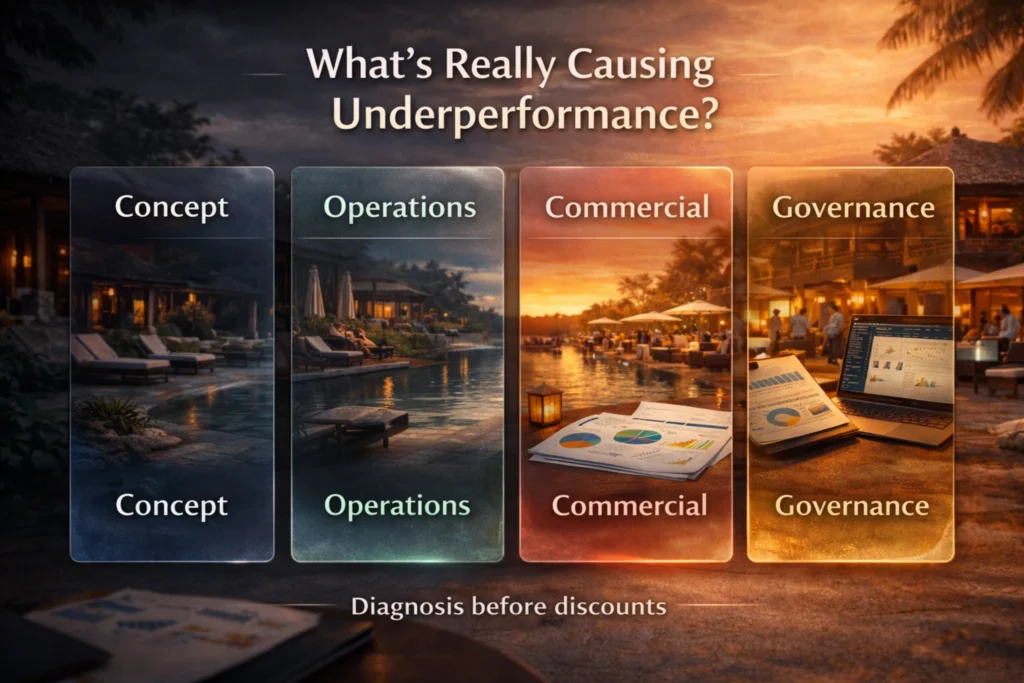
4. Governance failure
How should a hotel turnaround consultant Bali owners hire diagnose the problem?
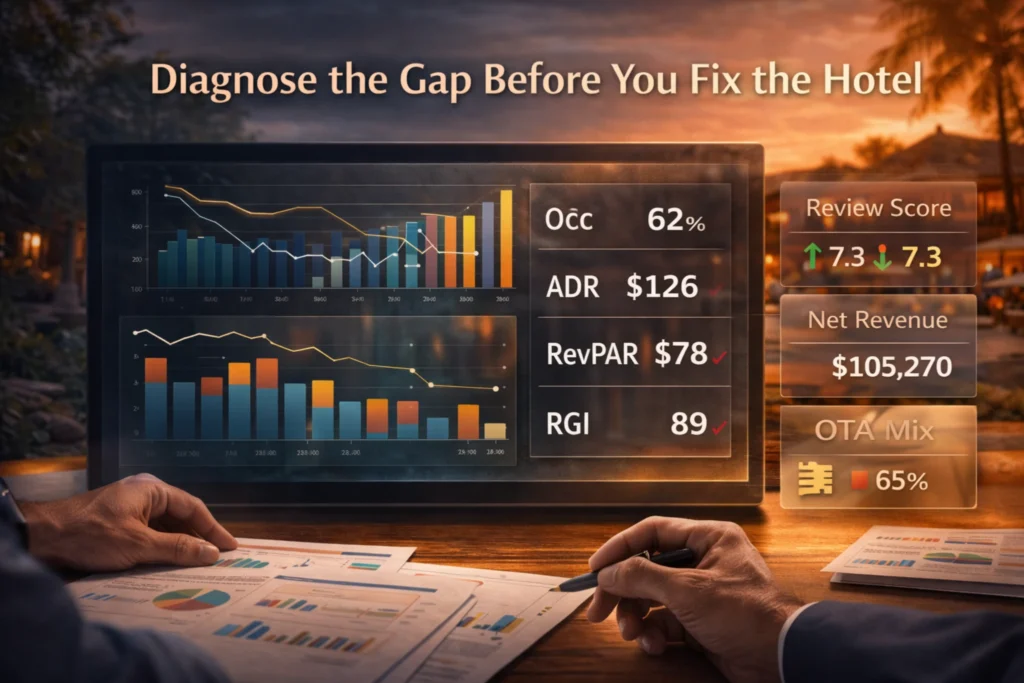
A credible hotel turnaround consultant Bali owners hire should run diagnosis in layers, not in slogans. The goal is to convert “the hotel is underperforming” into a measurable performance gap with clear drivers.
Benchmark the comp-set gap
Start with ARI, MPI, and RGI or a robust proxy benchmark. If the hotel has low MPI but acceptable ARI, the issue is usually demand capture, conversion, or visibility. If MPI is reasonable but ARI is weak, the property is often suffering from poor positioning, weak perceived value, or uncontrolled discounting. If both are weak, the concept itself may be wrong. STR’s benchmarking framework remains the standard language for that analysis.
Compare review profile against rate ambition
A hotel cannot sustainably ask premium rates if the lived guest experience does not support premium pricing. Cornell’s hospitality research found that even modest improvements in online reputation are associated with meaningful gains in ADR, occupancy, and RevPAR. If review sentiment is weak, discounting is often just an expensive substitute for fixing the product.
Rebuild the channel economics
Gross occupancy can hide structural weakness. A hotel that appears full may still be economically broken if mix is dominated by low-net channels. The correct dashboard is not just occupancy and ADR. It is net room revenue after commissions, merchant fees, promotions, loyalty costs, and direct acquisition costs. That is where many turnarounds first “find” profit.
Audit whether the operating model matches the promise
Ask one blunt question: can this hotel deliver what it is selling, at the rates it needs, with the labor model and cost structure it actually has? If not, training alone will not solve it. The operating model itself needs redesign.
For owners still early in the lifecycle of a project, this is exactly why we keep emphasizing structured readiness and operating-system discipline in pieces like our 42-point pre-opening handover audit for Bali hospitality properties and our broader pre-opening hotel checklist.
What does re-concepting actually mean?
The research file is clear on this point: re-concepting is a strategy and underwriting exercise that ends with a sharply defined guest promise and an operating model built to deliver it profitably. EHL’s hotel repositioning methodology follows a logical sequence: market research, strategic option testing, real estate implications, and then operational model adaptation. Fixing Underperforming Hotels_ …
In prame areas:
- Hero guest: Who exactly is this hotel for?
- Value proposition: Why should that guest choose this hotel instead of a villa or competitor?
- Price position: Where should ADR sit relative to the comp set?
- Experience logic: What must be true operationally for the promise to feel credible?
- Commercial strategy: Which channels, packages, and partnerships will support the model?
A hotel does not need to be all things to all guests. In Bali, that is usually the fastest route to invisibility.
Which concepts are more likely to work in Bali now?
There is no universal answer, but several concept directions are structuralFixing Underperforming Hotels_ …market hospitality in the current Bali environment.
Experience-forward leisure
These assets win because they create story, review strength, and rate justification. The point is not decorative design. The point is differentiation strong enough to defend ARI.
Package-led value
This is value without rate destruction. Instead of lowering BAR, the hotel adds relevance through curated inclusions, flexible stay structures, local partnerships, or themed micro-programming.
Rebuilt MICE or retreat logic
Hotels exposed to softer government or traditional meeting demand often need a reset toward corporate offsites, weddings, private buyouts, wellness retreats, or education-led gatherings rather than passive dependence on legacy segments.
Hybrid lifestyle and longer-stay logic
Some assets can improve resilience by blending accommodation with coworking, membership, wellness, or local capture. We explored that broader direction in our article on digital nomads and bleisure travel in Indonesia.
How to execute a hotel turnaround in Bali with a hotel turnaround consultant Bali playbook
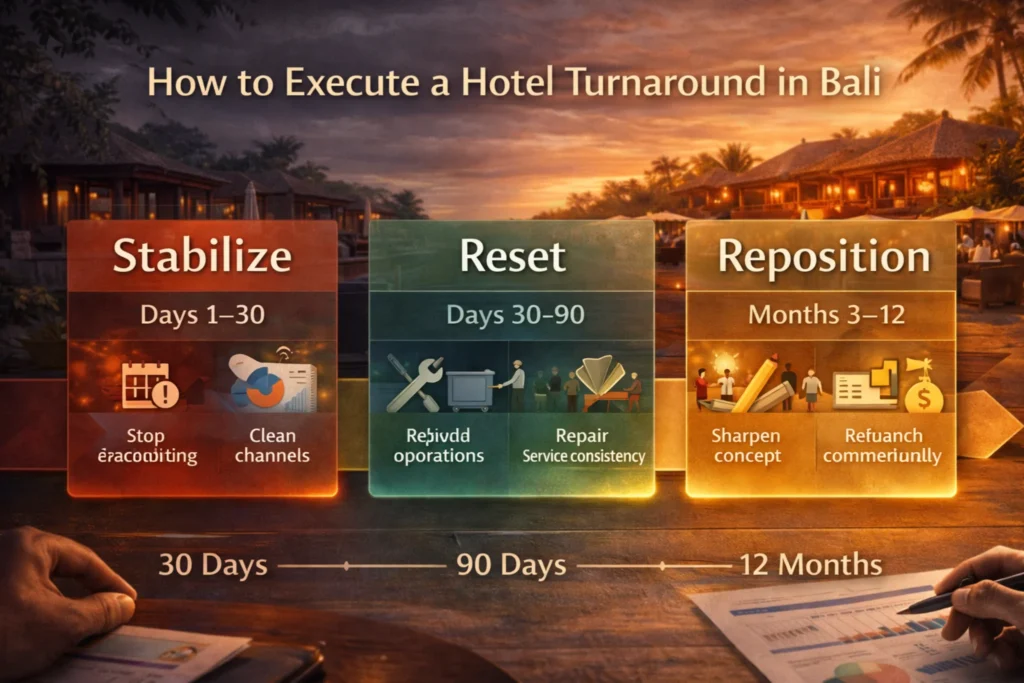
Step 1: Stabilize the first 30 days
The first month is about stopping damage, restoring visibility, and improving bookability without major CapEx.
- Freeze uncontrolled discounting
- Stop rate leakage across channels
- Clean up room-type mapping and content
- Tighten cancellation and payment logic
- Audit OTA and direct channel economics
- Reset review response discipline
- Identify the top five service failures hurting conversion
Cornell’s discounting research remains relevant here: broad discounting often fails to generate the revenue lift owners hope for, and it can damage long-term pricing power.
Step 2: Rebuild the operating model in thes where leadership must make hard choices.
- Redesign workflows around actual demand patterns
- Rebalance staffing rather than adding headcount blindly
- Reset service standards around repeatability, not aspiration
- Repair basic product delivery: cleanliness, maintenance, breakfast, noise, recovery
- Re-concept F&B if it is not contributing strategically or financially
A hotel with strong occupancy but weak cash flow usually has an operating model problem, a channel problem, or both. High activity is not the same as healthy profit.
Step 3: Reposition commercially over months three to twelve
Once the basics are stable, the target shifts to outperformance.
- Rebuild direct booking quality
- Protect ADR integrity
- Replace generic promotions with fenced offers
- Introduce partnerships that reduce acquisition costs
- Use review-score lift as a managed commercial KPI
- Align sales segmentation with the new concept
This is where many owners realize they did not have a marketing problem. They had a proposition problem.
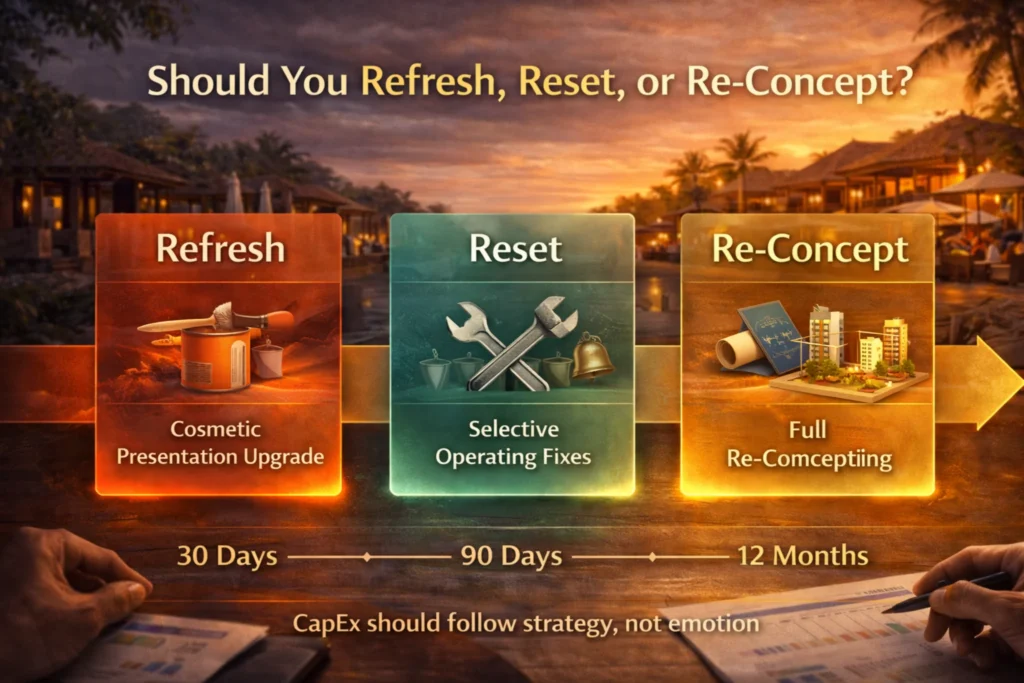
Why is “just renovate it” usually the wrong answer?
Because CapEx without concept clarity is one of the fastest ways to waste money.
CBRE’s turnaround perspective frames hotel repositioning as an investment discipline: every major capital decision should be linked to measurable performance uplift and long-term asset value, not aesthetics alone. In practical terms, a hotel should not spend on “freshness” unless that spend is clearly tied to better ADR defense, review improvement, segment access, or margin expansion.
A better owner question is not, “What can we renova CapEx items will move EBITDA, rate position, or asset value?”**
That is particularly important in Bali, where regulatory and land-use pressure is making “build more later” a weaker rescue strategy than it once was. The Bali provincial government’s land-protection direction and broader media reporting around new development constraints reinforce the need to fix the core business, not assume endless physical expansion.
What should owners do in the next 14 days?
Owner action checklist
- Build a 24-month performance pack covering Occ, ADR, RevPAR, segment mix, channel mix, review scores, payroll, and outlet P&Ls
- Define the true comp set instead of using vanity comparisons
- Separate concept issues from operator excuses
- Measure net room revenue, not just gross room revenue
- Identify the top service failures reducing pricing power
- Create two or three re-concepting scenarios: light, medium, and heavy
- Link every CapEx idea to a measurable commercial or operational outcome
If you need strategic context on legal and structural risk while reviewing your asset, our article on the hidden cost of illegal villas in Bali is also relevant because non-compliance, land use, and positioning mistakes often sit in the same underwriting blind spot.
FAQ
What is the difference between a hotel turnaround and a hotel rebranding?
A rebranding changes market presentation. A turnaround fixes business performance. Sometimes the two overlap, but they are not the same. A hotel can change its name, visuals, and website and still remain structurally weak if the concept, operating model, channel economics, and service delivery are not repaired. A proper turnaround starts with diagnosis and may or may not lead to rebranding.
When should an owner hire a hotel turnaround consultant Bali specialist?
You should bring in a specialist when the hotel is missing pro forma, ADR is deteriorating, occupancy is soft versus the market, reviews are suppressing conversion, OTA dependency is too high, or profit flow-through is not matching topline activity. The earlier you intervene, the more options you preserve. Once the asset has trained the market to buy on discount, recovery becomes slower and more expensive.
Can an underperforming Bali hotel recover without major renovation?
Yes, but only if the main problem is commercial execution, operating discipline, channel mix, or service consistency. If the asset suffers from deep concept mismatch or product obsolescence, some level of physical intervention may still be required. The key is sequencing: fix diagnosis first, then decide whether light, medium, or heavy repositioning is justified.
Is cutting rates a valid turnaround strategy?
Usually not as a primary strategy. Selective fenced offers can be useful, but broad discounting often weakens rate integrity without solving the underlying problem. If the property is underperforming because the concept is generic, the product is inconsistent, or reviews are weak, lower rates simply make a bad business busier at lower margins.
What should operators focus on first during a turnaround?
Operators should focus first on the basics that directly affect conversion and rate confidence: cleanliness, maintenance reliability, breakfast quality, review response, room content accuracy, booking clarity, and channel discipline. Fancy brand language is irrelevant if the guest journey fundamentals are unstable.
Summary Takeaways
- A weak hotel in a strong market is usually suffering from internal failure, not market failure.
- Discounting is often a symptom of weak diagnosis, not a strategy.
- Re-concepting is a business reset, not a cosmetic exercise.
- Net revenue matters more than vanity occupancy.
- Review quality directly affects pricing power.
- CapEx should be linked to EBITDA and asset value, not aesthetics alone.
- The best turnaround path is staged: diagnose, stabilize, reset, then scale.
How To Work With a Hotel Turnaround Consultant Bali Owners Can Trust
If you are evaluating an underperforming asset, the process should be structured and fast.
- Share the performance pack
Provide 24 months of data across rooms, channels, reviews, labor, and outlets. - Run a diagnostic sprint
Identify whether the primary issue is concept, operations, commercial execution, governance, or a combination. - Define turnaround scenarios
Build light, medium, and heavy intervention options with cost, timeline, and expected performance impact. - Select the operating model reset
Align staffing, SOP logic, service promise, F&B role, and channel strategy with the chosen concept. - Execute against measurable KPIs
Track review improvement, net RevPAR, ARI/RGI movement, flow-through, and outlet contribution. - Review owner governance monthly
Turnaround work fails when reporting stays cosmetic. Owners need a real asset-review cadence.
For background on Zenith Hospitality Global, our positioning, and how we work across concept, feasibility, operations, and management, see our About Us page.
Conclusion
The market does not reward generic hospitality in Bali, and not in any market where guests can compare everything instantly.
The owners who win the next cycle will not be the ones who panic first. They will be the ones who diagnose accurately, re-concept intelligently, and execute with discipline. That is the difference between a distressed asset and a repositioned one.
If your property is busy but unprofitable, full of promise but weak in conversion, or losing rate power in a healthy market, the answer is not another shallow promotion. The answer is to rebuild the business logic of the hotel.
Author
André Priebs
CEO & Co-Founder, Zenith Hospitality Global
André Priebs advises owners, developers, and operators on luxury hospitality strategy, concept development, pre-opening systems, operating-model design, and performance improvement across Bali and Indonesia. Through Zenith Hospitality Global, he works on hospitality assets where product DNA, commercial logic, and operating discipline need to align to create durable profitability.
Sources referenced in this article
External references are embedded contextually in the body, including Horwath HTL’s Bali Hotel & Branded Residences Report, BPS Bali tourism occupancy reporting, Colliers Bali hotel market reporting, Cornell research on online reputation and hotel performance, and EHL’s methodology on hotel repositioning.