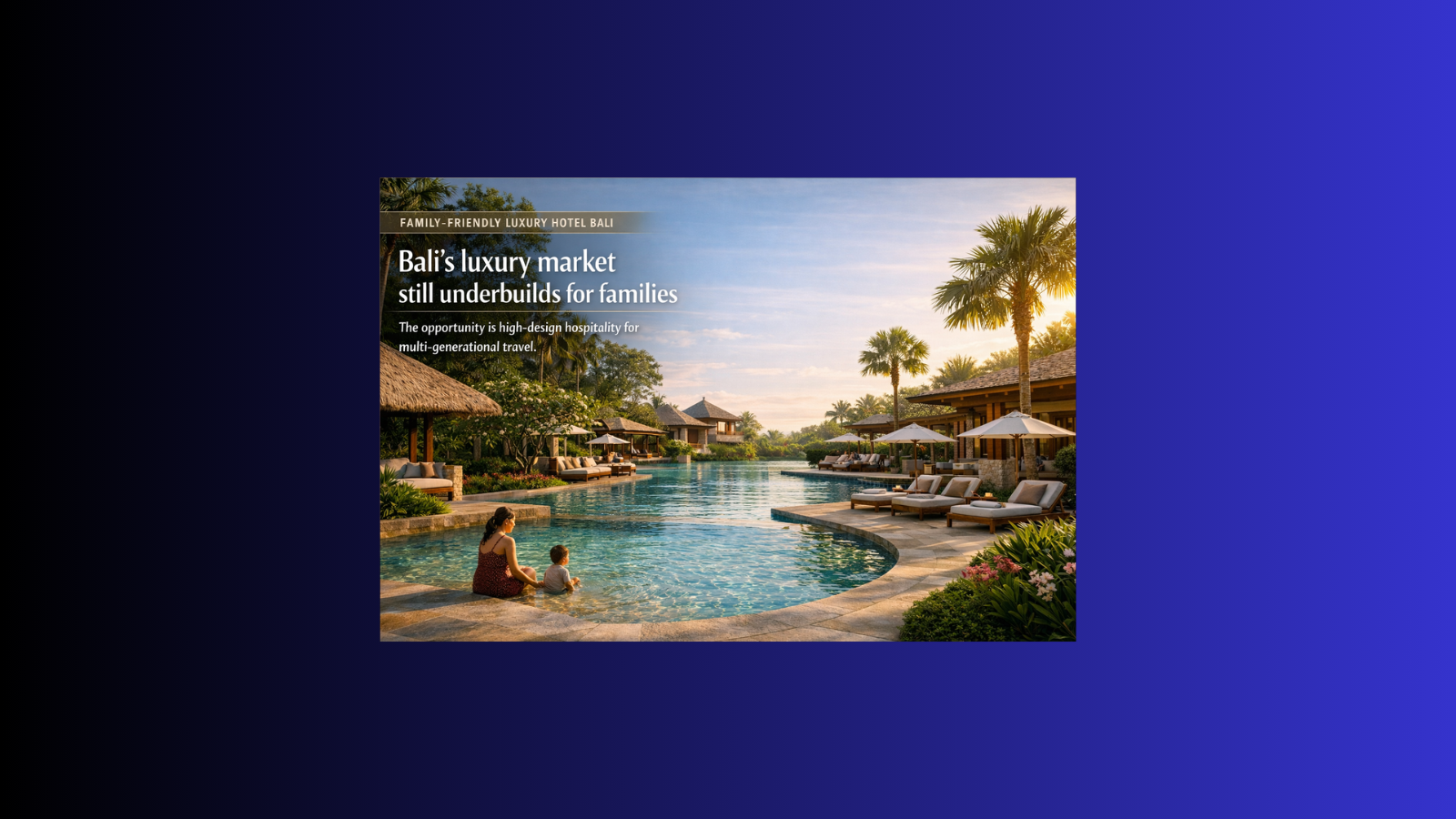
A family-friendly luxury hotel Bali concept remains one of the island’s most overlooked development opportunities. Bali’s hospitality pipeline still leans heavily toward adults-only rooftops, beach clubs, honeymoon villas, and lifestyle-led leisure. That product still sells, but it is also crowded, increasingly imitated, and often strategically undifferentiated.
The real gap sits elsewhere. A family-friendly luxury hotel Bali concept remains underserved, even though the island already attracts the volume, pricing power, and source markets to support it. According to BPS Bali’s 2025 arrivals release, Bali recorded 6.95 million direct foreign arrivals in 2025, up 9.72% year-on-year, with Australia remaining the largest source market. At the same time, HVS notes that Bali holds 36.3% of Indonesia’s luxury keys despite only 12.9% of national hotel supply, and that Bali’s ADR rose sharply in 2024.
For developers, hotel owners, and foreign investors, that combination matters. You are not trying to create family demand from scratch. You are solving a product mismatch inside an already premium destination.
TL;DR
- Bali has no shortage of luxury hospitality, but much of the visible pipeline still leans toward adult-lifestyle positioning.
- Family and multi-generational travel already exist at scale, yet premium family product remains limited relative to the island’s luxury inventory.
- The opportunity is not generic “family-friendly” hospitality. It is high-design, high-function luxury with the right room mix, kids’ infrastructure, family zoning, teen spaces, child-friendly dining, and safety-led planning.
- The winning concept is not a kids’ club added at the end. It is a full commercial and operational thesis designed from day one.
- This is exactly where an operator-first group like Zenith Hospitality Global can create an edge: concept DNA, pre-opening governance, operating systems, and revenue logic aligned to the segment.
Why is the family-friendly luxury hotel Bali opportunity larger than most developers assume?
Direct answer: Bali already has the arrivals, the luxury price environment, and the regional source markets. What it lacks is enough purpose-built premium product for families who want luxury without operational friction.
That is a different problem from weak demand. It is a supply-and-concept problem.
Bali’s tourism strength is well established. BPS Bali confirms nearly 7 million direct foreign arrivals in 2025, with Australia still dominant. That matters because Australian family travel is already structurally relevant to Bali. Add Indonesian domestic leisure demand, plus regional family markets from India, China, and broader Asia-Pacific, and the demand base becomes more than large enough to justify sharper product segmentation.
The commercial context is equally important. HVS identifies Bali as Indonesia’s strongest hotel market, with an outsized concentration of luxury inventory and materially improved average rates. That means the island can support premium positioning. The issue is that too much premium product still follows the same adult-lifestyle brief.
In short, Bali is not short of luxury. It is short of luxury that works properly for families.
What is the actual market mismatch?
The mismatch is simple: Bali has plenty of luxury rooms, but too many concepts still assume an adult guest first and a family guest second.
Seminyak and Canggu dominate the image economy of Bali hospitality through nightlife, social F&B, beach clubs, and “Instagrammable” positioning. Those markets are not wrong. They are simply crowded. When every new brief chases the same energy, differentiation weakens.
Families, meanwhile, evaluate a property differently. They do not experience luxury through visuals alone. They experience it through usability:
- Can parents and children sleep comfortably without compromising privacy?
- Is there a safe family pool area separate from adult-social energy?
- Can a child eat properly without the dining experience becoming stressful?
- Are there meaningful activities for younger children and teenagers?
- Does the property reduce friction, or create more of it?
If the answer is weak, the product may still photograph well, but it will not perform as a true family asset.
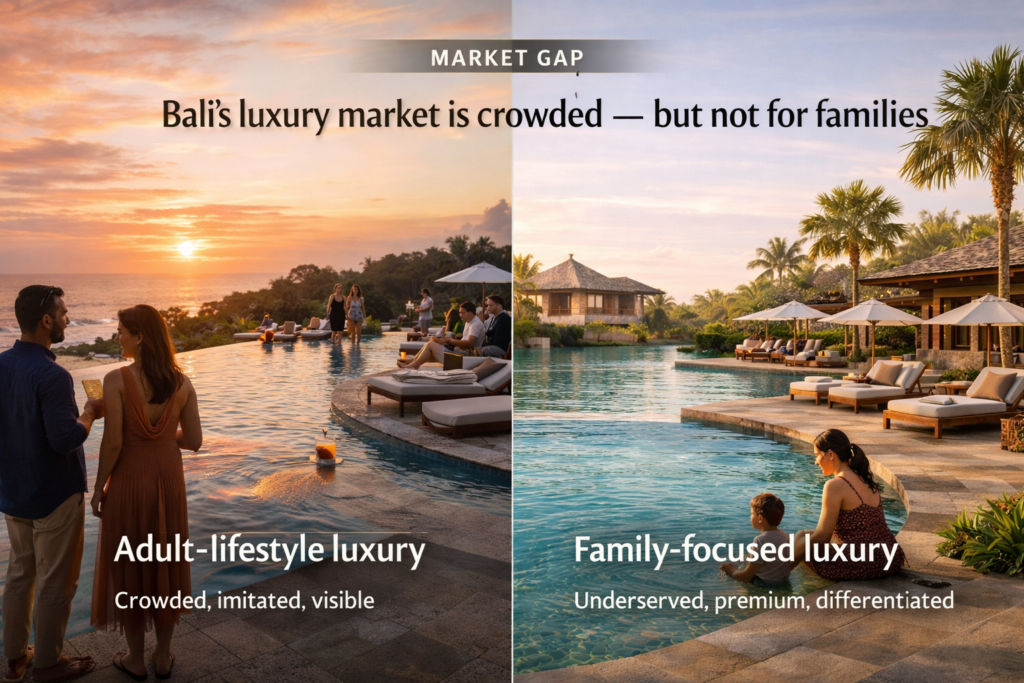
This is why many families still end up compromising. They choose design-forward luxury that is inconvenient for children, or functional family lodging that lacks real luxury DNA. That middle gap is where the opportunity sits.
What does current supply tell us about the family-friendly luxury hotel Bali gap?
There are luxury hotels in Bali that serve families well. They are just not numerous enough to define the island’s wider development logic.
For example, The Apurva Kempinski Bali actively promotes its family club, dedicated children’s programming, and separate pool infrastructure. Four Seasons Resort Bali at Jimbaran Bay offers a mature family proposition with kids’ club programming, family-friendly villas, and babysitting support. These examples prove that premium family demand exists and that luxury brands already know how to serve it.
But they also prove the opposite point: a handful of strong examples do not mean the wider market is saturated.
The broader pattern remains clear. Much of Bali’s highly visible hospitality development still focuses on couples, social groups, adult wellness, and lifestyle-led leisure. That is why a family-friendly luxury hotel Bali concept still has room to differentiate, especially when it is built as a complete product architecture rather than a marketing claim.
Why is Sanur relevant to a family-friendly luxury hotel Bali strategy?
Direct answer: Sanur matters because it already proves the family-use case. It is calmer, easier, and more naturally compatible with multi-generational travel than Bali’s louder lifestyle nodes.
That does not mean Sanur owns the opportunity exclusively. It means Sanur proves the demand logic.
The destination has long appealed to families because of its softer beachfront conditions, more relaxed pace, and lower-friction environment. Indonesia Travel’s Bali destination coverage reinforces the value of calmer coastal conditions and easier recreational use. In practical hospitality terms, that translates into stronger suitability for children, grandparents, and longer-staying groups.
But Sanur also reveals the remaining white space. It has family appeal, yet much of its historical positioning has leaned toward comfort and convenience rather than a fully reimagined, design-forward wave of luxury family hospitality.
That is a critical distinction for investors. A market with no family demand is speculative. A market with proven family behavior but limited next-generation luxury execution is opportunity.
Why do families matter economically?
Direct answer: Families are not a discount segment. In many cases, they represent higher total booking value because they need more space, consume more on-property services, and reward properties that remove friction.
The room revenue logic is only the starting point.
A well-designed family asset has multiple economic advantages:
- larger room or villa demand
- stronger interconnecting-room demand
- more breakfast and casual dining spend
- more activities and excursion attachment
- better cross-generation occupancy during holiday periods
- higher trust and repeat potential once the property proves itself
The mistake many developers make is evaluating family demand through ADR alone. That is too narrow. The right model looks at total family spend across accommodation, F&B, children’s programming, recreation, and adult upsell while children are safely occupied.
This is the same principle Zenith applies in broader hospitality strategy: the strongest assets do not rely on one revenue line. They build ecosystems. That is why our view on integrated hospitality in Bali is directly relevant here. Family luxury performs best when it is planned as a multi-revenue operating system, not just a room product.
What does a real family-friendly luxury hotel Bali concept require?
A real family-friendly luxury hotel Bali concept must be designed as a system. That means the room mix, public-space zoning, circulation, staffing model, operating SOPs, and commercial architecture all need to support family behavior from day one.
Below is the framework developers should use.
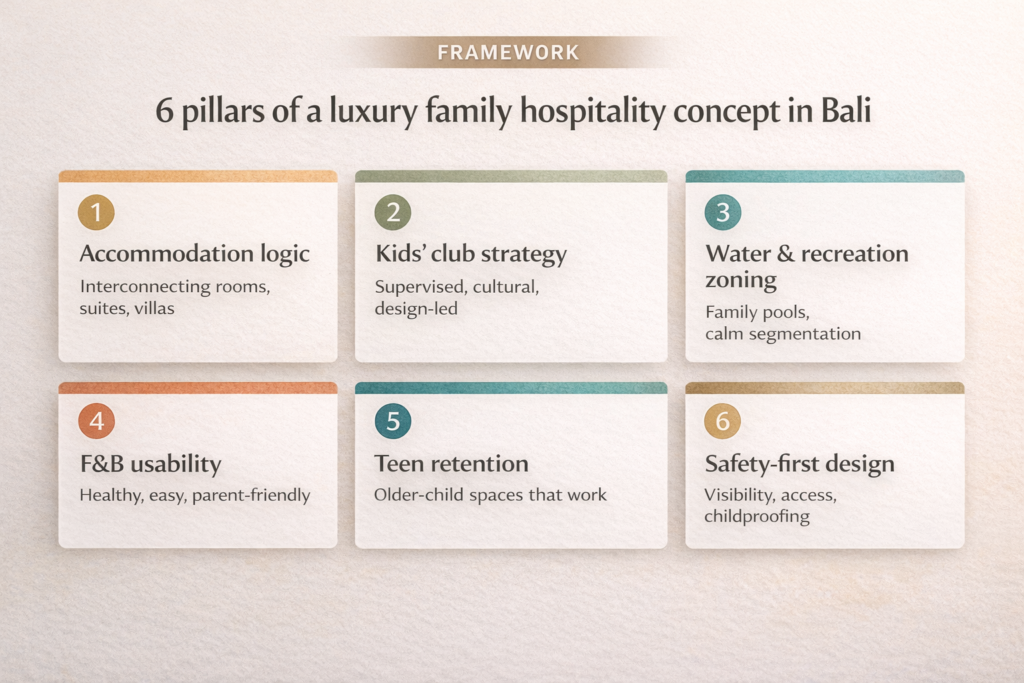
The 6 Pillars of a Luxury Family Hospitality Concept in Bali
| Pillar | What it means in practice |
|---|---|
| Accommodation logic | Interconnecting rooms, family suites, 2–3 bedroom villas, separate sleeping zones, extra-bed strategy, stroller-friendly circulation |
| Kids’ club strategy | Supervised, design-led, educational programming tied to Balinese culture, craft, movement, and nature |
| Water and recreation zoning | Dedicated family pool, children’s splash/play area, protection from adult-social spillover, lifeguard logic where relevant |
| F&B usability | Healthy children’s menu, family breakfast flow, early dining convenience, stroller/high-chair layout, nutrition-aware casual offers |
| Teen retention | Lounge, games/media corner, active programming, teen-appropriate independence without operational disorder |
| Safety-first design | Childproofing, visibility lines, secure access, non-slip surfaces, balcony/window controls, family concierge support |
This is where many projects fail. They focus on visual luxury and forget behavioral luxury.
Parents do not experience a hotel as luxury if every breakfast is stressful, if every path with a stroller is awkward, if the pool feels unsafe, or if the only children’s offer is a token room with plastic toys. In family hospitality, friction destroys value faster than finishes create it.
That is why Zenith’s operator-first methodology matters. We do not separate concept from execution. We align the commercial model, space logic, operating systems, and guest journey from the start. The same thinking already underpins how we approach pre-opening handover and operational readiness across Bali hospitality projects.
How should the kids’ club be positioned?
Direct answer: In a luxury family resort, the kids’ club should not be treated as a cost centre or token amenity. It should be treated as a booking driver, a brand asset, and a parent-spend enabler.
The strongest operators do not build cartoonish playrooms disconnected from the property’s identity. They build children’s environments that extend the brand and the destination.
That is visible in the best international examples, and it is increasingly visible in Bali. Four Seasons Bali frames its family proposition around curated programming and service quality, while The Apurva Kempinski Bali presents the family club as a meaningful part of the guest experience, not a side note.
For Bali, the answer should be obvious. The kids’ club should extend the island, not hide from it.
That means programming built around:
- Balinese craft and storytelling
- movement and nature-based play
- ocean and ecology awareness
- food, nutrition, and junior culinary activities
- cultural immersion without kitsch
- calm, design-led environments that parents trust
Done properly, the kids’ club increases booking confidence, lengthens dwell time, and unlocks adult spending across dining, wellness, and paid experiences.
What design and operating mistakes should developers avoid?
The most common mistake is treating family functionality as something that can be added after concept sign-off.
That is where projects get structurally stuck.
If the room mix is wrong, no amount of marketing can fix it. If the pool zoning is wrong, family and adult experiences will cannibalize each other. If the dining spaces do not work for parents with children, service friction becomes permanent. If teen spaces are ignored, the property weakens its own multi-generational positioning.
The second major mistake is confusing “family-friendly” with “mass-family.” A luxury family resort does not need to feel noisy, childish, or generic. In fact, the premium opportunity is the opposite: high design, strong operational discipline, and calm segmentation of guest use cases.
The third mistake is under-modeling ancillary revenue. A serious family concept needs a proper commercial model, not a generic GOP assumption. That is why broader articles such as our piece on hotel revenue strategy in Bali’s competitive market are relevant here. The principle is the same: rate matters, but total spend architecture matters more.
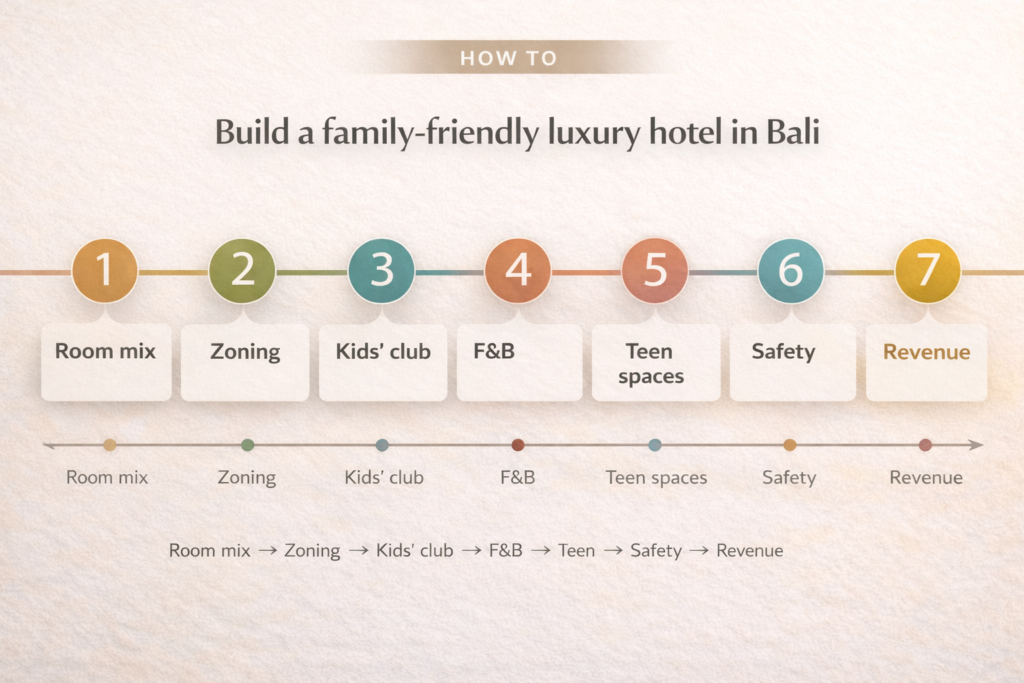
How to build a family-friendly luxury hotel in Bali without diluting luxury
- Start with the room mix.
Model interconnecting rooms, family suites, and multi-bedroom villas before discussing amenities. - Separate family activation from adult sanctuary.
Families want inclusion, not chaos. Strong concepts use parallel zoning rather than forcing all guests into the same atmosphere. - Design the kids’ club as brand infrastructure.
It should reflect the property’s aesthetic, values, and destination story. - Build F&B for parents under pressure.
Child-friendly dining is not only about menu items. It is about speed, predictability, layout, and nutrition. - Create teen relevance early.
Many “family” concepts stop at age ten. That is a mistake. Teens influence destination choice and on-property satisfaction. - Engineer safety into architecture and SOPs.
Solve childproofing, access control, non-slip surfaces, balcony safety, and visibility lines at design stage, not after opening. - Model total family spend, not room revenue alone.
Forecast accommodation, dining, activities, family packages, and adult upsell while children are engaged.
That is the difference between a brochure-level promise and a bankable hospitality concept.
Zenith’s point of view
At Zenith Hospitality Global, we would not treat this segment as a “kids add-on” strategy. We would treat it as a full concept and operating thesis.
That means:
- product DNA built around multi-generational use cases
- room mix and villa design aligned to real family behavior
- supervised kids’ club programming with educational logic
- family pool and recreation zoning separated from adult atmospherics
- child-friendly dining with nutrition, usability, and service-speed discipline
- teen engagement, safety protocols, and family concierge layers
- pre-opening governance that protects the concept from dilution during design development
This is also where the family thesis intersects with other shifts in Bali hospitality. Properties that already understand wellness, programming, and ecosystem thinking are better positioned to serve premium families. That is why our article on the wellness imperative is relevant to this discussion. Family luxury does not mean abandoning wellness or adult sophistication. It means segmenting them correctly and designing both with discipline.
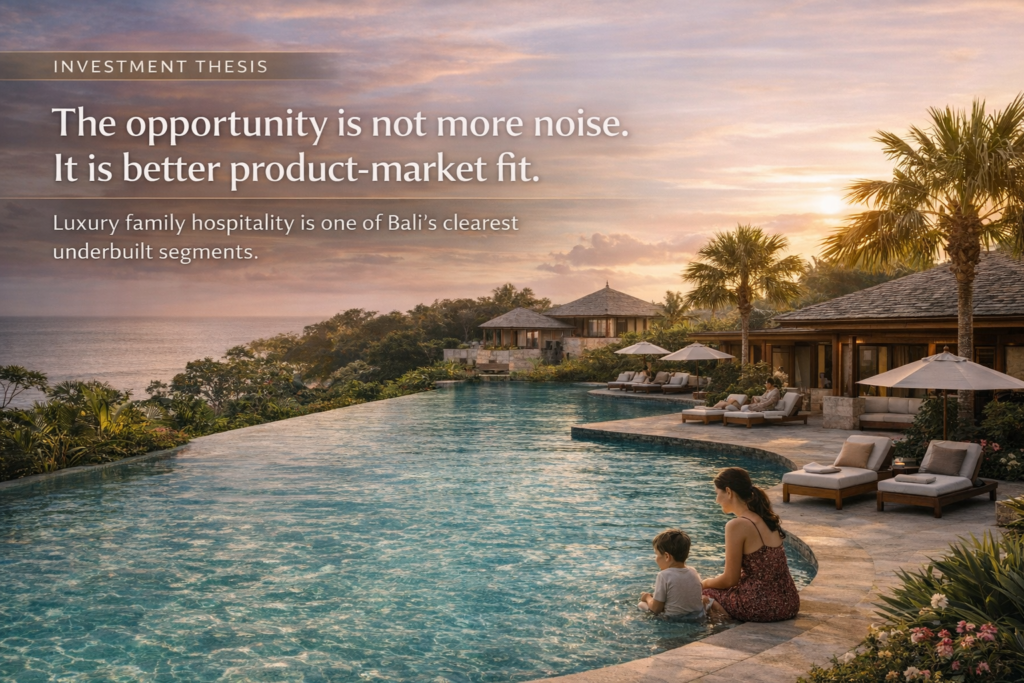
The market is crowded with adult-lifestyle luxury. One of the clearest ways to differentiate now is not to become louder. It is to become more useful for a high-value segment that already travels to Bali.
FAQ
Is a family-friendly luxury hotel Bali concept commercially viable at the top end?
Yes, provided the concept is built around the correct room mix, family spend logic, and operational ease. The risk is not the segment itself. The risk is shallow execution: weak zoning, generic kids’ programming, poor room configuration, and no serious ancillary revenue model. In Bali’s current luxury environment, differentiated utility can be more defensible than another adult-lifestyle clone.
Does family positioning weaken luxury brand prestige?
No. Poor design weakens prestige. Strong design that solves real guest behavior strengthens it. The correct benchmark is not a mass-market family resort. It is luxury hospitality that stays visually disciplined while becoming operationally intelligent for parents, children, and multi-generational groups.
Which Bali areas best fit this segment?
Sanur is the clearest proof-of-demand node because of its calmer environment and stronger family compatibility. Selected opportunities in Nusa Dua and Jimbaran also fit well. Canggu-style concepts can work only if the site and operating model actively buffer noise, traffic stress, and adult-social spillover. In this segment, micro-location discipline matters more than trend appeal.
What is the biggest design mistake developers make?
Treating family functionality as an add-on after concept approval. Once the room mix, pool layout, circulation, and dining flows are locked badly, operational pain becomes permanent. In family hospitality, architecture and operations must be developed together from the beginning.
What should an investor validate before approving concept design?
Validate six things early: source-market family demand, room-mix economics, public-space zoning, staffing model, safety standards, and ancillary revenue assumptions. If those six are weak, the project may still look beautiful, but it will not perform as a serious family-luxury asset.
Summary Takeaways
- Bali does not lack luxury demand. It lacks enough luxury product designed properly for families.
- The opportunity is not cheap family tourism. It is premium, multi-generational, high-spend hospitality executed with discipline.
- Sanur proves the demand logic; the next wave is raising the luxury and design standard.
- A kids’ club is not enough. Room mix, zoning, F&B, teen spaces, and safety must work as one operating system.
- The strongest family-friendly luxury hotel Bali concepts will outperform by being more useful, not more fashionable.
- Developers who keep copying adult-lifestyle templates are competing in the most crowded part of the market.
- The smarter move is to build a differentiated hospitality asset that parents, children, and investors all understand immediately.
Ready to pressure-test your concept?
If you are planning a hotel, resort, branded residence, or mixed-use hospitality asset in Bali, now is the right time to test whether your concept is overexposed to adult-lifestyle sameness.
Zenith Hospitality Global helps developers and investors align product DNA, family usability, space logic, pre-opening governance, and commercial performance into a single operator-ready concept. A true family-friendly luxury hotel Bali strategy is not a design moodboard. It is a market position, an operating model, and an investment thesis.
Author
André Priebs
CEO / Co-Founder, Zenith Hospitality Global
André Priebs advises developers, owners, and investors on luxury hospitality, wellness assets, concept architecture, pre-opening governance, and commercial performance in Bali and across Indonesia. Through Zenith Hospitality Global, he helps turn ambitious concepts into operator-ready, investor-sound hospitality assets built on strong foundations.