Digital nomad hotel design Bali is now a real asset category because Canggu’s remote-work boom created long-stay demand that behaves more like “live/work” housing than leisure travel. Yet most hotels are still designed to win 2–4 night stays, not 30–180 night occupancy. As a result, long-stay guests default to villas and co-living operators because hotels often don’t deliver the villa value stack (space, kitchen autonomy, privacy, call readiness), while villas usually can’t deliver what hotels should own: reliable service, safety, community, and operational consistency.
Digital nomad hotel design Bali is not an aesthetic trend. Instead, it is a conversion and underwriting problem: reduce friction → extend length-of-stay → raise retention → expand ancillary attach rate.
TL;DR (Key Takeaways)
- When call-ready rooms aren’t guaranteed, you won’t win 28+ night share in Canggu—no matter how good the lobby looks.
- Build the “villa value stack” into a hotel product (work + living autonomy) and then outperform villas with engineered community + reliable services.
- Treat coworking as inventory (seats, meeting rooms, passes), and staff community as a revenue function.
- Protect yield: monthly packages must use floors + LOS controls, and push 28+ nights into direct billing.
1) Digital nomad hotel design Bali: why the market is real, yet hotels keep missing it
Digital nomads are not “tourists who use laptops.” Rather, they are a long-stay segment with different friction points:
- Productivity risk (Wi-Fi stability, noise, calls, lighting)
- Living friction (laundry cadence, storage, kitchen access, packages/mail)
- Social friction (loneliness, lack of community, lack of introductions)
In addition, Bali has a structurally large alternative supply set. Short-term rental market trackers show a very large base of listings across Bali, which creates persistent substitution pressure for hotels that are not purpose-built for extended stays. See the Bali market snapshot on AirDNA.
2) How does visa clarity change long-stay underwriting?
Long-stay demand becomes more bankable when the legal pathway is clearer and the marketing message can be compliance-clean.
Indonesia’s immigration listings include a remote-worker visa pathway E33G (1-year) with published requirements and restrictions: Indonesia Immigration – E33G.
For higher-bar residency positioning, Indonesia also offers a Second Home category with multi-year options (subject to requirements and documentation): Indonesia Immigration – E33.
Developer takeaway: visa clarity raises the ceiling on achievable LOS and reduces “visa-run volatility.” However, it also increases enforcement sensitivity. Accordingly, treat compliance and guest conduct as underwriting variables, not footnotes. For the Bali compliance operating lens, link this to your cluster post: Bali Villa Licensing Checklist 2026.
PAA: What is the best product type to capture long-stay nomads in Bali?
A hybrid “hotel + cowork + community” product usually wins because it combines villa-level autonomy (work-ready room, light-kitchen strategy, laundry cadence) with services and social infrastructure that villas cannot deliver. The commercial advantage is base-load occupancy plus monetizable shared-space inventory—provided you build the operating system (community + billing) from day one.
3) What’s the design-to-revenue principle (and why it matters)?
Reduce friction → increase length-of-stay → increase retention → increase ancillary attach rate.
Therefore, design briefs must be written like a conversion funnel, not a mood board. If a guest can’t take calls reliably, they churn quickly—and your intended long-stay base-load collapses.
4) Digital nomad hotel design Bali: what is the non-negotiable space program?
A) Rooms that sell “home-office,” not “room”
Nomads churn because of call friction. Hotels rarely lose a 28-night guest because the pool is small; instead, they lose them because they cannot take calls.
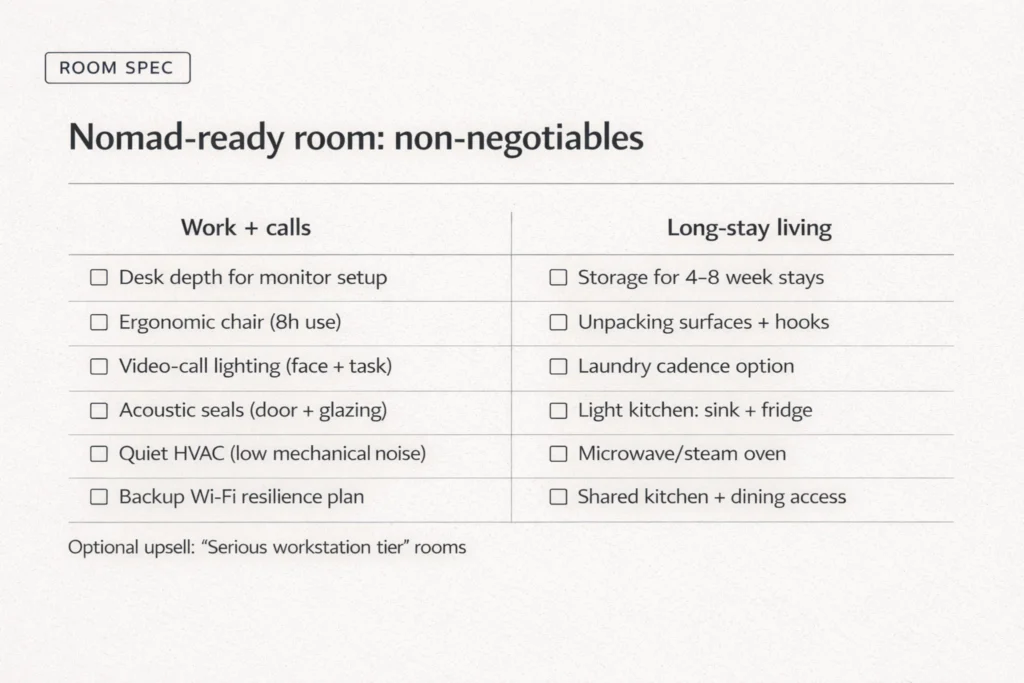
Minimum room-level requirements:
- Workstation kit (desk depth, monitor-ready setup, ergonomic chair)
- Video-call lighting (task + ambient + face-lighting strategy)
- Acoustics and sound privacy (door seals, corridor absorption, glazing strategy, mechanical noise control)
- Storage and unpacking surfaces sized for 4–8 week stays
Kitchen strategy (compete with villas without becoming a serviced apartment):
- “Light kitchen” in-unit (sink + undercounter fridge + microwave/steam oven + minimal prep)
- A strong shared kitchen + social dining hub (community + cost control)
B) Coworking as monetizable inventory (not a lobby with tables)
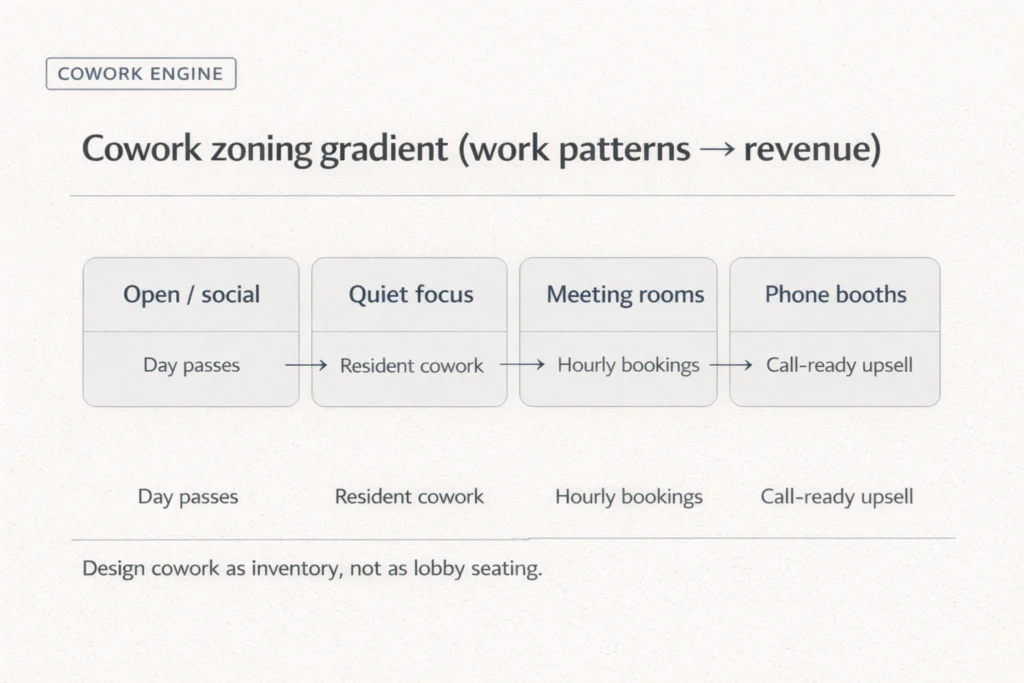
Coworking must map to real work patterns: open/social zones → quiet zones → meeting rooms → phone booths.
Monetize it with:
- Day passes for non-residents
- Meeting room sell-through
- Micro offsite packages (small teams, founders, creators)
C) Community infrastructure (designed, scheduled, staffed)
Community is not “vibes.” Instead, it is a retention and referral machine.
Operationalize it with:
- A weekly events calendar (welcome ritual, skill-share, networking, local culture)
- A community manager accountable for retention, referrals, and upsell conversion
If you want a reference point for governance and cadence (pre-opening → stable operations), anchor this to: Pre-Opening Hotel Checklist.
PAA: What is the single biggest design mistake hotels make for nomads?
Underinvesting in call-readiness (acoustics + lighting + workstation ergonomics) while overinvesting in generic lifestyle design. Long-stay guests churn when they cannot take calls reliably. Fix sound separation, mechanical noise, and video-call lighting layers first; only then optimize aesthetics.
D) Internet architecture built for resilience, not marketing claims
Nomads optimize for reliability: enterprise-grade Wi-Fi, network monitoring, segmented networks (guest/cowork/IoT/BOH), and backup power for the network core.
For a broader owner lens on risk, budgets, and operational trade-offs in Indonesia, reference: 2026 Hotel Budget Indonesia.
5) Digital nomad hotel design Bali: how long-stay pricing and revenue actually work
For digital nomad hotel design Bali, pricing is part of the product.
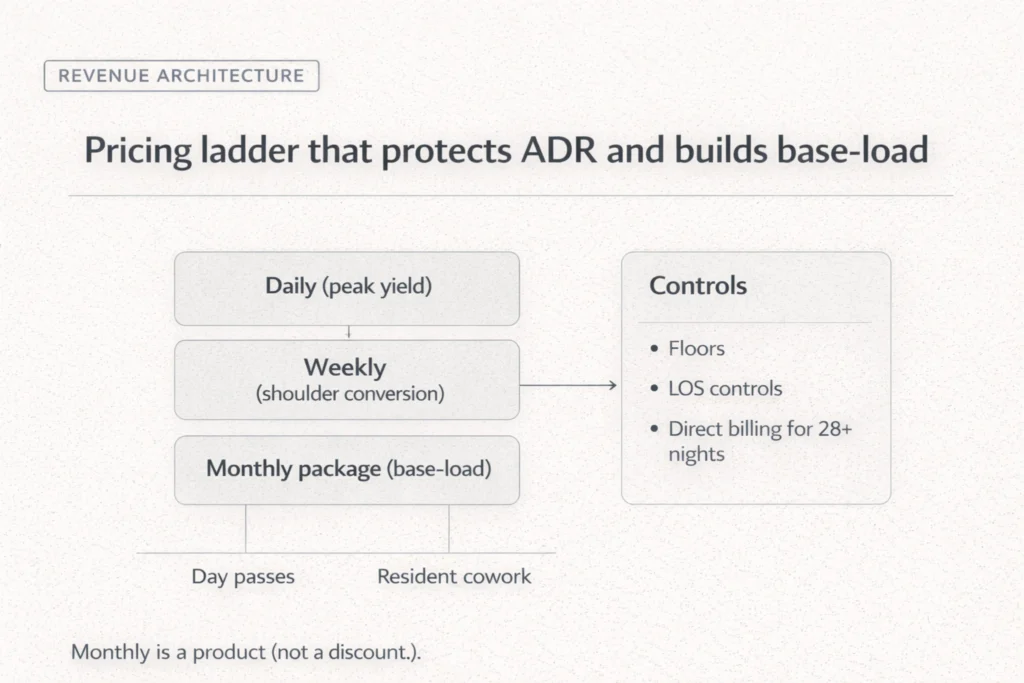
Hotels usually approach long-stay with blunt monthly discounts that destroy ADR and create channel conflict. In contrast, nomad-optimized assets create a long-stay base-load (predictability) while protecting peak-period yield through floors and LOS controls.
A practical pricing architecture:
- Daily rate (short-stay): your peak yield tool
- Weekly rate (7–27 nights): tactical; used for shoulder periods and conversion
- Monthly membership-style package (28+): your base-load product
- Includes: cowork membership, laundry cadence, meeting-room credits, community access, and “work-ready room” tiering
- Use flex terms (freeze, transfer, upgrade) to reduce churn without giving away revenue
Channel strategy:
- Use OTAs for discovery
- Then push 28+ nights into direct contracting for billing stability and margin protection
PAA: How do you avoid OTAs controlling long-stay pricing?
Keep OTAs for visibility, but sell monthly packages through direct contracts and membership billing. To protect peak yield, apply floors + LOS controls, and build a conversion funnel via cowork day-pass users, founders, relocation partners, and wellness/experience partners.
6) What does the market already prove (operator signals)?
These operators illustrate repeatable strategies (examples, not “authority sources”):
- Outpost: co-living with strong community cadence and monthly pricing signaling
- TRIBAL Bali: coworking-first demand generation (“work/play/stay”)
- Zoku: unit-as-product (living + working in-room), strong for call-heavy segments
- Selina: scaled “hotel + coworking + community” model; monetization discipline is essential
Developer lesson: the “software layer” (community + membership + programming + conversion) is often more important than luxury finishes for occupancy stability.
7) What changes specifically in Canggu?
Canggu’s long-stay demand is strong, but the product must be written for the substitution set:
- Villas win on: space, autonomy, privacy, kitchen, perceived value
- Hotels win on: service, safety, predictable infrastructure, and social access—if they actually build for it
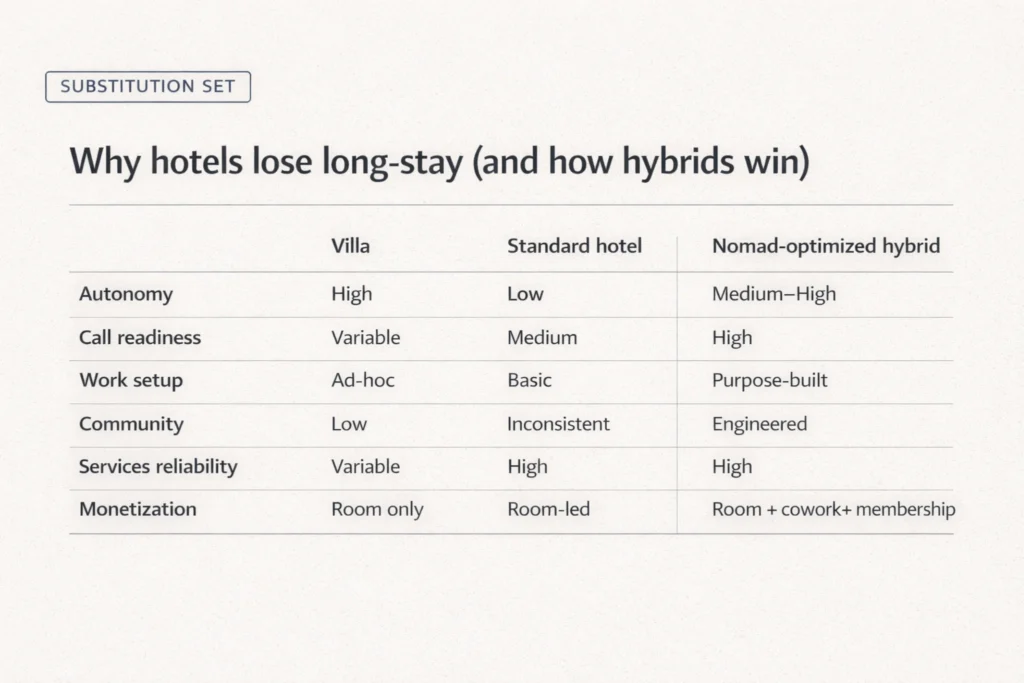
A simple underwriting comparison to keep teams aligned:
- Villas: autonomy high, reliability variable, community low, ops consistency low
- Standard hotels: reliability high, autonomy low, community inconsistent
- Nomad-optimized hybrid: autonomy medium-high, reliability high, community engineered, monetization structured
For destination pressure context (which influences enforcement, quality standards, and expectations), link to: Overcrowding in Bali Tourism: Action Plan. For an official tourism baseline reference set, use BPS Bali tourism updates.
8) The Zenith “Nomad-Optimized Long-Stay Engine” (buildable framework)
Use this as the investor/operator blueprint for digital nomad hotel design Bali:
Product (Unit + Work)
- Work-ready room tiering (standard vs serious workstation tier)
- Call-ready acoustics baseline
- Kitchen autonomy strategy (light kitchen + shared kitchen hub)
Place (Cowork + Social)
- Zoned cowork gradient with monetizable inventory
- Weekly programming OS (not ad-hoc events)
Platform (Tech + Billing)
- PMS + monthly billing + community CRM (membership + contracts)
Pricing (Base-load without killing yield)
- Monthly floors, LOS controls, peak protection
- Direct contracting bias for 28+ nights
People (Retention is staffed)
- Community manager as a revenue role
- SOPs built around long-stay cadence (housekeeping and laundry model)
9) How to design and launch a nomad-focused long-stay hotel in Bali (step-by-step)
First — Underwrite demand by LOS buckets
Define targets for 1–6 nights, 7–27 nights, and 28+ nights, and set a base-load objective for the next 60 days.
Second — Write the Product DNA as a conversion system
Translate friction points into non-negotiable specs (workstation, acoustics, lighting, internet resilience, kitchen autonomy).
Third — Lock the monetization map for shared spaces
Size cowork seats, meeting rooms, and social areas off revenue logic (day passes, meeting-room yield, community events), not aesthetics.
Fourth — Build pricing architecture and contract terms
Create monthly packages with flex terms; implement floors and LOS controls for peak periods; shift 28+ nights to direct billing for stability.
Fifth — Install the operating system (people + calendar + house rules)
Hire the community manager early; publish the weekly calendar; implement code-of-conduct aligned with Bali’s shifting quality tourism posture.
Sixth — Launch via founder-member presales
Pre-sell monthly base-load with founder pricing and referral loops, then iterate during soft opening.
If you want an operations-quality audit lens for readiness, use: 42-Point Pre-Opening Handover Audit.
10) KPI dashboard (owner/investor/operator minimum)
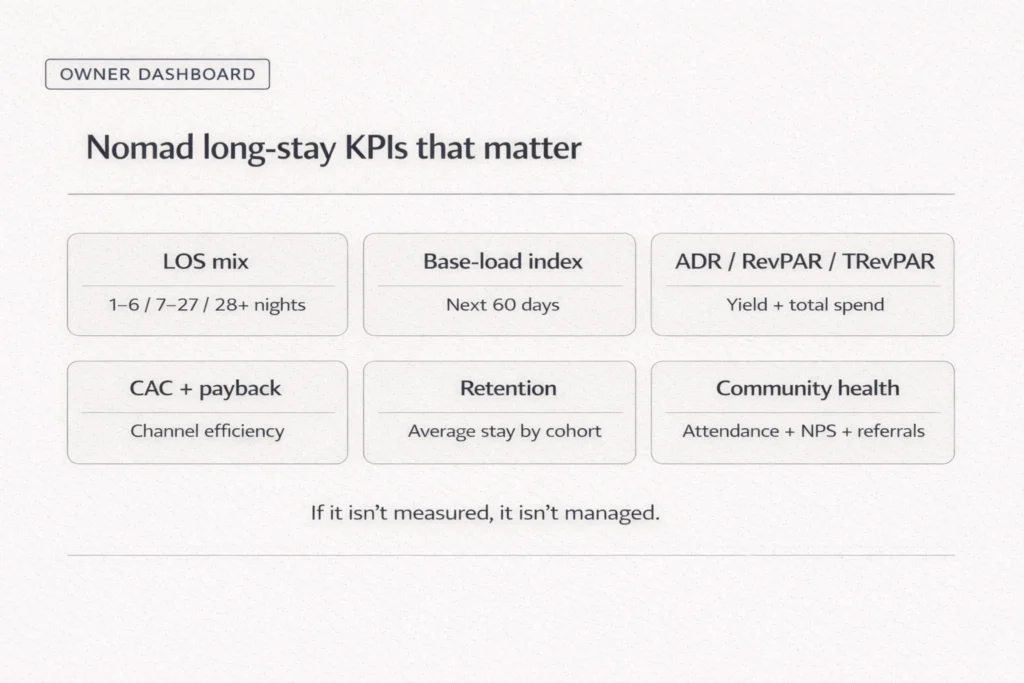
Minimum viable dashboard:
- Occupancy split by LOS bucket (1–6 / 7–27 / 28+)
- Long-stay base-load index (next 60 days)
- ADR, RevPAR, long-stay RevPAR, TRevPAR
- CAC by channel + payback period
- Retention (average stay length by cohort)
- Community health (event attendance, member NPS, referral rate)
- Housekeeping cost per occupied room-night (should decline as LOS rises)
Summary Takeaways
Digital nomad hotel design Bali works when product, community, and pricing are engineered together.
- Without the villa value stack (autonomy + call readiness), you will not win 28+ night share in Canggu.
- Because design is a conversion system, friction reduction becomes the real revenue lever.
- Since coworking is inventory, you must zone it, price it, and staff it—or it becomes dead CapEx.
- Likewise, community is an operating system, so staff it as a revenue function.
- Finally, monthly pricing must protect yield: use floors and LOS controls, and shift 28+ nights into direct billing.
Call-to-Action
If you are developing or repositioning an asset in Canggu/Ubud/Uluwatu and want to capture long-stay demand without destroying ADR, Zenith can deliver the Product DNA + space program + unit economics + operating system for a nomad-optimized long-stay model. Start here: About Zenith.
Author
Written by André Priebs, CEO of Zenith Hospitality Global. Zenith is an operator-first hospitality consultancy and operating partner for luxury boutique hotels, lifestyle retreats, and wellness/longevity assets in Indonesia—specializing in Product DNA, pre-opening governance, operating systems, and commercial performance.