If your villa is listed on Airbnb, Booking, or Agoda in Bali, the compliance bar is rising fast. The market signal is clear: OTAs are moving toward verification, and local enforcement pressure is increasing.
This Bali villa licensing checklist gives owners and operators a defensible, implementation-ready path to become legal-to-operate and OTA-verifiable in 2026—without guessing.
This is not “paperwork.” In Bali, licensing fails when land use, zoning, or building legality is broken. If those fundamentals are not fixable, no amount of OSS registrations will make an illegal villa safe.
TL;DR / Key takeaways (read this first)
- Most villas fail on land zoning (KKPR) and building legality (PBG/SLF), not on “missing a license.”
- OTAs increasingly act as gatekeepers: consistent documentation + entity alignment matters as much as the permits.
- The fastest path is a Day-1 triage: hard-stop vs fixable gaps, then execute a dependency-driven checklist.
- A minimum “legal stack” typically includes: KKPR/zoning defensibility, PBG/SLF position, OSS NIB + correct KBLI, tourism standards compliance, and tax readiness.
- Treat this like an operating system: verification can recur, so compliance must be maintainable.
What changed in Bali in 2025–2026 (and why OTAs now care)?
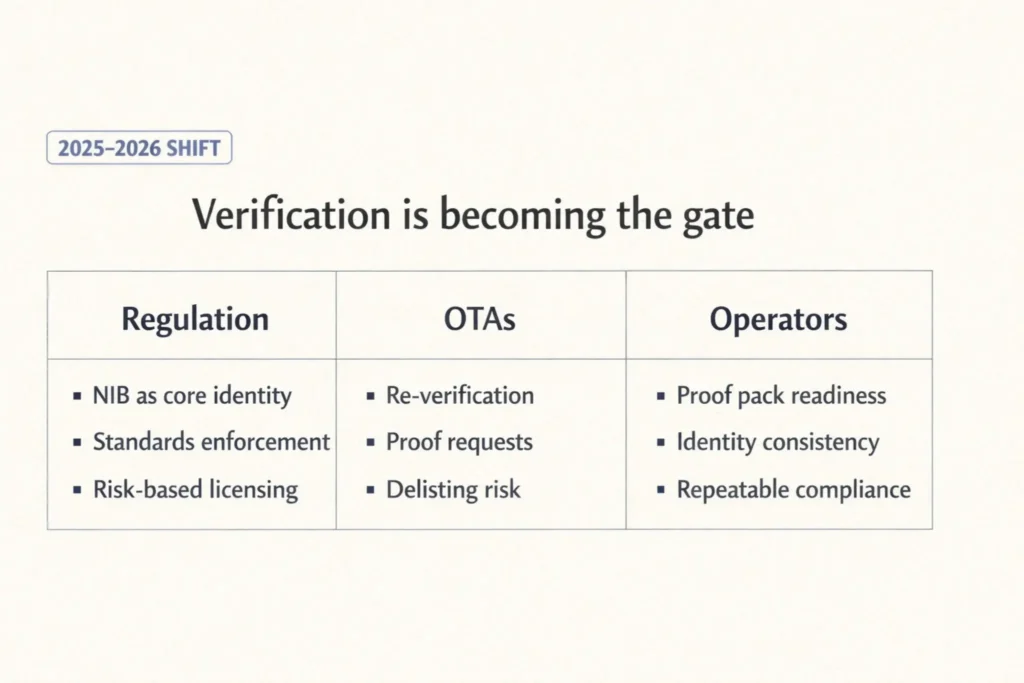
The shift is not that Bali “banned Airbnb.” The shift is that verification and enforcement are being pushed through risk-based licensing and platform compliance processes.
At the national level, Indonesia’s risk-based licensing framework reinforces NIB (Nomor Induk Berusaha) as the core business identifier issued via OSS. It also ties business legality to risk classification and standards fulfillment. Official regulation text: Government Regulation (PP) No. 28 of 2025.
At the tourism-sector level, the Ministry sets standards and compliance expectations for accommodation businesses, including villas. Official regulation (PDF): Minister of Tourism Regulation No. 6 of 2025.
Critically, the Ministry has signaled that accommodation supply on platforms must be licensed and verifiable, with OTAs expected to align listings accordingly. Circular reference (PDF): SE No. 4 of 2025 (Airbnb-hosted copy).
Operator implication: if your villa cannot produce a clean proof pack on demand—entity identity, OSS licensing alignment, and a defensible building/land position—you are exposed to delisting risk when platforms re-verify or when a listing is flagged.
What does “legal-to-operate” mean for a Bali villa listed on OTAs?
“Legal-to-operate” means the villa clears a chain of compliance gates in the right order. Most owners approach this backwards (start with OSS, ignore land/building legality). As a result, legalization stalls, becomes expensive, or fails.
Here is the operator-first model: the 6-gate system.
- Land and zoning legality (RTRW/RDTR + KKPR)
- Building legality (PBG + SLF; plus any legacy IMB transition reality)
- Business identity (OSS → NIB + correct KBLI)
- Tourism standards and certification pathway (Permenpar 6/2025; Sertifikat Standar + requirements)
- Tax registration and ongoing obligations (national + local hotel/restaurant tax)
- OTA verification readiness (data fields + proof pack consistency)
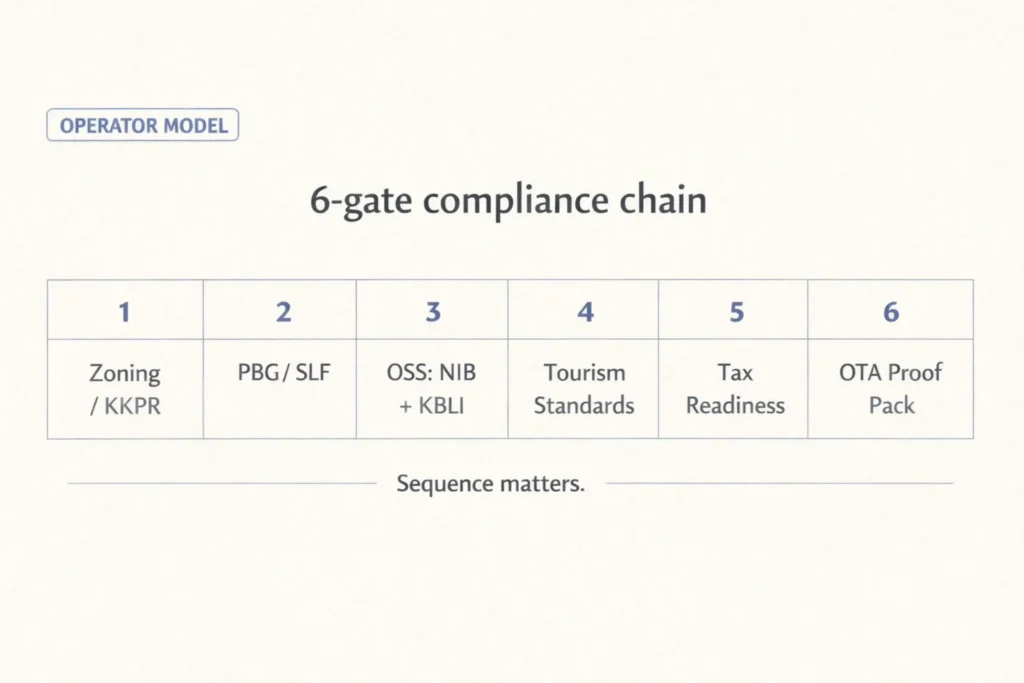
If any gate fails, you may still “operate,” but you are not defensible.
The 6-gate compliance map (use this on every villa)
Use this diagnostic map first. It forces correct sequencing and prevents wasted work. In other words: don’t start “licensing” before you know the land and building are legalizable.
| Gate | What it proves | Typical hard-stop (stop the project) | Typical fixable gap (plan + execute) |
|---|---|---|---|
| 1) Zoning / KKPR | The land can legally host short-stay accommodation | Land sits in protected/green/agricultural zone where accommodation is not approvable | Zoning position unclear; KKPR workflow not initiated; missing RDTR/RTRW mapping evidence |
| 2) PBG / SLF | The building is legal to build/use and fit-for-use | Protected/setback violations; unfixable siting/non-compliance | Missing as-built drawings; missing engineering documents; remediation + retroactive pathway (where possible) |
| 3) OSS (NIB / KBLI) | The operator-of-record exists and is correctly classified | Entity strategy is illegal / non-defensible (e.g., nominee risk; operator mismatch) | Wrong KBLI; inconsistent entity name/address; inaccurate OSS data; misaligned business activity declaration |
| 4) Tourism standards | Regulated operating standards are met (incl. required certifications where triggered) | Property cannot meet minimum standards or refuses to operate as accommodation | SOP gaps; safety/sanitation upgrades; missing HR or operational documentation |
| 5) Tax | Registration + reporting are in place and match real cashflow | Severe arrears/disputes that block compliance normalization | Basic registration missing; reporting cadence not established; mismatch between OTA payouts and declarations |
| 6) OTA proof pack | You can pass verification repeatedly with consistent evidence | Contradictory identity across documents (operator name/address/license references conflict) | Document normalization; proof pack assembly; submission log + resubmission process |
PAA Block 1: What is the minimum legal stack to keep a villa listed on OTAs in Bali?
The minimum stack is not one document. In most cases, it is: zoning/KKPR defensibility, a defensible building legality position (PBG/SLF or an accepted legacy pathway), an OSS-issued NIB under the correct KBLI, tourism standards compliance (including certification where triggered), and basic tax readiness. Without this stack, OTA verification is fragile.
For villa classification in OSS, start with KBLI 55193 (Villa): OSS KBLI 55193 detail page.
Step zero: classify the case correctly (this saves months)
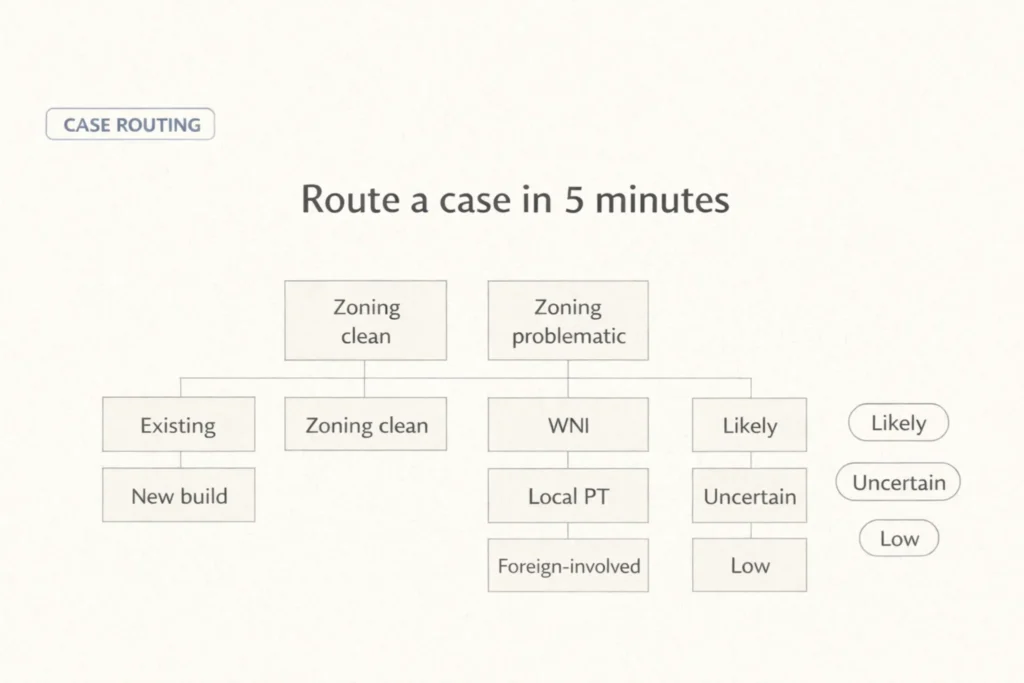
Before you touch licensing, classify the villa in three dimensions. This determines feasibility, time, cost, and risk.
1) Existing villa vs new build
- New build: KKPR → PBG → build → SLF must be sequential.
- Existing villa: verify if valid IMB/PBG exists, and whether SLF exists. If not, this becomes as-built legalization + remediation.
2) Zoning position: clean vs problematic
- Clean: tourism/commercial/mixed zones where accommodation is allowed.
- Problematic: agricultural/green/protected, coastal setbacks, unclear RDTR positioning.
3) Operator-of-record structure
- WNI individual operating directly
- Indonesian company (local PT)
- Foreign-involved scenarios (leasehold + Indonesian operator; PT PMA; management-only vs operator-of-record)
This classification step is where most “legalization shortcuts” collapse later.
PAA Block 2: How do you legalize an existing villa versus a new build?
New builds must follow the regulatory order: secure zoning/KKPR, obtain PBG before construction, build to approved plans, then secure SLF for fit-for-use. Existing villas are different: the case becomes a compliance audit of as-built reality versus what can be legalized. If PBG/SLF is missing, expect as-built documentation, inspections, and remediation before you can reliably proceed to OTA-proof compliance.
In practice, if the building does not match what was approved—or was built where it should never have been built—licensing becomes high-friction or impossible.
Bali villa licensing checklist (2026): step-by-step, dependency-driven
This Bali villa licensing checklist is structured so a junior team member can route a case correctly in minutes, and a senior operator can execute it without ambiguity.
Step 1 — Confirm land title and zoning viability (KKPR / spatial suitability)
Purpose: prove the land can legally host short-stay accommodation.
Responsible: owner + legal/notary + zoning consultant (if needed).
Documents: land certificate (SHM/HGB), site map, RDTR/RTRW reference, coordinates.
Where: ATR/BPN + local DPMPTSP pathways (kabupaten-specific).
Typical timeframe: weeks (case-dependent).
Common failure modes: green/protected zone, disputed title, setback conflicts, KKPR rejection.
Transition note: if zoning is not viable, stop. Do not waste time on OSS.
Step 2 — Confirm building legality pathway (PBG and SLF position)
Purpose: prove the building is legally permitted and fit-for-use.
Responsible: architect/engineer + owner + contractor.
Documents: site plan, drawings, structural/MEP, and as-built set if existing.
Where: Dinas PUPR (kabupaten/kota).
Typical timeframe: case-dependent; existing villas often take longer due to as-built verification.
Common failure modes: missing structural calculations, major deviations from plans, setback violations.
Transition note: once building legality is clear, you can lock the licensing entity with confidence.
Step 3 — Lock the operator-of-record (entity strategy)
Purpose: determine who holds licenses and receives revenue (the “compliance spine”).
Responsible: owner + legal counsel.
Decision points:
- WNI individual vs local PT vs PT PMA vs management-only model
- Who signs OTA contracts and receives payouts
Common failure modes: nominee risk, entity mismatch with revenue flows, foreign involvement structured informally.
Transition note: this step is where “paper-compliant but commercially broken” models are created—avoid that.
Step 4 — OSS registration: NIB + correct KBLI
Purpose: register the operator entity and classify the activity correctly.
Responsible: operator entity + compliance team.
Documents: ID docs, deed (if PT), address, business data, OSS questionnaire inputs.
Where: OSS RBA portal.
Key detail: villas commonly sit under KBLI 55193: OSS KBLI 55193.
Common failure modes: wrong KBLI, entity name inconsistencies, address mismatches.
Transition note: fix identity consistency now—before you upload anything to platforms.
Step 5 — Tourism standards and certification pathway (Permenpar 6/2025)
Purpose: meet tourism-sector standards and obtain required certificates where applicable.
Responsible: operator + certification pathway + local offices.
Documents: self-assessment, SOPs, HR docs, facility compliance evidence.
Where: depends on the standard/certification route. Regulation (PDF): Permenpar No. 6/2025.
Common failure modes: SOP gaps, safety/sanitation deficiencies, incomplete staffing documentation.
Transition note: standards compliance is often fixable, but it requires operational upgrades—not just forms.
Step 6 — Health feasibility / sanitation evidence (SLS readiness)
Purpose: meet hygiene and health feasibility expectations required in practice and embedded in standards.
Responsible: operator + health authority pathway.
Common blockers: wastewater handling, water quality, housekeeping systems, hygiene controls, storage discipline.
Transition note: plan this early. Sanitation upgrades can be fast, but only if scoped properly.
Step 7 — Tax registration and ongoing compliance (national + local)
Purpose: become defensible against audits and local enforcement; align payouts with reporting.
Responsible: operator + accountant/tax consultant.
Important: local hotel/restaurant tax is implemented by local regulations; confirm the workflow and rates locally. National framework reference: Law No. 28/2009 (local tax framework).
Common failure modes: arrears, irregular reporting, mismatch between OTA receipts and declared revenue.
Transition note: tax readiness is part of verification credibility, not an afterthought.
Step 8 — Register and prepare the OTA verification proof pack
Purpose: pass platform verification quickly and consistently.
Responsible: operator + compliance team.
Deliverable: a clean digital folder with consistent identity + required documents + submission log.
Verification driver context: SE No. 4/2025 (PDF).
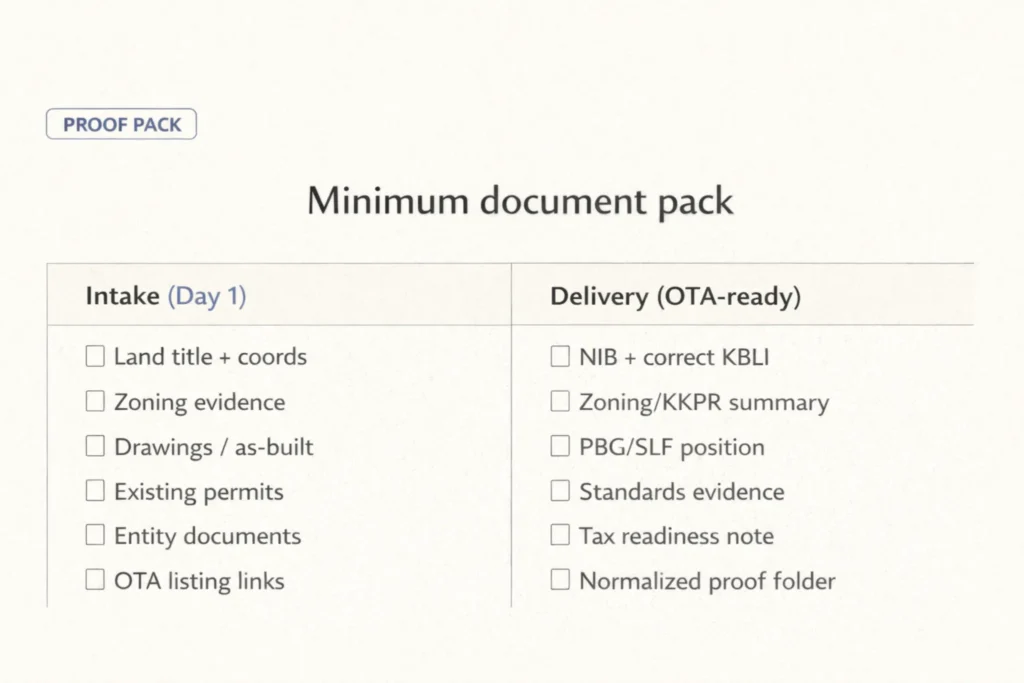
Warning (do not skip this):
If your entity name, address, or operator-of-record data differs across documents, platforms will reject or delay verification. Standardize identity first, then submit.
PAA Block 3: What do OTAs typically verify for Bali villas?
OTAs typically verify two things: (1) whether you are a legitimate accommodation supplier (business identity + licensing classification), and (2) whether your documentation is consistent and defensible (same entity name, address, and license references across the file set). In Bali, the highest-risk failures are wrong KBLI, weak building legality position, and inconsistent operator identity.
Label note: platform practice changes faster than law. Therefore, build a proof pack that would survive both a platform check and a local inspection.
Hard-stops vs fixable gaps (Day-1 risk triage)
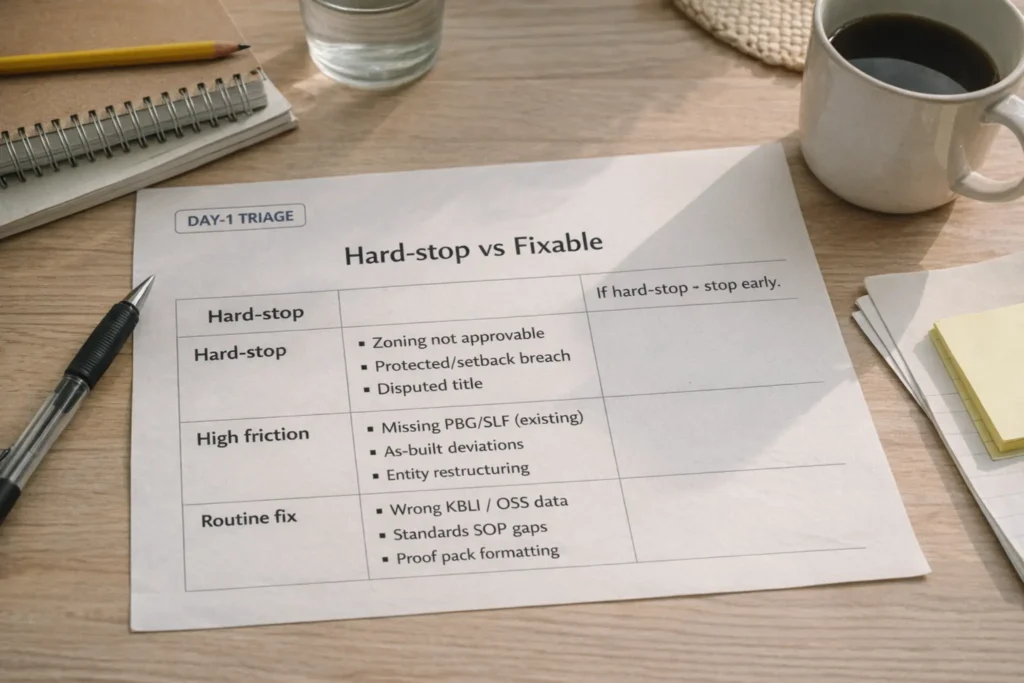
Hard-stops (do not proceed as short-stay accommodation)
- Land in protected/green/agricultural zones where accommodation use cannot be approved
- Protected coastal setbacks triggering demolition risk
- Disputed land title / unresolved ownership issues
- Unfixable building violations in protected areas
High friction (possible, but slow/expensive)
- Missing PBG/SLF for an existing villa (as-built drawings, inspections, remediation)
- Material deviations from approved plans
- Entity mismatch and foreign-involved structures requiring restructuring
Routine fixes
- Wrong KBLI selection in OSS
- Missing SOPs and standards documentation
- Proof pack formatting and consistency issues
Bali reality: what can differ by kabupaten/kota (Badung, Gianyar, Tabanan, Denpasar)
The legal direction is national. However, execution is local—so treat differences as confirmation checkpoints, not optional nuance.
Badung (Canggu/Seminyak/Uluwatu): often stricter around zoning/KKPR and building legality; local tax compliance is actively monitored.
Gianyar (Ubud): zoning sensitivity is high in rural/agricultural areas; KKPR feasibility is frequently the blocker; some local stakeholder expectations can be stronger in practice.
Tabanan: coastal/protected-zone sensitivity is high; confirm RDTR positioning early.
Denpasar City: more urban context; building legality can be more straightforward when zoning is compatible.
Zenith operator insight: the hidden costs are predictable (and preventable)
Owners underestimate legalization because they think it is admin work. In reality, the cost drivers are operational and technical.
- As-built drawings and engineering validation (when PBG/SLF is missing)
- Safety and sanitation upgrades to meet standards
- Time lost fixing OSS data, KBLI classification, and entity mismatches
- Tax discipline (monthly reporting and local payments)
- Local stakeholder friction (where applicable)
Therefore, if you run a disciplined triage on Day 1, you can quote and execute with far less variance.
Call to Action (Zenith)
If you want a defensible answer fast, start with a 5-day “Legalization Triage” (go/no-go + gap map + cost/time scenario), then move into execution only if fundamentals are legalizable.
Explore our compliance resources and operator-first approach on the Zenith blog: Zenith Hospitality Global Blog.
If you want the proven sequencing and document pack approach, start with our guide: Legalize your Bali villa in 60 days (without losing nights).
For investor/operator context (why foreign investors get it wrong), read: Navigating the Bali licensing maze: why foreign investors get it wrong.
If you need hands-on support, see our services here: Business consultant in Bali (compliance + operator support) and About Zenith.
FAQ (for owners, operators, and investors)
Is Airbnb banned in Bali in 2026?
No. The current direction is licensing verification and enforcement against unlicensed accommodation supply, not a blanket ban on platforms. Practically, the risk for owners is delisting when a listing is re-verified or flagged and the host cannot produce a consistent, defensible compliance stack. If you treat your villa like a private house with informal management, you will struggle when OTAs request proof and when inspection pressure increases.
Do I only need an NIB to stay listed on Booking/Airbnb?
Usually not. NIB is necessary but rarely sufficient. Most compliance failures occur earlier in the chain: zoning/KKPR feasibility and building legality (PBG/SLF). Even with an NIB, a villa can remain non-defensible if the land cannot legally host accommodation or if building legality cannot be validated. In 2026, OTA verification tends to test the full system: identity + classification + supporting permits and standards, with consistency across documents.
What is KBLI 55193 and when does it apply?
KBLI 55193 is the OSS business classification commonly used for villa accommodation operations. It matters because KBLI selection drives the standards and compliance expectations attached to your activity. Using the wrong KBLI can force re-registration or trigger licensing mismatch during verification. The operator-of-record must match reality: the entity holding the NIB should be the entity managing the accommodation business and receiving revenue through bank/tax reporting.
From an investor perspective, does compliance improve ROI or just add cost?
Compliance reduces revenue volatility and exit risk. Non-compliant villas are exposed to delisting shocks, enforcement disruptions, and pricing pressure because distribution becomes fragile. A legal-to-operate asset is more bankable, more transferable, and easier to professionalize. In Bali’s current environment, compliance increasingly reduces the “risk premium” buyers apply during underwriting and acquisition due diligence.
What are the most common hard-stops that make a villa impossible to legalize?
The dominant hard-stops are land zoning incompatibility (green/protected/agricultural restrictions), protected coastal setbacks, disputed or unclear land title, and structural building violations in protected areas. These are feasibility problems, not admin problems. If your villa is in a hard-stop category, the correct move is not to “push paperwork.” Instead, you re-scope the asset strategy: change use, change parcel, or restructure the investment thesis before spending more money.
Summary Takeaways
- Treat the Bali villa licensing checklist as a dependency chain: zoning/KKPR and building legality come first.
- If land use is not legalizable, stop early. Do not buy time with “paperwork.”
- OTAs increasingly require consistent, audit-ready proof packs—identity mismatches are a silent killer.
- KBLI selection is not a detail; it determines your standards and verification posture.
- Productized delivery starts with Day-1 triage and clean case classification.
- Build a compliance operating system, not just a folder—because verification can be recurring.
How to (implementation quick guide)
If you want the fastest defensible path, follow this operating order:
- Run Day-1 triage: zoning/KKPR + title clarity + building legality scan
- Decide operator-of-record structure (WNI/PT/PMA/management-only)
- Execute OSS NIB + correct KBLI with clean identity data
- Complete tourism standards + any triggered certification requirements
- Lock tax registrations and monthly reporting workflow
- Assemble and submit an OTA-ready proof pack; log submissions and outcomes
Author
Written by André Priebs, CEO of Zenith Hospitality Global. André leads operator-first advisory and execution across Bali and Indonesia, helping investors and owners structure hospitality and villa businesses that are legally defensible, operationally bankable, and commercially resilient—spanning feasibility, compliance pathways, pre-opening systems, and performance-driven operations.