Building a Hotel Development Advisory Team Indonesia Investors Can Trust
Foreign investors and first-time developers in Indonesia routinely get trapped in a predictable failure mode: they either under-hire (missing critical expertise until it’s too late), or over-hire (paying for overlapping scope, duplicated meetings, and expensive “advice” that never turns into bankable decisions). This is exactly why building a hotel development advisory team Indonesia investors can trust is the first real development decision—not a later admin task.
In Bali, this gets worse because planning controls and licensing sequencing can force redesign loops if discovered late—exactly when changes are most expensive.
This article shows you how to build a hotel development advisory team Indonesia investors can trust: the minimum bankable roles, when to hire them, what each must deliver, and what “fair fees” look like (USD + IDR).
TL;DR — Key takeaways
A “minimum viable” hotel development advisory team Indonesia is usually 6 roles: feasibility, architect, operator advisor, legal, finance/model, and construction manager/owner’s rep.
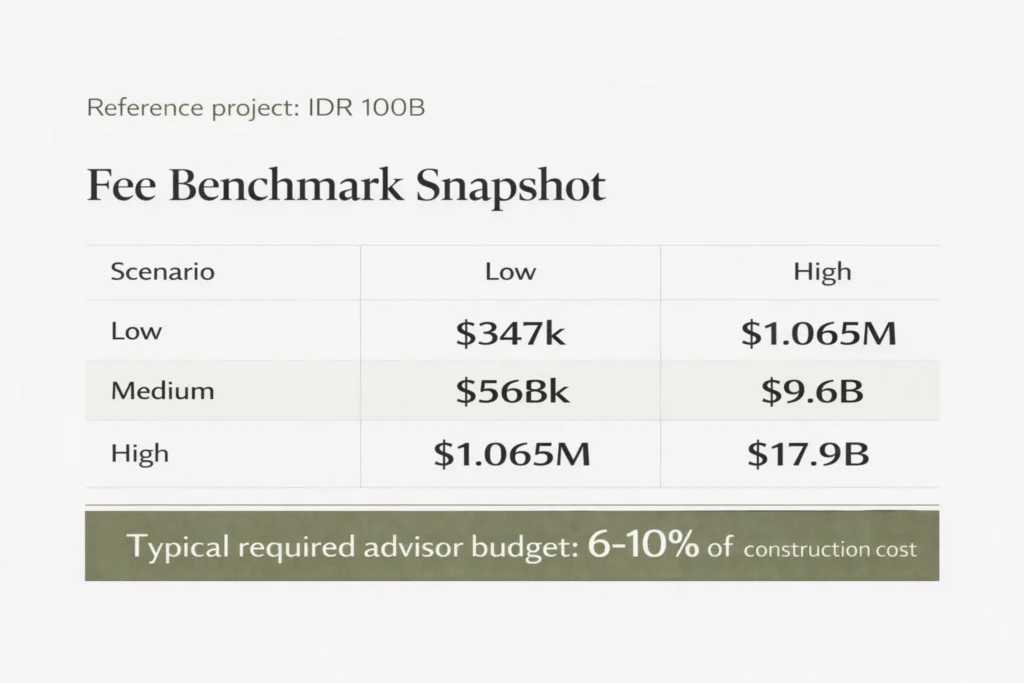
For a reference IDR 100B boutique/lifestyle hotel (construction cost, land excluded), a fair required-advisors budget commonly lands around ~6%–10% of construction cost (higher for complexity).
The winning move is timing: hire advisors when their outputs change irreversible decisions (land, massing, permit path, operator choice, tender readiness).
De-risk fees with phase gates, not-to-exceed caps, explicit exclusions, and owner IP rights for editable work product.
What is the minimum advisory team for a first-time hotel developer in Indonesia?
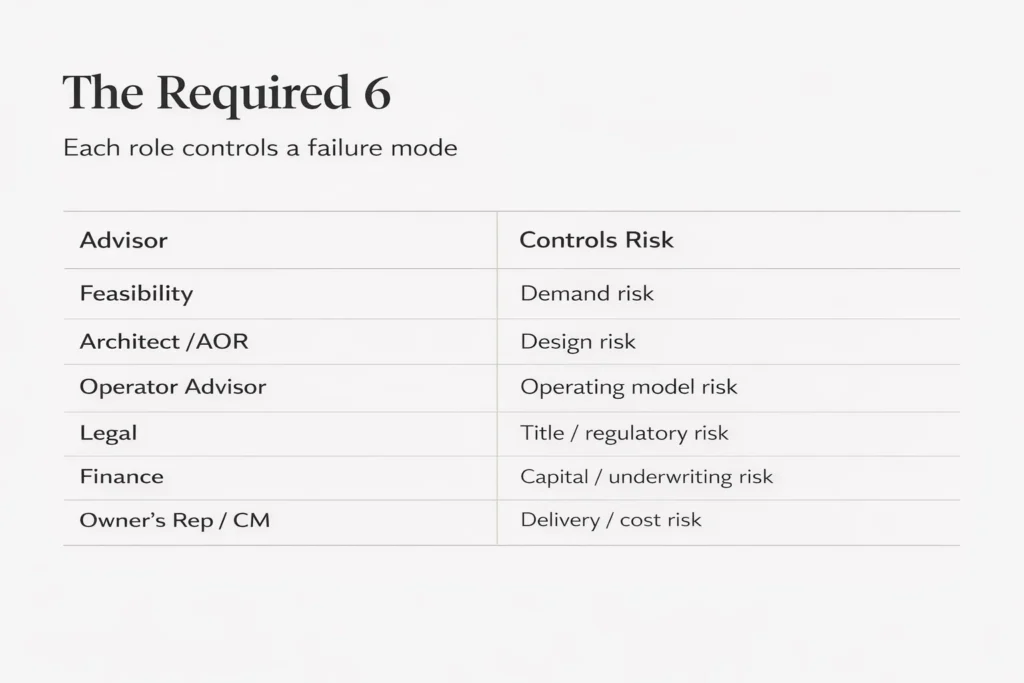
A bankable hotel project typically needs six required advisors because each governs a different failure mode: demand risk, design risk, operator risk, legal/title risk, capital/underwriting risk, and delivery risk.
The “Required 6” (minimum bankable set)
Feasibility consultant — demand + comp-set + positioning + pro forma
Architect (lead) + local architect-of-record + engineers — concept → permit set → tender set → construction admin
Financial advisor/modeler — bankable model + lender package + capital logic
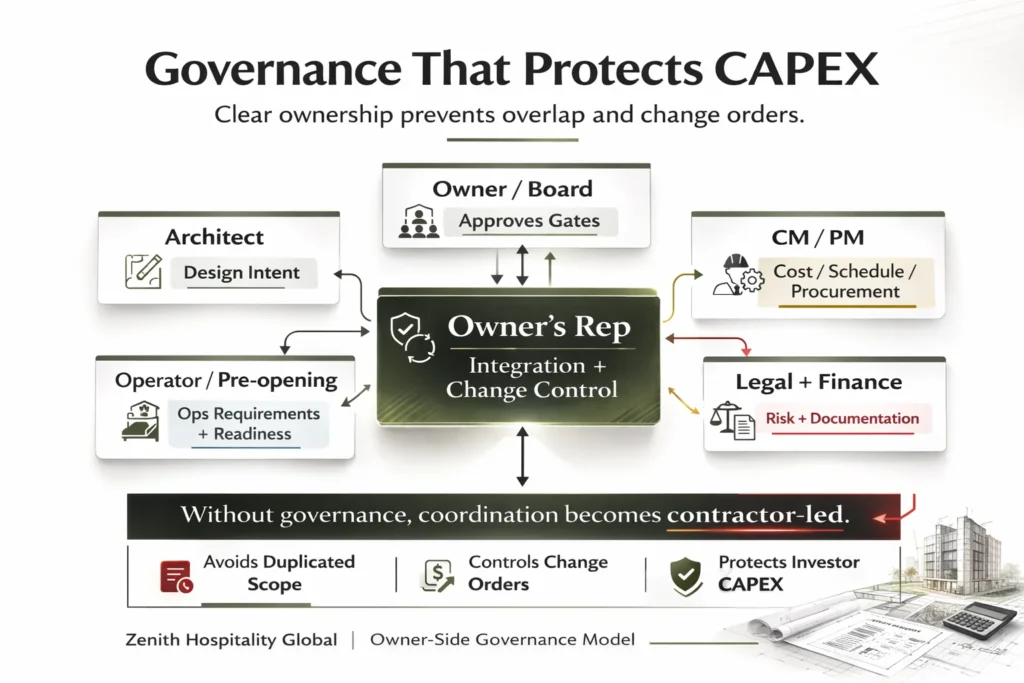
Construction manager / owner’s rep — governance for cost, schedule, procurement, QA/QC, change orders
Truth bomb: If you don’t install owner-side governance (owner’s rep + clean authority matrix), “coordination” becomes a contractor-led outcome—not an investor-led one.
What should each advisor cost in a hotel development advisory team Indonesia?
Below is a reference fee benchmark for a Bali boutique/lifestyle hotel with IDR 100B construction cost (land excluded), using USD/IDR 16,844 as the reference rate (Bank Indonesia JISDOR). External reference: Bank Indonesia JISDOR reference rate
Important: Bali private-market fee surveys are not consistently public for several roles; treat these ranges as budget assumptions to validate via RFQ.
Fee benchmarks — Required advisors (IDR 100B construction cost reference)
Advisor (required)
What you’re buying (plain English)
Typical fee structure
Fair fee range (USD) low / med / high
Fair fee range (IDR) low / med / high
Feasibility consultant
Demand + comp set + positioning + 10-year model you can underwrite
Fixed / capped time
20k / 45k / 120k
340M / 760M / 2.02B
Architect (lead) + local AOR
SD/DD/CD + permit set + construction admin discipline
% of cost or staged
148k / 190k / 237k
2.50B / 3.20B / 4.00B
Operator advisor
Operator strategy + shortlist + negotiation of HMA/TA/FA
Retainer + milestone/success
15k / 50k / 150k
250M / 840M / 2.53B
Legal counsel
Land/title DD + structuring + contract suite + licensing roadmap
Hourly w/ cap + packages
25k / 75k / 200k
420M / 1.26B / 3.37B
Financial advisor/modeler
Bankable model + lender package + capital process
Fixed/retainer; success optional
20k / 60k / 150k
340M / 1.01B / 2.53B
Construction manager / owner’s rep
Cost/schedule/procurement governance + change-order control
% / retainer / hybrid
119k / 148k / 208k
2.00B / 2.50B / 3.50B
What does that total mean for investor underwriting?
Using the same reference project:
Required 6 — Low / Med / High (USD)
Low: $347k
Med: $568k
High: $1.065M
Required 6 — Low / Med / High (IDR)
Low: ~IDR 5.84B
Med: ~IDR 9.57B
High: ~IDR 17.93B
As a % of IDR 100B construction cost: Low ≈ 5.8%, Med ≈ 9.6%, High ≈ 17.9% (upper bound reflects complexity / scope expansion).
Which optional specialists actually pay for themselves?
Optional specialists are not “nice-to-haves” when you’re (a) a first-time developer, (b) targeting luxury/wellness, or (c) negotiating with an operator/brand that has strict standards. They compress learning curves and protect guest-experience ROI.
Advisor (optional)
What they prevent
Typical “one-line value”
Reference fee (USD / IDR)
Concept consultant
Design drift + weak product story
Product DNA + guest journey architects can build
60k / 1.01B
Brand strategist
Commodity positioning
Brand system for distribution story
75k / 1.26B
Pre-opening specialist
Chaos in the last 60 days
SOPs + training + readiness discipline
120k / 2.02B
Technology consultant
Systems failure + CX friction
PMS/POS + network + cybersecurity baseline
50k / 840M
When should you hire each advisor so you don’t pay for meetings instead of decisions?
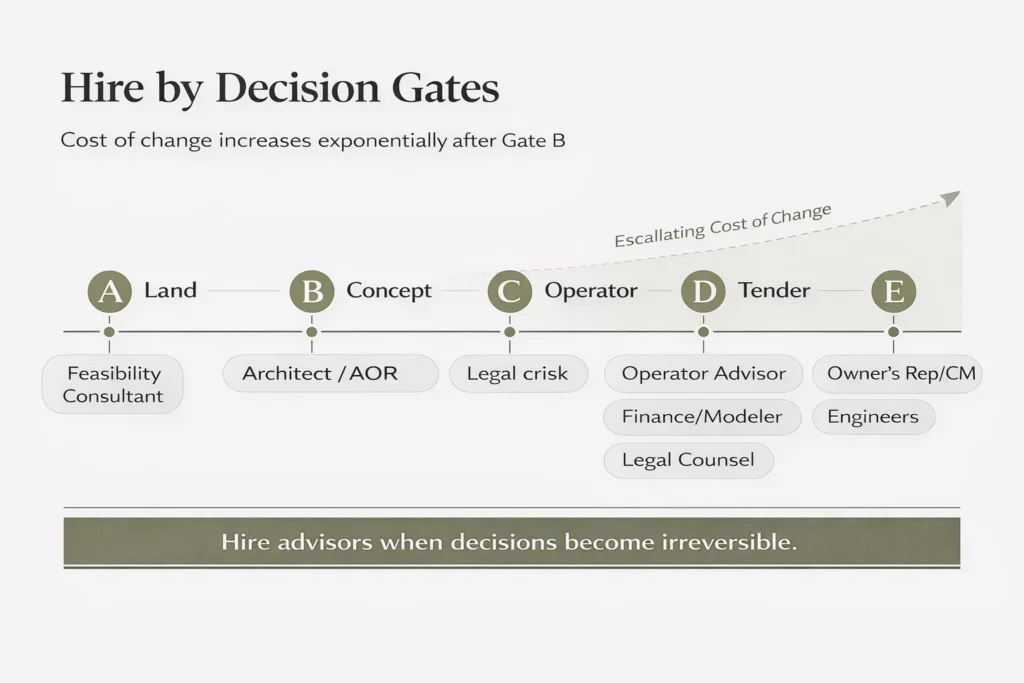
A simple rule: hire advisors when their outputs change irreversible decisions.
A practical stage-gate hiring model (Indonesia/Bali)
Before land/lease signing: feasibility + legal DD (don’t buy a problem you can’t build profitably).
Before design freeze: architect + operator advisor (if branded/managed) + owner’s rep/CM (so BOH and standards don’t surface late).
Before tender: complete CDs/specs + BOQ discipline (incomplete tender docs become change orders).
9–12 months pre-opening: pre-opening + technology (so readiness isn’t improvised in the last 60 days).
Bali/Indonesia reality check: where foreigners get hurt
Foreign investors often underestimate two Bali realities:
Licensing is sequenced, and “basic requirements” dictate when it’s safe to spend on detailed design and pre-opening buildout. External reference (building approvals pathway): SIMBG (PBG/SLF) portal
Investor implication: Even if you hire strong design talent, without owner-side governance (owner’s rep + legal + licensing roadmap), you risk a project that is beautiful—but delayed, non-bankable, or value-engineered into mediocrity.
What “fair fees” look like in Indonesia (and how to prevent overpaying)
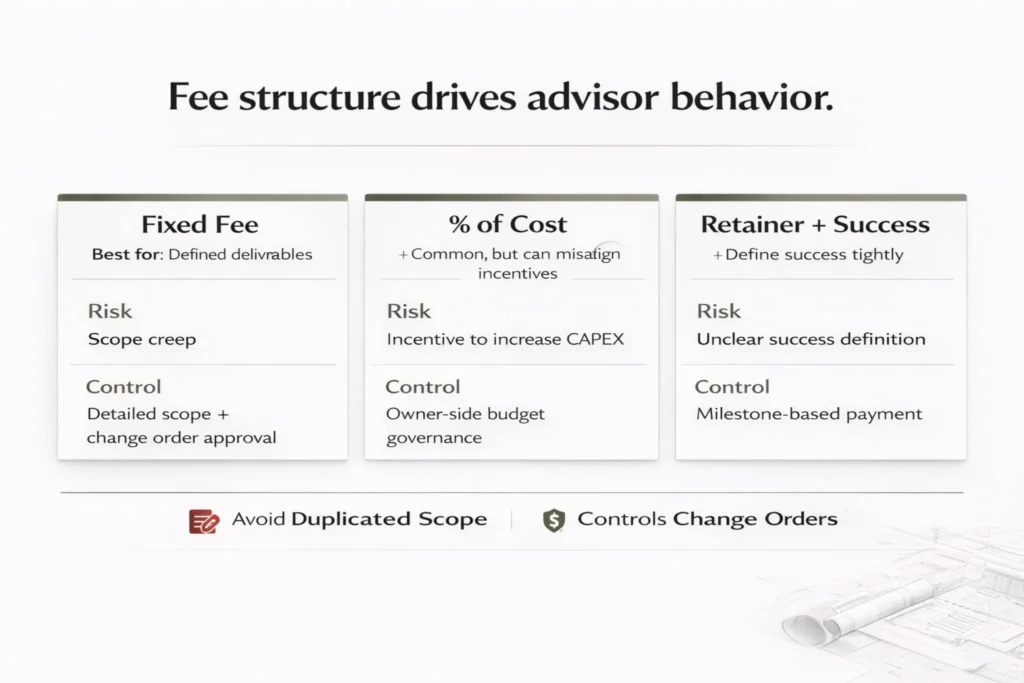
The three fee models you’ll see
Fixed fee (deliverables-based): best for feasibility, concept, branding, defined legal DD packages.
% of project cost: common for architects and construction managers; risk is moral hazard (fees rise with cost).
Retainer + success fee: common for operator and fundraising advisors; success definitions matter.
Fee “anchors” investors can use in negotiations (without being naïve)
Architect fee reasonableness: use national guidance as a reference frame (then validate via market RFQs). External reference: IAI guideline (Pedoman 2007)
Time-based consulting floors: use INKINDO billing-rate tables as a baseline, then adjust to Bali reality and seniority. External reference: INKINDO billing rate (PDF)
The single most important pricing principle
The key metric is not hourly rate—it’s: Did the advisor output remove uncertainty and prevent rework?
HOW TO: Build and procure your advisory team (without gaps or overlap)
This is the investor-grade process serious developers use—and the one an owner’s rep should run.
Step 1 — Define your decision gates (what must be true to proceed)
Gate A: Go/no-go on land + envelope + permits path
Gate B: Concept lock (keys, adjacencies, BOH logic)
Gate C: Operator decision (if applicable)
Gate D: Budget + tender readiness (CDs/specs/BOQ)
Gate E: Commissioning + SLF readiness + opening plan
Step 2 — Issue a clean RFQ pack to 3–5 firms per role
Minimum RFQ contents:
1-page brief (project type, keys, positioning, site context)
Required deliverables list (by role)
Timeline + meeting cadence
Required commercial terms (stage gates, caps, IP ownership)
Step 3 — Score proposals using a single owner-side checklist
Common pitfalls (Bali/Indonesia) that destroy budgets
“Assist with permits” language that doesn’t produce a licensing roadmap
Architect vs CM authority confusion → contractor controls quality by default
No change-control discipline → verbal additions become change orders
Success fees tied to “introductions” instead of executed outcomes
Feasibility models delivered as PDFs (no editable model = not bankable)
FAQ (PAA-style, investor-friendly)
1) What percentage of construction cost should I budget for advisors in Indonesia?
A practical benchmark for the required advisor set is typically ~6%–10% of construction cost, with upside if you have title/structuring risk, complex permits sequencing, or operator negotiations. Validate this through RFQs using stage gates and not-to-exceed caps so fees don’t drift as scope expands.
2) When should I hire an operator advisor?
Start during feasibility and continue into early design development—before design freeze. If you wait, BOH widths, service flows, and technical service obligations surface late and force redesign or value engineering in the wrong places.
3) Do I need an owner’s representative if I already have an architect and contractor?
If you want investor-grade control over scope, cost, schedule, and change orders, yes. The owner’s rep is a governance function, not a design function. Without it, the contractor’s incentives typically dominate day-to-day decisions.
4) What’s the single best way to avoid overpaying consultants in Indonesia?
Stage-gate every engagement to deliverables, add not-to-exceed limits, ban commissions and hidden success definitions, and require editable work products with owner IP rights.
5) How do I handle Bali permit sequencing in my advisory stack?
Treat permits as a spend-control system: confirm planning envelope early, then design for PBG/SLF requirements and align operational licensing only when the approvals pathway is governed. Your legal + owner’s rep functions should own the tracker, not the architect alone.
Summary Takeaways
Build your hotel development advisory team Indonesia around risk domains, not job titles.
Budget ~6%–10% of construction cost for the required 6—then validate via RFQ with caps.
Hire advisors based on irreversible decisions, not who is best in meetings.
Use phase gates, owner IP rights, and explicit exclusions to stop scope creep.
Governance (owner’s rep + clean authority matrix) is what prevents change-order leakage.
CTA (Zenith’s role)
Zenith Hospitality Global helps owners and first-time developers structure the right advisory team, validate scope and pricing, negotiate owner-favorable terms, and coordinate advisors as the owner’s representative—so you get full coverage without paying twice for the same work.
André Priebs — CEO & Co-Founder, Zenith Hospitality Global. Operator-first hospitality advisor and owner-side representative for luxury boutique hotels, lifestyle retreats, and wellness/longevity assets across Indonesia. (Disclosure: Benchmark ranges and assumptions are designed to be validated via an RFQ process; final pricing depends on scope, project complexity, and contracting strategy.)
Tags:
architect fees Indonesia, Bali, construction management, feasibility study, foreign investors, hospitality licensing, hotel advisory team, hotel development, hotel development consultants, hotel feasibility consultant fees, hotel project governance, hotel technology, Indonesia, owner’s representative, pre-opening